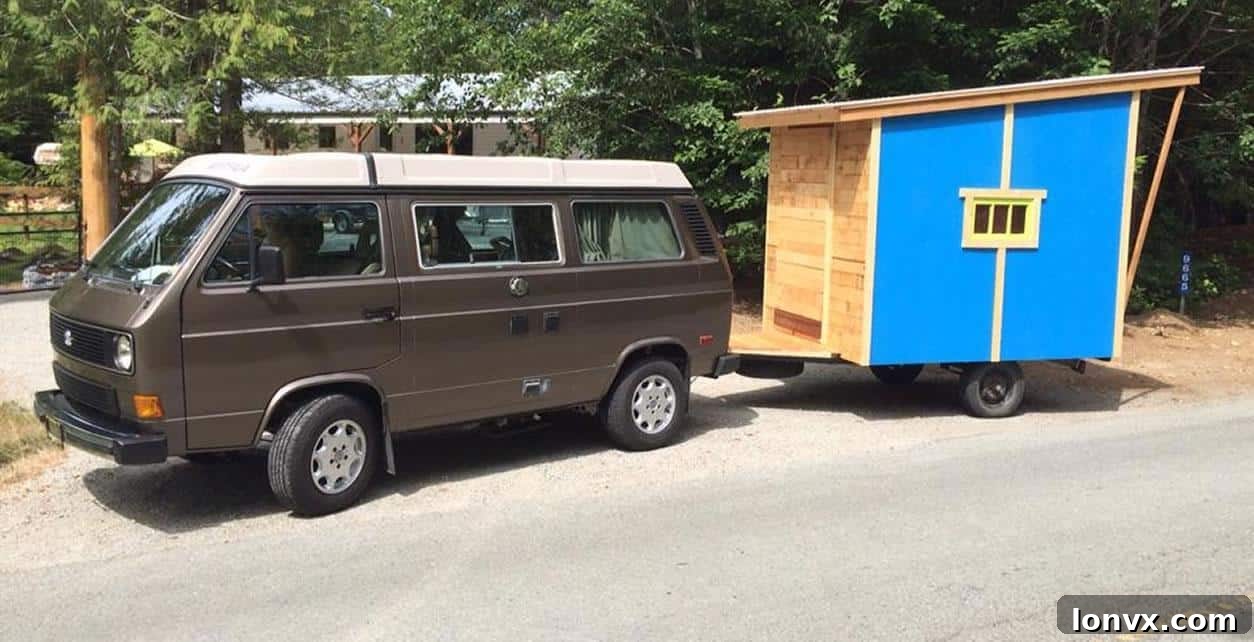
The spirit of innovation and the pursuit of a unique family adventure converged for Dave Koszegi, his wife Erin, and their three children, Julia, Francesca, and Matteo, during their annual Hornby Island, B.C. camping trip. It was two summers ago when Dave, engrossed in Lloyd Kahn’s inspiring book, Tiny Homes on the Move, stumbled upon an idea that would transform their leisure time into a memorable, educational, and deeply personal project. As the family collectively admired the captivating photographs of Derek Diedricksen’s ingenious tiny house on wheels, a realization sparked: this wasn’t just a fascinating concept, but a perfect, space-saving complement to their beloved, yet often overcrowded, Volkswagen Westfalia camper van. More profoundly, it presented an unparalleled opportunity for a hands-on, collaborative family endeavor that would teach invaluable life lessons.
Dave Koszegi, a seasoned sales representative with Re/Max of Nanaimo, often reflects on the practical gaps in conventional education. “Kids aren’t taught even the most basic things in school about finances or about housing – or how those go together,” he notes. Yet, his own children, aged 8, 7, and 4 when the actual construction commenced in their driveway in January 2015, quickly began to demystify the complexities of home construction. Through immersive, hands-on experience, they transcended theoretical knowledge, grappling with real-world problems. The family meticulously planned their design using graph paper and committed to utilizing recycled materials wherever feasible, a practice that instilled a profound understanding of resourcefulness and efficiency, learning to make every centimeter, kilogram, and dollar count.
Dave Koszegi
The design and construction phase presented its own set of unique challenges, primarily dictated by the limitations of their existing vehicle. Their trusty Volkswagen Westfalia could only tow a maximum of 1,000 pounds (approximately 453 kilograms). Diedricksen’s original tiny house, however, weighed a hefty 1,500 pounds, necessitating a significant re-engineering effort. The Koszegi family rose to the occasion with remarkable ingenuity, opting to substitute heavier 2×4 lumber with lighter yet structurally sound 2x2s and 2x3s. To compensate for the reduced material size and ensure maximum durability and strength, every single piece was meticulously screwed and glued into place. This innovative approach allowed them to achieve a robust yet lightweight structure. Their final version, a marvel of compact living, measures five-feet-wide, nine-feet-long, and eight-feet-high, not including the cleverly integrated bathroom area, making it slightly larger and more functional than the original floor plan they drew inspiration from. This custom design also boasts impressive versatility: “The whole side of the house opens to join the van, so it’s pretty versatile,” Koszegi explains, highlighting the seamless integration between their mobile home and their new, expandable living space.
For a busy young family juggling the demands of modern life – from dance practices and recitals to competitive soccer games and Dave’s client showings – dedicating consistent time to such an ambitious project was a feat in itself. Instead of prolonged work sessions, the family found bits of time, half an hour here, an hour and a half there, painstakingly piecing together their tiny home over six months. “A builder might look at it and say, ‘Man, I could have done this in a weekend,’ but it took us six months’ worth of half an hour to an hour and a half at a time, gluing our fingers together,” he reminisces with a laugh. This protracted, hands-on process, however, yielded invaluable dividends. Koszegi proudly shares the profound impact on his children’s understanding of construction: “Some people are buying houses and don’t know what a 2×4 is – now my kids actually understand better than some Realtors about what a piece of lumber is, what the dimensions mean, how it’s all put together and how all this stuff kind of works – and they’re little!” This unique learning experience provided them with practical knowledge far beyond what many adults possess, fostering a tangible appreciation for the craft of building.
The tiny home movement has undoubtedly become a significant cultural phenomenon, capturing the public’s imagination and sparking conversations about sustainable living, minimalism, and affordable housing. Dave Koszegi’s personal experience is a testament to this burgeoning interest. He points out the stark contrast in engagement between his traditional real estate advertising and his family’s tiny home venture. His purpose-built commercial, titled “Hi, I’m Dave Koszegi,” has averaged around 100 yearly views over its five years online. In stark comparison, the raw, three-minute YouTube video he recorded on his phone, documenting his family building their tiny home, garnered more than 910 hits in just one year. The true viral explosion occurred when a short feature about the Koszegi family and their distinctive tiny house on wheels aired on CTV that spring, racking up an astonishing 5,400 hits in a mere three days – a viewership figure equivalent to more than a quarter of the population of Port Alberni, the city where Dave grew up. “My social media person called me and cried ‘It’s viral!’” he exclaims, highlighting the unexpected and widespread appeal of their project.
While the Koszegi family’s tiny home on wheels perfectly serves its recreational purpose, Dave, who stands at an imposing 6’5″, offers a nuanced perspective on tiny living for primary residences. “If I was thinking about a tiny home as a principal residence I wouldn’t be thinking so compact. My tiny home on wheels is tiny,” he clarifies. However, he firmly believes in the broader concept of small homes as a highly viable solution for individuals and families seeking more affordable and cost-effective housing options, particularly in recreational areas abundant with outdoor activities. He advocates for the mainstream adoption of 500-square-foot houses built on fixed foundations, which he describes as “small but not ridiculous,” striking a balance between compact living and practical comfort. In regions like Port Alberni, where house prices are generally lower, conventional condominiums or attached housing units haven’t achieved widespread popularity. Koszegi observes, “When you come all this way, you want your own little yard or whatever,” underscoring the strong desire for personal space and connection to nature, even within smaller home footprints.
For the widespread acceptance and implementation of smaller housing solutions, Koszegi identifies a crucial need for policy reform and institutional support. He emphasizes that municipalities must implement provisions accommodating smaller homes within their zoning bylaws. Furthermore, a significant hurdle lies in securing acceptance from key national institutions, notably the Canada Mortgage and Housing Corporation (CMHC), which plays a pivotal role in mortgage insurance and housing policy. “If you’ve got to get Canada Mortgage and Housing Corp. to accept the idea – I think you’d have a form of housing that people would absolutely buy. It’d be more like buying a car,” Koszegi asserts, envisioning a future where purchasing a compact, affordable home is as straightforward and accessible as buying a vehicle. Such an initiative, he suggests, would unlock a wealth of opportunities, particularly for demographics currently underserved by the traditional housing market. This includes renters who often face restrictions on pet ownership in their units, offering them the freedom of homeownership. It would also greatly benefit retired couples who desire the flexibility to travel for months of the year without the burden of maintaining larger, more demanding properties, thereby fostering greater lifestyle freedom and financial ease.
Dave Koszegi’s roots run deep in Port Alberni, a vibrant city of approximately 18,000 residents nestled two and a half hours northwest of Victoria on Vancouver Island. Now 46, he has dedicated 26 years of his professional life to real estate, consistently maintaining an impressive 25 to 35 percent market share within the area, which boasts a total population of about 30,000. From a young age, Dave harbored a profound passion for everything related to housing, enjoying his time working in a hardware store where he could indulge this interest. However, he candidly admits to also being “always a car nut,” a passion that sparked initial uncertainty about whether his career path should lead him to sell automobiles. It was a perceptive marketing teacher who provided the pivotal guidance, helping him to recognize that real estate offered not just an interesting profession, but a multifaceted career path rich with opportunity and personal fulfillment. This realization aligned perfectly with his pragmatic approach to life and career development.
Reflecting on his career choice, Koszegi acknowledges the importance of formal qualifications and a structured professional journey. “It also had a process, going to school and getting qualifications – and with old-world European parents it was important for me to have papers,” he explains, highlighting the cultural values instilled in him. This commitment to professional development has undoubtedly contributed to his enduring success in real estate. Today, Dave’s enthusiasm for his work remains undiminished: “Now I go to work every day and I love it.” This genuine passion translates into his interactions and dedication to his clients. The widespread media attention garnered by the family’s tiny house on wheels project, particularly after the CTV spot aired, created an unexpected and heartwarming surge in public engagement. “I’ve had people follow us on the highway and pull us over to have a look, and clients waving,” he recounts, painting a picture of newfound recognition and connection. He also received texts and pages from clients he hadn’t heard from in a while, signifying a renewed sense of community and appreciation.
Prior to the tiny home project, Koszegi was well-established in his professional sphere. “I’ve been known for my high volume and a certain amount of competence, but people didn’t know my personal side,” he reveals. The tiny home became an authentic bridge, allowing his clients and the wider public to connect with him on a more personal level. He emphasizes that the project’s genesis was not driven by a desire for self-promotion; “I didn’t do it for that – I was thinking about my kids – but clients picked up on it.” The genuine nature of the endeavor resonated deeply, humanizing his professional persona and fostering a sense of approachability. “It’s made me more approachable and created all these points of connection that I didn’t expect,” he observes, underscoring the powerful, often unforeseen, impact of authentic personal projects on professional relationships and brand perception. This unique initiative inadvertently became a powerful marketing tool, demonstrating his values and character beyond typical business interactions.
Ultimately, the tiny house project served as a remarkable culmination of Dave Koszegi’s two enduring passions. “It brings housing and cars together, so I ended up being able to do both of my passions,” he proudly states. This synthesis of interests, coupled with his unwavering dedication to family, defines his balanced approach to life. Unlike many who might fill their leisure time with hobbies like golf, Dave prioritizes his work and, more importantly, his family time. The tiny home project has even clarified his priorities to his network: “now if I’m not available people get what’s going on with me, and they don’t mind it.” It’s a testament to a life built on authentic values, collaborative effort, and the joy of pursuing one’s passions while building a lasting legacy with the ones you love.