Toronto Real Estate Market: A Glimmer of Recovery or a False Dawn?
The Greater Toronto Area (GTA) real estate market appears to be exhibiting signs of a tentative recovery, stirring discussions among investors, homeowners, and prospective buyers alike. After a prolonged period of cooling, October’s data from the Toronto Regional Real Estate Board (TRREB) suggests a notable shift: demand has begun to outpace supply for the first time in recent memory, sparking cautious optimism across the sector. While active listings remain considerably higher year-over-year, sales figures have surged even more dramatically, indicating a potential turning point in market sentiment.
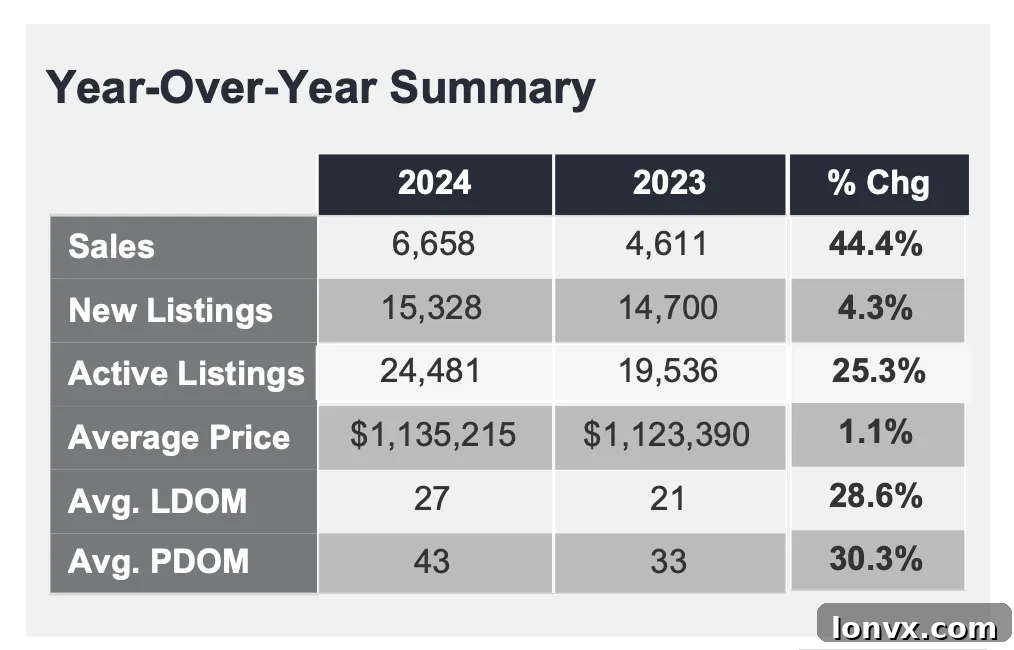
According to TRREB’s October report, active listings recorded a significant 25.3 percent increase compared to the previous year. However, sales demonstrated an even more impressive leap, climbing by 44.4 percent over the same period. This discrepancy between the growth in active listings and the even faster growth in sales is a key indicator that the market’s absorption rate is improving, potentially setting the stage for more balanced conditions.
Source: TRREB
Navigating the Nuances of Market Sentiment
There’s little doubt that the overall mood in the GTA real estate market is undeniably warming. The uptick in home sales compared to last October is a welcome development, especially given the various advantages bestowed upon buyers throughout the year. Indeed, if we hadn’t observed some positive shifts, it would be a cause for significant concern. A confluence of factors has contributed to this improved buyer sentiment and increased purchasing power, creating a more dynamic environment:
- Interest Rate Adjustments: We’ve seen a cumulative reduction of 125 basis points in interest rates, which directly translates to lower borrowing costs and improved affordability for mortgages. This provides a tangible relief for buyers, making homeownership more accessible.
- Extended Amortization Periods: The decision to extend mortgage amortizations to 30 years is a game-changer for many. This policy adjustment can increase buying power by approximately 8 percent, significantly reducing monthly mortgage payments and allowing buyers to qualify for larger loans or purchase more desirable properties.
- Increased Insured Mortgage Cutoff: The threshold for insured mortgages has been raised from $1 million to $1.5 million. This expansion brings a wider range of properties, particularly in competitive markets like Toronto, within the scope of mortgage insurance, benefiting a broader segment of buyers.
- Zoning Changes and Density: Several neighborhoods have been upzoned to allow for four units, promoting higher density and potentially increasing the supply of housing options. This structural change aims to address the long-standing issue of housing scarcity in urban areas.
- Government Incentives for Unit Additions: The government has proactively created incentives for property owners willing to add secondary or even tertiary units to their homes. This encourages the creation of more rental or multi-generational living spaces, further contributing to the overall housing supply.
Warm, But Not Yet Heated: A Realistic Market Assessment
While the market shows signs of warming, it’s crucial to differentiate this from a full-blown “heating up” scenario. The past year has largely been characterized by a cooler market, with new listings surging significantly. This heightened pace of supply, coupled with suppressed demand, led to a rapid accumulation of active listings. However, October’s data presents a slightly different picture: new listings are up by a more modest 4.3 percent compared to last year. This moderated influx of new supply could dramatically slow the rate at which active listings accumulate.
Should the robust sales momentum continue into the end of the year, we could witness a significant absorption of existing supply. This, in turn, could build considerable momentum for a more pronounced and potentially stronger spring market. It’s important to note, as observed in previous analyses, that recent rate cuts seem to have unleashed a wave of “pent-up supply” rather than purely “pent-up demand.” Sellers, much like buyers, are carefully timing the market, waiting for perceived signs of recovery to list their properties, suggesting a more strategic approach from both sides of the transaction.
Deciphering Market Dynamics: Buyer’s, Seller’s, or Balanced?
Despite the recent surge in sales, a critical metric for understanding market balance is the “days on market” (DOM). Currently, homes are spending 28 to 30 percent more time on the market compared to the previous year. This extended marketing period indicates that properties are taking longer to be absorbed, which is a hallmark of a market that still offers buyers considerable leverage. For the GTA to transition into a true seller’s market by the next spring, a substantial acceleration in the absorption rate is necessary. Based on the current DOM metrics, the market leans more towards a balanced state, if not slightly favoring buyers, rather than decisively signaling a seller’s advantage.
A balanced market implies that neither buyers nor sellers hold a dominant position, leading to more stable price negotiations and transaction times. While increased sales volume is positive, the longer DOM suggests that buyers still have options and time to make informed decisions, preventing rapid price escalation.
The Pulse of the Condo Sector: A Leading Indicator
The 416 condo sector often serves as a sensitive barometer for the broader Toronto real estate market, as it frequently exhibits the most pronounced supply/demand imbalances. This segment’s recent performance offers valuable insights into current market trends. For several months, year-over-year growth in condo sales remained stagnant or even negative. However, October brought a significant turnaround, with condo sales posting impressive gains.
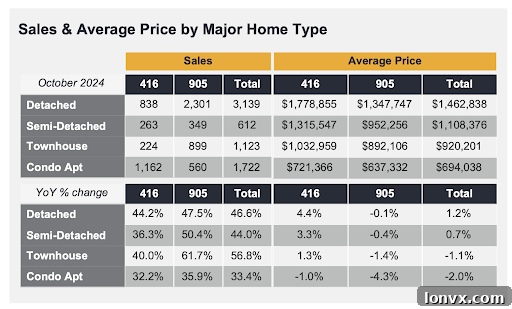
Specifically, the 416 condo market saw a 32.2 percent increase in sales this October compared to last year. Similarly, the 905 condo market experienced a robust 35.9 percent surge in sales. This resurgence is largely attributable to improving affordability. Falling interest rates have reduced monthly carrying costs, while a slight dip in condo prices has made these units more attainable. Toronto (416) condo prices have decreased by 1 percent since last year, translating to an average drop of about $7,200. The 905 region saw an even more significant adjustment, with condo prices falling by 4.3 percent, representing an average reduction of approximately $27,000. These adjustments have made condos particularly attractive to entry-level buyers, downsizers seeking more manageable living spaces, and investors looking for opportunities in a recovering market.
Source: TRREB
Dynamics of Detached Homes: Resilient Performance
The detached home segment presents a somewhat different narrative. In the highly sought-after 416 area, detached home sales have seen a healthy 4.4 percent increase. This performance is likely bolstered by two key factors: the aforementioned upzoning initiatives, which create potential for multi-unit dwellings and thus add long-term value, and anticipatory demand. Buyers are increasingly making decisions based on the prospect of increased insurable mortgages and longer amortization periods, which promise enhanced buying power in the near future. This positive momentum in detached homes has also created a beneficial “knock-on effect” for other housing types, with semi-detached homes seeing a 3.3 percent rise in sales and townhouses increasing by 1.3 percent, signaling a broader recovery across various freehold property categories.
Urban Resurgence: The 905 vs. 416 Divide
This month’s data strongly indicates a burgeoning trend of re-urbanization of demand within the GTA. Following the pandemic-era shift towards suburban living in the 905 regions, many residents are now reconsidering the advantages of a 416 lifestyle. This re-evaluation is driven by factors such as the re-opening of physical workplaces and Toronto’s infamous traffic congestion, which has unfortunately earned the city the ranking of third-worst globally. The desire for shorter commutes, access to urban amenities, and a vibrant city life is compelling many to look back towards the core.
This “re-urbanization” trend is most vividly illustrated by examining the sale-to-list-price ratio (SP/LP) across different regions, comparing suburban areas like Simcoe County and Peel Region with the more urban 416 areas:
- (905) Halton Region – 98 per cent
- (905) Peel Region – 98 per cent
- (416) City of Toronto – 100 per cent
- (905) York Region – 98 per cent
- (905) Durham Region – 100 per cent
- (705) Dufferin County – 98 per cent
- (705) Simcoe County – 97 per cent
From an analytical perspective, the sale-to-list-price ratio functions as a powerful bid/ask spread indicator. A narrower spread typically signifies a more efficient and liquid market, where there’s a closer alignment between buyer and seller expectations. In real estate terms, an SP/LP ratio nearing 100 percent suggests a market where buyers and sellers are in strong agreement on property valuations, indicating a balanced playing field. When this ratio falls significantly below 100 percent, it often points to a buyer’s market, where properties are typically selling for less than their initial asking price. Conversely, a ratio above 100 percent is a clear signal of a seller’s market, where high demand pushes sale prices beyond the original listing price.
Analyzing the recent data reveals distinct patterns. The City of Toronto (416) and Durham Region (905) stand out with a 100 percent SP/LP ratio, indicating the most balanced market conditions where properties are generally selling for their list price. This suggests robust demand and seller confidence in these specific areas. In contrast, other regions like Halton, Peel, York, Dufferin, and Simcoe counties exhibit ratios between 97 and 98 percent. While still relatively strong, these figures suggest that buyers in these suburban and ex-urban markets might have a slight edge, potentially securing properties just below the asking price. This nuanced regional performance underscores the diverse dynamics at play across the vast GTA housing landscape.
Key Points of Concern and Market Vulnerabilities
Despite the positive signs, several potential vulnerabilities warrant close observation as we head into the spring market. These factors could introduce headwinds and temper the current momentum in Toronto’s real estate sector:
- Stock Market Volatility and Wealth Effect: The global stock market has been reaching all-time highs. A significant correction or decline in equity markets could trigger a “negative wealth effect.” This phenomenon occurs when a decrease in perceived wealth from investments leads consumers and investors to reduce spending and investment in other assets, including real estate. This could impact purchasing power and investor confidence in the housing market.
- Federal Policy on Population Growth: The federal government has articulated a commitment to moderating population growth, with a potential reduction in the annual growth rate by 0.2 percent. For Toronto, a city whose real estate market has historically relied on robust population growth and immigration to fuel demand, this policy shift could mute the “evergreen bull case” – the long-held belief that demand will perpetually outpace supply. A slower population influx could ease demand pressures, impacting price growth.
- Rising Unemployment and Mortgage Delinquencies: Canada is currently experiencing an upward trend in unemployment rates, alongside an increase in mortgage delinquencies. These are critical leading indicators for the housing market. Rising unemployment can lead to financial distress for homeowners, potentially forcing distressed sales and increasing the supply of properties on the market. An increase in mortgage delinquencies points to broader affordability challenges and could become a significant headwind against sustained house price growth, introducing an element of uncertainty into the market’s recovery trajectory.
Outlook: A Return to Normality for the Spring Market?
Considering the current data, policy introductions, and the momentum carried over from the fall market, my outlook for the upcoming spring market is reasonably strong. While caution is warranted due to the identified vulnerabilities, the confluence of increased sales, stabilizing supply dynamics, and buyer-friendly policy adjustments sets a positive tone. Barring any unforeseen major shifts in the broader economic picture, Spring 2025 is anticipated to resemble more typical spring markets seen in pre-pandemic years like 2018 and 2019. This suggests a return to more predictable cycles and a potentially more balanced, albeit competitive, environment for both buyers and sellers in the Greater Toronto Area real estate landscape.
Enjoying this article?
Get the latest REM articles in your inbox 3x week so you stay up to date on the latest in the Canadian real estate industry