
Canada’s Housing Market Outlook: Navigating Uncertainty Towards a Potential Bottom
The Canadian housing market has experienced a period of significant volatility and adjustment, marked by widespread economic uncertainty and a rapid escalation in interest rates. These powerful forces have collectively pushed many prospective homebuyers and sellers to the sidelines, leading to a noticeable shift in market dynamics. Prices have seen considerable declines from their peaks, sales activity has slowed substantially, and inventory levels, while showing some regional variations, generally remain low. This complex interplay of factors has created a challenging environment, prompting questions about the market’s stability and its future trajectory.
However, amidst this backdrop of caution, there’s a growing sentiment of cautious optimism. According to a recent report from TD Economics, which addresses key issues impacting Canada’s economic and financial outlook, the Canadian housing market may have already weathered the worst of its correction. This assessment offers a glimmer of hope, suggesting that the most turbulent phase of the market’s adjustment could be largely behind us, paving the way for a more stable and predictable environment in the near future.
Price Corrections: Nearing the Forecasted Floor
One of the most keenly observed indicators of the market correction has been the extent of the decline in home prices. TD Economics has provided a precise forecast, predicting that the average Canadian home price will ultimately drop by just over 20 percent on a peak-to-trough basis. This projection is pivotal, as it suggests that the market may be nearing its bottom, a critical juncture for both buyers and sellers alike.
Remarkably, recent market performance has closely mirrored these expert predictions. Data released by the Canadian Real Estate Association (CREA) revealed that by October, the average national selling price of a home had already fallen by 21 percent, reaching approximately $644,643. This figure represents a significant retreat from the market’s pinnacle of $816,348, which was observed in February. The close alignment between the actual price decline and TD’s forecast lends considerable weight to the argument that the most substantial price adjustments have already occurred, potentially setting the stage for a period of stabilization rather than further drastic declines.
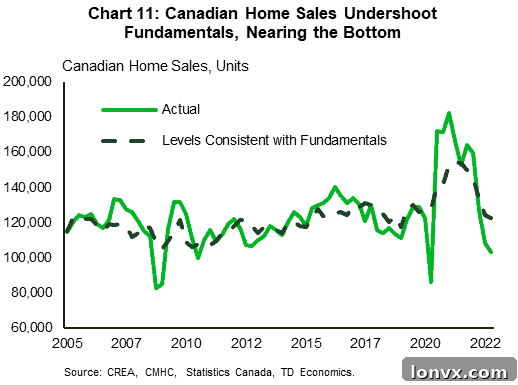
Home Sales Activity: The Bulk of Adjustments Are Complete
Beyond price movements, the volume of home sales serves as another crucial barometer of market health and buyer confidence. TD economists anticipate that national home sales volumes will eventually bottom out at levels approximately 40 percent lower than the robust activity recorded at the beginning of 2022. This projected decrease reflects a significant cooldown from the heated market conditions prevalent in the earlier part of the year.
Encouragingly, the TD report indicates that a substantial portion of this anticipated sales adjustment has already transpired. With home sales having already declined by about 30 percent, the report confidently states that “the largest part of the sales adjustment has likely occurred.” This suggests that while some further moderation in sales might still be observed, the dramatic month-over-month drops that characterized the initial market correction are less probable. A stabilization in sales, even at a lower baseline, is vital for the market to find its footing and for predictability to return, offering a more encouraging outlook for prospective participants.
Evolving Supply Dynamics: From Sluggishness to Gradual Growth
The availability of homes for sale, or resale supply, plays a critical role in balancing the market. According to TD’s analysis, resale supply is expected to remain sluggish over the next few quarters. This reluctance by homeowners to list their properties is a common phenomenon in a weaker market, as sellers often prefer to postpone their plans in hopes of achieving better prices once market sentiment improves. This “wait and see” approach contributes to constrained inventory levels, even as demand wanes.
However, the long-term outlook for supply is more positive. TD Economics forecasts an “orderly increase in supply to take place” after this initial period of hesitancy. This is anticipated as markets gradually find their bottom next year and as demand and prices begin to show signs of recovery. An orderly increase in supply is crucial for a healthy market correction and subsequent recovery. It avoids a sudden influx of listings that could further destabilize prices, while also gradually meeting the evolving demand. This balanced approach to supply growth is a key component in the market’s projected return to more stable and sustainable conditions.
The Persistent Weight of Rising Mortgage Rates
Despite the emerging signs of stabilization in prices and sales, the trajectory of mortgage rates remains a significant and complex factor influencing Canada’s housing market. TD economists anticipate that mortgage rates are set to head even higher, continuing to exert downward pressure on affordability and overall market activity. The Bank of Canada’s mandate to combat inflation has necessitated a series of aggressive rate hikes, and while the pace of these increases may decelerate, the cumulative impact is still unfolding.
The forecast specifically points to another 50-basis point rate hike in December, followed by smaller 25-basis point increments in early 2023, contingent on economic data. These continued increases in borrowing costs will inevitably weigh on buyer purchasing power and affordability, extending the period of adjustment for the housing market. The report cautions that “the increase in carrying costs may force some overstretched owners to list their homes.” This refers to a scenario where existing homeowners, particularly those with variable-rate mortgages or those nearing renewal, find themselves unable to manage significantly higher monthly payments.
Analyzing the Downside Risk to Price Forecasts
TD economists are closely monitoring this potential dynamic, acknowledging it as a significant downside risk to their otherwise optimistic price forecasts. They have modeled a specific scenario to illustrate this risk: if just two percent of Canadian homeowners with mortgages are compelled by financial pressures to list their properties, the average Canadian home prices could end up four percent lower by the end of 2024 than their current baseline projection. This highlights the delicate balance of the market and the profound impact that even a relatively small percentage of distressed sales could have on overall price trends. It underscores the need for continued vigilance from policymakers and market participants alike.
Long-Term Structural Challenges: Immigration and Housing Supply
Beyond the immediate cyclical fluctuations, Canada faces a deeply entrenched structural challenge: a persistent shortage of housing supply. This issue is set to be amplified by the federal government’s ambitious immigration targets, which aim to welcome nearly 1.5 million new permanent residents over the next three years. While immigration is vital for Canada’s economic growth and demographic needs, this significant influx of people will inevitably place immense pressure on an already strained housing market.
TD Economics highlights that if these immigration targets are met, the demand for rental units will remain exceptionally strong in the short to medium term. Newcomers typically enter the rental market first, seeking flexible and often more affordable housing options as they establish themselves. Over time, however, as these individuals integrate into the workforce and achieve financial stability, this robust rental demand is projected to “eventually shift towards increased demand for ownership.” This transition will add substantial pressure to the homeownership market, which is already struggling with inadequate inventory and affordability issues.
Multifaceted Constraints on Housing Construction
It is crucial to understand that immigration, while a powerful demand driver, is only one piece of Canada’s complex housing supply puzzle. Several other structural impediments continue to hinder the timely and sufficient construction of new homes:
- Restrictive Zoning Bylaws: Many municipalities still operate with outdated zoning regulations that limit density, particularly in established urban areas, making it difficult to build multi-unit dwellings like townhouses and apartments that could address affordability.
- Soaring Construction Costs: The cost of building materials, exacerbated by supply chain disruptions, coupled with chronic labor shortages in the construction trades, drives up the price of new homes, making them less accessible.
- Lengthy and Complex Approval Processes: Developers often face arduous and time-consuming municipal approval processes for new projects, which adds significant costs and delays, slowing down the delivery of new housing units to the market.
- Infrastructure Deficits: Inadequate existing infrastructure, such as transit networks, water and sewer systems, and social amenities, can limit the capacity for new housing developments, particularly in rapidly growing regions.
Addressing these multifaceted supply constraints requires a concerted and collaborative effort across all levels of government, working in conjunction with the private sector. Without comprehensive strategies to streamline development, invest in infrastructure, and reform outdated regulations, Canada risks perpetuating its housing affordability crisis, even as demand continues to grow.
Conclusion: Cautious Optimism Amidst Lingering Headwinds
The Canadian housing market stands at a critical juncture, navigating a complex landscape of economic shifts and structural challenges. While the significant price corrections and slowdown in sales activity appear to be largely complete, fostering a sense of cautious optimism, the journey toward a truly balanced and healthy market remains ongoing. The insights from TD Economics provide a valuable framework, suggesting that the most turbulent period of adjustment may indeed be behind us, and the market could be nearing a long-awaited bottom.
Nevertheless, the path ahead will continue to be shaped by several influential factors. The trajectory of interest rates, for instance, still holds the potential to exert further downward pressure through increased carrying costs for homeowners, posing a notable downside risk. More profoundly, the long-term structural issue of housing supply, compounded by ambitious immigration targets and entrenched construction hurdles, represents a formidable challenge. While a recovery in demand is anticipated, the market’s capacity to meet this demand sustainably will be the ultimate determinant of long-term affordability and overall stability. Moving forward, a strategic blend of prudent monetary policy, proactive urban planning, and targeted housing initiatives will be indispensable in guiding Canada’s housing market towards a more resilient, equitable, and sustainable future for all its citizens.