
The housing market in British Columbia is currently exhibiting concerning parallels to the cycle that unfolded in the aftermath of the 2008 global financial crisis. According to a comprehensive new report from the B.C. Real Estate Association (BCREA), these historical echoes suggest a potential path toward severe housing undersupply and a significant deterioration in affordability across the province. This critical analysis highlights how current trends, if left unaddressed, could replicate a damaging pattern that once before reshaped the province’s real estate landscape.
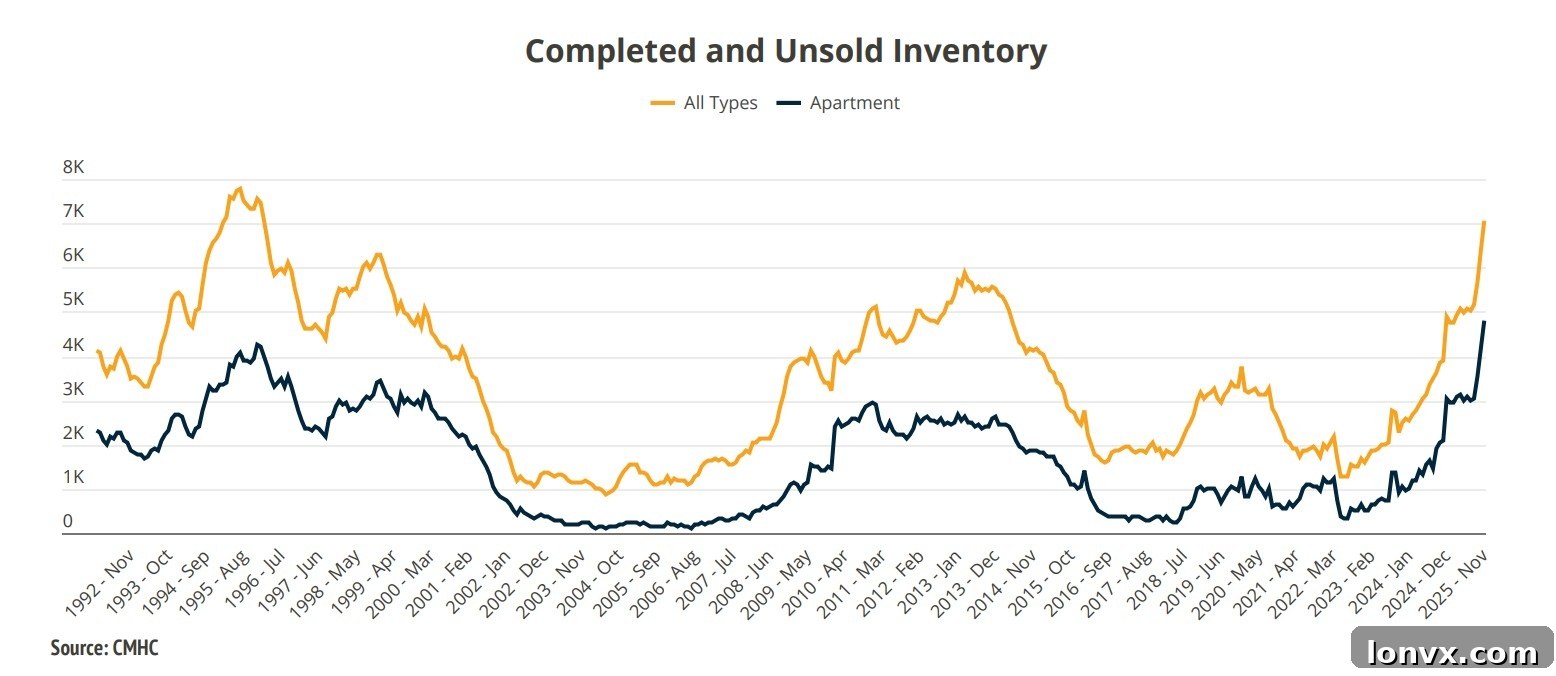
A key indicator of this impending challenge is the notable surge in unsold new-home inventory, which has now reached a staggering 30-year high. This accumulation is particularly pronounced within the apartment segment, where weak pre-sales are making it increasingly difficult for developers to secure necessary financing. Consequently, many developers are being forced to delay or outright cancel planned projects, a trend that severely impacts the future supply pipeline. This slowdown in new construction poses a significant risk: the province may find itself critically short of new housing units precisely when demand is expected to rebound robustly later in the decade. The BCREA report forecasts dire consequences, projecting that inflation-adjusted home prices could soar by as much as 27 percent by 2032 if current trajectories continue unchecked, pushing homeownership further out of reach for many British Columbians.
The Alarming Resemblance: Why Today’s Market Mirrors the Post-2008 Era
British Columbia’s housing market is currently navigating what the BCREA report describes as a “several-year malaise.” This challenging period is characterized by a confluence of detrimental factors, including elevated interest rates that deter buyers and make financing more expensive, alongside persistent trade uncertainty that complicates development and investment decisions. While many regions within the province have shown resilience and recovered from initial economic shocks, the housing markets in B.C.’s largest and most densely populated areas continue to grapple with persistent weakness. This struggle extends beyond the resale market, deeply impacting the development sector.
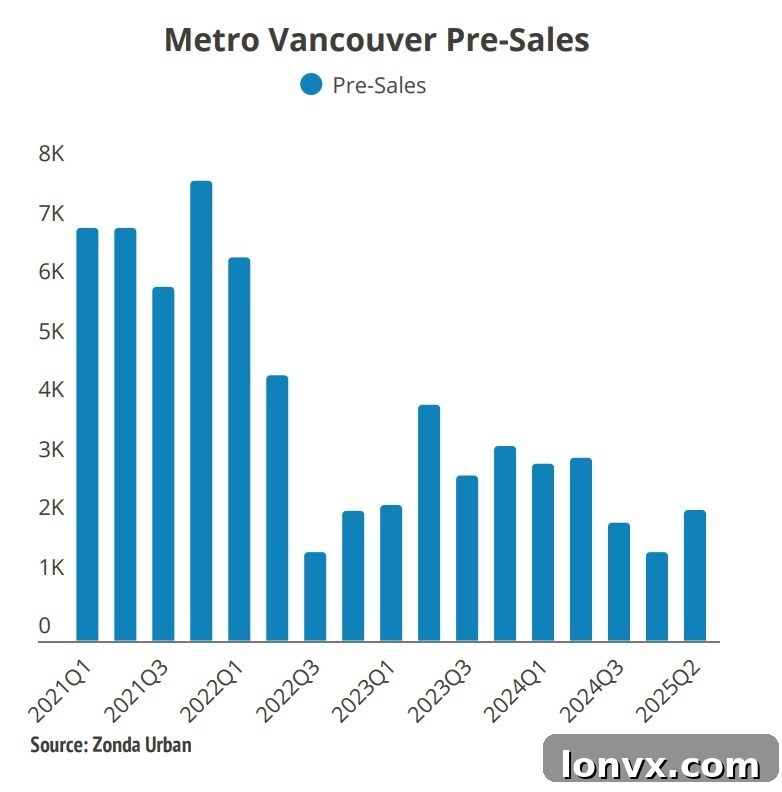 The report underlines that this pervasive weakness has not been confined to existing homes; it has significantly exacerbated an already difficult development environment. The compounding effects of economic uncertainty and tighter financial conditions in recent years have directly led to a wave of project cancellations, instances of developer bankruptcies, and a dramatic downturn in the pre-sale market. The most visible manifestation of this trend is the rapid and alarming accumulation of unsold new units. The current level of completed and unsold inventory in B.C. now exceeds 7,000 units, a volume not witnessed since the late 1990s. This inventory build-up is predominantly driven by apartment complexes, which account for nearly two-thirds of all newly constructed and as-yet-unabsorbed housing stock.
This unsettling pattern strikingly echoes the overall market behavior observed immediately following the devastating financial crisis of 2008. During that period, the absorption of standing supply lagged significantly, leading to a protracted slowdown in homebuilding that persisted throughout the remainder of the 2010s. The BCREA report starkly reminds us of the eventual outcome: “Ultimately, demand not only recovered but roared and collided with a market that had been severely undersupplied, leading to a dramatic deterioration in housing affordability that set the stage for the housing crisis of today.” This historical precedent serves as a potent warning, suggesting that without proactive measures, B.C. is on a perilous course to repeat past mistakes, thereby intensifying the province’s ongoing housing affordability challenges.
Unchecked Conditions Risk Eventual Price Acceleration and Worsening Affordability
The current market environment in British Columbia exhibits alarming dynamics and vulnerabilities that bear a strong resemblance to the conditions prevalent more than a decade ago. Market demand remains subdued amidst lingering economic uncertainties, a scenario that, on the surface, might suggest stability. However, the BCREA report issues a critical caution, asserting that “history tells us that a strong recovery is inevitable.” This historical certainty implies that British Columbia faces a significant danger of reliving the post-Global Financial Crisis cycle, a path that would inevitably set the stage for a further and potentially catastrophic deterioration of housing affordability for its residents.
To underscore this threat, the BCREA conducted a rigorous model simulation of today’s market conditions, drawing direct comparisons to the 2008-2018 period. The simulation’s findings are stark: unsold new inventory is projected to continue its upward trajectory through 2026 before finally cresting. This continued accumulation, even if temporary, has profound implications for future supply, as it directly impacts developers’ decisions and financial viability.
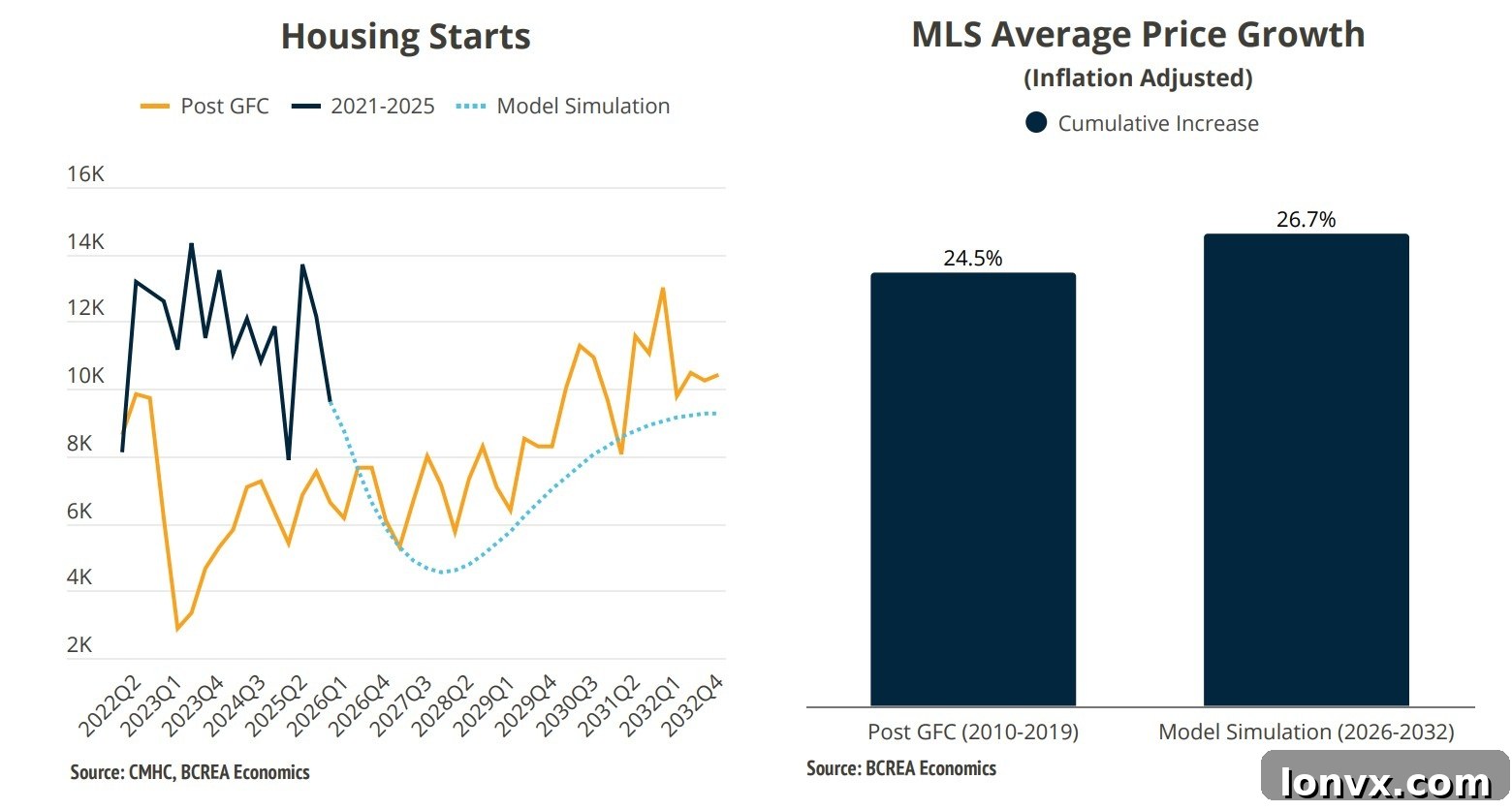
The combination of elevated inventory levels and a persistently weak pre-sale environment will inevitably compel more developers to either postpone or entirely cancel their projects. This reluctance to build will lead to a discernible fall in housing starts, culminating in a noticeable drop in housing completions towards the end of the current decade. Concurrently, active listings are anticipated to peak around 2027, followed by a steady decrease as underlying demand gradually recovers to historical norms. The report concludes with a sobering outlook: “Taken together, prices, while expected to remain flat over the short-term, are at risk of accelerating sharply toward the end of the decade, similar to the pattern observed in the back half of the 2010s.” This predicted acceleration is a direct consequence of a future supply-demand imbalance, where a recovering population and economic growth will encounter a severely constrained housing stock. Such a scenario would only intensify the existing housing affordability crisis, making the dream of homeownership a distant reality for even more British Columbians.
Proactive Measures: What Can Policymakers Do to Avert a Crisis?
In light of these looming threats to housing affordability, the BCREA advocates for a sophisticated and multifaceted approach to policy, emphasizing the necessity of a two-pronged strategy to effectively balance supply and demand within the B.C. housing market. The association firmly argues that genuinely unlocking new housing supply requires carefully calibrated measures aimed at reducing the existing standing inventory while simultaneously bolstering demand for new housing, particularly in those market segments and regions where sales activity and construction have notably lagged behind the provincial average. This balanced approach is crucial to prevent the market from spiraling into another affordability crisis.
On the critical demand side, the BCREA report thoughtfully outlines two key policy options that could provide immediate and impactful relief:
- Expanding the GST Exemption: The report proposes extending the Goods and Services Tax (GST) exemption on new homes beyond its current scope of first-time buyers to include all purchasers. Such an expansion would significantly support demand, especially for property types like apartments and semi-detached homes in key regions such as the Lower Mainland, where both sales and construction activity have demonstrably fallen behind the rest of the province. By reducing the overall cost of a new home, this measure would make homeownership more accessible and stimulate sales velocity, helping to absorb existing inventory and encouraging new construction.
- Reassessing Foreign-Buyer Participation: The BCREA also calls for a comprehensive reassessment of foreign-buyer participation in the vital pre-sale market. The report underscores that weaker domestic demand has rendered the financing of new projects significantly more challenging. Pre-sales are not merely transactions; they are the cornerstone for launching multi-unit construction projects, acting as a crucial “vote of confidence” for lenders. Financial institutions typically require builders to pre-sell approximately 65 to 70 percent of a project’s units before they are willing to provide construction financing, primarily due to concerns about default risk. By reviewing and potentially adjusting policies around foreign buyer involvement, policymakers could help ensure developers can meet these pre-sale thresholds, thus unlocking crucial financing and preventing project delays or cancellations. This delicate balance would need careful consideration to avoid unintended consequences while addressing the immediate financing bottlenecks.
Strategic Supply-Side Policy: Fostering Sustainable Homebuilding
Beyond demand-side interventions, the BCREA report unequivocally states that expanding housing supply remains the single most important ingredient for moderating future price growth and ensuring long-term housing affordability in British Columbia. The core philosophy underpinning supply-side policy, as articulated by the BCREA, is to fundamentally make homebuilding an attractive and viable business for developers and investors alike. This involves addressing both the revenue potential and the cost structure associated with residential construction.
The report identifies two primary channels through which policymakers can achieve this critical objective: increasing potential revenue by stimulating demand (as discussed above) and, equally important, significantly reducing the costs associated with building. To this end, the BCREA offers two concrete recommendations aimed at alleviating the financial burdens on developers and streamlining the development process:
- Immediate Relief Through Cost Reductions: Policymakers are urged to provide immediate and tangible relief to developers by substantially reducing development and amenity cost charges. These charges, levied by municipalities, can add significant expenses to the overall cost of a new home, often passed directly onto the buyer. By lowering these fees, the government can improve the economic viability of development projects, making it more attractive for builders to initiate and complete new housing, thereby increasing supply without necessarily inflating market prices. This measure directly impacts the bottom line of development, encouraging more projects to move forward.
- Innovative Financing with Municipal Bonds: The report also suggests allowing municipalities, under strictly defined parameters, to offer tax-advantaged municipal bonds to private investors. This innovative financing mechanism could serve multiple purposes. It could provide municipalities with additional capital to invest in critical infrastructure necessary for new housing developments, such as utilities and roads, without solely relying on development charges. Furthermore, it could potentially be structured to directly support or subsidize specific housing initiatives, including affordable housing projects, by leveraging private investment through attractive tax incentives. This strategy offers a creative way to inject capital into the housing ecosystem, fostering growth and increasing supply.
The Bottom Line: A Critical Juncture for B.C.’s Housing Future
The British Columbia Real Estate Association’s report delivers a stark and urgent message: if the current warning signs are ignored, the province’s housing market remains just as vulnerable to severe undersupply and escalating unaffordability as it was more than a decade ago. The echoes of the post-global financial crisis cycle are undeniable, and the potential consequences of repeating those mistakes are profoundly serious for the future of British Columbia.
The association emphasizes that a critical lesson must be learned from the housing cycle that followed the 2008 crisis. That period demonstrated how a temporary slowdown in construction, driven by market uncertainties, can quickly lead to a severe supply deficit when demand inevitably recovers. This imbalance then fuels dramatic price increases, eroding affordability and making homeownership an increasingly unattainable dream for many. If policymakers fail to heed these lessons and implement proactive, strategic interventions now, the report warns, “we risk repeating the same mistakes and making the prospect of home ownership in this province even more challenging in the years to come.” The time for decisive action is now, to safeguard the future of housing affordability and ensure a sustainable real estate market for all British Columbians.