
British Columbia Real Estate: BCREA Forecasts Robust Sales Growth Amidst Shifting Market Conditions
The British Columbia Real Estate Association (BCREA) has released its highly anticipated 2024 Second Quarter Housing Forecast, providing a comprehensive outlook on the province’s dynamic property market. The report suggests a positive trajectory for real estate activity across British Columbia, with significant increases in sales projected for both the current year and 2025.
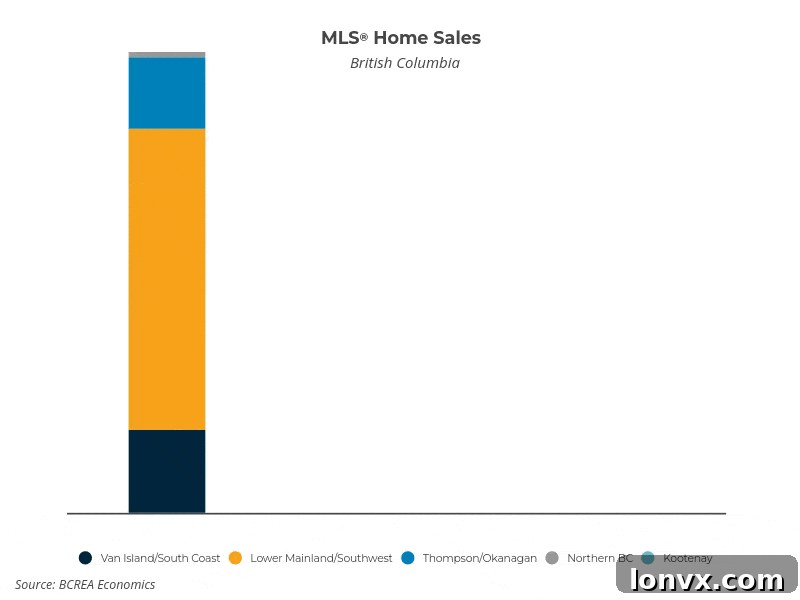
According to the BCREA’s projections, total residential sales in British Columbia are anticipated to climb by a notable 7.8 percent this year, reaching an estimated 78,130 units. This growth is expected to continue into 2025, with sales forecast to rise further to 86,480 units. These figures paint a picture of a resilient market poised for recovery and expansion after a period of adjustment.
The Bank of Canada’s Pivotal Role: Interest Rates and Buyer Confidence
A key factor influencing the current and future state of the British Columbia housing market, as highlighted by BCREA’s chief economist Brendon Ogmundson, is the monetary policy stance of the Bank of Canada. Despite a slow start to 2024 for the housing sector, all eyes remain firmly fixed on the central bank’s upcoming decisions regarding its policy rate. Ogmundson notes that while fixed mortgage rates have already seen a significant decline, buyer confidence appears to be critically dependent on the Bank of Canada’s tangible move to lower its benchmark rate.
“After a slow start for the housing market in 2024, all eyes are on the Bank of Canada. Although fixed mortgages are down significantly, it appears that buyer confidence is hinging on seeing the Bank lower its policy rate,” states Brendon Ogmundson. This sentiment underscores the psychological impact of interest rates on prospective homebuyers, who are often waiting for clear signals of easing financial conditions before making major investment decisions.
The BCREA’s economic analysis suggests that such a move from the Bank of Canada is likely on the horizon. Ogmundson elaborates, “Given weak economic growth, a slowing labour market and a downward trend in inflation, we expect that the Bank will begin to loosen monetary policy this summer, which should spur some pent-up demand off the sidelines.” This forecast is rooted in macroeconomic indicators that typically precede shifts in central bank policy. A period of subdued economic growth, coupled with a softening labour market, provides the Bank of Canada with room to maneuver without excessively stimulating inflation. The persistent downward trend in inflation, nearing or within the central bank’s target range, further strengthens the case for rate cuts.
A reduction in the policy rate would directly influence variable mortgage rates and indirectly affect fixed rates, making borrowing more affordable. This anticipated loosening of monetary policy is expected to unlock a significant amount of “pent-up demand” – potential buyers who have been waiting on the sidelines due to higher borrowing costs and economic uncertainty. As interest rates ease, these buyers are likely to re-enter the market, contributing to the projected increase in sales volume across British Columbia. This influx of demand, combined with more accessible financing, could create a more dynamic and competitive environment in the latter half of 2024 and into 2025.
Navigating Affordability, Price Growth, and Housing Supply Challenges
While the BCREA’s forecast for sales growth is optimistic, the report also addresses ongoing challenges within the British Columbia housing market, particularly concerning affordability and the critical balance between supply and demand. In recent months, the province has continued to grapple with significant affordability hurdles, exacerbated by rising property prices. This situation underscores the urgent need for a robust and consistent supply of new listings to keep pace with projected sales increases.
Addressing Supply Shortages
The association notes that housing affordability remains a paramount concern for many British Columbians. Despite the expectation of increased sales activity, the underlying issue of high property values continues to challenge prospective buyers, especially in densely populated urban centers. The BCREA emphasizes that for the market to maintain a healthy equilibrium, the supply of new listings must effectively absorb the anticipated surge in demand. The good news, according to the BCREA, is that listings are expected to rebound from an almost record low experienced in 2023. This anticipated increase in available homes for sale is crucial for moderating price appreciation and providing more choices for buyers.
The historical low in listings witnessed in 2023 was a significant bottleneck, contributing to fierce competition and rapid price escalation. A sustained rebound in new listings would offer much-needed relief to the market. This could be driven by various factors, including sellers who were previously hesitant to list due to market uncertainty or high interest rates now feeling more confident, or a steady flow of new construction reaching completion and entering the market. Adequate supply is not just about quantity; it’s also about variety, ensuring there are homes available across different price points and types to meet the diverse needs of the population.
Price Growth Expectations
Despite the persistent affordability challenges and recent price increases, the BCREA’s forecast suggests a relatively modest average price growth for the province this year, estimated to be between 1 to 2 percent. This controlled growth, particularly if accompanied by an increase in listings, could signal a more sustainable market environment. A lower rate of price appreciation helps to slowly improve affordability over time, especially if wage growth outpaces property value increases, and it prevents the market from overheating. The projected increase in listings plays a vital role in this moderation, as more options for buyers typically reduces upward pressure on prices.
The dynamic interplay between sales volume, available inventory, and interest rates will ultimately determine how prices evolve. If the increase in listings is substantial and demand is spread out, the market could see further stabilization. However, if the anticipated pent-up demand is released too rapidly without a corresponding surge in supply, price growth could exceed these modest projections. The BCREA’s cautious outlook on price growth reflects a hope for a balanced market where increased activity does not immediately translate into runaway property values, thus offering a glimmer of hope for buyers struggling with affordability.
Regional Divergence: A Look Across British Columbia
The British Columbia real estate market is far from monolithic; it comprises diverse regions each with its unique economic drivers, demographic shifts, and housing characteristics. The BCREA’s comprehensive forecast offers a granular view of how unit sales and average prices are expected to perform across these varied areas. Understanding these regional differences is critical for both potential buyers and sellers, as localized conditions can significantly impact market outcomes.
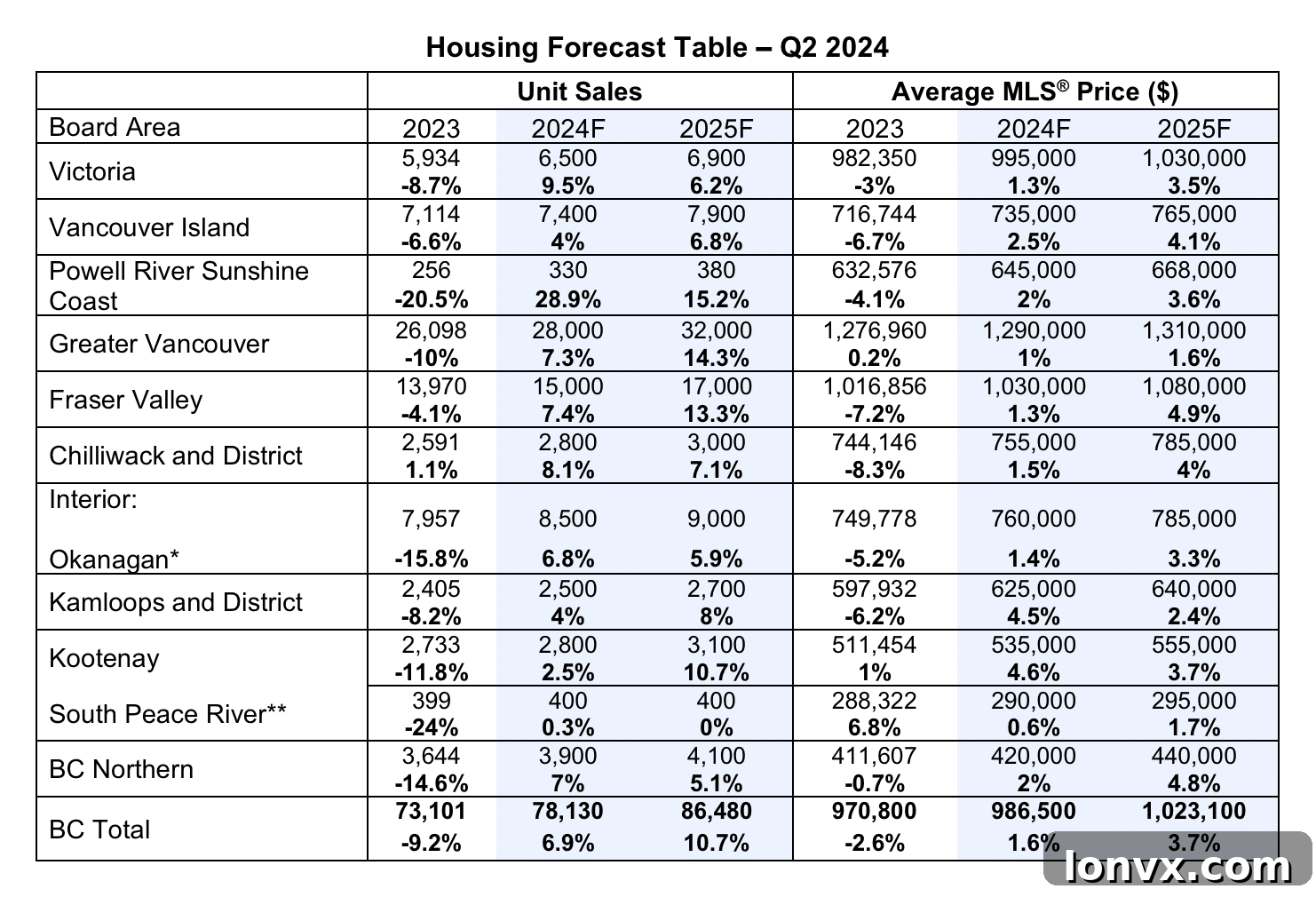
While a provincial average provides a useful benchmark, actual market experiences will vary considerably. For instance, major metropolitan areas like Greater Vancouver and Victoria typically exhibit different dynamics than smaller communities in the Okanagan, Fraser Valley, or Northern BC. Factors such as local employment growth, specific industry performance, population migration patterns, and the availability of developable land all contribute to these regional divergences. Some areas might see more aggressive sales growth due to high demand and limited supply, while others might experience more stable or even slower growth. Similarly, average price trends can differ, with some regions continuing to see strong appreciation while others experience more modest gains or even slight adjustments.
The BCREA’s detailed, interactive housing forecast tool, accessible via their website, allows stakeholders to delve deeper into these regional specifics. This resource is invaluable for gaining targeted insights, enabling more informed decision-making for those looking to buy, sell, or invest in particular areas of British Columbia. It underscores the importance of looking beyond the provincial aggregate to understand the nuanced realities of local markets.
For a detailed, interactive exploration of the complete British Columbia housing forecast, including specific regional breakdowns and historical data, please visit the official BCREA Economics page: BCREA Interactive Housing Forecast.