
The Canadian residential construction sector commenced the year on a subdued note, with fresh data from the Canada Mortgage and Housing Corporation (CMHC) signaling a persistent deceleration in homebuilding activity. This trend suggests that a significant rebound may not be on the immediate horizon, posing challenges for the nation’s ambitious housing supply goals and broader economic stability.
According to CMHC’s latest report, the seasonally adjusted annual rate (SAAR) of housing starts across Canada experienced a notable 15 percent decline in January, settling at 238,049 units. This figure represents a substantial drop from the 280,668 units recorded in December, effectively erasing the modest gains observed towards the close of 2025. This sharp monthly contraction underscores a challenging start to the year for an industry vital to Canada’s economic health and social infrastructure.
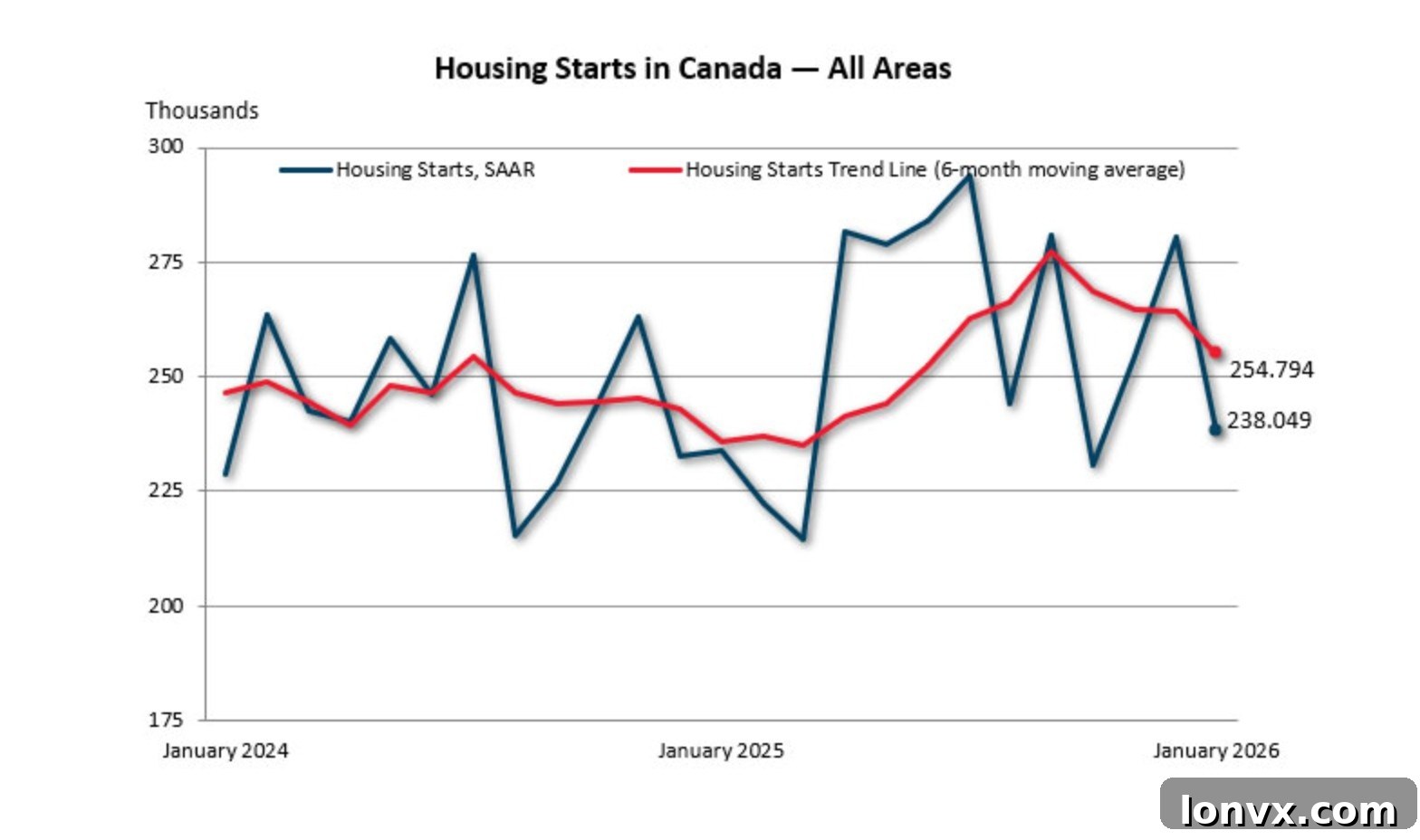
While monthly statistics in the housing market can often exhibit considerable volatility, the broader trend, as indicated by CMHC’s robust six-month moving average, also points firmly downwards. This critical metric, which smooths out short-term fluctuations to reveal underlying patterns, decreased by 3.5 percent in January to 254,794 units. This marks the fourth consecutive monthly decline, signaling a more entrenched slowdown rather than a temporary blip. Such a sustained contraction in housing starts has significant implications for future housing availability and affordability across the country.
The reasons behind this slowdown are multifaceted, stemming from a complex interplay of structural and cyclical pressures that are collectively constraining developer activity. CMHC identifies several key factors, including elevated construction costs, which continue to squeeze profit margins for builders; softer buyer demand, likely influenced by higher interest rates and inflationary pressures; and rising inventories of unsold homes, which reduce the urgency for new construction. Additionally, broader economic and geopolitical uncertainties, such as fluctuating trade relations and global economic instability, contribute to a cautious investment climate within the sector.
Tania Bourassa-Ochoa, CMHC’s deputy chief economist, reinforced this perspective, stating that a near-term turnaround in housing starts appears improbable. This assessment aligns with consistent feedback CMHC has been gathering from builders and developers nationwide over recent months, highlighting widespread concerns about market conditions and future prospects. The sentiment among industry players suggests that the current challenges are deep-seated and require more than just quick fixes.
Further exacerbating the situation are shifting macroeconomic conditions that directly impact housing demand and investor confidence. Recent adjustments to Canada’s immigration targets, for instance, could alter population growth projections and, consequently, the demand for new housing units. Simultaneously, ongoing uncertainty surrounding U.S. trade policy introduces an element of unpredictability for construction material supply chains and overall economic stability, influencing cross-border investment and operational costs for Canadian builders.
Urban Resilience: Major Cities Show Mixed Performance
Despite the national deceleration, the picture within Canada’s larger urban centers presents a more nuanced and, in some cases, surprisingly stable outlook on a year-over-year basis. This regional divergence highlights the varied dynamics at play across different local housing markets, where specific economic conditions, population growth patterns, and policy environments influence construction activity.
For municipalities with populations of 10,000 or greater, actual housing starts totaled 16,088 units in January. This figure represents a modest one percent increase compared to the 15,957 units recorded during the same month last year. While not a strong surge, this slight year-over-year growth in major urban areas suggests a degree of resilience, particularly when contrasted with the overall national decline in the seasonally adjusted annual rate. This indicates that while the pace of new construction might be slowing down nationally, the need for housing in dense urban cores remains a driving force.
Among Canada’s three largest metropolitan areas, performance varied significantly. Vancouver, a city grappling with some of the highest housing costs in the country, recorded a robust 37 percent increase in actual starts. This impressive growth was primarily fueled by a surge in both multi-unit developments, such as condominiums and townhouses, and a notable rise in single-detached starts. Vancouver’s consistent appeal for immigration, its strong job market, and proactive municipal policies aimed at increasing density likely contributed to this sustained construction momentum, signaling robust developer confidence in the region.
In contrast, Toronto, Canada’s largest city and another high-demand market, experienced a two percent decline in housing starts. This decrease was predominantly attributed to a slowdown in single-detached home construction. The Greater Toronto Area has faced intense pressure regarding land availability and affordability, pushing developers towards multi-unit residential projects. The decline in single-detached starts may reflect both the scarcity of suitable land for such projects and the increasing financial barriers for buyers seeking detached homes, which continue to command premium prices in the market.
Montreal, Quebec’s largest city, posted the most significant year-over-year decrease among the big three, with a substantial 44 percent drop in housing starts for January. This sharp contraction was driven by lower activity in both multi-unit and single-detached sectors. Several factors could be at play in Montreal, including potentially softer local demand compared to its Western counterparts, specific regional economic conditions, or temporary delays in the approval and commencement of large-scale projects. Such a dramatic fall underscores the susceptibility of even major urban markets to localized shifts in economic sentiment and development pipelines.
Deep Dive into the Drivers of Slowdown
The intricate web of factors influencing Canada’s housing starts extends beyond immediate market fluctuations. Elevated construction costs remain a persistent headache for developers. The price of essential building materials like lumber, steel, and concrete has seen volatile swings in recent years, often exacerbated by global supply chain disruptions and geopolitical events. Coupled with a persistent shortage of skilled labor across various trades, these factors significantly push up the cost of bringing new homes to market. These increased expenses inevitably translate into higher selling prices, further straining housing affordability for prospective buyers and potentially dampening demand.
Softer buyer demand is another critical component of the current slowdown. The Bank of Canada’s aggressive interest rate hikes over the past year have cooled the previously red-hot housing market. Higher borrowing costs directly impact mortgage affordability, pushing some buyers out of the market entirely or forcing others to delay their purchasing decisions. Consumer confidence has also wavered amidst broader economic uncertainty and persistent inflation, leading many Canadians to adopt a more cautious approach to large financial commitments like homeownership. This reduced demand trickles down to developers, making them hesitant to launch new projects if they anticipate slower sales or difficulty securing pre-construction commitments.
The issue of rising inventories further complicates the landscape. When a significant number of newly completed or nearing-completion homes remain unsold, it signals an imbalance between supply and demand. Developers with substantial inventory may put new projects on hold until existing stock is absorbed, to avoid saturating the market and potentially driving down prices. This cautious approach, while financially prudent for builders, directly contributes to the slowdown in new housing starts and can exacerbate long-term housing supply shortages.
Beyond domestic market dynamics, broader economic policies and global events cast a long shadow. The federal government’s recent decision to lower immigration targets, while aimed at addressing other societal pressures, will inevitably impact housing demand in the medium to long term. Immigrants are a significant driver of population growth and, consequently, housing demand in Canada. A reduction in these targets could temper future housing needs, prompting developers to re-evaluate their investment strategies. Additionally, the ongoing uncertainty surrounding U.S. trade policy, particularly concerning tariffs and cross-border movement of goods, can impact the cost and availability of construction materials sourced from or through the U.S., adding another layer of complexity and risk for the Canadian construction sector.
Outlook and Implications for Canada’s Housing Future
The current state of Canada’s residential construction sector underscores a critical juncture for the nation’s housing strategy. While the immediate outlook, as articulated by CMHC, points to an unlikelihood of a rapid turnaround, the long-term implications of a sustained slowdown are profound. Canada faces an acknowledged housing supply crisis, with ambitious targets set by various levels of government to address affordability and availability. A continued dip in housing starts risks widening the gap between supply and demand, potentially pushing home prices further out of reach for many Canadians and exacerbating social inequalities.
For policymakers, the challenge lies in navigating this complex environment. Strategies to alleviate construction costs, such as streamlining permitting processes, incentivizing innovation in building techniques, and addressing labor shortages through training and immigration programs, could help stimulate activity. Furthermore, measures aimed at bolstering buyer confidence and improving affordability, potentially through targeted financial supports or adjustments to interest rate policies (when economic conditions allow), would be crucial.
Investors and prospective homeowners alike will be closely watching several key economic indicators in the coming months. Decisions from the Bank of Canada regarding interest rates will heavily influence mortgage markets and buyer sentiment. Global economic stability, inflation trends, and any shifts in government policy regarding housing and immigration will also play significant roles in shaping the trajectory of Canada’s housing starts. The residential construction sector is not merely an economic engine; it is fundamental to the well-being and prosperity of Canadian communities. Addressing its current challenges with strategic foresight and collaborative efforts will be paramount to building a more stable and equitable housing future for all.