The Great Canadian Rental Shift: Mid-Sized Cities Emerge as Top Destinations
The Canadian rental market is undergoing a significant transformation, moving away from its traditional focus on major urban centers. A recent comprehensive report from RentCafe reveals a compelling trend: mid-sized cities across the nation are rapidly becoming the new hotspots for renter interest. This shift indicates a broader re-evaluation of priorities among Canadians seeking rental accommodation, driven by factors ranging from affordability to quality of life and burgeoning economic opportunities. This report delves into the key findings, highlighting which cities are capturing the most attention and the underlying reasons for their newfound popularity, offering crucial insights for both renters and investors navigating this evolving landscape.
The Rise of Mid-Sized Cities: A New Paradigm for Canadian Renters
For decades, major metropolises like Toronto, Vancouver, and Montreal have been the default choices for renters across Canada, attracting a constant stream of individuals seeking career opportunities and vibrant urban living. However, the relentless escalation of housing costs, persistent affordability challenges, increasing urban congestion, and the growing acceptance of remote work models have prompted many Canadians to look beyond these traditional hubs. Mid-sized cities, often offering a more balanced lifestyle, a significantly lower cost of living, and thriving local economies, are now stepping into the spotlight as highly desirable alternatives.
These burgeoning urban centers provide an attractive blend of urban amenities with a stronger sense of community and easier access to natural landscapes. This combination appeals to a diverse demographic, from young professionals looking to start their careers without crushing debt, to growing families seeking more space and better schools, and even retirees looking for a peaceful yet engaging environment. The data suggests a deliberate migration towards regions where renters can achieve a higher quality of life, better work-life balance, and greater financial stability.
Winnipeg Leads the Pack: A Deep Dive into Canada’s Top Rental Destination
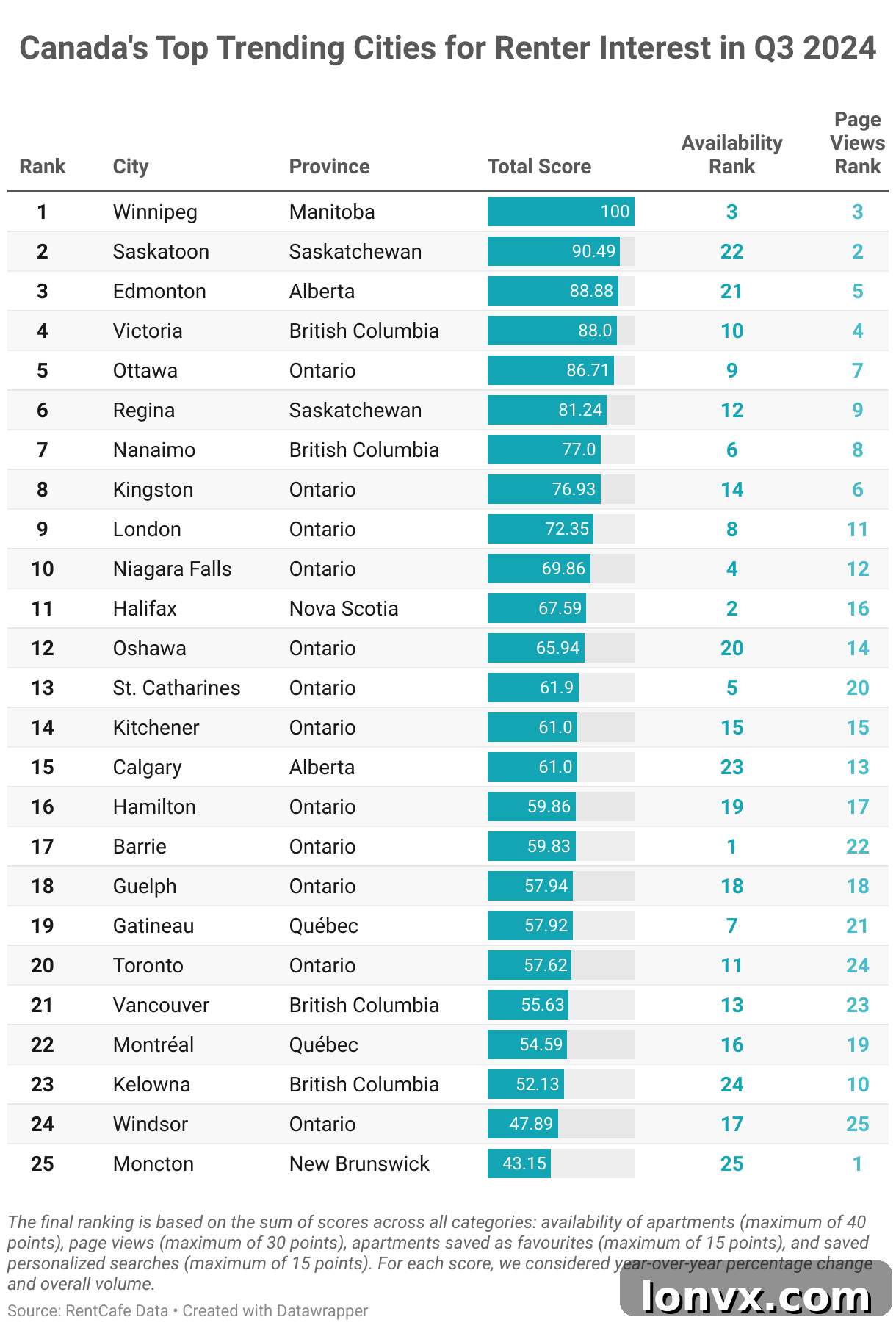
According to RentCafe’s latest analysis for the third quarter of 2024, Winnipeg has unequivocally claimed the top spot as Canada’s most sought-after city for renters, achieving a perfect score of 100 in their comprehensive assessment. This vibrant prairie metropolis has become a magnet for individuals and families alike, primarily due to its exceptional affordability when compared to Canada’s notoriously expensive major cities. The lower average rent prices and overall cost of living provide significant financial relief, making it possible for residents to save money or invest in other areas of their lives.
Beyond just attractive housing costs, Winnipeg boasts a robust and diversified economy that spans critical sectors such as manufacturing, education, healthcare, and an increasingly active technology scene. This economic stability translates into ample job opportunities across various industries, making it an appealing destination for those seeking career advancement without the prohibitive expenses found elsewhere. Renters from high-cost markets like Toronto, Calgary, and Vancouver are particularly active in saving Winnipeg listings, indicating a deliberate and strategic migration towards value, opportunity, and a sustainable lifestyle. The city’s rich cultural scene, numerous green spaces, and a reputation for friendly communities further enhance its appeal, promising a high quality of life alongside undeniable economic viability.
Prairies Powerhouses: Saskatoon and Edmonton’s Ascendancy
Trailing closely behind Winnipeg, Saskatoon has secured the second position in RentCafe’s ranking with a strong score of 90.49. This picturesque Saskatchewan city is experiencing a remarkable surge in renter engagement, evidenced by a 27% increase in listing views and a significant 34% rise in favourited properties compared to the previous year. Saskatoon’s appeal is multifaceted; it skillfully combines genuinely affordable housing options with a rapidly growing economy, particularly strong in agriculture, mining, and cutting-edge research. This economic vitality makes it an attractive destination for young families and professionals looking for stability and growth.
The city offers a welcoming community feel, excellent educational institutions, and a lower-stress lifestyle compared to the often-overwhelming pace of larger metropolises, presenting a compelling package for those looking to establish roots and build a future. Moreover, Saskatoon’s vibrant arts scene, numerous festivals, and beautiful riverside parks contribute to its overall desirability, creating a community where residents can thrive both professionally and personally.
Further west, Edmonton stands out as a major city defying the “plateau” trend seen in other large urban centers, ranking third overall with an impressive score of 88.88. Edmonton’s robust, energy-based economy, combined with its relative affordability compared to Calgary and Vancouver, and consistent population growth, has made it an undeniable magnet for renters. The city recorded the highest number of favourited apartment listings nationwide, a clear indicator of renters’ strong confidence in its housing options and future prospects. Unlike some of its larger counterparts, Edmonton continues to offer a compelling value proposition, providing big-city amenities, diverse cultural attractions, and significant job opportunities at a more accessible price point. Its expanding infrastructure, burgeoning culinary scene, and close proximity to the stunning natural beauty of the Rocky Mountains also contribute significantly to its growing popularity among those seeking a dynamic yet affordable urban experience.
Beyond the Prairies: Victoria and Ottawa’s Enduring Charm
The trend of mid-sized cities gaining traction extends far beyond the prairie provinces, demonstrating a nationwide shift in renter preferences. Victoria, British Columbia’s picturesque capital, secured the fourth spot, benefiting from a substantial 34% rise in favourited listings. This interest is particularly notable from renters migrating from the highly competitive and extraordinarily expensive Vancouver market, seeking Victoria’s unique blend of breathtaking natural beauty, a mild climate, and a relaxed island lifestyle. While still pricier than the prairie cities, Victoria offers a relative reprieve from Vancouver’s astronomical costs while maintaining a high quality of life and a thriving local economy driven by tourism, technology, and government administration, making it an attractive destination for those prioritizing lifestyle and scenic beauty without completely sacrificing urban conveniences.
Ottawa, Canada’s national capital, rounds out the top five. Interestingly, despite a reported decline in overall page views for listings, the city demonstrated strong renter engagement through a high volume of favourited properties. This suggests that while fewer people might be casually browsing, those seriously searching for rentals in Ottawa are finding attractive options and are highly motivated to secure accommodation there. Ottawa’s appeal stems from its stable job market, primarily driven by the federal government, a burgeoning tech sector, and numerous prestigious educational institutions. Its bilingual environment, diverse cultural offerings, and proximity to nature reserves and national parks make it an ideal place for families and professionals seeking stability, excellent public services, and a high standard of living in a cosmopolitan yet comfortable setting.
Ontario’s Strong Showing: A Provincial Hotbed for Renters
Ontario has solidified its position as a diverse and dynamic rental market, with three additional cities – Kingston, London, and Niagara Falls – joining Ottawa in the top 10. Kingston, an historic city nestled gracefully on the shores of Lake Ontario, is highly attractive due to its tight rental market, consistently low vacancy rates, and the significant presence of major academic institutions like Queen’s University and Royal Military College. This creates a consistent and reliable demand from students, faculty, and support staff, ensuring a vibrant and stable rental ecosystem that supports local businesses and a rich cultural calendar.
London, often affectionately referred to as the “Forest City,” benefits significantly from its affordability relative to the much more expensive Greater Toronto Area and its rapidly expanding tech and agri-food industries. This economic diversification attracts a diverse pool of renters seeking robust employment opportunities and a lower cost of living than Ontario’s biggest city. The city offers a compelling blend of urban amenities with a strong sense of community and abundant access to green spaces and parks, making it particularly appealing to young families and professionals looking for growth opportunities without the prohibitive big-city price tag. Niagara Falls, globally renowned for its breathtaking natural wonder, is also carving out a distinct niche in the rental market. Its appeal extends beyond its immense tourism draw, with a growing focus on hospitality, service industries, and cross-border commerce, offering unique living opportunities in a picturesque setting with increasing economic vitality and a growing range of amenities.
In contrast to these thriving mid-sized cities, Toronto, Vancouver, and Montreal rank 21st, 22nd, and 23rd, respectively. RentCafe notes that the majority of renter interest in these major hubs now primarily originates from local residents or those already within the same province, suggesting a strategic shift by renters to more accessible markets for inter-provincial moves.
The Shifting Tides: Major Urban Centers See Plateaued Interest
In stark contrast to the burgeoning interest in mid-sized cities, Canada’s traditional rental giants – Toronto, Vancouver, and Montreal – have seen their renter engagement “plateau.” Ranking 21st, 22nd, and 23rd respectively, these cities, while still immensely popular and densely populated, are experiencing a noticeable slowdown in their year-over-year growth in renter interest. This phenomenon is largely attributable to their already well-established and highly competitive rental markets, coupled with significantly higher average rental costs and often critically low vacancy rates. The sheer difficulty and expense of securing housing in these top-tier cities have become major deterrents for new residents and those looking to relocate.
RentCafe notes that the majority of renter interest in these major hubs now primarily originates from local residents or those already situated within the same province. This suggests that inter-provincial migration is increasingly favoring more affordable alternatives, as prospective tenants weigh the high costs against the benefits of living in these global cities. The persistent challenges of housing affordability, limited rental supply, and intense competition for available units continue to characterize these markets, pushing new renters towards less saturated and more budget-friendly options, or prompting existing residents to seek better value within their own provincial boundaries.
What Drives Renter Interest? Understanding the Metrics
RentCafe’s comprehensive report scores cities based on three critical metrics, each providing a unique lens into renter sentiment and market dynamics. The first metric, “availability,” reflects the number of active rental listings in a given market, directly indicating the current supply of rental units. A higher number of available listings generally suggests more options for renters and potentially less intense competition, making a city more attractive.
The second metric, “listing views,” measures the sheer volume of prospective renters actively browsing properties in a specific city. This serves as a strong indicator of general interest and overall market activity, helping to gauge the initial allure of a city to potential tenants. A high volume of views implies significant curiosity and exploration of what a particular market has to offer. Finally, “saved searches” serve as a powerful and highly reliable indicator of serious intent and preference. This metric reveals which cities renters are genuinely considering for their next home, going beyond casual browsing to actively bookmarking properties that meet their criteria.
A high volume of saved searches strongly suggests that renters are not just passively browsing, but are finding attractive options that resonate with their needs and are actively planning to move to these areas. The combination of these meticulously analyzed metrics provides a holistic and accurate view of renter sentiment and market dynamics, offering invaluable insights into where demand is truly surging and where the future of Canadian renting is headed.
Implications for Renters and Investors
This pronounced shift in Canada’s rental landscape carries significant implications for both renters and real estate investors, reshaping strategies and expectations across the board. For renters, the emergence of mid-sized cities as vibrant and affordable hubs offers a broader array of attractive housing options, potentially leading to a better quality of life and reduced financial strain. This trend empowers them with more choices beyond the confines of expensive major cities, allowing them to find communities that better align with their lifestyle, financial goals, and personal values, without sacrificing career prospects.
For investors, this trend signals exciting new opportunities. While traditional, major markets may still offer long-term stability and prestige, the rapid growth in renter interest and demand in mid-sized cities points towards lucrative prospects for investment in these developing areas. Understanding these evolving preferences can guide strategic decisions, identifying markets ripe for new rental property development, conversion, and acquisition. This proactive approach can foster balanced growth across the Canadian real estate sector and potentially yield higher returns as these markets continue to mature and attract more residents. This paradigm shift encourages a more diversified investment portfolio and a broader geographical focus for real estate endeavors, moving away from an over-reliance on a few dominant urban centers.
Conclusion
The latest RentCafe report paints a clear and compelling picture of a dynamic and evolving Canadian rental market. The era of mid-sized cities is undoubtedly upon us, with locations like Winnipeg, Saskatoon, and Edmonton, alongside Victoria, Ottawa, Kingston, London, and Niagara Falls, taking center stage as preferred destinations for renters. Their unique blend of affordability, robust economic opportunity, and desirable lifestyles is fundamentally reshaping renter preferences nationwide. As housing costs continue to be a primary concern for many Canadians, this decentralization of rental interest underscores a fundamental re-calibration of what constitutes an ideal place to live, work, and thrive.
This powerful trend not only offers a beacon of hope for renters seeking better value and quality of life but also provides crucial insights for developers, policymakers, and investors looking to navigate and capitalize on the future of Canada’s diverse and growing real estate landscape. Adapting to these significant shifts will be absolutely key to meeting the evolving needs of the Canadian population and ensuring a robust, equitable, and sustainable housing market for all.
Enjoying this article?
Get the latest REM articles in your inbox 3x week so you stay up to date on the latest in the Canadian real estate industry