
Canada’s housing market has long been a topic of intense discussion, particularly concerning affordability. For many aspiring homeowners, the dream of owning a property has felt increasingly out of reach. However, a glimmer of hope has emerged, as new data suggests that homeownership in Canada is experiencing its most significant improvement in affordability since 2022. This encouraging trend, detailed in a comprehensive report by Robert Hogue, Assistant Chief Economist at RBC, provides valuable insights into the current state and future trajectory of the Canadian real estate landscape. This article delves into the factors driving this positive shift, examines regional variations, and explores the outlook for prospective buyers in the coming months.
Canadian Homeownership Affordability on the Rise: A Closer Look at the Data
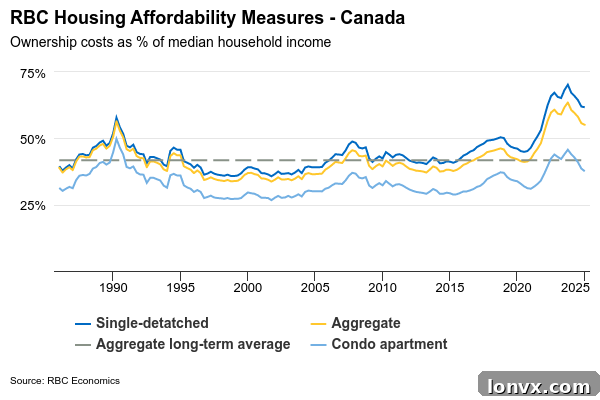
According to RBC’s latest report, the bank’s aggregate affordability measure saw a notable decrease to 55.1 per cent in the first quarter of 2025. This marks a significant improvement from 60.7 per cent recorded just one year prior. This metric represents the proportion of a typical household’s income needed to cover homeownership costs, including mortgage payments, property taxes, and utilities. A lower percentage indicates greater affordability, making the recent decline a welcome development for many. The substantial drop reflects a confluence of favorable market conditions that are beginning to alleviate some of the pressures that have characterized the Canadian housing market for years. Understanding the nuances of this improvement is crucial for anyone navigating the real estate landscape, from first-time buyers to seasoned investors.
Key Drivers Behind the Affordability Improvement
Several critical factors have converged to create this more accessible market environment:
- Lower Interest Rates: A primary catalyst for improved affordability has been the easing of interest rates. After a period of aggressive hikes designed to curb inflation, central banks have begun to signal a more accommodative stance. Lower borrowing costs directly reduce monthly mortgage payments, thereby enhancing the purchasing power of potential buyers and making the financial commitment of homeownership less daunting. This shift in monetary policy has injected much-needed liquidity and confidence into the market, directly impacting mortgage affordability in Canada.
- Modest Price Reductions: While not a widespread collapse, certain segments and regions of the Canadian housing market have experienced slight price reductions. These corrections, though sometimes minor, are significant when combined with lower interest rates. They signal a cooling of the intense bidding wars and rapid appreciation seen during the pandemic era, allowing home prices to align more closely with underlying economic fundamentals and buyer capacities. These subtle recalibrations are essential for a sustainable real estate market recovery.
- Steady Household Income Growth: Alongside these market adjustments, sustained growth in household incomes has also played a pivotal role. As wages and salaries steadily increase, the proportion of income required to service housing costs naturally decreases, even if home prices remain elevated. This organic growth in purchasing power provides a more stable foundation for affordability improvements, ensuring that gains are not solely dependent on external market forces but also on the economic well-being of Canadian households.
Despite these positive developments, Robert Hogue cautions against excessive optimism. He emphasizes that “prices are still a long way from more attainable pre-pandemic levels.” Indeed, the gains observed over the past five quarters have only managed to reverse approximately one-third of the affordability lost during the pandemic-driven housing boom. This stark reality underscores the deep-seated challenges that remain and highlights that while progress is being made, the journey toward truly broad-based affordability is still ongoing. The pre-pandemic era serves as an important benchmark, representing a period when the housing market, while competitive, was generally more accessible to a wider segment of the population.
Regional Nuances: A Patchwork of Affordability Across Canada
The national aggregate measure, while informative, often masks significant variations at the regional level. The RBC report reveals a complex picture across Canada’s major markets, indicating that not all cities are experiencing the same trends in housing affordability.
Markets Experiencing Notable Improvement
Many of Canada’s most prominent and historically expensive markets witnessed substantial improvements in affordability. Vancouver and Toronto, notorious for their high housing costs, posted the largest gains. For residents in these metropolitan centers, even a slight easing of the financial burden is a welcome relief. However, despite these positive shifts, both cities stubbornly retain their status as the least affordable housing markets in the entire country. This indicates that while the trajectory is positive, the absolute cost of entry remains exceedingly high, requiring sustained efforts to achieve genuinely widespread accessibility. The improvements in these markets are often a result of a combination of factors, including a slight increase in housing supply, a moderate slowdown in demand due, in part, to higher rates, and targeted urban planning initiatives. This makes the Vancouver housing market and Toronto housing market still challenging but showing signs of relief.
Markets Facing Worsening Affordability
In stark contrast to the trends in Vancouver and Toronto, affordability actually worsened in several other key Canadian cities, including Quebec City, Montreal, and Victoria. This divergence highlights the localized nature of real estate dynamics. In these markets, factors such as robust demand fueled by strong local economies, comparatively lower initial price points that may have seen continued appreciation, or a slower response to national interest rate changes could be at play. For instance, strong population growth and persistent demand in Montreal might be outweighing the impact of interest rate reductions. The worsening conditions in these cities remind us that a single national narrative doesn’t always apply uniformly across Canada’s diverse housing landscape. Understanding these local factors is crucial for both policymakers and individuals making housing decisions.
Condos Lead the Charge: A Deeper Dive into Property Types
When dissecting the affordability gains, one particular segment stands out: the condominium market. The improvement has been demonstrably strongest for condos, offering a more accessible entry point for many buyers across the country.
Condo Market Resilience and Recovery
Buyers in several major Canadian cities have seen condo affordability return to near pre-pandemic levels. This includes markets such as Edmonton, Saskatoon, Regina, Winnipeg, and notably, Toronto. These cities experienced less severe affordability deteriorations in their condo sectors during the pandemic boom, meaning they required less “resetting” to achieve current levels. The relative resilience of the condo market during the pandemic, coupled with recent price adjustments and lower borrowing costs, has made this housing type increasingly attractive and attainable. Condos often represent a more affordable option than single-detached homes, particularly for first-time buyers, downsizers, and those seeking urban living spaces. This trend significantly impacts condo affordability in Canada.
Toronto’s condo affordability measure is particularly noteworthy, according to Hogue. After a sharp deterioration from 2021 to 2023, recent price drops and reduced borrowing costs have propelled its affordability close to the levels seen before the pandemic. This resurgence in Toronto’s condo market is a significant development, as it represents a tangible improvement in one of Canada’s most challenging housing environments. Vancouver and Victoria have also shown progress in condo affordability, though Hogue notes that these markets “still have a long way to go” to reach optimal levels. This suggests that while positive momentum exists, the inherent high costs in these prime locations present ongoing hurdles, particularly for those seeking a balance of lifestyle and budget in a competitive market.
The Persistent Challenge of Single-Detached Homes
In stark contrast to the condo market, single-detached homes remain significantly less affordable across virtually all Canadian markets. This segment, often considered the epitome of the “Canadian dream,” saw more substantial price growth during the pandemic and has experienced slower corrections. The gap in affordability between single-detached homes and condos has widened, making the former an increasingly exclusive option. This is particularly evident in Vancouver and Victoria, where the costs associated with single-detached properties continue to be substantially higher than pre-pandemic levels, posing a formidable barrier to entry for many families and individuals. The scarcity of land, higher construction costs, and persistent demand for larger living spaces contribute to the sustained high prices in this category, keeping single-detached home affordability a distant dream for many.
Outlook for the Remainder of 2025: Cautious Optimism and Future Hurdles
Looking ahead, Robert Hogue projects continued improvement throughout the rest of 2025. He anticipates that further interest rate cuts, coupled with modest price declines and ongoing income gains, could collectively reverse about half of the pandemic-era affordability deterioration by the end of this year. This outlook is predicated on the assumption that central banks will continue their easing cycle, and that the Canadian economy will maintain its growth trajectory, supporting household incomes. Such a recovery would be a significant milestone, bringing the real estate market closer to a state of equilibrium and offering more opportunities for prospective buyers, as reflected in the RBC affordability report.
Beyond 2025: The Long-Term Landscape
However, the path to sustained affordability becomes “trickier” once interest rates stabilize. Hogue warns that once the Bank of Canada concludes its rate-cutting cycle, any further progress in affordability will rely almost entirely on the twin engines of income growth and favorable home price trends. This implies that future affordability gains will need to be driven more by organic economic improvements rather than cyclical monetary policy shifts.
In a stabilized interest rate environment, income growth becomes paramount. If household incomes can outpace the rate of home price appreciation, affordability will naturally improve. Conversely, if demand outstrips supply and prices begin to accelerate again without commensurate income gains, the market could quickly revert to less affordable conditions. This balance is critical for the long-term health of the Canadian housing market.
The supply side of the equation also remains a critical long-term determinant. Insufficient housing supply, particularly in high-demand urban centers, will continue to exert upward pressure on prices, regardless of interest rate levels. Government policies aimed at accelerating housing construction, streamlining zoning regulations, and encouraging diverse housing forms will be essential to ensure that supply can keep pace with Canada’s growing population and evolving demographic needs. Addressing these structural issues is key to fostering sustainable home prices in Canada.
Furthermore, demographic shifts, such as continued strong immigration, will play a significant role. While immigration fuels economic growth and demand, it also puts pressure on housing markets if supply doesn’t respond adequately. Balancing these forces will be key to fostering a healthy and accessible housing market in the years to come, impacting everything from mortgage rates to overall market stability. The real estate market forecast for Canada is complex, demanding a multi-faceted approach.
Conclusion: A Promising Trend with Persistent Challenges
The latest RBC report paints a cautiously optimistic picture for Canadian homeownership affordability. The improvements observed in early 2025, driven by lower interest rates, subtle price corrections, and steady income growth, are undoubtedly positive signals. While major markets like Vancouver and Toronto are showing encouraging signs of easing, significant regional disparities persist, and the overarching challenge of reaching pre-pandemic affordability levels remains substantial. The condo market offers a more immediate avenue for many buyers, while single-detached homes continue to pose considerable hurdles. As we move through 2025 and beyond, the trajectory of affordability will increasingly depend on the delicate balance between income growth, prudent monetary policy, and robust housing supply initiatives. For now, the dream of homeownership in Canada appears a little closer, though prospective buyers must remain vigilant and informed about the dynamic nature of the market.