
Canadians have navigated a turbulent real estate landscape in recent years, but a significant shift towards more predictable conditions is on the horizon for 2024. According to the latest Market Survey Forecast from Royal LePage, the national real estate market is poised for a period of growth and adjustment, ushering in what experts are calling a “new normal.” This comprehensive outlook suggests that while the era of ultra-low interest rates is firmly behind us, buyers and sellers are adapting to a new economic reality, setting the stage for renewed confidence and activity across the country.
Canadian Housing Market Outlook: A Glimpse into 2024’s Resurgence
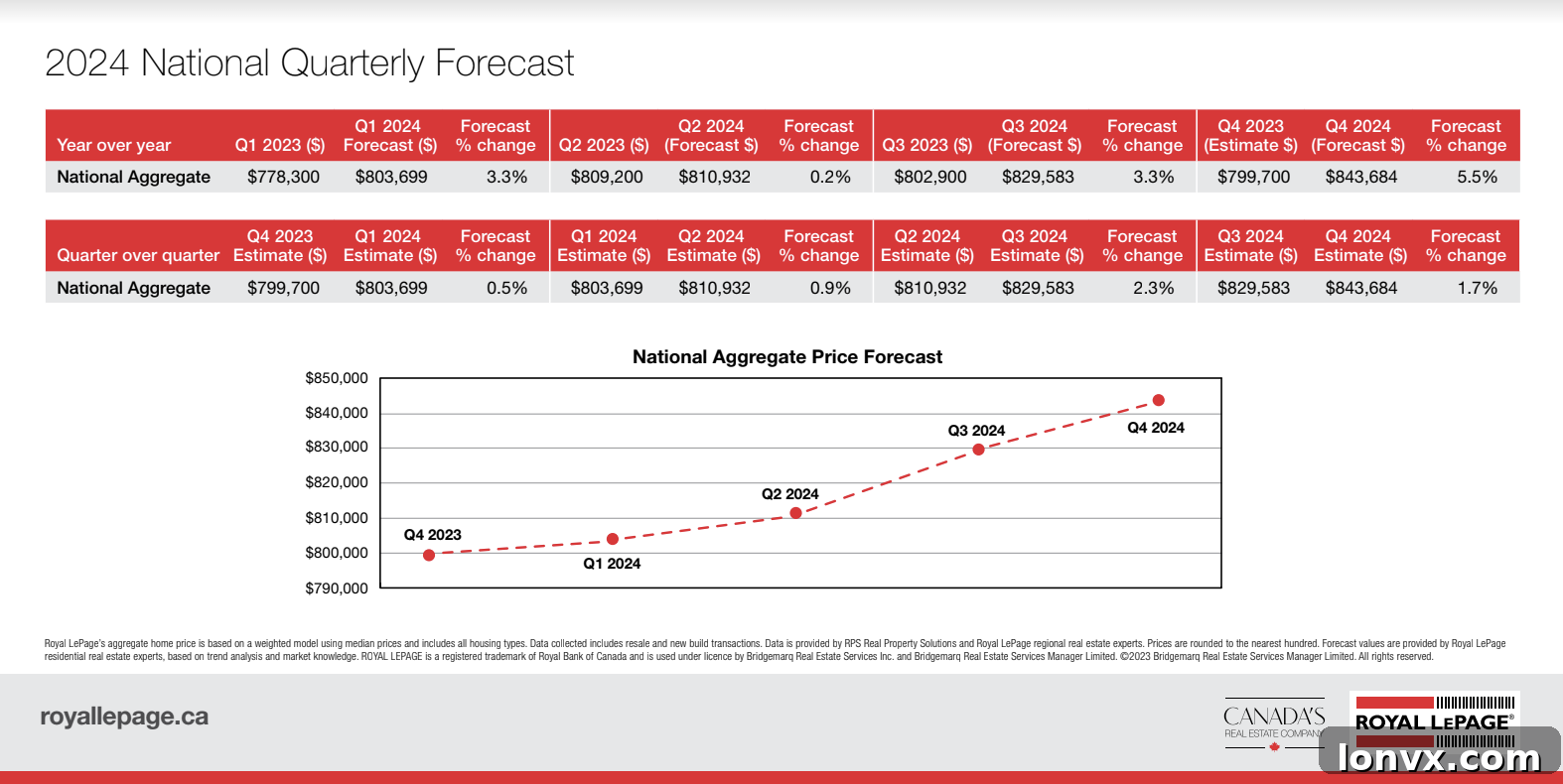
Royal LePage projects a notable increase in aggregate home prices nationwide. By the fourth quarter of 2024, the aggregate home price is expected to rise by 5.5 percent year-over-year, reaching an average of $843,684. Digging deeper into property types, the median price for a single-family detached home is forecast to climb by 6 percent to $879,164, while condominiums are anticipated to see a 5 percent increase, bringing their median price to $616,140. These figures signal a robust recovery and a return to appreciation after a period of volatility.
Phil Soper, President and CEO of Royal LePage, articulates this critical juncture: “Looking ahead, we see 2024 as an important tipping point for the national economy as the majority of Canadians acknowledge that the ultra-low interest rate era is dead and gone. We believe that the ‘great adjustment’ to tolerable, mid-single-digit borrowing costs will have a firm grip on our collective consciousness after only modest rate cuts by the Bank of Canada.” This perspective underscores a fundamental shift in market psychology, moving away from expectations of exceptionally low rates towards an acceptance of more sustainable lending environments.
Regional Real Estate Spotlight: Calgary Leads the Pack in Price Growth
The anticipated surge in home prices is not confined to a single region but is expected to ripple across all major Canadian markets. However, some areas are poised for more significant gains than others. Calgary, in particular, stands out, projected to experience the most substantial growth with an 8 percent increase in aggregate home prices by the end of 2024. This vibrant city has defied national trends in the latter half of 2023, consistently reporting rising prices even as other markets saw declines, indicating strong underlying demand and economic resilience.
Other key Canadian metropolitan areas are also on an upward trajectory. Royal LePage forecasts that by the end of next year, the aggregate home price in the Greater Toronto Area will be 6 percent higher than in the last quarter of 2023. Montreal is expected to see a 5 percent increase over the same period, reflecting steady demand in Quebec’s largest city. Greater Vancouver, a traditionally high-value market, is projected to experience a more modest but still significant increase of 3 percent, showcasing continued strength despite affordability challenges.
These regional variations highlight the diverse dynamics within Canada’s vast real estate market. Factors such as local economic growth, population migration, housing supply, and employment rates all contribute to these distinct outlooks, making localized analysis crucial for buyers and sellers.
The Bank of Canada’s Pivotal Role: Interest Rates and Buyer Confidence
The foundation of Royal LePage’s optimistic forecast rests heavily on the assumption that the Bank of Canada has concluded its cycle of interest rate hikes. The expectation is that the key lending rate will remain stable at 5 percent throughout the first half of 2024. This period of stability is crucial for allowing the market to absorb previous rate increases and for consumer confidence to solidify.
While stability is the immediate outlook, the forecast also anticipates small, strategic interest rate reductions by the Bank of Canada in late summer or fall of 2024. This expectation is already influencing the market, with several financial institutions pre-emptively offering attractive fixed-rate mortgage discounts, creating a window of opportunity for prospective homebuyers.
Phil Soper further elaborates on the psychological shift among homebuyers: “For the last year, many Canadians have been fixated on the idea of interest rates needing to come down significantly before they can afford to enter or re-enter the housing market. Acceptance that a mortgage rate of 4 to 5 percent is the new normal should untether pent-up demand as first-time buyers, flush with savings collected during the extended down market in housing, regain the confidence to go home shopping. And, with the return of first-timer demand, we expect families who have put off upgrading their homes to begin to list their properties in much greater numbers.” This commentary highlights the critical transition from waiting for a return to historical lows to embracing a new, albeit higher, benchmark for borrowing costs.
The stabilization of rates, coupled with potential modest cuts, is expected to unlock significant pent-up demand. Many first-time buyers, who have been accumulating savings during the recent market slowdown, are likely to re-enter the market. Simultaneously, homeowners who delayed upgrading due to uncertainty are expected to list their properties, injecting much-needed inventory into the market and fostering a more balanced transactional environment.
Recalling the “Roller Coaster Ride”: Four Years of Unprecedented Market Fluctuations
The Canadian real estate market has indeed been on an extraordinary journey over the past four years. The period from early 2020 to late 2023 can be best described as a “roller coaster ride,” marked by extreme highs and lows that profoundly impacted market dynamics and consumer sentiment.
Phil Soper aptly summarizes this volatile period: “Canada’s real estate market has been on a roller coaster ride for the last four years. A global pandemic briefly brought market activity to a grinding halt in early 2020, followed by a rapid, widespread spike in demand and price appreciation as Canadians sought safety and greater living space in their homes among a world of uncertainty. By the spring of 2022, home prices had reached unprecedented highs, but when interest rates started rising quickly and steeply to combat inflation, the extended market correction began.” This historical context is essential for understanding the current state and the anticipated trajectory of the market.
During the year and a half leading up to this forecast, the majority of the country witnessed a decline in sales activity. This slowdown was accompanied by a gradual increase in housing inventory. While transaction volumes in some areas plummeted by as much as 20 or 30 percent, home prices exhibited a more modest decline, largely due to simultaneous lower demand as prospective buyers paused, hoping for a significant drop in interest rates. Despite these recent dips, it’s important to note that many home prices remained above their 2022 levels, indicating the underlying strength and long-term appreciation trends of the market.
The market’s ability to absorb these shocks and maintain relatively stable price levels, even amidst reduced sales, speaks to its fundamental resilience. As Soper concludes, “Markets take time to adjust. We see a move toward typical home sale transaction levels in 2024, and as the year progresses, appreciating house prices.” This outlook points towards a return to more sustainable and predictable market conditions, signaling a period of steady growth rather than dramatic fluctuations.
National Quarterly Forecast: A Phased Approach to Price Appreciation
Royal LePage’s forecast outlines a detailed quarterly progression for national home prices in 2024, anticipating a phased approach to appreciation that aligns with the expected Bank of Canada’s actions.
- Q1 2024: The aggregate home price is expected to be 3.3 percent higher compared to the same quarter in 2023, representing a modest 0.5 percent increase over the fourth quarter of 2023. This early quarter will likely see the market absorbing current conditions and preparing for future shifts.
- Q2 2024: Prices are forecast to be 0.2 percent higher year-over-year and show a more robust 0.9 percent increase above the previous quarter. This period is anticipated to mark the beginning of renewed buyer confidence as interest rate stability becomes more entrenched.
- Q3 2024: As the year progresses and potential rate cuts emerge, prices are expected to accelerate. The third quarter is forecast to see a significant 3.3 percent increase year-over-year and a 2.3 percent rise quarterly. This surge is likely driven by pent-up demand being unleashed and improved affordability.
- Q4 2024: The year will conclude with strong growth, with the national aggregate home price projected to be approximately 5.5 percent above the same quarter of 2023, marking a 1.7 percent increase quarter-over-quarter. This strong finish indicates a fully revitalized market.
By the end of 2024, based on this comprehensive forecast, national home prices are expected to have effectively rebounded and returned to their pandemic peak levels observed in the first quarter of 2022. This recovery signifies a remarkable adjustment and a testament to the underlying strength of the Canadian housing market, moving beyond the recent correction and embracing a new phase of growth.
Implications for Buyers, Sellers, and Investors in the New Normal
For potential homebuyers, the “great adjustment” signals a critical shift. Accepting mid-single-digit mortgage rates as the new standard will be key to re-engaging with the market. The anticipated stability and modest rate cuts could create a favorable environment, particularly for first-time buyers who have saved diligently. The increased inventory from homeowners looking to upgrade will also offer more choices, easing some of the competitive pressures experienced in previous boom periods.
Sellers, on the other hand, can look forward to appreciating property values and a more active market. Those who postponed listing their homes during the period of uncertainty may find 2024 an opportune time to make their move. The return of first-time buyers, coupled with demand from growing families, will ensure a healthy pool of potential purchasers.
Real estate investors will also find renewed interest in the Canadian market. The predictable growth and stabilizing conditions offer a clearer investment landscape compared to the volatile swings of the past. Strategic investments in areas showing strong fundamentals, like Calgary, or established markets with steady appreciation, such as Toronto and Montreal, could yield favorable returns.
Conclusion: A Balanced and Optimistic Outlook
The Royal LePage Market Survey Forecast for 2024 paints a picture of a Canadian real estate market transitioning from an era of unprecedented irregularity to one of renewed stability and growth. The “great adjustment” to mid-single-digit interest rates, coupled with the Bank of Canada’s anticipated policy, is set to unlock pent-up demand and encourage both buyers and sellers back into the market. With aggregate home prices expected to return to their pandemic peaks by year-end, 2024 is poised to be a pivotal year, marking the establishment of a “new normal” characterized by predictable appreciation and a more balanced transactional environment across the nation.
For a detailed analysis, including individual market summaries and further insights, readers are encouraged to consult the full forecast directly from Royal LePage. Understanding these nuances will be crucial for navigating the evolving Canadian real estate landscape effectively.
Read the full forecast here.
Enjoying this article?
Get the latest real estate articles in your inbox 3x a week so you stay up to date on the latest in the Canadian real estate industry.