
The Canadian Real Estate Association (CREA) has recently unveiled its comprehensive forecast for home sales activity and average home prices across Canada’s Multiple Listing Service (MLS) systems for both 2023 and 2024. This eagerly anticipated report provides crucial insights for homeowners, prospective buyers, real estate professionals, and policymakers alike, painting a picture of a market navigating through uncertainty towards a projected recovery.
According to CREA’s detailed analysis, the national home sales landscape has demonstrated a remarkable level of stability since the summer of 2022. This period of relative calm is expected to give way to a gradual upward trajectory, with sales volumes anticipated to align more closely with long-term trends throughout 2024. This projected resurgence in activity signals a potential shift in market dynamics, moving away from the volatility observed in previous years.
CREA economists are observing key indicators suggesting a renewed sense of confidence among potential buyers, many of whom had adopted a wait-and-see approach. This cautious stance was largely influenced by prevailing uncertainties surrounding future mortgage payment obligations and the stability of property values. The recent actions of the Bank of Canada have played a pivotal role in alleviating some of these concerns. Specifically, the Bank’s decision to pause interest rate hikes in January 2023, followed by subsequent meetings in March and April where the overnight rate remained unchanged, has fostered a more predictable lending environment. Coupled with the observed stabilization and leveling out of home prices, these factors have significantly contributed to easing the anxieties that previously kept many prospective buyers on the sidelines, encouraging a gradual return to the market.
Understanding the Current Canadian Real Estate Landscape
The Canadian housing market has been a subject of intense scrutiny and rapid change over the past few years. From the frenetic pace of sales and exponential price growth during the pandemic to the subsequent cooling effect of aggressive interest rate hikes, the market has proven its resilience and adaptability. CREA’s latest forecast offers a nuanced perspective on where the market stands and where it is headed, emphasizing the interplay of economic factors, supply dynamics, and buyer sentiment. The reported stability since mid-2022 suggests that the initial shock of rising rates has been absorbed, and the market is now finding a new equilibrium. This stability is a foundational element for the anticipated gradual rise in sales activity, as it allows both buyers and sellers to plan with greater certainty. The proactive communication from the Bank of Canada regarding its monetary policy stance has been instrumental in providing the clarity needed for market participants to make informed decisions, transforming a period of apprehension into one of cautious optimism for a more balanced market ahead.
Navigating Potential Headwinds: Key Risks to the Forecast
While the outlook generally points towards stabilization and a gradual recovery, CREA’s forecast prudently acknowledges several significant risks that could influence the trajectory of the Canadian housing market. These potential headwinds warrant careful consideration from all stakeholders, as they have the capacity to alter market outcomes.
One of the most pressing and persistent risks identified is the exacerbation of Canada’s long-standing housing supply issue. This challenge is not confined to new construction but spans the entire housing continuum, profoundly impacting the existing home market. The report highlights a concerning trend: new listings have been dropping rapidly, reaching a staggering 20-year low. This severe shortage of available properties poses a substantial threat to the sales forecast, as a scarcity of inventory inherently limits the number of transactions that can occur, regardless of buyer demand. Furthermore, this constricted supply introduces an upside risk to the average price forecast; with fewer homes available, competitive pressures among buyers could intensify, leading to renewed upward pressure on prices. Addressing this fundamental imbalance between supply and demand remains critical for the sustainable health of the Canadian housing market.
Another significant risk factor pertains to the broader economic climate. CREA’s report cautions about the possibility of a short and mild recession, initially anticipated around the middle of 2023, evolving into a more severe and prolonged economic downturn than currently projected. A deeper and longer recession would undoubtedly have profound implications for the housing market. Such an scenario could lead to increased job losses, diminished consumer confidence, and tightened lending conditions, all of which would suppress buyer demand. Moreover, a more pronounced economic contraction could lead to a deterioration in household financial stability, potentially triggering a rise in mortgage defaults and a downward adjustment in property values. The delicate balance between managing inflation and preventing a significant economic slowdown is a continuous challenge for policymakers, and its outcome will heavily influence the housing sector’s performance.
Sales Forecast for 2023: A Year of Adjustment
For the calendar year 2023, CREA projects that approximately 492,674 properties will be traded through the MLS systems across Canada. This figure represents a 1.1 per cent decline compared to the sales volume recorded in 2022. It is notable that this national forecast for 2023 remains largely consistent with CREA’s previous national forecast, indicating a stable outlook despite the ongoing market adjustments. The slight reduction reflects a market that is still absorbing the impact of higher interest rates and striving for equilibrium after the unprecedented activity of prior years.
However, beneath the national aggregate, the report reveals important regional divergences, underscoring the necessity of examining local market dynamics. Two particularly significant offsetting revisions were made to the provincial forecasts:
- Alberta Home Sales: The forecast for Alberta was revised lower. This adjustment was primarily driven by a weaker-than-expected performance in the first quarter of 2023. Factors such as regional economic conditions, potentially including shifts in commodity prices or local employment trends, may have contributed to this softer start to the year for the province’s housing market.
- Ontario Home Sales: Conversely, the forecast for Ontario home sales saw an upward revision. This positive adjustment was a result of a somewhat stronger-than-expected first quarter. This strength in Ontario, particularly in its major urban centers like the Greater Toronto Area, suggests a more robust rebound or resilience than initially predicted, possibly driven by pent-up demand or a faster adjustment to new market realities among buyers in these high-demand regions.
These provincial revisions highlight the diverse nature of Canada’s real estate market, where national trends often mask significant variations at the local and regional levels. Understanding these nuances is crucial for both buyers and sellers operating within specific provincial markets.
National Average Home Price Forecast for 2023: A Modest Dip Before Recovery
The national average home price is anticipated to experience a 4.8 per cent decline annually, settling at approximately $670,389 for 2023. This projection reflects the ongoing market correction following the peak prices observed in early 2022. However, it’s important to note a slight upward adjustment compared to CREA’s previous forecast: the current projection is about $8,000 higher than initially anticipated.
This marginal increase in the average price forecast is attributed to a “compositional boost” observed in the first quarter of 2023. This compositional effect arises when a higher proportion of sales occur in more expensive regions or property types. In this instance, outsized gains in the pricey markets of British Columbia’s Lower Mainland and the Greater Toronto Area significantly influenced the national average. Despite a general cooling trend across many parts of the country, the robust performance and higher transaction volumes in these high-value areas disproportionately elevate the national average price, illustrating the limitations of using a single national average to describe the diverse Canadian real estate market.
Sales and Price Forecast for 2024: A Year of Rebound and Normalization
Looking ahead to 2024, CREA’s forecast paints a picture of substantial recovery and normalization for the Canadian housing market. National home sales are projected to experience a robust increase of 13.9 per cent, reaching an estimated 561,090 units. This anticipated surge in activity reflects a broader return of housing markets towards long-term trends, facilitated by a more stable and predictable economic environment. A significant contributing factor to this optimistic outlook is the expectation that monetary policy will gradually shift towards a more neutral stance, potentially involving stable or even slightly lower interest rates, thereby enhancing affordability and market accessibility.
While this projected sales volume for 2024 represents a strong rebound, it is crucial to place it in historical context. This forecast would still position activity well below the record-breaking levels witnessed in 2021, a year characterized by unprecedented demand and rapid price escalation. Nevertheless, it signifies a healthy return to normalcy, bringing sales volumes back in line with the long-term trend and, notably, lifting them above the 10-year average. This suggests a market that is not overheating but rather settling into a sustainable pattern of growth, offering greater predictability for both buyers and sellers.
Correspondingly, the national average home price is also forecast to embark on a significant recovery in 2024. After the adjustments seen in 2023, prices are expected to rebound by 4.7 per cent from their 2023 levels, reaching approximately $702,200. This recovery would effectively bring the national average home price back on par with the values recorded in 2022, effectively erasing the declines experienced in the preceding year. This projected price recovery, coupled with increased sales activity, indicates a market that is regaining its footing and moving towards renewed stability and growth.
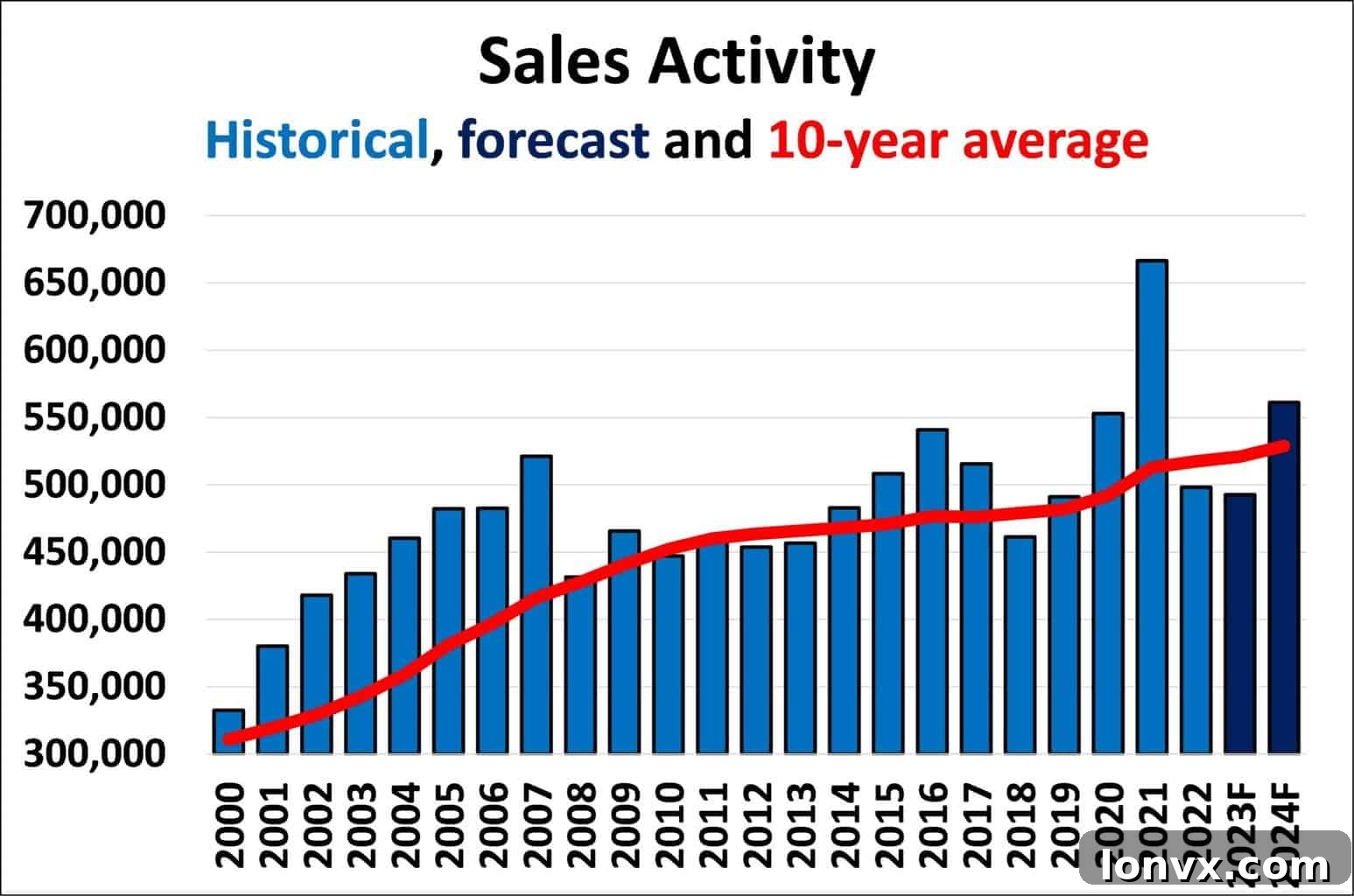
Sales activity, historical, forecast and 10-year average (Canadian Real Estate Association)
A Final Perspective on Average Home Price Projections
In its concluding remarks, CREA’s report offers an important caveat regarding the interpretation of provincial average price forecasts for 2023 and 2024. The report notes that many of the projected increases and declines in provincial average prices for these years are largely “an echo of the volatility seen last year.” This means that the figures might be more reflective of the rapid market shifts and corrections from 2022 than indicative of fundamental, forward-looking trends. In other words, these specific provincial forecasts are likely to possess a “low signal-to-noise ratio” until the market moves closer to 2025.
This distinction is crucial for market participants. It suggests that while national averages provide a useful overview, provincial-level price movements in the immediate future should be viewed with a degree of caution, as they are still reverberations of past market shocks rather than clear indicators of future sustainable growth or decline. The inherent volatility in market corrections means that pinpointing exact provincial price trajectories can be challenging in the short term. A clearer, more stable signal regarding provincial market performance is expected only as the market further normalizes and the lingering effects of the recent interest rate cycles fully dissipate. This emphasizes the dynamic nature of real estate forecasting and the need for a long-term perspective when evaluating market trends and making investment decisions in Canadian real estate.