
The Unintended Consequences of CMHC Mortgage Insurance: A Call for Reform in Canadian Housing
Canada’s housing market is at a critical juncture, characterized by unprecedented price surges and diminishing affordability. At the heart of this complex issue lies the Canada Mortgage and Housing Corporation (CMHC) mortgage loan insurance program. Originally conceived as a vital safety net to help Canadians realize the dream of homeownership with smaller down payments, CMHC insurance has, over the decades, evolved into something far different. It has become a significant driver of real estate demand, inadvertently contributing to the very affordability crisis it was meant to alleviate.
In a recent move, CMHC announced an increase in its coverage limit for homes, from $1 million to $1.5 million, citing “greater affordability” as the objective. However, this decision appears profoundly misguided. Far from enhancing affordability, such an expansion risks further inflating housing prices and entrenching the current market imbalances. A sober assessment of our collective fiscal interests and the long-term health of our housing market demands a contrary approach: CMHC insurance should be gradually and strategically phased out.
“Over the past 40 years, its effect on the market has been disastrous; incomes have become seriously misaligned from today’s house prices.”
Understanding the Economic Impact of CMHC Insurance on Housing Demand
The dynamics of the Canadian housing market, at their core, can be understood through fundamental economic principles of supply and demand. When demand for homes outstrips a finite supply, prices inevitably rise. Crucially, in the context of CMHC, this demand is significantly influenced by monetary availability and the ease of access to credit, rather than solely by demographic need. The more readily accessible financing becomes, the more ‘effective demand’ there is in the market, regardless of whether that demand aligns with long-term affordability or sustainable growth.
During periods of economic expansion and particularly in recent times, such as the pandemic era, governments and central banks have injected substantial liquidity into the economy. The dramatic increase in the monetary supply – by as much as 25 percent in a single year during the pandemic – had a profound and undeniable impact on housing prices. With more money readily available, and despite a relatively stable population, more homes were purchased at escalating values. Conversely, when quantitative tightening measures were introduced in the years following the pandemic, demand began to cool, demonstrating the direct link between monetary availability and housing market activity.
CMHC insurance functions as a pervasive form of monetary stimulus, directly influencing and, more often than not, artificially inflating housing demand. By mitigating risk for lenders, it allows individuals to purchase homes with down payments as low as 5%, effectively granting access to a significant pool of buyers who would otherwise be unable to enter the market. While this was its original noble purpose, the long-term consequence over the past four decades has been nothing short of disastrous for market equilibrium. The most glaring outcome is the severe misalignment between average household incomes and the skyrocketing house prices across Canada. What was once a proportional relationship has become an insurmountable gap for many.
The Eroding Dream of Homeownership and Crushing Debt Burdens
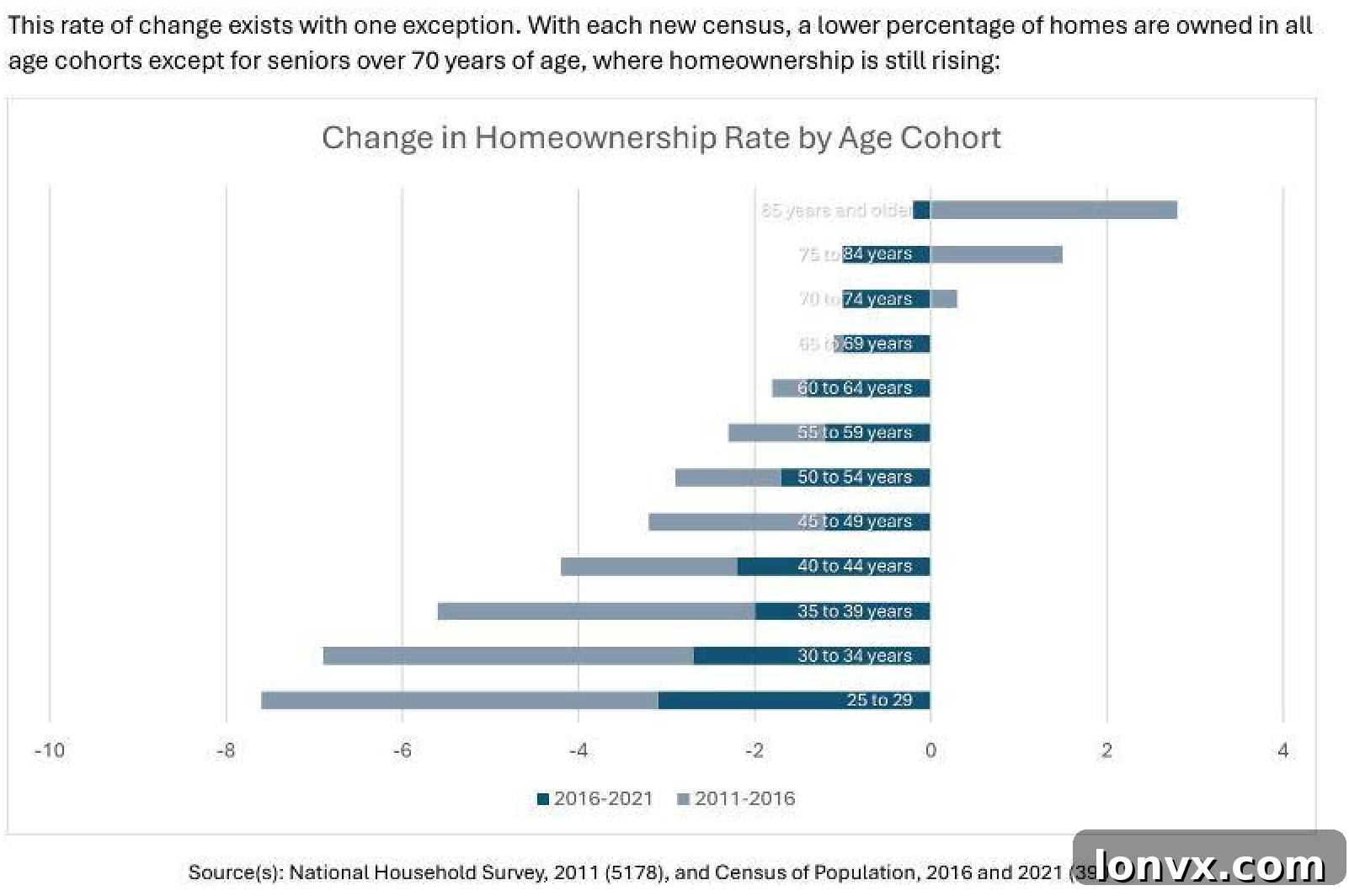
The stark reality of this misalignment is palpable: for a growing number of young Canadians, the dream of homeownership has become an increasingly distant, if not impossible, aspiration. The statistics are sobering; homeownership is now disproportionately concentrated among older demographics, with those aged 75 and above being the primary beneficiaries of historical market appreciation, while younger generations face an uphill battle against prohibitive entry costs.
Even for those fortunate enough to qualify for CMHC-insured mortgages, the path is often fraught with peril. The very mechanism that enables them to purchase a home frequently saddles them with crushing debt burdens. These substantial mortgage obligations significantly restrict their financial freedom, often depriving young families of crucial savings, opportunities for enriching life experiences, and the superior quality of life that previous generations of Canadians enjoyed. The mental and financial strain associated with carrying such heavy debt can have profound long-term consequences, impacting everything from retirement planning to the ability to invest in education or entrepreneurship.
CMHC: From Enabler to Catalyst of Unaffordability
The Canadian housing market has reached a pivotal and unsustainable point. It is imperative that we confront the fundamental sources of this contagion with direct, honest, and courageous policy action. Reducing the availability of CMHC insurance will undoubtedly impact the immediate buying power of some Canadians. However, we must be brutally honest with ourselves: the average person is already struggling to afford a home, even with the “assistance” provided by CMHC. The program’s effectiveness as a gateway to affordability has been severely diminished by the very price inflation it helps perpetuate.
Consider the realities of major urban centres. The average home price in Toronto, for instance, now exceeds $1.1 million. To comfortably afford a property in this price range, a household typically requires a gross annual income upwards of $263,300. Within such a pricing matrix, CMHC’s role has inverted dramatically. What was once heralded as the great enabler of homeownership for the masses has transformed into a critical element pushing housing markets ever higher. The very pricing structure in Canadian cities, infused and influenced by CMHC-backed demand, spirals upwards year after year, exacerbating the pain for the majority of Canadians aspiring to own a home.
By effectively underwritng higher-risk mortgages (those with low down payments), CMHC indirectly signals to the market that higher prices are “insurable.” This creates a moral hazard and distorts risk perception, allowing prices to detach further from economic fundamentals. It incentivizes lenders to approve mortgages that might otherwise be considered too risky, because the government, through CMHC, bears much of that risk. This mechanism, while superficially appearing to support buyers, actually props up an unsustainable price structure, making it harder for cash-buyers and those with larger down payments to compete in a hyper-inflated market.
“We need to gradually phase out CMHC insurance and, in the process, lessen the monetary demand for housing.”
Charting a New Course: The Gradual Phase-Out of CMHC Insurance
It is time for Canada to confront this issue head-on and implement meaningful reform. The most prudent and effective path forward involves the gradual phasing out of CMHC mortgage insurance. This strategic withdrawal would serve to lessen the artificial monetary demand for housing, allowing market forces to recalibrate more naturally over time. A gradual approach is crucial to avoid sudden shocks to the market, providing time for adjustment for both buyers and sellers, and allowing developers to respond to evolving demand signals.
Implementing such a phase-out could involve several mechanisms. For instance, the minimum down payment requirement for CMHC eligibility could be progressively increased over a set period, making it gradually harder to access low-down-payment mortgages. Alternatively, the maximum insurable amount could be incrementally reduced year over year, moving in the opposite direction of the recent $1.5 million increase. This would send a clear signal to the market that government-backed insurance is not an open-ended subsidy for ever-increasing home values. Furthermore, any remaining CMHC programs could be more tightly targeted to specific, truly vulnerable demographics or under-served regions, ensuring that the assistance reaches those in genuine need without broadly distorting the national market.
The ultimate goal of this correction is to restore a long-term, sustainable balance between household incomes and house prices. By tempering demand that is inflated by readily available low-down-payment mortgages, we can create an environment where homeownership once again becomes an attainable reality for the average Canadian, based on genuine economic capacity rather than government-backed financial leverage.
A Mandate for Future Generations: Rebuilding a Sustainable Housing Market
Though initially born of good intentions and designed to serve a vital social purpose, CMHC’s broad mortgage insurance program is now demonstrably harming our housing markets, stifling the aspirations of our youth, and jeopardizing our collective economic future. The current trajectory is unsustainable and inequitable.
We owe it to the next generation of Canadians to chart a new, more responsible course. The elimination – or at the very least, a radical restructuring and significant reduction – of CMHC mortgage insurance must become a top priority for the next federal government. This is not merely an economic adjustment; it is a fundamental re-evaluation of policy that has profound social implications. It requires courage, foresight, and a commitment to long-term national prosperity over short-term political expediency.
The time for incremental adjustments and superficial measures has passed. It is time to pull the trigger on comprehensive reform and rebuild a Canadian housing market that truly serves the best interests of all Canadians, fostering genuine affordability, stability, and equitable access to homeownership for generations to come.
Enjoying this article?
Get the latest real estate industry insights directly in your inbox three times a week to stay informed on the Canadian market.