The AI Revolution in Real Estate: Why Authenticity is Your New Superpower
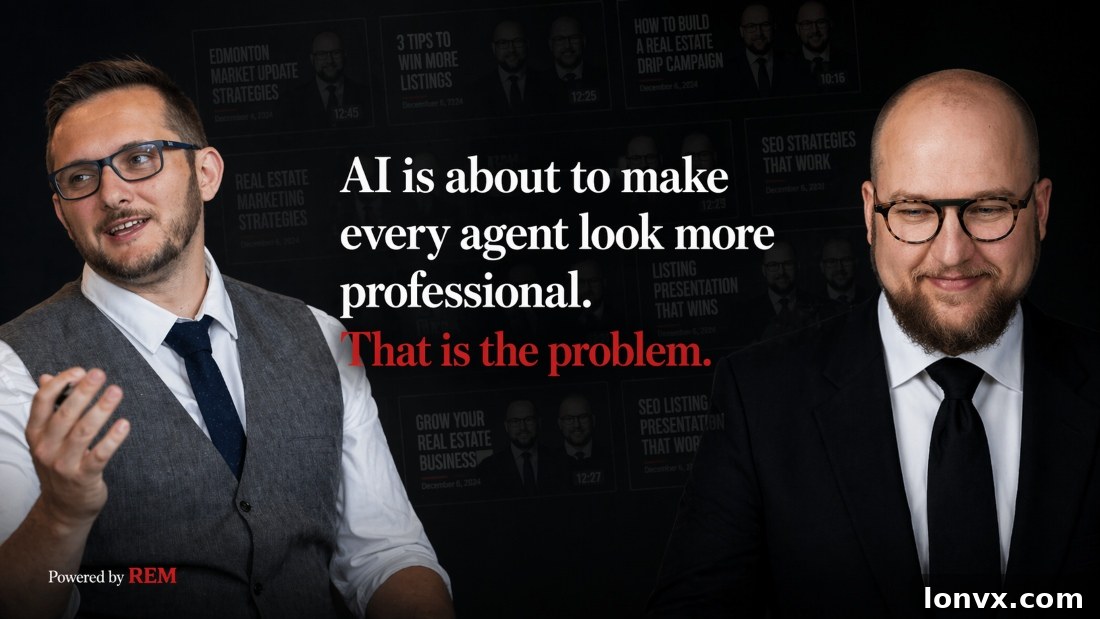
In a recent live broadcast, a simple experiment showcased the seismic shift artificial intelligence is bringing to real estate marketing. Andrew Fogliato, co-host of a weekly sales and marketing show, fed a thumbnail image and a transcript into ChatGPT’s new image generator. Within seconds, it produced a nearly professional-grade thumbnail. The AI preserved the hosts’ faces, extracted a compelling hook directly from the conversation, and applied relevant design elements—all without a human designer or a creative brief.
His co-host, Taylor Hack, captured the startling efficiency of the moment. “Do you know someone who’s never met you before, who, given access to the internet the way that this does and given only what you’ve told them, would have ever come this close to the mark on the first shot?” he asked. “Not a chance.”
This single example is a microcosm of a larger trend: AI is democratizing professional marketing. But when everyone can look like a pro, what does it truly mean to stand out? For real estate agents, the answer lies not in adopting AI, but in how you master it to amplify what makes you unique.
When Everyone Looks Professional, “Professional” Loses Its Meaning
The same powerful AI tools are now at every agent’s fingertips. The ability to generate a polished marketing asset in mere moments means the competitive advantage once held by agents with bigger budgets or a keen eye for design is rapidly vanishing. The digital landscape is about to get significantly louder, flooded with AI-generated content that looks good on the surface.
As Hack aptly framed it, any process that AI touches is replicated and multiplied at an astonishing speed. This is creating a clear divergence. On one side, casual users will leverage AI for quick, generic output—a simple listing description here, a basic social media post there. On the other, serious operators will use AI as a strategic partner to go deeper, analyze data faster, and refine their messaging with incredible precision. The gap between these two approaches is already widening.
“The way that we are about to replicate the noise now visually – the noise is going to be so loud,” Hack warned. In a sea of polished, AI-assisted content, the only thing that will truly capture attention is the one element AI cannot fabricate: your unique point of view. Original insights, personal stories, and content born from your direct experience are becoming the most valuable assets in your marketing arsenal.
Commodity vs. Non-Commodity Content: Your New Competitive Edge
Fogliato distinguished between two types of content: commodity and non-commodity. This distinction is crucial for navigating the AI era. Commodity content is generic and could be written by anyone, or any AI. Think articles like “Seven Tips for Buying Your First Home” or “How to Stage Your Living Room.” While once a staple of SEO, this type of content is now easily replicated and offers little unique value.
Non-commodity content, however, is deeply specific, rooted in real-world experience, and impossible for an AI to generate from scratch. It’s the difference between a generic tip list and an article titled, “Three Things I Learned Helping a Client Buy in Sherwood Park and How We Saved $18,000 on the Deal.” This type of content showcases genuine expertise and builds trust that generic articles cannot.
This shift isn’t just a marketing theory; it’s being reinforced by the world’s largest search engine. “Google is now working to prioritize that style of content,” Fogliato explained. “The specific stuff over the generic stuff.” Google’s emphasis on Experience, Expertise, Authoritativeness, and Trustworthiness (E-E-A-T) directly rewards agents who share their unique, hands-on knowledge. AI can help you structure this content, but it cannot provide the core experience.
How Serious Operators Use AI Differently
The majority of agents using AI today are taking shortcuts. They ask an AI to write a listing description, copy the result, and publish it. The fundamental flaw in this approach is that the output is indistinguishable from what every other agent using the same tool is producing. It’s a race to the bottom of generic content.
A far more powerful method is to change your relationship with AI from a content generator to an intelligent partner. Fogliato suggested a transformative approach: instead of asking AI to write for you, ask it to interview you. For example, a prompt could be: “You are a world-class copywriter. Ask me five critical questions about this property at 123 Main Street to help you write a listing description that appeals to first-time homebuyers.” By answering these questions, you inject your personal knowledge and unique insights into the process. The AI then structures your expertise into a compelling narrative.
“What’s going to make it the best is original insight,” Fogliato emphasized. “Nothing will outperform that.”
This principle extends beyond single pieces of content. For ongoing campaigns, like email drip sequences, most agents “set it and forget it.” The strategic operator lets the campaign run, then feeds the performance data—open rates, click-through rates, replies—back into the AI. The conversation becomes: “Here is the performance of my last five emails. Analyze what worked and what didn’t, and help me write three new subject lines that will resonate better with this audience.” Now, the AI isn’t just guessing; it’s learning from your specific audience’s behavior and helping you make data-driven improvements.
The same logic applies to video content. Export your YouTube analytics, provide them to an AI, and ask it to identify patterns and suggest new video topics based on what has historically performed well. This transforms brainstorming from a guessing game into a strategic planning session, ensuring your efforts are focused on what your audience actually wants to see.
The Authenticity Problem AI Cannot Solve
One of the most critical takeaways from the discussion was the gap between technical perfection and genuine authenticity. AI-generated content, particularly text, often scores high on technical metrics. It’s grammatically flawless, well-structured, and easy to read. However, it frequently lacks a human touch, a recognizable voice that builds connection and trust.
Clients are becoming adept at spotting this. “An email written by AI: grammatically way better than yours. Authenticity so low people look at it like toilet paper,” Hack stated bluntly. An overly polished, impersonal email doesn’t build trust; it erects a wall. The only way to bridge this gap is to own the process, infusing your personality and, as Hack suggested, even adding a disclaimer like, “Here is an explanation I approve,” to signal your personal endorsement.
This “uncanny valley” effect is also emerging in visual media. Buyers are growing suspicious of listing photos and virtual staging that look too perfect. They can often tell when a digital couch has been awkwardly dropped into a room or when the lighting and scale feel unnatural. As consumers become more educated on what AI-generated images look like, using these tools carelessly can damage credibility rather than enhance it.
The agents who will succeed won’t use AI to replace authentic marketing but to iterate toward it faster. Use AI to brainstorm staging concepts, not to create a fake final image. Use it to generate headline ideas, but choose the one that best reflects your voice and message.
A Live SEO Experiment for the Modern Agent
Putting these principles into practice, Fogliato and Hack concluded their show by committing to a public SEO experiment. Over the course of future episodes, they plan to rank Taylor’s real estate website for a specific, competitive keyword in the Edmonton market, documenting every step of the process using AI.
The framework is both simple and powerful:
- Select a Target Keyword: Identify a valuable search term that ideal clients are using.
- AI-Powered Analysis: Use a tool like Claude to analyze the top-ranking pages on Google for that keyword.
- Strategic Page Building: Instruct the AI to create a detailed outline for a new page designed to outperform the competition, focusing on Google’s current ranking priorities and tailored to a specific client profile.
- Track and Report: Build the page, monitor its performance, and share the results publicly.
During a live demo, Fogliato showed how Claude could produce a comprehensive, strategically sound page outline in minutes—an outline far superior to what most agents currently have on their websites. “Even that version, without any additional prompting, would probably already be sniffing the first page within a couple of months,” he predicted.
By making this process transparent, they are providing a replicable roadmap for any agent looking to leverage AI for a tangible competitive advantage in their own market. It’s a powerful demonstration that the future of real estate marketing isn’t about letting AI do the work for you; it’s about working with AI to do your best work ever.