
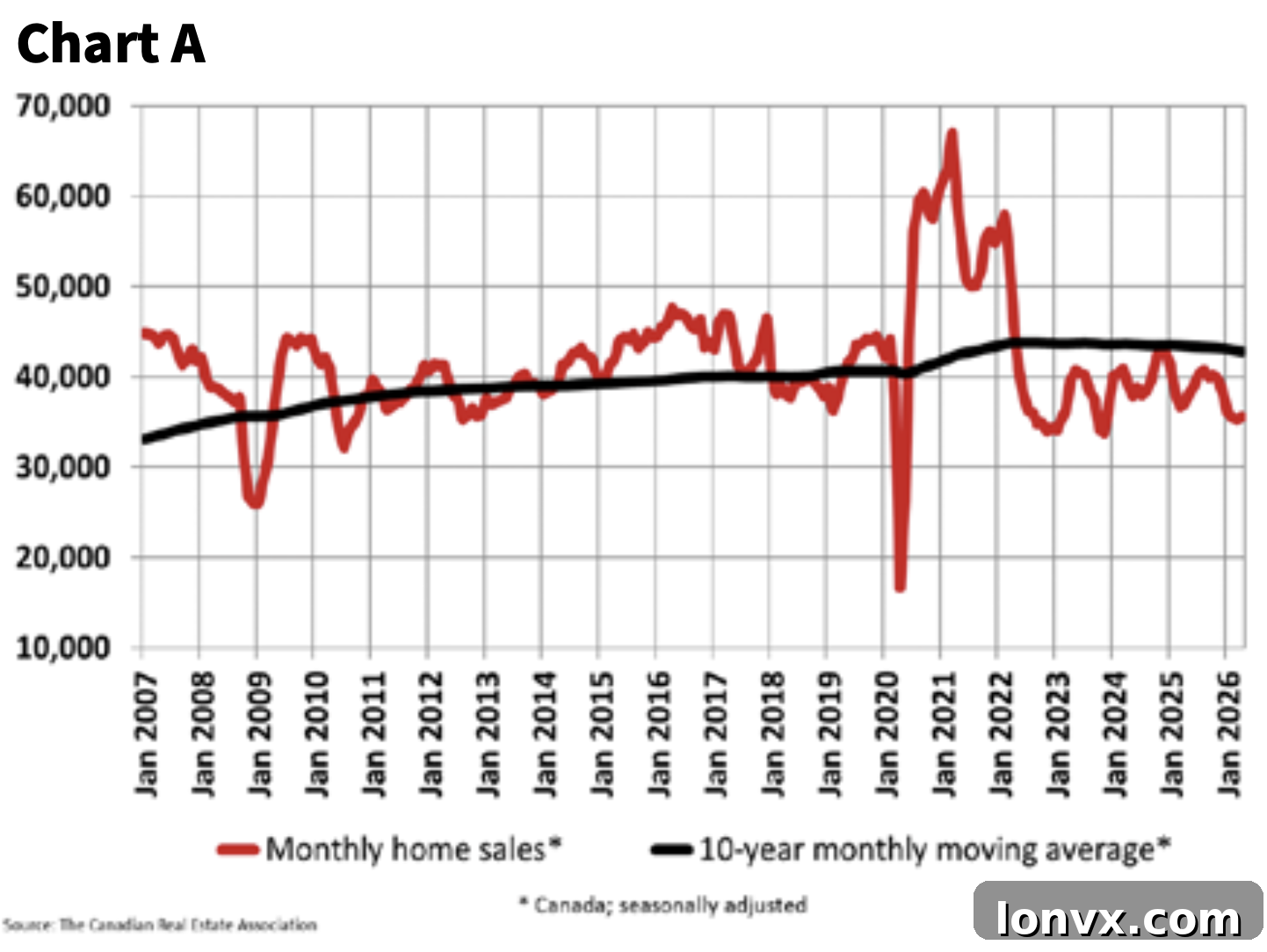
In its latest update, CREA highlighted a cautiously optimistic view—an approach that’s become familiar. There is, to be fair, some reason for optimism: national home sales increased 0.7% month-over-month in April 2026, marking the first monthly and year-over-year gain so far this year. Seasonal patterns often produce a March-to-April uptick, so this result should be taken in context. CREA also noted a stronger handoff into May, shorter days on market, and early signs of price stabilization. Yet the broader picture remains considerably weaker than the headline suggests.
Actual activity in April was 4% lower than in April 2025, and the MLS Home Price Index fell 4.2% year-over-year. Year-to-date residential sales are down 7.1% on a seasonally adjusted basis and 6.7% on a non-seasonally adjusted basis versus last year. Remember that 2025 was already a weak year: CREA reported 470,314 transactions in 2025, down 1.9% from 2024 after a tariff-related slowdown in Q1. Put bluntly: 2025 was one of the poorest years on record, and 2026 has started even weaker relative to that base.
CREA’s claim that a Q1 “snowstorm” delayed activity could still be partially correct. The market did not permanently freeze—many buyers stepped back rather than vanished. April may represent an early thaw, but it is not yet a full recovery.
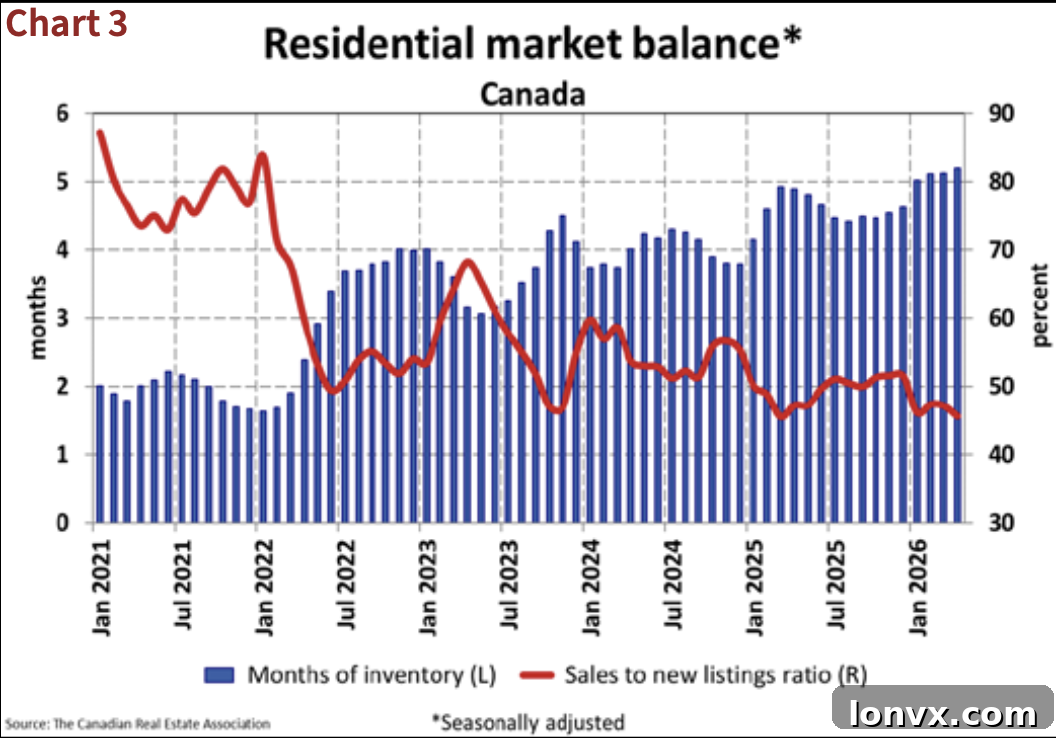
Supply is still outpacing demand
The key takeaway from April’s report isn’t that sales rose—it’s that listings rose more. Sales climbed 0.7% month-over-month, while new listings jumped 4.1%. That pushed the national sales-to-new-listings ratio down to 45.6% from 47.1% in March. CREA classifies roughly 45–65% as balanced, but 45.6% sits at the very bottom of that range. In plain terms: supply is still outpacing demand. Earlier debates that framed markets solely as a function of immigration versus housing starts ignored the fact that growing supply can quickly shift dynamics.
There were 5.2 months of inventory nationally at the end of April—slightly above March and close to the long-term average. CREA notes a buyer’s market typically starts above 6.4 months, so Canada as a whole is not technically a buyer’s market by that metric. However, this national average masks regional weakness. British Columbia had 7.7 months of residential inventory and a residential sales-to-new-listings ratio below 40%. Ontario’s ratio was just 36.4%. Those figures do not signal seller dominance.
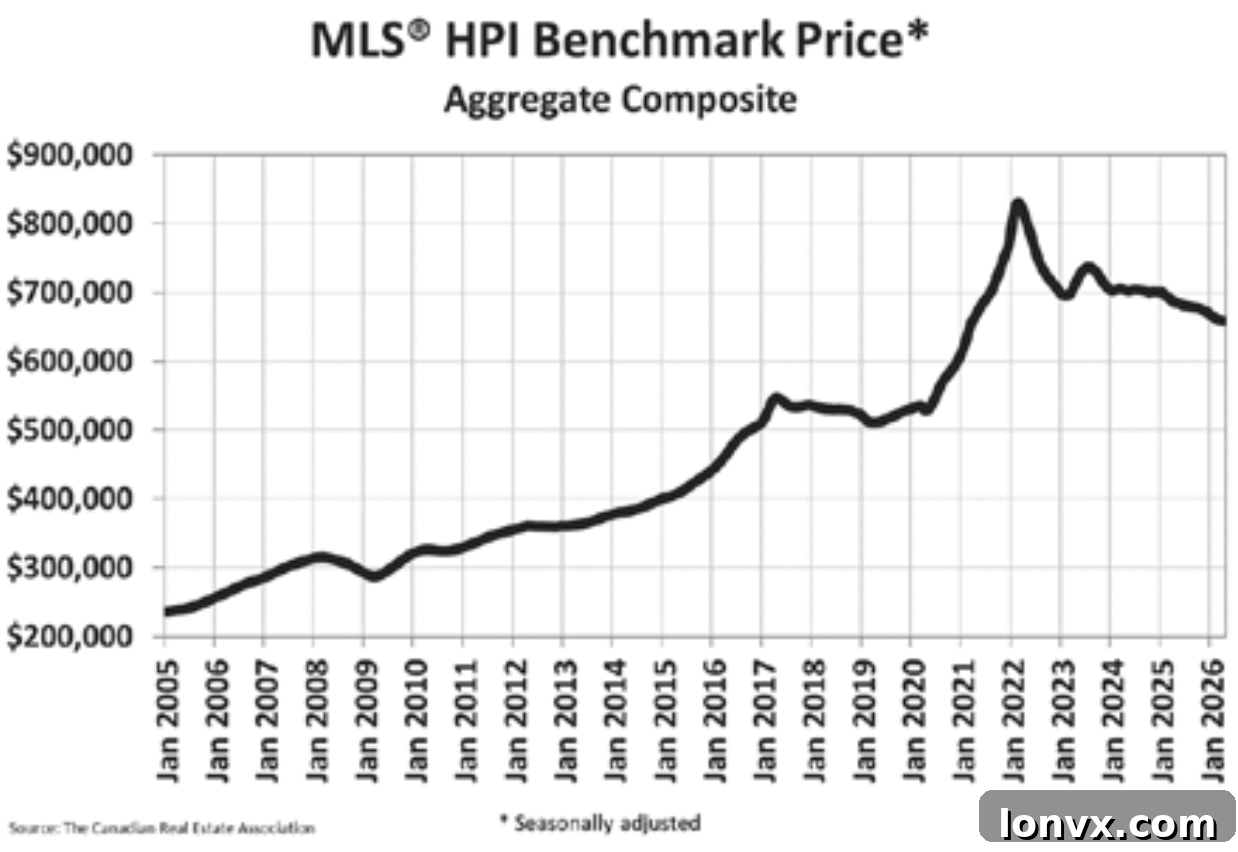
Prices are still moving lower
Prices continue to trend downward. The national HPI slipped 0.1% in April—the smallest monthly decline since October 2025—but slowing declines are not the same as rising prices. The HPI remains down 4.2% year-over-year, with lower prices in British Columbia, Alberta, and Ontario. The average sale price rose 2.2% year-over-year, but averages are sensitive to the mix of sales. The HPI offers a cleaner measure and it still points lower.
Lower prices can draw some buyers back, which matches an early forecast for 2026: falling prices would improve affordability and entice marginal buyers. But the environment today is not the same as 2021. Buyers face economic and job uncertainty, pressure from higher mortgage rates, trade tensions, oil-price volatility, and worries about delinquencies and foreclosures. CREA itself flagged global economic uncertainty and elevated mortgage rates as factors likely to mute any rebound.
“In 2021, buyers felt like waiting would cost them money. In 2026, many buyers feel like waiting might save them money.”
Many buyers are waiting to see how conditions evolve. Some will gradually return if they find attractive deals, but they’re not in a hurry while supply is growing and prices are still drifting down. That shift in psychology is crucial: in 2021 impatience pushed buyers to act quickly; in 2026 patience and selectivity dominate.
The regional picture
Regional patterns underline the uneven market.
Greater Toronto showed a 6.1% month-over-month increase in residential sales, but new listings also rose and the sales-to-new-listings ratio was only 34.7%. The benchmark price was flat month-over-month and down 6.3% year-over-year. That activity reflects engagement rather than a recovery—buyers are present but not aggressively bidding.
Greater Vancouver appears even weaker. Residential sales fell 4.0% from March while new listings rose 6.3%. The sales-to-new-listings ratio was 33.2%, and the benchmark price dropped 1.0% on the month and 6.8% year-over-year. That’s ongoing price discovery rather than stabilization.
Fraser Valley saw sales up 3.2% month-over-month and 7.6% year-over-year (non-seasonally adjusted), yet the benchmark price was down 7.3% year-over-year and the sales-to-new-listings ratio was 35.5%. Buyers are active, but at lower price levels.
In Alberta, Calgary and Edmonton posted month-over-month sales gains—Calgary +5.3%, Edmonton +2.6%—but both remain down year-over-year and saw rising new listings. Calgary’s benchmark price is down 2.1% year-over-year, Edmonton’s down 1.5%. Alberta’s market has cooled from the earlier momentum.
Ottawa highlights the supply story: residential sales slipped 0.7% month-over-month and were down 2.4% year-over-year, while new listings jumped 10.2% month-over-month and 13.4% year-over-year. The benchmark price eased only 0.7% year-over-year, but growing supply strengthens buyers’ negotiating positions.
Some markets outside B.C., Alberta, and Ontario still show year-over-year HPI gains—Saskatchewan, Winnipeg, Quebec CMA, Montreal, and Newfoundland and Labrador among them. Even so, those markets are not uniform. Montreal’s residential sales were down 4.3% from March and 7.1% from last April while listings rose. Quebec CMA prices rose strongly year-over-year, yet sales fell and new listings increased. The regional split is pronounced: a few markets are seeing price growth while the large, expensive markets continue to absorb downward pressure.
Is this the start of a real spring market in 2026?
Possibly—but not the spring market sellers might expect. This appears to be a spring season characterized by more listings and bargain-seeking buyers rather than competitive bidding wars. Sales can increase from depressed levels even as prices soften, which is consistent with modest improvements in affordability combined with fragile buyer confidence.
For buyers with stable incomes, reliable financing, and patience, opportunities are likely to arise. For sellers, realistic pricing from the outset is essential. The buyer pool exists, but it is selective; as supply grows and prices continue to fall, urgency diminishes.
CREA is correct that April moved in a more positive direction, but one small monthly sales increase doesn’t erase a weak year-to-date picture, rising supply, and falling benchmark prices. The spring market may be beginning, but buyers currently hold the stronger position.