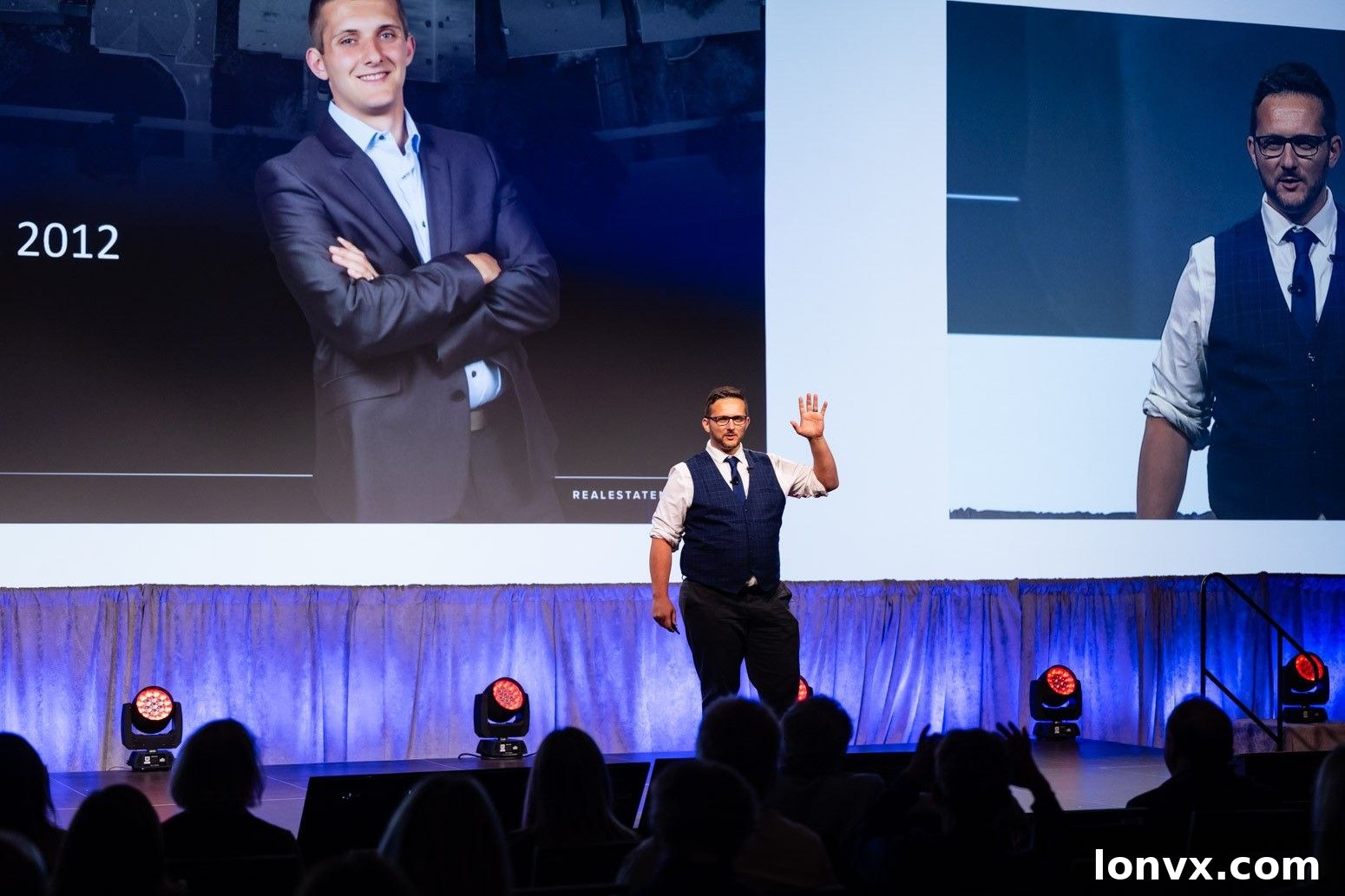
People ask me about this all the time. They see someone onstage, think “I could do that,” and want to know how it really works.
So here it is: the honest version. Not the glamour of having your name on the banner as the keynote, but the long, unglamorous build that makes that possible.
There’s a ladder, and you climb it
Almost nobody starts at the top. There’s a ladder, and everyone climbs the same one. You usually begin as a panelist, then earn a breakout session, then a main-stage slot, and eventually—if you put in the work—you become the keynote.
That last rung requires real focus. It doesn’t happen because you want it; it happens because an organizer trusts you with the biggest moment of their event, the one their entire audience came for. Keep that ladder in mind as you read on—most of the advice below is about how to climb one more rung.
Your first yes is closer than you think
Often it’s your own brokerage or a firm in your network.
Offer to run a training session for the agents in your office on something you genuinely know well. That’s the on-ramp. You get reps, become comfortable in front of a room, and start to discover what you’re actually good at—something you can’t fully know until you’ve done it a few times.
That’s how you get on the ladder. Nobody hands you a large stage before you’ve stood on a small one.
Before you climb, be honest about which kind of speaker you are
This is one most people overlook.
Events generally want two kinds of speakers. The first type draws an audience—people buy tickets because that name is on the bill. The second type may be unknown but delivers such a great experience that the audience feels they got their money’s worth.
Some speakers aren’t incredible onstage but sell tickets and can figure out delivery later. Others are lesser-known but blow the room away. Most of us start in that second camp and have to earn our way toward being a draw.
Be honest about where you stand because it determines everything downstream: how you pitch, which events will say yes, and what you can charge. Pretending you’re a draw when you’re not just prices you out of the rooms that would actually build your name.
Speak about what you actually know
Present on topics you know cold and have a real point of view. Then decide what you want to be known for.
A common mistake: people pitch with “tell me what you need, I can speak on anything.” That gets you nowhere. It hands the work back to the organizer, who now has to invent your talk for you.
Have clear, defined pitches. Know how to deliver each one in 20, 30, 45, and 60 minutes, because events give different time windows and “I only have a 60-minute version” is not the answer they want to hear.
There are actually two ladders
Before we talk fees, be clear about why you speak—money isn’t the only reason people do this.
Some people speak to give back and never charge. Some use talks to drive referrals—the talk itself isn’t the payday; relationships in the room are. For many agents, the financial return comes months later as business, so speaking for free can be a deliberate strategy. Others simply love the stage and that energy is their return.
Know your reason, because it changes what “getting paid” means and whether a free gig is a loss or an investment.
There’s another point few mention: the career ladder and the money ladder don’t move in sync.
When you’re starting out you may not command fees, and that’s normal. Think about the host: if someone profits from an event, they’re more likely to pay speakers. Smaller community events may not have budget, and that’s not a slight.
Pay climbs its own rungs. Some events won’t cover travel or even give a ticket. Others comp tickets, some cover travel, and eventually some pay fees. I started at zero—no fee, sometimes not even a ticket. My first paid engagement was $500 after I’d offered to speak for free. Today I charge up to $10,000 for engagements and sometimes more as part of broader packages.
In the Canadian market, fewer events exceed $5,000 and opportunities thin out above that. If you want consistent speaking revenue in real estate, you’ll likely need to pursue U.S. events eventually.
If you sell services, your upfront fee may vary depending on potential backend revenue. I’ve accepted unpaid gigs when the room was full of ideal clients and charged premiums when there was no chance of backend return.
Be creative: if an event lacks budget, ask if you can find a sponsor for your talk. Some companies may pay to have their logo on slides or a brief thank-you—only do this with the event’s approval.
The unwritten rules
Most hosts don’t want direct selling from the stage, especially those paying you. Ask what you’re allowed to offer. If you’re an agent, that may be referrals. If you can’t pitch from the stage, offer downloadable slides or a follow-up resource so you can continue the conversation afterward.
Treat event staff like gold. They talk. Be the easy speaker everyone appreciates. Be difficult and you’ll get labeled a “diva,” and booking you again becomes harder. People in this industry talk more than you think.
On travel: a flat amount you book yourself is often best because you control flight times and hotel location. Not every event allows this—work with their policies. Event planning is already stressful; don’t make it harder.
Have everything organizers ask for ready so they never have to chase you: headshot, bios, and any pronunciation guides if your name is uncommon. They’ll appreciate it.
Be the easiest speaker in the building
This is the engine that moves you up the ladder: give overwhelming value to the audience and be the easiest speaker to work with. Do both consistently and much of the rest takes care of itself.
Part of being easy is being prepared. If possible, do a walkthrough beforehand. Check with AV that your slides load and advance properly. Ask whether anything about your talk could make their job easier. Walk the stage and get a feel for it; if you wear heels, test the surface and watch for gaps where a heel can get stuck—discovering that mid-talk is a disaster.
Network with other speakers. They’ll send you more work than anyone else. Speakers are asked for recommendations constantly; if I’ve never seen you speak, I won’t put my name behind you. The speakers who get recommended are the ones others have actually watched perform.
Give it all a home
You need a place to point organizers and referrers.
If you’re serious, create either a standalone site or a dedicated page on your existing site where an organizer can find everything in one spot: who you are, what you speak on, your headshot and bio, and clips and testimonials that prove you can deliver. Organizers want to see you before they book you—this is where they decide.
It also matters for referrals. When someone asks me, “Who’s good on X?” I want somewhere to send them. No page and you’re counting on me to make your case from memory. A dedicated page makes you referable.
Practice for when it goes wrong
I once attended a boot camp for real estate speakers where day one focused on delivering content and day two focused on delivering content while everything around you falls apart.
Slides failing, mics cutting out, power issues, noisy audience members, hecklers—any of it can happen and eventually will. Practice for that chaos because the day it shows up is not the day to improvise your reaction.
Fun fact: the highest-rated talk I ever gave was a live demo showing how to build Facebook ads at a large event, and the internet failed completely. If I hadn’t trained for disruption, I would have fallen apart.
If you ever must cancel (which should be rare), show up with a suggested replacement speaker. They might not accept it, but you’ll have made their life easier.
You have to keep working at it
I consider myself a good speaker now, but being truly great is a long road. The best speakers obsess over cadence, pauses, and phrasing. Some can run a talk ten times and nail it identically. I’m still climbing toward that and prefer to be honest about it.
Some final lessons I’ve learned:
- Some people are excellent panelists but only okay on the main stage. That’s fine—panels are valuable and audiences love them. You may find your main-stage niche is fireside chats rather than solo keynotes.
- Breakout rooms are about tactical value and takeaways; main stages can lean more motivational. Know which room you’re in and tailor your talk accordingly.
- Collect stories. They land your points better than bullets and stick with people long after slides are gone.
- Collect testimonials, clips, and reels. Organizers want to see you before they book. Make that easy.
It’s normal to be nervous
Nervousness is normal and never fully disappears. Don’t wait for it to vanish. Unlike school, the room isn’t hoping you fail—people are rooting for you. Remember that you’re there for a reason and the nerves become easier to carry.
The real path
That’s it: panelist, breakout, main stage, keynote. Climb the career ladder, let the money ladder catch up, and don’t confuse the two.
Be useful. Be easy. Keep getting better.
Where to start
Here’s a first move you can do today: write down three things that move the needle in your business—topics that make other agents lean in and ask questions. That’s the spine of your first talk.
Map it out, then ask your broker if you can teach it to the office. If you don’t have access to a room, find a Zoom session, local board, mastermind, or online group that will host you. There are always options. Your first yes is closer than you think—you just have to ask for it.
If you’re already on the road and want to compare notes, I’m always happy to talk shop.