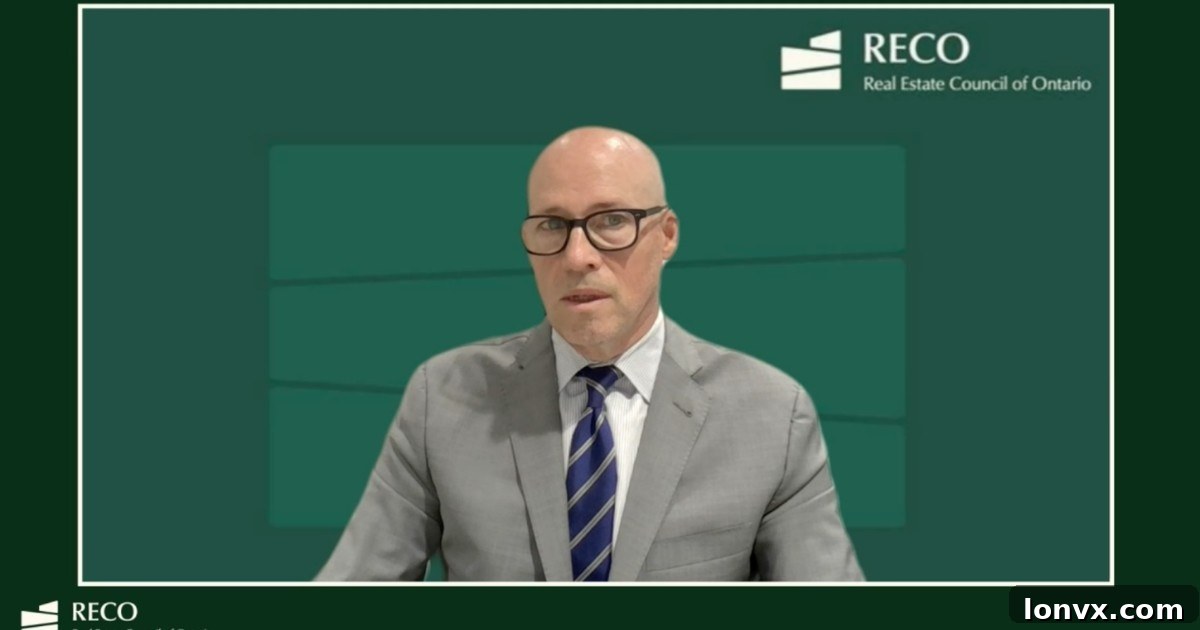
A screenshot of RECO’s administrator Jean Lépine during Thursday’s AGM.
Four of the five members of the interim Real Estate Council of Ontario (RECO) board have now been confirmed. The newly assembled board brings together experienced leaders with backgrounds in governance, finance, safety and energy regulation, reflecting a deliberate emphasis on independence, professional expertise and consumer protection.
At the regulator’s annual general meeting on Thursday, government-appointed administrator Jean Lépine — who held decision-making authority for the event — approved a motion to elect three board members. The selection follows Minister’s Orders issued in April to reset RECO’s governance after the trust account failures at iPro Realty Ltd., and aims to restore public confidence and strengthen oversight of Ontario’s real estate sector.
Who are the new board members?
RECO says the candidates were chosen through an independent recruitment process supported by executive search firm Boyden Canada. The three elected members begin staggered terms designed to provide continuity as the interim board moves toward full operation.
Colin Shaw was elected to a four-year term. RECO’s meeting materials describe Shaw as a governance educator and former chief audit executive with more than 30 years of leadership experience in highly regulated organizations. His past roles include senior positions with OMERS, CIBC, Canadian Tire, PwC and American Express Bank of Canada. He also currently holds board leadership roles with national and community organizations, which contribute to his governance and accountability expertise.
Josie Erzetic will serve a three-year term. Erzetic has spent more than three decades in senior executive roles across regulation, public safety, energy sector oversight, legal affairs and stakeholder engagement. She currently serves as president and CEO of the Electrical Safety Authority and is recognized for leading complex organizational transformations and strengthening regulatory frameworks.
Jennifer Quaglietta was elected for a two-year term. RECO highlighted her experience in guiding organizations through strategic and digital modernization, regulatory renewal and operational change. As CEO and registrar of Professional Engineers Ontario, Quaglietta has been advancing a modernization agenda focused on public trust, regulatory effectiveness and organizational performance.
Minister’s appointment
Minister Stephen Crawford named lawyer J. Mark Rodger as chair for a two-year term. Rodger is a senior partner at Borden Ladner Gervais LLP with deep experience in commercial and regulatory matters related to electricity and natural gas markets, and he has served on the boards of major corporations in multiple provinces.
The minister will appoint one more member to complete the five-person interim board, which will assume full responsibilities no later than Dec. 1. A later transition to a full nine-member board is planned, with further details to be determined as the interim board establishes priorities and timelines.
Where do agents fit in?
One of the central concerns raised at the AGM was how practicing real estate professionals will be represented under the new governance model. The interim board, following the Minister’s Orders, excludes active RECO registrants from serving as voting board members. The rationale is to separate the regulator’s governance from the regulated community to preserve impartial oversight and reduce conflicts of interest.
Lépine told attendees this structure is intended to strengthen independent decision-making and enhance public confidence. He emphasized the distinction between governing the regulator and providing input to it, saying that registrants can and should continue to influence regulatory initiatives without occupying governance roles.
To ensure registrants’ perspectives remain visible, the Minister’s Orders require RECO to establish a renewed industry advisory council by January 2027. That council will serve as a formal mechanism for those working in the field to provide expertise, raise operational concerns and advise the regulator on policy and implementation issues.
Operating with a “structural deficit”
RECO reported a deficit of $691,000 for 2025, a significant change from the $6.85 million surplus recorded in 2024. The regulator attributes much of the revenue decline to a reduction in registrant fees that took effect in March 2023; RECO estimates the fee decision will amount to roughly $30 million in foregone revenue by the end of this year. Registration fees remain the largest source of operational income and fell by about eight per cent last year.
The 2026 budget projects an operating deficit of $12.4 million (excluding the registrant insurance program), to be covered using reserves. Administrator Lépine acknowledged the financial strain and said addressing long-term fiscal sustainability is a priority.
When asked after the AGM whether fee increases are under consideration, RECO responded that ensuring financial sustainability is essential to fulfilling its regulatory mandate. The regulator indicated it continually reviews operational costs and revenue models but had no specific fee changes to announce at the time of the meeting.
The interim board’s immediate tasks include stabilizing governance, restoring trust following the iPro Realty Ltd. trust account failures, implementing the advisory mechanisms required by the Minister’s Orders, and developing a financial plan that preserves regulatory capacity while protecting consumers and registrants alike.