A Decade of Transformation: Unpacking Canada’s Single-Family Home Price Evolution (2013-2023)
Canada’s dynamic real estate landscape has undergone an extraordinary evolution over the last decade, marked by profound shifts driven by a confluence of economic, demographic, and global factors. From 2013 to 2023, the market has navigated through significant interest rate adjustments, volatile economic climates, a notable surge in immigration, and the unprecedented impact of a global pandemic. Amidst these changes, one consistent trend has emerged as a defining characteristic of this era: the relentless ascent of single-family home prices across the nation.
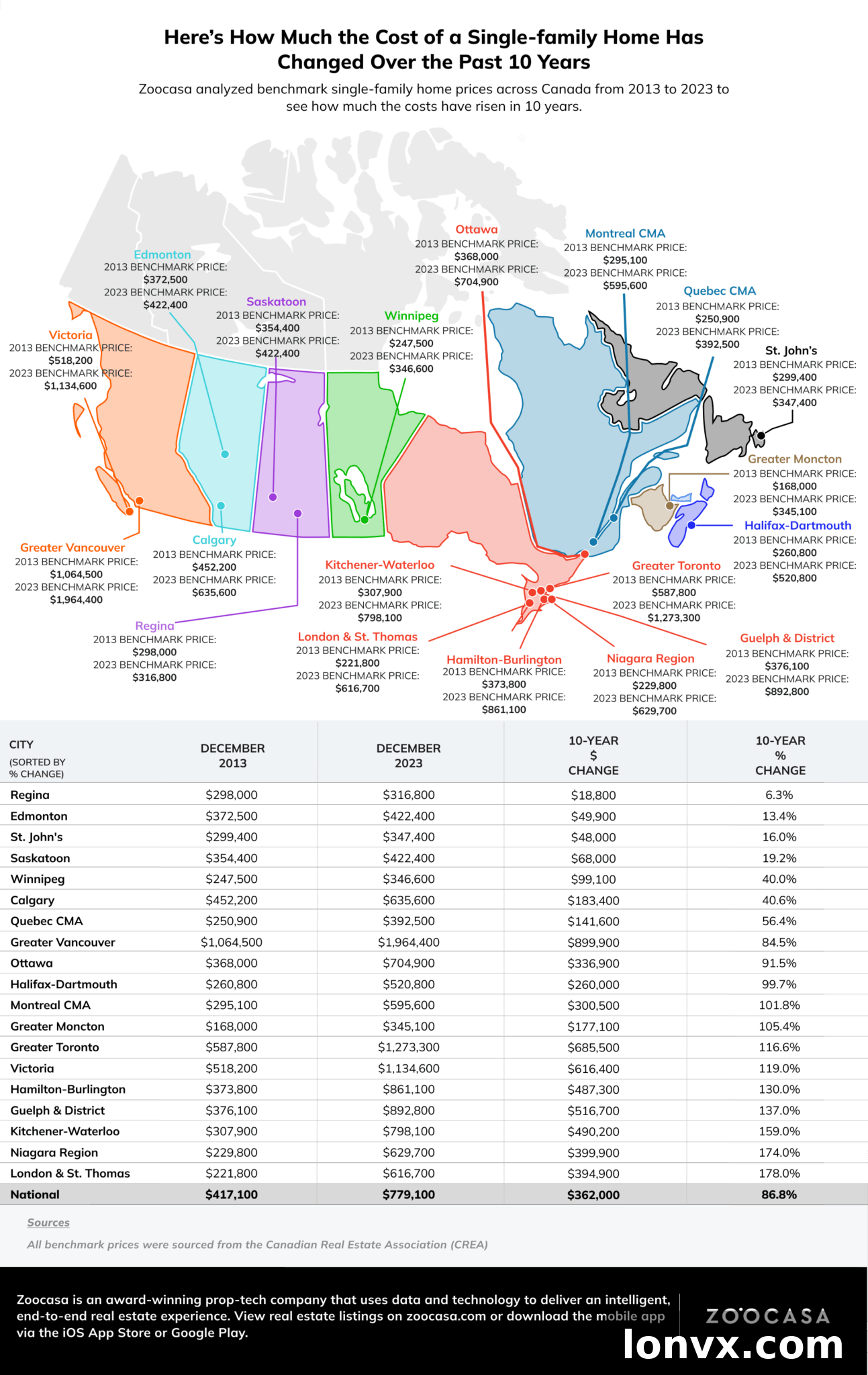
Indeed, the benchmark single-family home price in most Canadian urban centers has nearly doubled within this ten-year span, representing a staggering 86.8 percent increase. This remarkable growth underscores a fundamental transformation in Canadian homeownership, affecting millions of citizens and reshaping the economic fabric of communities nationwide. To delve deeper into these shifts, Zoocasa meticulously analyzed single-family home prices across 19 major Canadian cities during this pivotal period, uncovering substantial price appreciation, with cities in Southern Ontario demonstrating the most explosive growth.
Southern Ontario: A Hotbed of Real Estate Growth
The Southern Ontario region stands out as the undisputed leader in single-family home price appreciation over the past decade. This area, known for its economic vitality and strategic location, has witnessed monumental increases that have fundamentally altered its housing market. The data paints a clear picture of unparalleled demand and a robust market characterized by rapid value escalation.
Leading the Charge: London & St. Thomas
At the forefront of this impressive growth are London & St. Thomas, which topped the list with an astonishing 178 percent increase in benchmark single-family home prices. A home valued at approximately $221,800 in 2013 skyrocketed to an average of $616,700 by 2023. This explosive growth can be attributed to several factors, including its growing reputation as a desirable mid-sized city offering a balance of urban amenities and relative affordability compared to larger metropolitan areas. The expansion of remote work capabilities during the pandemic further amplified its appeal, drawing buyers seeking more space and value.
Niagara Region and Kitchener-Waterloo: Riding the Wave
Close behind, the Niagara Region and Kitchener-Waterloo also experienced substantial price increases, with 174 percent and 159 percent growth respectively. These areas have become increasingly attractive alternatives for buyers priced out of the highly competitive Greater Toronto Area (GTA) market. The ongoing trend of GTA residents relocating to more affordable, yet still well-connected, markets has been a primary driver. Kitchener-Waterloo, in particular, benefits from a burgeoning tech industry and two major universities, attracting a steady stream of talent and investment. The Niagara Region, with its scenic beauty and growing tourism sector, offers a unique lifestyle appeal that has also contributed to its housing boom.
Guelph & District: Significant Gains Beyond the GTA Core
Outside of the immediate GTA, Guelph & District recorded the largest absolute price increase, an impressive $516,700. This growth underscores Guelph’s attractiveness as a vibrant community with a strong local economy and excellent quality of life. While the GTA itself saw an even larger absolute increase of $685,500, pushing its single-family home prices past the $1,000,000 mark for the first time—with the current benchmark sitting at a formidable $1,273,300—Guelph’s performance highlights the widespread nature of the Southern Ontario housing surge. The GTA’s relentless appreciation is a testament to its status as a global financial hub, a magnet for immigration, and a region with persistent housing supply challenges.
The Prairies: A Beacon of Stability in a Volatile Market
In stark contrast to the rapid appreciation seen in Southern Ontario, cities across the Prairies have demonstrated remarkably stable price growth over the past decade. This regional divergence highlights the varied economic drivers and demographic pressures influencing Canada’s diverse housing markets.
Modest Gains in Regina, St. John’s, and Edmonton
Regina, for example, exhibited the most stable price growth with a modest increase of $18,800 over the decade. This steadiness reflects a market less susceptible to the speculative surges experienced elsewhere, often characterized by more balanced supply-demand dynamics and an economy heavily influenced by resource sectors. St. John’s and Edmonton found themselves in similar situations, experiencing respective 10-year price jumps of $48,000 and $49,900. While these increases are significant for homeowners, they pale in comparison to the exponential growth seen in Central and Western Canada, offering a greater degree of affordability and predictability for residents.
Greater Vancouver: High Prices, Strong Growth
Despite having the highest benchmark price in the entire country at a staggering $1,964,400, Greater Vancouver experienced an 84.5 percent increase in single-family home prices over the past 10 years. This figure, while substantial, is slightly below the national average percentage increase, largely because its starting base price was already exceedingly high in 2013. Vancouver’s market is unique, driven by geographic constraints, strong international demand, a thriving tech industry, and a reputation for unparalleled quality of life. The continuous demand coupled with limited land supply ensures its position as one of the world’s most expensive housing markets, even if its percentage growth rate during this period was outpaced by some Southern Ontario cities starting from a lower baseline.
The Rising Tide of Mortgage Payments: A Key Affordability Challenge
The decade’s dramatic increase in home prices has been further compounded by significant shifts in mortgage rates, creating a substantial burden for many Canadian homeowners and aspiring buyers. The report highlights a critical trend: five-year fixed mortgage rates have predominantly risen over the past decade, especially in the latter half of the period, influenced by central bank efforts to combat inflation.
Staggering Increases for Homeowners
This dual impact of higher home values and elevated interest rates has led to a dramatic escalation in monthly mortgage payments. Homeowners in many Southern Ontario cities, in particular, are now facing substantially higher bills in 2023 compared to what they paid in 2013. This creates a significant challenge for household budgets, impacting disposable income and consumer spending.
To illustrate the magnitude of this change, consider the example of a typical London homeowner. In 2013, their monthly mortgage payment would have been approximately $999. Fast forward to 2023, and that same homeowner is now likely facing a payment of around $3,407 per month. This more than threefold increase reflects not only the substantial rise in benchmark home prices but also the significant shift in borrowing costs. Such an increase represents a major financial adjustment for families, potentially limiting their ability to save, invest, or spend on other necessities. For new homebuyers, qualifying for a mortgage under these conditions has become significantly more challenging, often requiring larger down payments and higher household incomes to pass stringent stress tests.
This scenario underscores a broader affordability crisis gripping many parts of Canada. While existing homeowners who purchased before the major price surge may have seen their equity grow, they are now confronted with higher renewal rates. New buyers, however, face an uphill battle, often needing to compromise on location, property type, or defer homeownership altogether. The implications extend beyond individual finances, potentially influencing demographic trends, urban planning, and the overall health of the Canadian economy.
Looking Ahead: Navigating Canada’s Evolving Housing Market
The past decade has undeniably reshaped Canada’s real estate landscape, moving from a period of relatively accessible homeownership to one defined by intense competition and significant affordability challenges in major urban centers. The rapid appreciation in Southern Ontario, contrasted with the more stable growth in the Prairies, illustrates a geographically diverse market influenced by distinct economic conditions and demographic pressures. The persistent rise in home prices, coupled with increasing mortgage rates, has put immense pressure on household finances, making the dream of homeownership more elusive for many.
As we move forward, understanding these historical trends is crucial for policymakers, developers, and potential homebuyers alike. Future market dynamics will likely continue to be shaped by interest rate policies, population growth, government initiatives aimed at increasing housing supply, and evolving work patterns. Addressing housing affordability remains a paramount challenge, requiring innovative solutions and a concerted effort to ensure a balanced and sustainable housing market for all Canadians. Whether the next decade will bring a continuation of these trends or a significant market correction remains a subject of intense debate, but the lessons from the last ten years highlight the profound and often unpredictable nature of real estate.
For a complete and detailed analysis, you can read the full report here.