Coober Pedy: Unearthing Life in the Australian Outback’s Underground City
Deep within the sun-baked plains of South Australia lies Coober Pedy, a town unlike any other, globally renowned as the “Opal Capital of the World.” Here, the traditional concept of a home is turned literally on its head, as approximately half of its vibrant community chooses to live beneath the surface in remarkable dwellings known as “dugouts.” This subterranean lifestyle is not a novelty but a deeply ingrained tradition, born from a century-long pursuit of precious opal and an ingenious adaptation to one of Earth’s most challenging environments.
Coober Pedy’s very existence is intertwined with the discovery of opal in 1915. Early miners quickly realized that working under the unforgiving desert sun was untenable, leading them to seek refuge and shelter within the earth itself. This pragmatic solution evolved into a distinctive way of life, where the harsh realities of the Outback paved the way for a hidden world of comfort and tranquility.
The Genesis of Subterranean Living in Coober Pedy
The decision to build underground was initially a matter of survival. The searing summer temperatures and surprisingly cold winter nights of the Australian desert presented formidable obstacles to surface living. Miners, often living in rudimentary conditions, discovered that their prospecting shafts could be expanded into simple, cool, and quiet living spaces. This early innovation laid the groundwork for the unique architectural style that defines Coober Pedy today.
From Humble Beginnings to Modern Marvels: The Evolution of Dugouts
What began as small, one-room shelters carved out directly from opal mining shafts has blossomed into sophisticated underground homes. The early dugouts were often rudimentary extensions of the mine itself, providing basic shelter. However, as the town grew and technology advanced, so too did the complexity and comfort of these subterranean residences. Today, many dugouts are meticulously designed and constructed by excavating directly into hillsides using state-of-the-art tunneling machines. These modern methods allow for the creation of expansive, multi-room dwellings that seamlessly blend practicality with an extraordinary aesthetic.
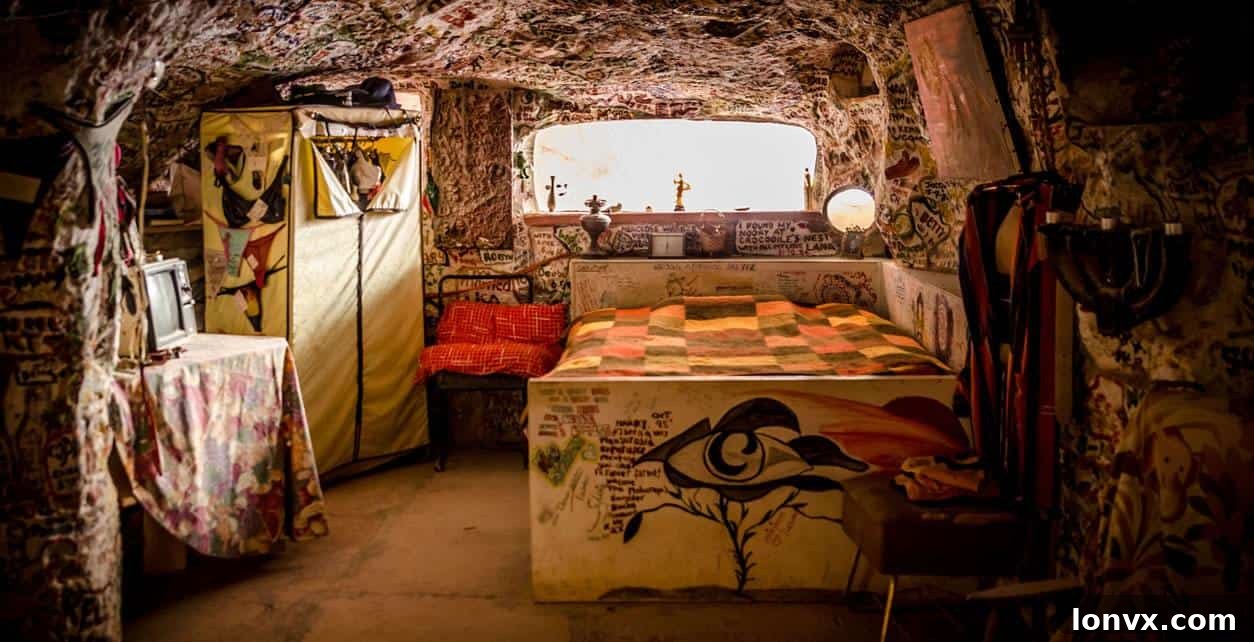
The interior of a local inhabitant’s dugout. (Photo by Diane Slawych)
The interiors of these unique homes are a testament to human ingenuity and a striking connection to the earth. The tunneling machinery leaves a distinctive, often ribbed, pattern on the rose-colored sandstone walls, creating a naturally textured and visually appealing finish. To manage the omnipresent dust of the desert environment, a clear sealer is meticulously applied to walls and other surfaces, ensuring a clean and durable living space. One of the most remarkable features of a dugout is its inherent flexibility: when additional storage, shelving, or even an entirely new room is needed, homeowners simply pick up their tools and dig another hole in the wall. Ventilation is ingeniously managed through vertical shafts that extend from the dugout up to the surface, their tops often seen protruding discreetly from the hillsides, serving as silent sentinels of the homes below.
The geology of Coober Pedy plays a crucial role in enabling this underground architecture. The local sandstone is ideally suited for subterranean construction; it is robust and stable enough to support vast ceiling spans, allowing for surprisingly spacious rooms and open-plan living areas. This stability also facilitates further expansion, making it common for families to acquire adjacent properties and tunnel through to connect two or more dwellings, creating sprawling underground estates. Some of these intricate homes can extend up to an impressive 500 square meters beneath the surface, offering ample space for living, entertaining, and even operating businesses.
A Historical Imperative: Escaping the Elements
The adoption of underground living is often attributed to soldiers returning from the trenches of France after the First World War. Familiar with subterranean shelters, they brought this practical knowledge to Coober Pedy. Local miners quickly recognized the immense advantages of living underground, primarily as an escape from the extreme climatic conditions. The desert environment presents a relentless cycle of scorching summer days, where temperatures can soar past 40 degrees Celsius, and surprisingly cool winter nights. Above ground, maintaining a comfortable temperature requires significant energy and infrastructure. Below ground, the earth itself acts as a natural insulator, providing a stable and pleasant environment year-round, making underground living not just a preference, but a practical and sustainable solution.
Coober Pedy’s Challenging Landscape and the Comforts Below
For those accustomed to verdant landscapes, Coober Pedy can be a stark visual departure. Situated on the fringes of the Stuart Ranges, the town’s surface environment is largely a sand and stone landscape, sparsely populated with vegetation. This semi-desert climate is characterized by its harshness: summer temperatures are frequently scorching, often exceeding 40°C (104°F), and strong winds are common. With little plant life to anchor the soil, the surface environment can be incredibly dusty, adding another layer of challenge to daily life above ground.
However, beneath this uninviting exterior lies a peaceful and stable retreat. One of the most compelling advantages of living in a dugout is the remarkable consistency of the internal temperature. Regardless of the extreme fluctuations outside, underground rooms maintain a comfortable and even temperature, typically ranging from 23°C to 25°C (73°F to 77°F) day and night, throughout all seasons. This stands in stark contrast to surface dwellings, which struggle against the elements, or even basements in other parts of the world, which can often be cold, damp, or prone to mold. In Coober Pedy, the earth provides a natural, energy-efficient climate control system, making the dugouts a truly comfortable haven.
The Unparalleled Benefits of Underground Living
Beyond the thermal stability, dugouts offer several other profound benefits. The thick earth walls provide exceptional sound insulation, creating an environment of profound quietness. External noise simply doesn’t penetrate, offering residents and visitors an unparalleled sense of peace and tranquility. It’s not uncommon for guests staying in underground hotels to remark on the “best night’s sleep I’ve ever had,” attributing it to the serene silence. This natural soundproofing is a significant draw, particularly for those seeking refuge from the hustle and bustle of modern life.
A room at the Desert Cave Hotel looks much like a bedroom in an average Coober Pedy home.
Moreover, living underground offers inherent protection from bushfires, severe storms, and even dust storms, which are common in the Outback. This added layer of safety contributes to the peace of mind for residents. The energy efficiency of dugouts is also a significant advantage; the earth’s natural insulation drastically reduces the need for artificial heating and cooling, leading to lower energy consumption and a more sustainable way of life. This ecological benefit aligns perfectly with contemporary concerns for environmentally friendly living, making Coober Pedy a surprisingly forward-thinking example of sustainable architecture.
A Vibrant Underground Community and Its Global Appeal
Coober Pedy’s inhabitants, a diverse group of approximately 3,500 people from over 45 nationalities, form an incredibly close-knit community. This unique blend of cultures has been drawn together by the lure of opal and the shared experience of living in such an extraordinary environment. This camaraderie is evident in the town’s social fabric, which is rich with unique amenities. Reflecting the town’s subterranean inclination, Coober Pedy boasts four churches, several shops, art galleries showcasing local opal and desert art, and fascinating museums – all built underground. A prime example is the Umoona Opal Mine and Museum, which offers visitors a comprehensive insight into the town’s history, geology, and the opal mining process, all from the cool confines of the earth.
The sense of community is further strengthened by shared challenges and triumphs associated with opal mining. Miners often work collaboratively, and the unique conditions foster a resilient and resourceful population. Despite its remote location, Coober Pedy is a place where people rely on each other, creating a supportive and welcoming atmosphere.
Coober Pedy in Pop Culture and Tourism
The distinctive charm of the Australian dugout has not gone unnoticed by the world. Coober Pedy’s unique landscape and lifestyle have provided a dramatic backdrop for several films, cementing its place in popular culture. Perhaps most famously, a renowned local character known as “Crocodile Harry” – an eccentric Finnish miner whose fascinating life was even documented in a *Lonely Planet* guidebook – lived in an elaborate underground home that was prominently featured in the iconic film *Mad Max – Beyond the Thunderdome*. Harry’s dugout, a quirky and captivating maze of rooms filled with his unique artwork and relics, remains a popular tourist attraction today, offering a glimpse into the individualistic spirit of Coober Pedy.
For travelers seeking an unforgettable experience, Coober Pedy is a bucket-list destination. Visitors can explore Crocodile Harry’s fascinating home or, for a more immersive experience, book a night at one of the town’s many underground hotels. Among these is the multi-award-winning Desert Cave Hotel, established in 1987. This pioneering establishment offers guests a choice of 19 exquisitely designed underground rooms and 25 comfortable above-ground rooms, allowing visitors to choose their preferred level of immersion in the subterranean lifestyle. Staying underground provides not just a novel experience, but also the practical benefits of the dugout, including the peaceful quiet and stable temperature, ensuring a remarkably restful stay.
Exploring the “Opal Capital”: Mining and Discovery
The heart and soul of Coober Pedy remain its opal. The town was founded on the promise of this iridescent gem, which was first discovered here by a teenage boy in 1915. Since then, Coober Pedy has become the world’s largest producer of gem-quality opal, particularly white opal, crystal opal, and the highly prized “harlequin” pattern. The arduous process of opal mining has shaped the town’s identity, its economy, and the very landscape around it, with countless mullock heaps (piles of excavated earth) dotting the horizon, testament to generations of relentless digging.
Visitors to Coober Pedy have the unique opportunity to learn about this fascinating industry firsthand. Numerous opal shops and galleries display the dazzling array of local finds, while guided tours into active or disused opal mines offer a glimpse into the challenging and often rewarding work of the opal miner. It’s a chance to understand the intricate geological processes that create these beautiful stones and to appreciate the dedication of the miners who unearth them.
Planning Your Visit to Coober Pedy
Visiting Coober Pedy is an adventure into a truly unique corner of the world. Beyond the dugouts and opal mines, the town offers several other distinct attractions. The incredible underground Serbian Orthodox Church, complete with carved domes and stained-glass windows, is a marvel of subterranean architecture. The world’s only underground drive-in cinema, a relic of a bygone era, occasionally opens for special screenings. The local golf course is unique for having no grass at all, requiring golfers to carry a piece of turf with them for teeing off.
To truly appreciate Coober Pedy, one must embrace its quirks and its remoteness. It’s a place where resourcefulness meets community, where the harshness of the environment is countered by human ingenuity, and where the promise of iridescent beauty lies just beneath the surface. From its challenging beginnings to its status as a global attraction, Coober Pedy continues to fascinate and inspire.
Conclusion: Coober Pedy – A Testament to Human Ingenuity
Coober Pedy stands as a remarkable testament to human resilience and adaptation. What might appear at first glance as an inhospitable landscape has been transformed into a thriving, vibrant community through sheer ingenuity and a profound connection to the earth. The dugouts are more than just homes; they are a symbol of sustainable living, cultural diversity, and a unique response to environmental challenges. As the “Opal Capital,” Coober Pedy continues to draw dreamers, miners, and tourists alike, inviting them to experience a world where life beneath the surface is not just possible, but wonderfully comfortable, quiet, and utterly unforgettable.