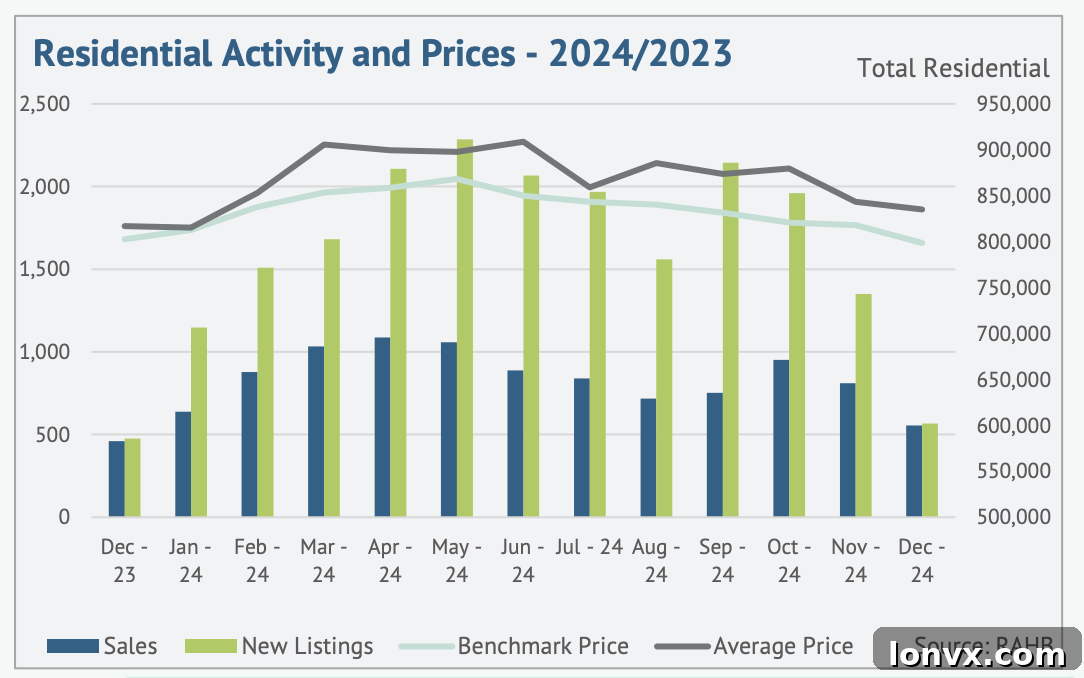
The year 2024 presented significant challenges for the real estate sector, particularly within the dynamic Hamilton-Burlington market. According to the Cornerstone Association of Realtors (CAR), the persistent environment of higher interest rates coupled with broader economic uncertainties cast a shadow over market activity. Total sales for 2024 reached 10,210 transactions, a figure consistent with 2023 levels but notably 26 percent below long-term market trends. This downturn reflects a period of adjustment as both buyers and sellers grappled with shifting financial landscapes and a cautious economic outlook.
Navigating the Hamilton-Burlington Real Estate Market: A Comprehensive 2024 Review and 2025 Outlook
The Impact of Interest Rates and Economic Headwinds on 2024 Sales
The initial months of 2024 were characterized by a palpable slowdown in real estate activity across the Hamilton-Burlington region. Central bank policies aimed at curbing inflation led to a prolonged period of elevated interest rates, directly impacting mortgage affordability and dampening buyer enthusiasm. This environment created a cautious atmosphere, causing many potential purchasers to delay their homeownership plans. The spring selling season, typically a bustling period, experienced significantly slower sales compared to historical averages, contributing to the overall subdued transaction volume for the year.
Economic uncertainty, ranging from inflationary pressures to geopolitical events, further compounded the challenges. Consumers faced higher costs of living, making significant financial commitments like home purchases seem daunting. This collective hesitancy meant fewer homes changing hands, pushing total sales figures below the historical long-term averages that typically define a robust market. For many, the decision to enter the housing market became a delicate balance between necessity and financial prudence.
A Glimmer of Hope: Renewed Buyer Confidence Emerges Late in the Year
Despite the tough start, the Hamilton-Burlington real estate market began to show signs of resilience and recovery towards the latter half of 2024. As the year progressed, there was a noticeable easing in interest rates, which acted as a catalyst for renewed buyer interest. This shift in monetary policy, even if gradual, significantly improved affordability for a segment of the market, encouraging previously hesitant buyers to re-evaluate their positions.
Nicolas von Bredow, Cornerstone spokesperson for the Hamilton-Burlington market area, highlighted this positive trend in a recent press release. “As interest rates have begun to trend downward, some homebuyers are taking advantage of the opportunity to enter the market while there is still a good selection of homes available,” he stated. This observation points to a critical turning point where improved lending conditions, combined with a healthier inventory, started to restore confidence among potential purchasers.
The “gradual” pace of return underscores a market that is cautiously optimistic rather than experiencing an explosive rebound. Buyers are becoming more confident, not just because rates are easing, but also because they perceive a more balanced market where they have more choice and less pressure than during the intense bidding wars of previous years. This newfound confidence is crucial for sustaining a recovery and setting a more predictable trajectory for the upcoming year.
Source: Cornerstone Association of Realtors (CAR)
Unpacking Supply and Demand: A Shifting Landscape Favors Buyers
One of the most significant developments in the Hamilton-Burlington real estate market during 2024 was the substantial improvement in housing supply. Von Bredow noted that the association consistently observed an increase in new listings and overall inventory throughout the year, with over 3,000 units available for sale for the majority of the period. This surge in supply represents a pivotal shift from the tight market conditions experienced in prior years, where demand far outstripped available homes.
The increase in inventory was not limited to specific niches; it was widespread across all property types, including detached homes, townhouses, and condominiums, and extended across most price ranges, notably including more affordably priced products. This broader selection provided buyers with more options, reduced competitive bidding scenarios, and offered more time for informed decision-making. For sellers, however, it meant increased competition and potentially longer market times for their properties.
This trend of improved supply choice has been ongoing since 2023, and its continued presence in 2024 has had a direct impact on home prices. A more balanced market, where supply better meets demand, naturally moderates price appreciation or, in some cases, leads to modest price adjustments. The Hamilton-Burlington market exemplifies this dynamic, moving away from the extreme seller’s market conditions towards a more normalized environment where buyers have greater leverage.
Price Trends: A Nuanced Perspective Beyond the Headlines
While headlines might suggest a steep decline in home prices, a closer look at the data provided by CAR reveals a more nuanced picture for the Hamilton-Burlington region. The average benchmark price in 2024 experienced a nearly 1.0 percent annual decline. However, this adjustment must be understood in the context of the extraordinary highs witnessed during the pandemic-driven real estate boom.
Crucially, CAR emphasizes that these declines are relative to the peak prices observed in previous years. Despite the modest dip in 2024, the average benchmark price remains consistent with 2021 levels. Furthermore, it stands 9.0 percent higher than the 2020 average annual benchmark price of $651,425. This indicates that while the market has softened from its unsustainable peak, it has not crashed. Instead, it has undergone a healthy correction, stabilizing at levels that are still significantly appreciated compared to pre-pandemic times.
For long-term homeowners, this means their equity gains from the past few years largely remain intact. For new buyers, the combination of slightly lower prices and easing interest rates offers a window of opportunity to enter the market at more manageable affordability levels than just a year or two ago. This stabilization of prices, coupled with increased inventory, sets the stage for a more sustainable and predictable real estate market moving forward.
Review the full report here.
Looking Ahead: Navigating the 2025 Real Estate Horizon in Hamilton-Burlington
As the Hamilton-Burlington real estate market transitions from the challenges of 2024, the outlook for 2025 appears to be one of cautious optimism and continued adjustment. The trends observed in late 2024—easing interest rates, increasing buyer confidence, and a more balanced supply—are expected to carry forward and shape the market dynamics of the new year. Economists and real estate experts are closely watching for further central bank decisions regarding interest rates, as any additional cuts could provide a significant boost to housing demand and affordability.
The sustained improvement in housing supply is likely to keep the market from overheating, preventing the return of aggressive bidding wars seen during the peak pandemic frenzy. This environment offers a more favorable setting for buyers, providing ample choice and enabling them to negotiate more effectively. For sellers, understanding the current market dynamics, including realistic pricing strategies and strategic home staging, will be paramount to achieving successful outcomes.
Moreover, factors such as population growth, continued migration to the Hamilton-Burlington area, and local economic development initiatives will continue to underpin long-term demand for housing. While 2025 may not see a return to the explosive growth rates of past years, it is anticipated to be a period of steady activity, potentially leading to gradual price appreciation and increased transaction volumes as market confidence solidifies further. Both buyers and sellers are advised to stay informed about local market statistics and work with experienced real estate professionals to navigate the evolving landscape effectively.
Conclusion: A Year of Transition and Resilience for Hamilton-Burlington Real Estate
In retrospect, 2024 stands out as a pivotal year for the Hamilton-Burlington real estate market. It was a period defined by significant adjustments, primarily driven by the twin forces of high interest rates and economic uncertainty, which led to a notable dip in transaction volumes compared to long-term averages. However, the year also demonstrated the market’s underlying resilience and capacity for adaptation, particularly with the emergence of renewed buyer confidence towards the end of the year as interest rates began their descent.
The improvement in housing supply, offering more choice across various property types and price points, played a crucial role in stabilizing the market. This increased inventory, combined with a moderation in prices from their pandemic highs, has created a more balanced and accessible market for prospective homeowners. While the annual decline in benchmark prices was marginal, it reflected a healthy correction rather than a collapse, bringing values back to more sustainable levels relative to pre-pandemic growth.
Looking forward, the insights from the Cornerstone Association of Realtors paint a picture of cautious optimism for 2025. With potential further easing of interest rates and a market that is better supplied and more transparent, the Hamilton-Burlington real estate landscape is poised for a period of more stable and predictable growth. This comprehensive review underscores that understanding these nuanced shifts is key for anyone involved in the region’s dynamic property market.