
The Canadian real estate market is currently navigating a period of cautious optimism, a sentiment eloquently captured in the latest report from the Canadian Real Estate Association (CREA). June’s data, much like May’s, paints a picture of subtle shifts rather than dramatic upheavals, reflecting a market that is slowly finding its footing amidst a landscape of economic uncertainty. This isn’t the loud, unmistakable rebound often seen in real estate cycles; instead, it’s a quiet, deliberate movement, akin to testing the waters before committing to a full plunge.
For two consecutive months, Canada’s housing sector has shown incremental gains in sales volume, yet prices have remained largely flat. This nuanced trajectory suggests a market in a state of suspended animation, patiently awaiting clearer signals. Buyers, acutely aware of ongoing economic risks, geopolitical tensions, and potential tariff threats, continue to exercise considerable caution. In many Canadian markets, this cautious approach has empowered buyers, placing them firmly in the driver’s seat and allowing them to leverage their position in what has become a more balanced environment.
This period demands a strategic approach from all participants. Sellers are adjusting expectations, while buyers are conducting thorough due diligence. The prevailing wisdom is clear: patience and informed decision-making are paramount. As the market slowly thaws, the underlying currents of supply and demand are subtly reshaping local conditions, creating a patchwork of opportunities and challenges across the vast Canadian landscape. Understanding these evolving dynamics is crucial for anyone looking to navigate the contemporary Canadian housing market successfully.
The Measured Pace of Canada’s Housing Rebound
The journey towards recovery in the Canadian housing market began to show tangible signs in May, breaking a six-month decline in national home sales with a modest 3.6% increase. June continued this trend, reporting another incremental gain of 2.8%. These back-to-back increases, though slight, are significant indicators that activity, previously suppressed by economic jitters and political shifts, is gradually flowing back into the system. This consistent, albeit gentle, upward trend suggests a foundational shift, moving away from the prolonged slump experienced earlier in the year.
It is important to clarify the nature of this rebound. We are primarily observing a recovery in sales volume, not necessarily a resurgence in home prices. In fact, sales volume often strengthens when prices become more accessible, as affordability improves for a broader spectrum of potential buyers. The basic economic principle holds true: when homes are more affordable, more people are inclined and able to purchase them, thereby boosting transaction levels. This straightforward relationship is a key driver behind the current market’s trajectory.
Leading this cautious resurgence is the Greater Toronto Area (GTA), which has seen its transaction volume rebound by a cumulative 17.3% since April. While impressive, this revitalization merely nudges the region out of historically subdued territory. It’s less of a booming market and more of a measured return of confidence, reflecting a slow but steady re-engagement from buyers who had previously remained on the sidelines. The GTA’s performance is often a bellwether for the national market, and its current pace suggests that while stability is returning, exuberance remains in check.
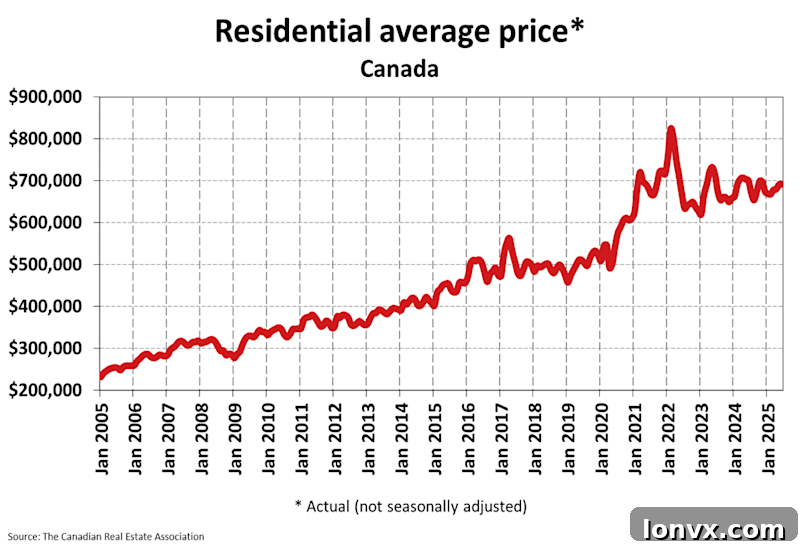
Nationally, the average home sale price in June held remarkably steady at $691,643, a near carbon copy of May’s $691,299. This stability reinforces the narrative that while prices have largely stopped their downward slide, they are not yet poised for significant appreciation. Year-over-year, the national average remains 1.3% lower, a more moderate decline compared to the 1.8% drop observed the month prior. This deceleration in year-over-year price depreciation further underscores the market’s transition from active cooling to a period of consolidation, where price stability is becoming the new norm, albeit a fragile one.
Understanding Market Dynamics: Balance and Regional Divergence
CREA’s latest Canadian housing market report describes a national picture that appears balanced, suggesting neither buyers nor sellers hold a decisive advantage. However, this national average masks a rich tapestry of wildly varied local conditions. It is a fundamental truth that “the Canadian real estate market” is a misnomer; what truly exists is a collection of distinct local markets, each telling its own unique story driven by specific economic, demographic, and geographical factors. The old adage “location, location, location” remains as pertinent as ever, highlighting why market experiences can differ so dramatically from one province or city to another. While headlines might focus on challenges in major urban centers like British Columbia and Ontario, many other regions are experiencing entirely different market realities.
Decoding Buyer’s vs. Seller’s Markets
To accurately gauge the balance of power in any real estate market, two key indicators are universally employed: the sales-to-new-listings ratio and months of inventory. These metrics provide clear insights into whether supply is meeting, exceeding, or falling short of demand.
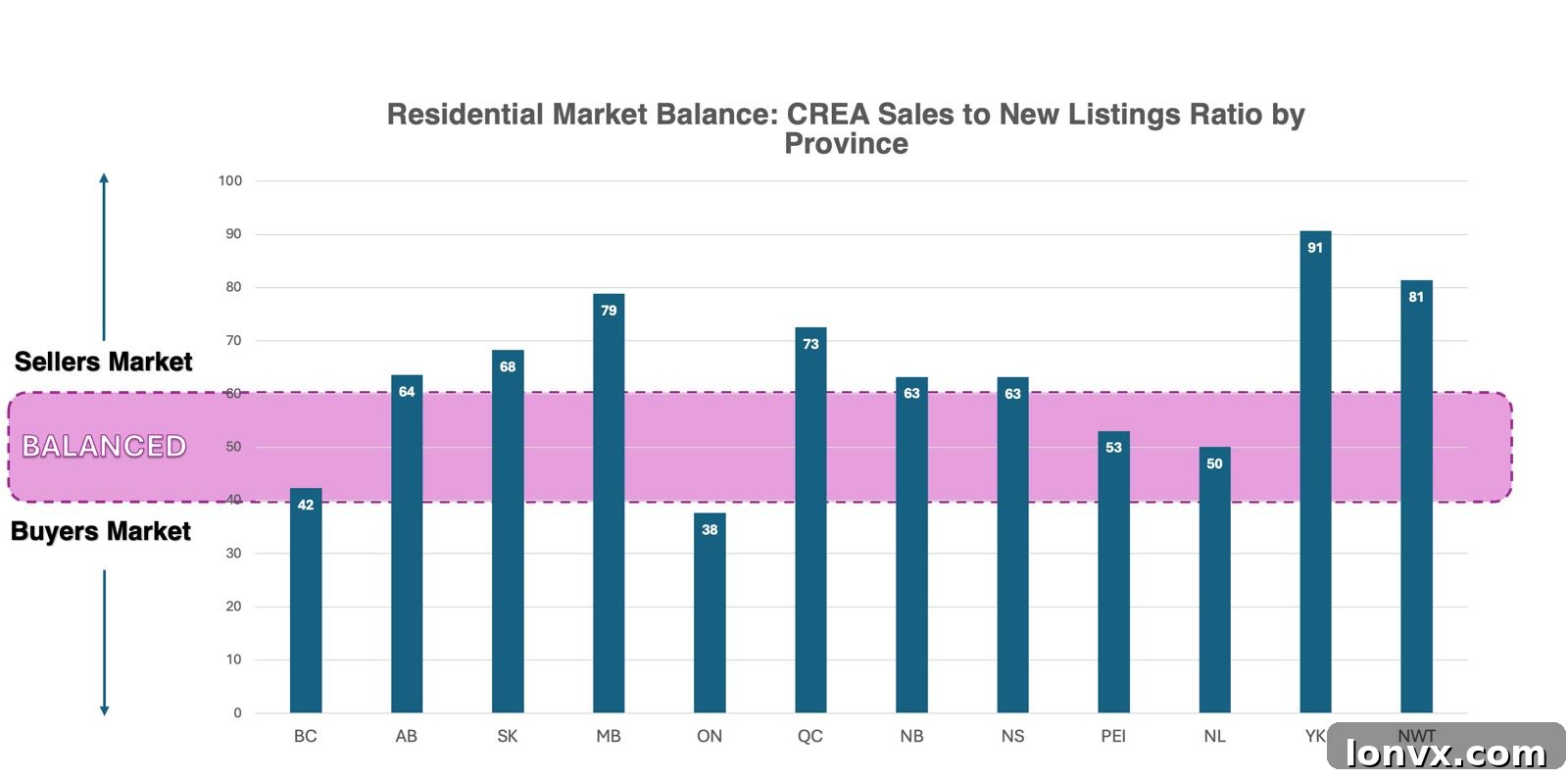
A buyer’s market materializes when the supply of homes significantly outstrips demand. In such conditions, buyers enjoy a wider selection of properties and possess greater leverage in negotiations. This advantageous position for buyers typically occurs when the sales-to-new-listings ratio dips below 45% or when the months of inventory—representing the time it would take to sell all currently listed homes at the present sales pace—rises above 6.4 months. Buyers in these markets can take their time, compare multiple options, and often secure more favorable terms.
Conversely, a seller’s market emerges when demand overwhelms the available supply. In this scenario, sellers hold the upper hand, as buyers often find themselves competing for a limited pool of listings. This competitive environment leads to quicker sales and potentially higher prices. A seller’s market is indicated when the sales-to-new-listings ratio climbs above 65% or when months of inventory drops below 3.6 months. In these regions, buyers often need to act swiftly and decisively to secure a property.
A balanced market, where neither buyers nor sellers dominate, typically falls within these thresholds. It’s a dynamic equilibrium where negotiation is key, and pricing aligns more closely with fair market value.
The Current Landscape Across Canada
Delving into the regional data provides a clearer picture of these diverse market conditions. For instance, in Ontario, a sales-to-new-listings ratio of 38% unmistakably points to a robust buyer’s market. This implies an abundance of inventory and intensified competition among sellers, affording buyers the luxury of time for negotiation and a broad array of properties to choose from. Vancouver echoes this trend, also favoring buyers who are finding more opportunities and less pressure. These conditions enable strategic purchasing decisions, a stark contrast to the heated markets of previous years.
In contrast, many other Canadian provinces are experiencing ratios greater than 65%, firmly placing them in seller’s market territory. In these regions, the housing supply is tighter, prompting buyers to act with greater urgency to avoid missing out on desirable properties. Such disparity highlights the importance of local market knowledge. What might be a challenging environment for sellers in one province could be a boom for them in another, emphasizing that a generalized “Canadian real estate trend” can often be misleading without looking at specific geographical nuances.
Supply Dynamics: Demand Picks Up as Listings Slow
A significant development in the June Canadian real estate market was the 2.9% dip in newly listed properties. This decline comes after several months of increasing supply, which had previously provided buyers with greater negotiating power, particularly in Canada’s major urban centers. The combined effect of rising sales and fewer new listings has caused the national sales-to-new-listings ratio to edge upwards to 50.1% from 47.3% in May. This shift indicates a gradual tightening of market conditions, albeit still within what is generally considered a balanced range nationally.
Despite this recent moderation in new listings, overall inventory levels across Canada remain comfortable. By the end of June, a total of 206,435 properties were listed for sale, representing an 11.4% increase compared to the same period last year. This figure is also just one percent below the long-term seasonal average, suggesting that while the market is absorbing more properties, there’s still a healthy selection available for buyers.
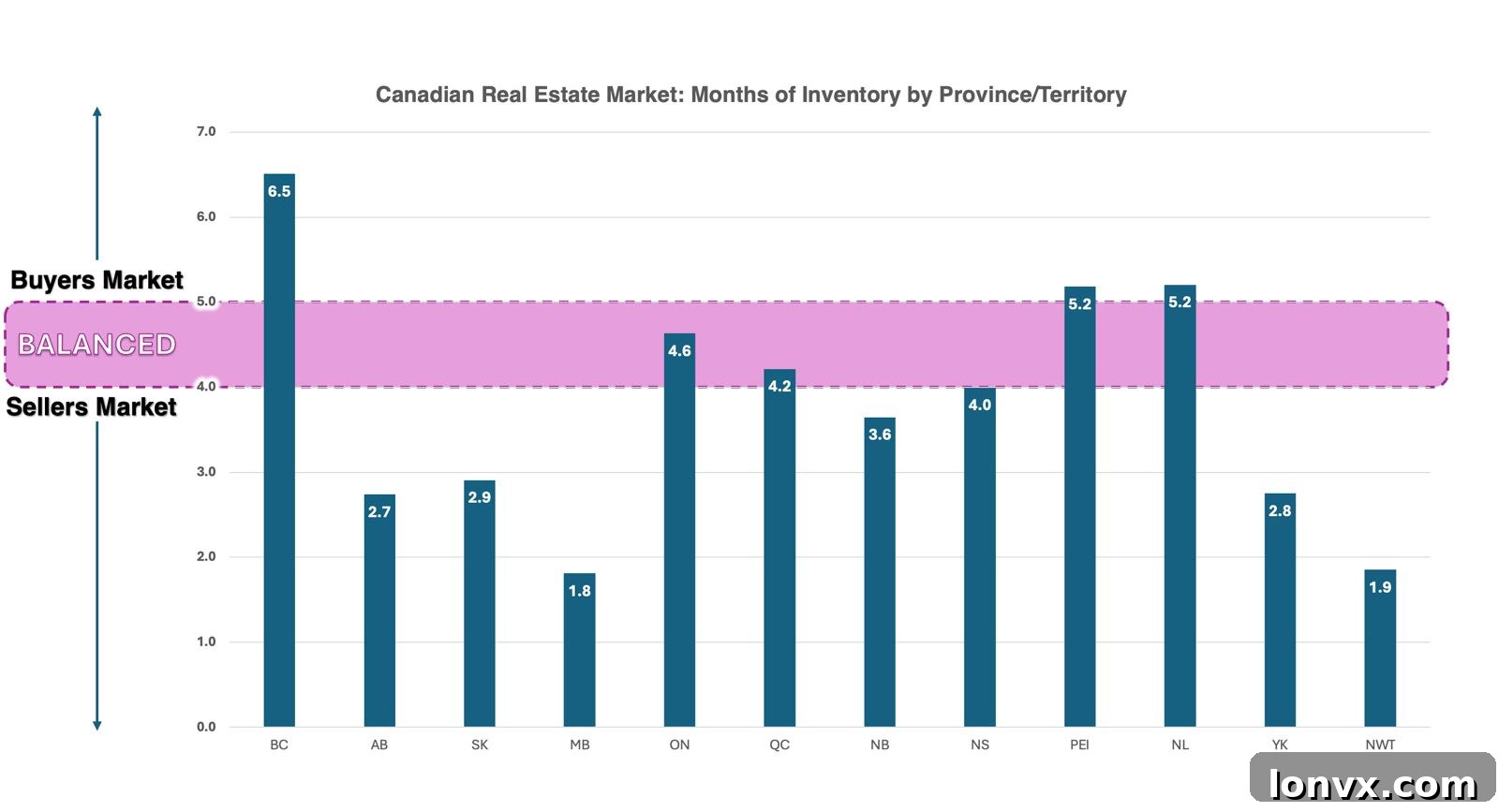
The “months of inventory” metric provides further granular insight into market balance. Nationally, there are 4.7 months of inventory available, which is slightly below the long-term norm of five months. This national average again belies significant regional variations. Provinces like Alberta and Manitoba are firmly entrenched in seller’s territory, with exceptionally tight inventory levels of 2.7 and 1.8 months, respectively. This scarcity drives competition and quicker sales. Conversely, British Columbia, with 6.5 months of inventory, leans towards a buyer-friendly market, offering more choice and negotiation opportunities. These provincial differences are critical for understanding local market dynamics and for making informed decisions whether buying or selling.
Home Prices: Stability with Lingering Fragility
After three consecutive months earlier in the year saw near one percent price drops, the Canadian real estate market has experienced a welcome pause in recent months. The MLS Home Price Index (HPI) slipped by a marginal 0.2% from May to June, signaling that the rapid depreciation of home values has largely stabilized. This flatlining suggests a period of price consolidation, where market forces are working to establish new baseline values rather than pushing for further significant drops or gains.
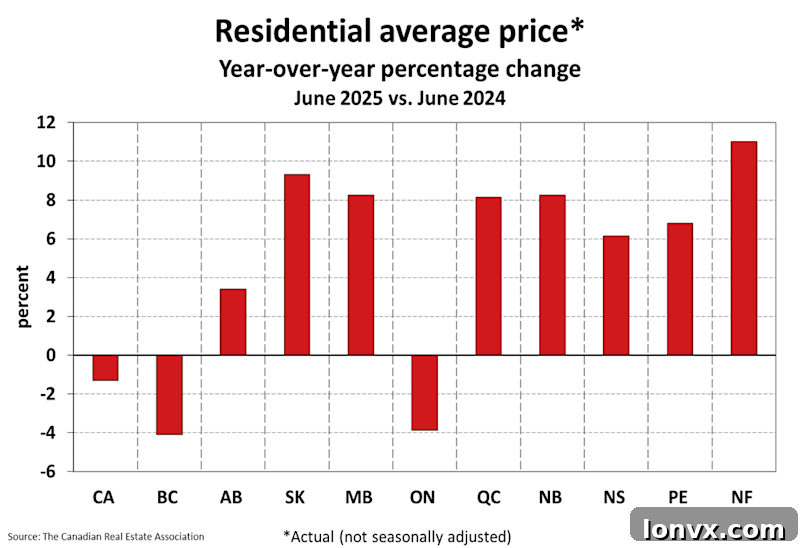
However, beneath this national stability, regional price performance continues to diverge significantly, underscoring the fragmented nature of the Canadian housing market. Provinces such as Saskatchewan, Manitoba, and Newfoundland have all posted impressive year-over-year gains, ranging from 8% to 12%. These robust increases are often driven by stronger local economies, sustained demand, and comparatively affordable entry points. In these regions, sellers are often finding themselves in advantageous positions, sometimes fielding multiple offers for desirable properties.
In contrast, Ontario and British Columbia, two of Canada’s most populous and historically expensive provinces, have continued to experience declines, with home prices dropping by approximately 4% year-over-year. For buyers in major metropolitan areas like Vancouver or Toronto, this translates into a noticeable shift in leverage. They are now negotiating in markets where conditions have moved in their favor, offering more room to maneuver on price and terms. This uneven pattern reinforces the critical importance of local context; a blanket assessment of the Canadian housing market would fail to capture the distinct experiences of buyers and sellers across different regions.
The Age of the Measured Move in Real Estate
The current state of the Canadian real estate market is far removed from the frenzied activity of recent boom cycles, characterized by rushed deals and overextended buyers. Equally, it is not the frozen landscape of earlier downturns where transactions stalled. Instead, we have entered what can be best described as a “negotiation market.” In this environment, strategic thinking unequivocally trumps speed, and comprehensive knowledge holds far more weight than sheer bravado.
Today’s active buyers are increasingly analytical and discerning. They are meticulously comparing properties, diligently calculating value propositions, and demonstrating a readiness to walk away if terms do not align with their perceived value. This methodical approach reflects a newfound empowerment among purchasers. On the other side of the transaction, sellers are also adapting. They are testing the market with more realistic pricing strategies and approaching sales with restrained optimism, understanding that overpricing in a negotiation market can deter potential buyers and prolong listing times.
This advantageous window for buyers, however, may not remain open indefinitely. Several factors could trigger a shift. A significant easing of interest rates later in the year, for example, could unleash a considerable wave of pent-up demand. If sidelined buyers, who have been patiently waiting for more favorable financing conditions, decide to re-enter the market in force, especially heading into the autumn, the current negotiating room could rapidly shrink. Therefore, while buyers currently hold an advantage, strategic action now could prove beneficial before market dynamics potentially shift once more.
What Comes Next for the Canadian Housing Market
June’s CREA data, consistent with the trends observed in May, does not signal a runaway market on the verge of a dramatic upturn. Instead, it reinforces a theme that has been steadily building over recent months: the return of discipline and thoughtfulness to the Canadian housing market. This period marks a pivotal moment where both buyers and sellers are compelled to engage with greater precision and careful consideration, moving away from the impulsive decisions that characterized previous market highs.
As highlighted in my May op-ed, “Pent-Up Demand: Buyers Are in No Rush,” this particular phase of Canadian real estate inherently rewards those who prioritize precision over haste. The past two months have only deepened this lesson, emphasizing that success in the current environment stems from informed strategy, diligent research, and a clear understanding of local market nuances. Whether you are looking to buy your first home, sell an existing property, or invest in real estate, the current climate demands a measured approach. Consulting with local real estate professionals who possess deep market knowledge is more crucial than ever to navigate these intricate and evolving conditions successfully and make decisions that align with long-term goals.