
The British Columbia real estate market opened 2023 with a notable recalibration, as economic pressures continued to influence buyer activity and property values. According to the latest report from the British Columbia Real Estate Association (BCREA), January 2023 witnessed a substantial decrease in residential unit sales across the province’s Multiple Listing Service (MLS), reflecting a market in transition from the frenetic pace of previous years. This comprehensive overview delves into the key findings from the BCREA, examining the implications for sellers, potential buyers, and the broader economic landscape of British Columbia.
British Columbia Real Estate Market Faces Significant Adjustment in Early 2023
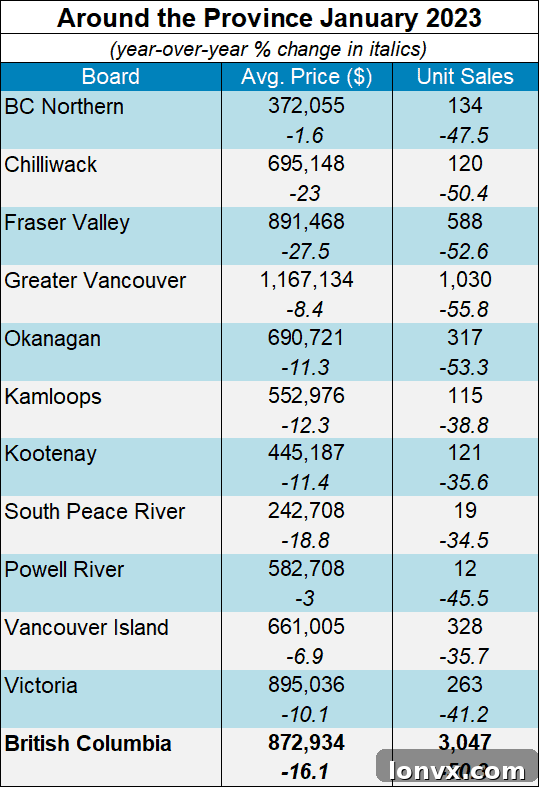
January 2023 marked a pivotal period for the British Columbia housing market, with the British Columbia Real Estate Association (BCREA) reporting a significant contraction in sales activity. A total of 3,047 residential unit sales were recorded in MLS, a sharp decline of 50.3 per cent when compared to the robust activity seen in January 2022. This substantial year-over-year decrease underscores a pronounced shift in market dynamics, moving away from the peak conditions observed just twelve months prior. The cooling trend is a direct response to a confluence of economic factors, prompting a more cautious approach from both prospective buyers and sellers.
Alongside the reduction in sales volume, the average residential price in B.C. experienced a notable adjustment. In January 2023, the average price dipped to $872,934, representing a 16.1 per cent decrease from the average price of over $1 million recorded in January 2022. This earlier figure was near the apex of the market’s historic surge, making the current decline a significant indicator of price correction. While a 16.1% drop may seem steep, it reflects a necessary market correction, bringing prices more in line with affordability metrics after a period of unprecedented growth.
The cumulative effect of reduced sales and lower average prices resulted in a total sales dollar volume of $2.7 billion for January. This figure signifies a considerable 58.3 per cent decrease year-over-year, highlighting the dramatic deceleration in market momentum. The overall economic impact of this reduction extends beyond the real estate sector itself, potentially influencing related industries such as construction, lending, and retail, all of which benefit from a vibrant housing market.
Chief Economist Pinpoints Key Drivers Behind the Market Shift
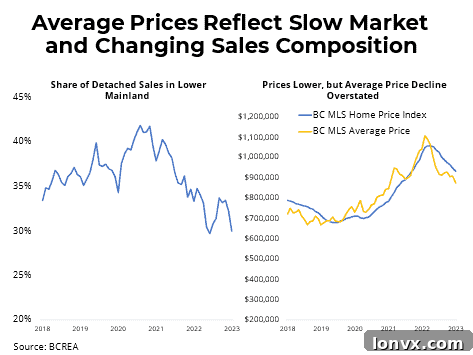
Brendon Ogmundson, the chief economist for BCREA, offered critical insights into the underlying causes of this market adjustment. He attributes the decline primarily to two significant factors: high borrowing costs and a noticeable shift in the composition of sales towards more affordably priced homes. The Bank of Canada’s aggressive interest rate hikes throughout 2022 have made mortgages significantly more expensive, directly impacting buyer purchasing power and confidence. This has, in turn, led many potential homeowners to either delay their purchasing decisions or to seek out properties in lower price brackets.
In a recent news release, Ogmundson elaborated on the pricing trends, stating, “While average prices have flattened out in many markets over the past few months, year-over-year measures reflect the decline that occurred from the peak in 2022…” This distinction is crucial for understanding the current state of the British Columbia housing market. While month-over-month price changes might show stabilization or even minor increases in some areas, the year-over-year comparison clearly illustrates the extent of the correction from the extraordinary highs of early 2022. The “peak” of 2022 serves as a high benchmark, making current average prices appear more significantly reduced in comparison.
The shift in the composition of sales is also a vital element. As borrowing costs rise, the pool of buyers able to afford high-value properties shrinks. This naturally directs demand towards entry-level homes, condominiums, and properties in less expensive regions or suburbs. Such a compositional change can inherently pull down the overall average sale price, even if prices for specific property types or in certain micro-markets haven’t seen an equivalent percentage drop. This indicates a more resilient demand in the lower and middle segments of the market.
Understanding the Evolving Landscape of Housing Inventory
The supply side of the British Columbia real estate market presents a nuanced picture. While the total number of active listings has “significantly increased” compared to the record low levels observed in 2022, BCREA reports that inventory remains a challenge. At just under 22,000 listings province-wide in January, the total stock of homes for sale is still below the average for a typical January. This paradoxical situation arises from a scarcity of new listings entering the market, particularly in many of B.C.’s vibrant urban centers and popular regions.
The increase in active listings predominantly stems from homes remaining on the market for longer periods, rather than a surge of new properties becoming available for sale. Sellers who were once in a highly advantageous position might now be holding back, waiting for more favorable market conditions to return, or adjusting their price expectations. This reluctance to list new properties creates a bottleneck, preventing the market from achieving a truly balanced state. A lack of fresh inventory can perpetuate competitive bidding for desirable properties, even amidst a general slowdown in sales.
The scarcity of new listings is a critical factor influencing market dynamics. It suggests that while buyers may have more options than during the peak frenzy of 2022, the overall supply has not yet caught up to historical averages needed to truly alleviate price pressures or to give buyers abundant choice. This creates a complex environment where some properties linger, while others, particularly those well-priced and in prime locations, might still attract multiple offers. This delicate balance between active listings and the dearth of new properties highlights the evolving nature of the BC housing market.
Source: BCREA
Broader Economic Context and Future Outlook for BC Real Estate
The current state of the British Columbia real estate market cannot be viewed in isolation. It is intrinsically linked to broader macroeconomic conditions, both nationally and globally. The Bank of Canada’s monetary policy, specifically its efforts to combat inflation through interest rate hikes, remains the primary driver of higher borrowing costs. As long as inflation remains elevated, the likelihood of significant rate reductions in the near future appears low, suggesting that high borrowing costs will likely continue to temper buyer demand for the foreseeable future.
Consumer confidence also plays a pivotal role. Economic uncertainty, potential recessionary fears, and the rising cost of living have made potential buyers more hesitant to commit to major investments like homeownership. This cautious sentiment, combined with the stringent mortgage stress test requirements, creates significant barriers for many, particularly first-time homebuyers. The provincial economy’s resilience, driven by sectors like technology, natural resources, and trade, will be critical in supporting a eventual rebound in the real estate sector.
Looking ahead, the British Columbia real estate market is expected to remain in a period of adjustment. While the dramatic declines seen in year-over-year comparisons may moderate as the market stabilizes, a return to the peak conditions of early 2022 is not anticipated in the short to medium term. Economists generally predict a more balanced market, where sellers may need to adjust their expectations regarding pricing and sales timelines. For buyers, this period presents opportunities for negotiation and a less frenzied purchasing experience, provided they can manage the elevated borrowing costs.
Regional variations within British Columbia will also be important to monitor. While the BCREA report provides a provincial aggregate, real estate is inherently local. Markets in major metropolitan areas like Vancouver and Victoria, which experienced significant price growth, might see continued adjustments, while more affordable regions or those benefiting from specific economic developments could show greater resilience or even modest growth. Understanding these localized nuances will be key for anyone participating in the BC housing market.
Implications for Buyers, Sellers, and Real Estate Professionals
For prospective homebuyers in British Columbia, the current market environment offers a distinct change from the bidding wars and rapid escalations of the past. There is now more time for due diligence, property inspections, and thoughtful decision-making. However, navigating higher interest rates requires careful financial planning and a robust understanding of personal affordability limits. Working closely with mortgage professionals to secure pre-approval and understand various financing options is more crucial than ever.
Sellers, on the other hand, need to adapt their strategies to a more competitive landscape. Realistic pricing, professional staging, and effective marketing are paramount. The days of multiple unconditional offers might be less frequent, and sellers should be prepared for longer listing periods and potential negotiations. Understanding recent comparable sales in their immediate area, rather than relying on peak market values, will be essential for successful transactions.
Real estate professionals in British Columbia are adapting to these evolving conditions by enhancing their advisory roles. Providing accurate, up-to-date market intelligence, guiding clients through complex financial considerations, and demonstrating strong negotiation skills are becoming increasingly valuable. The shift towards a more balanced market underscores the importance of expertise and strategic guidance for all participants.
In conclusion, the British Columbia real estate market’s January 2023 performance highlights a significant and ongoing adjustment. Driven by high borrowing costs and a shift in demand, the market is undergoing a necessary recalibration from its previous highs. While inventory challenges persist in certain segments, the overall trend points towards increased buyer leverage and a more stable, albeit slower, transactional environment. As the year progresses, all stakeholders will need to remain agile and informed to navigate the evolving landscape of the BC housing market effectively.