
British Columbia’s housing market is currently navigating a period of significant adjustment, with industry experts forecasting a challenging year for 2023 before a robust resurgence takes hold in 2024. This outlook, provided by the British Columbia Real Estate Association (BCREA), offers a detailed glimpse into the province’s real estate landscape, highlighting the intricate interplay of economic factors, demographic shifts, and market sentiment.
Navigating British Columbia’s Dynamic Housing Market: A 2023-2024 Forecast Overview
The BCREA’s 2023 First Quarter Housing Forecast Update paints a picture of two distinct halves for the immediate future of BC real estate. While the current year is expected to see a contraction in sales activity and a stabilization of prices, the stage is being set for a powerful recovery. This forecast is crucial for potential buyers, sellers, investors, and policymakers, providing invaluable insights into market dynamics and future trends across British Columbia.
The Ebb and Flow of Sales: A Challenging 2023 Paving the Way for 2024 Recovery
According to the BCREA, residential sales in British Columbia are projected to experience a notable decline of 7.1 per cent in 2023, settling at approximately 75,150 units. This anticipated slowdown is largely attributed to a combination of persistent economic headwinds and elevated mortgage rates that have significantly impacted buyer affordability and overall market confidence. The Bank of Canada’s aggressive rate-hiking campaign throughout 2022 and early 2023 has led to higher borrowing costs, effectively sidelining a segment of potential purchasers and causing others to adopt a wait-and-see approach. Furthermore, broader economic uncertainties, including inflation and the potential for a mild recession, have contributed to a more cautious market environment. First-time homebuyers, in particular, face increased barriers to entry, while existing homeowners may be hesitant to upgrade or downsize due to higher financing costs.
However, this period of contraction is expected to be relatively short-lived. BCREA economists are forecasting a substantial rebound in 2024, with residential sales predicted to surge by an impressive 23.8 per cent, reaching an estimated 93,025 units. This optimistic outlook is underpinned by several key factors. Chief among these is the anticipated decline in mortgage rates, which is expected to restore a significant degree of purchasing power and affordability to the market. As inflation potentially moderates and central banks begin to ease monetary policy, borrowing costs should become more manageable, reigniting buyer demand. Additionally, record levels of immigration into British Columbia are poised to inject substantial momentum into the housing market. Newcomers to the province consistently drive demand across both rental and ownership segments, and with Canada’s ambitious immigration targets, this demographic factor will be a powerful catalyst for growth, particularly in urban centres and surrounding communities. The cumulative effect of these tailwinds is expected to translate into a much more active and competitive market environment throughout 2024.
Unpacking Inventory Levels: A Persistent Challenge Amidst Shifting Demand
One of the most critical aspects influencing British Columbia’s housing market is the ongoing issue of inventory levels. While the BCREA notes that inventory has seen an increase since the beginning of 2022, it remains notably low when compared to historical averages. This situation is particularly striking given the sharp decrease in sales volume experienced over the same period. Typically, a significant drop in sales would lead to a more substantial accumulation of available homes, providing buyers with more choice and potentially easing price pressures. The fact that inventory remains constrained, even with reduced demand, underscores a deeper, structural challenge within the BC housing supply.
This persistent scarcity of listings has several implications. For buyers, a limited selection means continued competition, particularly for desirable properties or in popular neighbourhoods, even if overall market activity is subdued. It can also lead to a mismatch between what buyers are looking for and what is available, prolonging search times and potentially forcing compromises. For sellers, low inventory can provide a floor for prices, preventing steep declines even during periods of lower transaction volume. The underlying reasons for this constrained supply are multifaceted, including a historical underbuilding of new housing units relative to population growth, the slow pace of new construction completions, and a reluctance among some homeowners to list their properties due to economic uncertainty or a lack of suitable replacement housing options. Addressing this fundamental supply imbalance will be key to achieving long-term affordability and market stability in British Columbia.
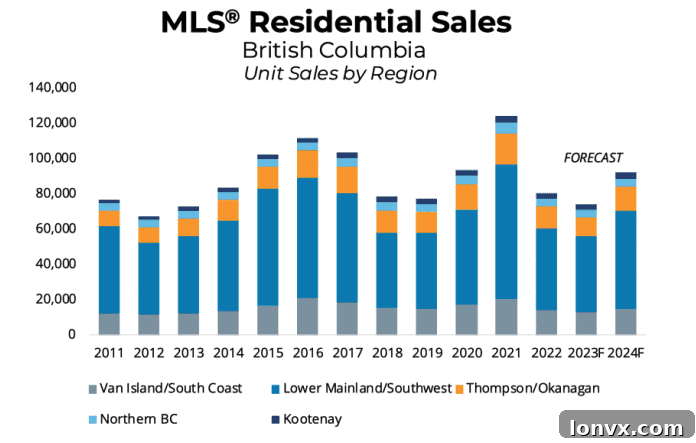
Source: BCREA – Illustrating forecasted residential sales volumes in British Columbia for 2023 and 2024.
Home Price Stability: A Nuanced Picture Through 2023 and Beyond
The BCREA forecasts that home prices across British Columbia will remain “relatively stable” throughout 2023. While this might sound reassuring, it’s essential to understand the nuances of this projection. “Relative stability” in this context implies that while month-over-month price changes may show modest fluctuations, a dramatic collapse in prices is not anticipated. However, year-over-year comparisons are expected to register negative for much of 2023. This means that, when comparing average prices in 2023 to the higher peaks observed in 2022 (before interest rate hikes began to cool the market), the annual growth rate will appear negative. This statistical effect, often referred to as a “base effect,” can create the impression of significant price declines even if the market has merely plateaued or experienced a moderate correction from its previous highs.
Despite these negative year-over-year comparisons, the report anticipates that monthly prices will begin to recover towards the latter half of 2023. This expected recovery aligns with the broader forecast of improving market conditions, including stabilizing interest rates and returning buyer confidence. The underlying demand for housing, fueled by population growth and sustained economic activity in key sectors, combined with limited inventory, acts as a critical buffer against steep price depreciation. As the market transitions into 2024, the momentum from increased sales activity and a more favourable economic environment is expected to translate into more positive price growth, signaling a return to more normalized appreciation trends.
The Expert’s View: Brendon Ogmundson on Economic Headwinds and Future Tailwinds
Brendon Ogmundson, BCREA Chief Economist, provides insightful commentary that encapsulates the association’s forecast. His remarks underline the dual nature of the market’s trajectory, acknowledging both the immediate challenges and the strong potential for future growth.
The Impact of Elevated Mortgage Rates and Economic Slowdown
Ogmundson highlights that “A slowing economy and still elevated mortgage rates are expected to keep housing activity lower than normal through much of 2023.” This statement points to the significant influence of macroeconomic conditions on real estate. Elevated mortgage rates directly impact affordability by increasing the monthly cost of homeownership, thereby reducing the purchasing power of potential buyers. Many buyers find themselves “stress-tested” at higher rates, making it more difficult to qualify for mortgages, even if property prices have seen minor adjustments. The broader “slowing economy” encompasses factors such as high inflation eroding consumer purchasing power, concerns about job security, and general economic uncertainty, all of which contribute to reduced consumer confidence and a hesitation to make large financial commitments like purchasing a home. These factors collectively create a quieter market, characterized by fewer transactions and a more cautious approach from both buyers and sellers.
Record Immigration: A Powerful Catalyst for Future Demand
Looking ahead, Ogmundson expresses strong optimism for 2024, stating, “However, we expect a strong recovery, boosted by an expected decline in mortgage rates and record high immigration that will carry significant momentum into 2024.” The anticipated decline in mortgage rates is a pivotal factor, as it directly alleviates the affordability crunch, allowing more buyers to enter or re-enter the market. Perhaps even more impactful is the role of “record high immigration.” British Columbia, particularly its major urban centres like Vancouver, remains a highly desirable destination for immigrants from around the world. These newcomers, seeking employment, education, and a better quality of life, contribute significantly to population growth and consequently, housing demand. This influx of new residents creates a fundamental and sustained need for housing, whether it be rental units initially or homeownership in the longer term. The demographic tailwind from immigration is a powerful and persistent force that is expected to underpin the resilience and eventual robust recovery of the BC housing market, ensuring continued demand for available properties.
Government Policies and Market Dynamics
It’s also worth briefly considering how various government policies, both provincial and federal, might interact with these market dynamics. Measures such as the foreign buyer ban, speculation and vacancy tax, or first-time homebuyer incentives can subtly influence market behaviour. While they might not be the primary drivers of the overall forecast, they can certainly fine-tune the market’s response to broader economic shifts and demographic changes. Understanding these policy layers provides a more holistic view of the complex factors at play in British Columbia’s real estate landscape.
As the housing market continues to evolve, staying informed with official data and expert analysis is paramount. The BCREA’s forecast serves as a critical resource for anyone involved in or considering entering the British Columbia real estate market. Its comprehensive data and forward-looking analysis offer invaluable guidance.
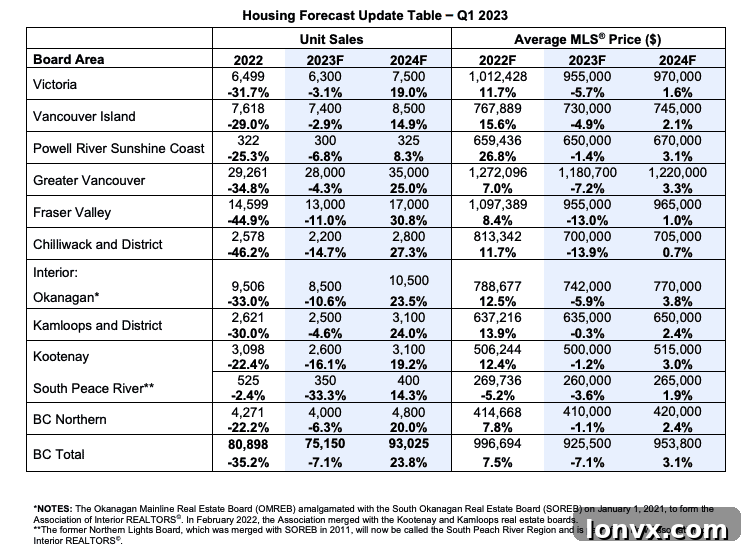
For a comprehensive understanding of the forecast, including detailed regional breakdowns, specific data points, and the full methodology behind these projections, readers are strongly encouraged to consult the original source. The complete report provides a richer context and deeper insights into British Columbia’s diverse real estate segments.Click here to read the full BCREA Housing Forecast Update.
What Lies Ahead: A Look into BC’s Housing Future
In conclusion, British Columbia’s housing market is poised for a significant turnaround, transitioning from a period of challenging conditions in 2023 to a strong recovery in 2024. This cyclical pattern, driven by economic fundamentals, interest rate policies, and demographic forces, underscores the resilience and dynamic nature of BC real estate. While the immediate future demands caution and strategic planning, the long-term outlook remains positive, especially with the sustained impact of high immigration levels and the anticipated easing of borrowing costs. For prospective buyers, this forecast suggests a potentially more favourable environment emerging in the coming year. For sellers, strategic timing and understanding local market nuances will be key. Investors will find opportunities in a recovering market, particularly in sectors supported by ongoing population growth. British Columbia’s housing market will undoubtedly continue to be a focal point of economic activity and public discourse, requiring adaptability and informed decision-making from all participants.