
The dynamic British Columbia housing market is showing encouraging signs of transitioning towards a more balanced state, according to the latest comprehensive statistics released by the British Columbia Real Estate Association (BCREA). After a period of unprecedented activity and subsequent cooling, the market appears to be recalibrating, offering a nuanced landscape for both prospective buyers and sellers across the province.
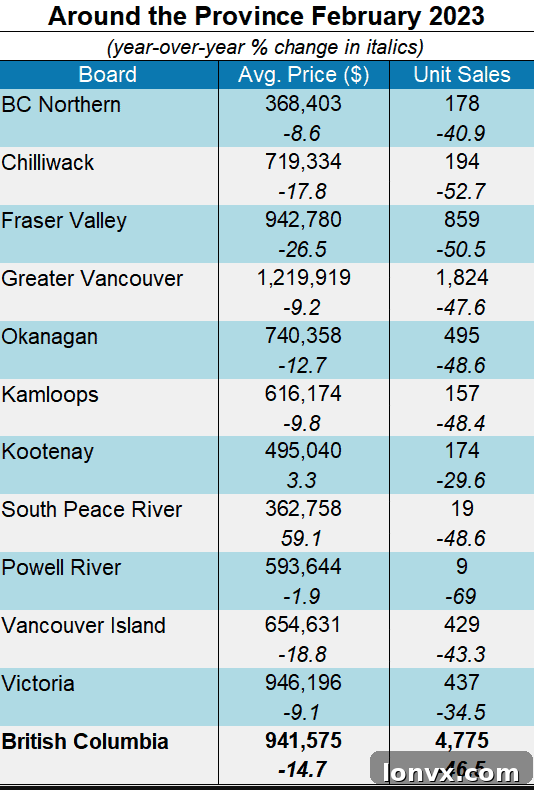
BCREA’s recent report details that 4,775 residential unit sales were recorded through the Multiple Listing Service (MLS) in February 2023. This figure represents a notable decrease of 46.5 per cent when compared to the robust market activity observed in February 2022. This substantial year-over-year decline underscores the significant shift in buyer behaviour and market conditions over the past twelve months.
Accompanying the reduced sales volume, the average home price in B.C. in February 2023 settled at $941,575. This marks a considerable drop of 14.7 per cent from the average price of over $1.1 million recorded in February 2022, a period widely recognized as the market’s recent peak. The cumulative effect of fewer transactions and lower average prices resulted in a total sales dollar volume of $4.5 billion for the month, indicating a sharp 54.4 per cent decrease year-over-year. These figures paint a clear picture of a market that has decelerated from its frenetic pace, prompting a period of adjustment for all participants.
Source: BCREA
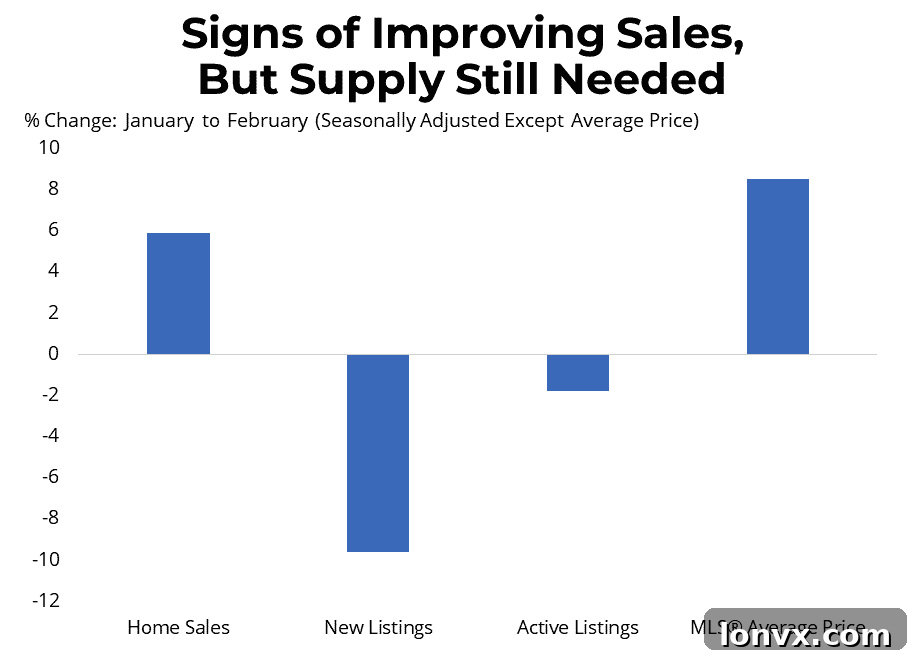
Despite the substantial year-over-year declines, BCREA Chief Economist Brendon Ogmundson offered a forward-looking perspective, emphasizing the positive month-over-month momentum. Ogmundson explained, “While activity across provincial housing markets remains well below normal, there are encouraging signs that the market is balancing out. Home sales rose month-over-month in most markets, and prices appear to be firming up in the face of low supply.” This statement provides a crucial insight into the evolving dynamics, suggesting that the initial shock of interest rate hikes and economic uncertainty might be giving way to a more stable environment.
Average Price Shifts: A Closer Look at Market Dynamics
Digging deeper into the price trends reveals a compelling narrative of a market in flux. While the year-over-year average price saw a significant decline, the month-over-month data tells a story of recovery and stabilization. The average price witnessed an 8.5 per cent increase from January to February 2023, reaching its highest level since July 2022. This upward movement is not merely a statistical anomaly but a reflection of several underlying market factors.
Part of this month-over-month gain can be attributed to the market settling into a more stable rhythm after the initial volatility. However, a significant contributor was the composition of sales reverting to a more typical mix. January experienced unusually low sales volumes for single-detached homes, particularly across the Lower Mainland. As the market entered February, the proportion of higher-priced single-family homes sold increased, naturally nudging the overall average price upwards. This normalization in sales composition, combined with other stabilizing forces, indicates a potential floor forming beneath property values after the significant corrections witnessed throughout 2022.
Source: BCREA
Key Factors Shaping B.C.’s Real Estate Equilibrium
The journey towards a balanced market in British Columbia is influenced by a confluence of economic and societal factors. Understanding these elements is crucial for anyone looking to navigate the provincial real estate landscape:
The Impact of Interest Rates and Affordability
The aggressive interest rate hikes by the Bank of Canada in 2022 significantly cooled buyer demand and impacted borrowing capacity, driving down sales volumes and prices. While interest rates have stabilized in recent months, their cumulative effect continues to shape affordability. Prospective homeowners are recalibrating their budgets, leading to increased demand for more affordable housing options, such as condominiums and townhouses, in contrast to the once-dominant single-detached market. This shift is a key driver in the evolving sales composition and average price trends, pushing the market towards a new equilibrium where financial feasibility plays a more prominent role.
Persistent Low Supply and Market Resilience
Despite the slowdown in sales, a persistent theme in the B.C. market is the relatively low inventory of homes for sale. This lack of available listings acts as a crucial buffer against steeper price declines, as competition for existing properties can remain robust, particularly in desirable areas. This tight supply environment contributes to prices “firming up,” as noted by Ogmundson, even with subdued demand. The resilience of the B.C. market is also underpinned by strong underlying fundamentals, including continued population growth and a desirable lifestyle that attracts both domestic and international migrants, ensuring a consistent long-term demand for housing.
Economic Outlook and Consumer Confidence
The broader economic environment, including inflation rates, employment figures, and overall consumer confidence, plays a pivotal role. As inflation shows signs of easing and the job market remains relatively strong in B.C., consumer confidence may begin to improve. This renewed confidence could translate into increased buyer activity, especially if potential buyers feel more secure about their financial futures and the stability of the housing market. A cautious optimism is emerging, suggesting that the worst of the economic uncertainties might be behind us, allowing the market to slowly regain momentum.
Regional Nuances and Diversified Markets
While the BCREA data provides a provincial overview, it’s important to acknowledge the distinct characteristics of individual markets within British Columbia. Regions like the Lower Mainland, Vancouver Island, and the Interior each have unique supply-demand dynamics, economic drivers, and affordability challenges. The “month-over-month increase in most markets” suggests a widespread positive trend, but the extent of recovery and stabilization will vary significantly from one community to another. Understanding these regional differences is essential for a complete picture of B.C.’s evolving real estate landscape.
What Does a Balanced Market Mean for You?
For buyers, a balanced market often translates to more options and less intense bidding wars compared to the frenzied peak of 2021-2022. It provides an opportunity to conduct due diligence, negotiate terms, and make decisions without feeling undue pressure. However, with prices firming up and supply remaining low, securing a desired property still requires strategic planning and readiness. The upward trend in average prices since July 2022 suggests that waiting indefinitely might not yield significantly lower prices, rather it might be about timing the purchase when interest rates and personal finances align.
For sellers, a balanced market means realistic pricing and presentation are paramount. While the days of multiple unconditional offers might be less frequent, well-priced and well-maintained properties continue to attract serious buyers. The firming of prices indicates that sellers can still achieve good value, especially if they understand current market conditions and align their expectations accordingly. It’s a market that rewards preparation, patience, and professional guidance.
Looking Ahead: Navigating B.C.’s Real Estate Future
The BCREA’s latest report signals a crucial turning point for the British Columbia housing market. The steep year-over-year declines are a testament to the significant market correction that has occurred, but the month-over-month improvements hint at a nascent recovery and a return to healthier market dynamics. The interplay of persistent low inventory, stabilizing interest rates, and evolving buyer sentiment will continue to shape the trajectory of home prices and sales activity. As B.C. moves deeper into 2023, all eyes will be on how these delicate balances unfold, paving the way for a potentially more sustainable and predictable real estate environment.
This period of recalibration offers an opportune moment for potential buyers and sellers to assess their strategies. With expert insights indicating that the market is finding its equilibrium, the emphasis shifts from rapid price appreciation to sustainable growth and long-term value. British Columbia’s housing market, while having endured a significant shake-up, continues to demonstrate its inherent strength and adaptability, charting a cautious but optimistic course towards a more balanced future.