
British Columbia’s Housing Market: Unpacking BCREA’s Q3 2023 Forecast and Future Outlook
The real estate landscape in British Columbia has proven to be a fascinating study in resilience, defying conventional expectations amidst a backdrop of rising interest rates and economic shifts. The British Columbia Real Estate Association (BCREA) has recently released its comprehensive 2023 Third Quarter Housing Forecast Update, providing crucial insights into the province’s dynamic housing market. This report illuminates a market that has not only withstood unexpected challenges but has also shown remarkable adaptability, with both residential sales and property prices demonstrating a stronger performance than many experts had initially anticipated.
This detailed analysis delves into the BCREA’s findings, exploring the factors that have shaped the market in 2023, dissecting the current price dynamics, and peering into the crystal ball for projections into 2024 and beyond. For anyone invested in British Columbia real estate – whether as a potential buyer, a seasoned seller, or an industry observer – understanding these trends is paramount to making informed decisions in an ever-evolving environment.
Market Resilience Amidst Headwinds: A Closer Look at 2023
Despite a global economic climate marked by inflationary pressures and aggressive interest rate hikes by the Bank of Canada, British Columbia’s housing market has exhibited an unexpected tenacity. The BCREA’s assessment highlights this resilience, noting that sales activity and price appreciation have consistently surpassed earlier conservative forecasts. This phenomenon can be attributed to a confluence of factors, including persistent underlying demand, a significantly constrained housing supply, and perhaps a degree of market adaptation to the “new normal” of higher borrowing costs.
The initial outlook for 2023 was cautious, with many predicting a more substantial cooling period. However, the province’s attractive lifestyle, strong inter-provincial migration, and a robust job market in key urban centers continued to fuel buyer interest. While rising interest rates inevitably impacted purchasing power and mortgage qualification, a segment of buyers remained active, particularly those with substantial equity or less reliance on financing. This sustained demand, coupled with a critical shortage of available homes, created upward pressure on prices, preventing the sharp declines some had forecasted.
Understanding 2023 Sales Trends and Future Projections
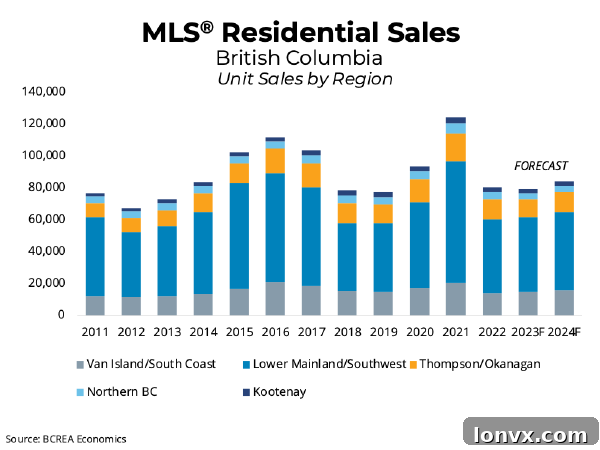
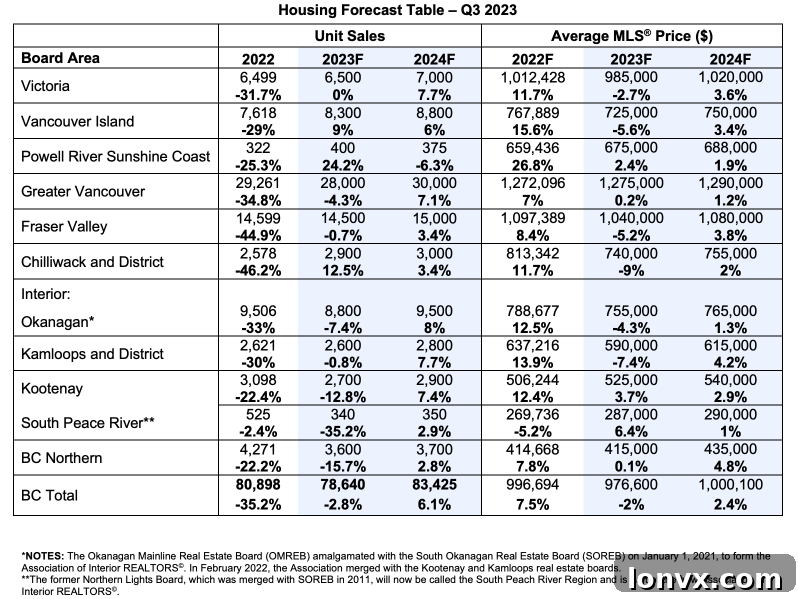
While the market demonstrated resilience, it wasn’t immune to deceleration. The BCREA’s report projects a 2.8 per cent decline in MLS residential sales for 2023, settling at an estimated 78,640 units. This decline, though modest compared to the market’s activity in recent boom years, reflects the tightening financial conditions that began to influence buyer behaviour more profoundly in the latter half of the year.
Brendon Ogmundson, BCREA’s Chief Economist, offers a critical perspective on this trend. He anticipates a further cooling of sales activity, primarily due to the Bank of Canada’s renewed tightening policies. Furthermore, the market’s expectations regarding future rate cuts have shifted significantly. What was once hoped for in early 2024 has now been pushed back, potentially to late 2024 or even mid-2025. This delay in anticipated rate relief means that prospective buyers will continue to face elevated borrowing costs for an extended period, which is likely to temper sales volumes in the near term.
Looking ahead, the forecast for 2024 suggests a modest rebound. MLS residential sales are projected to increase by 6.1 per cent, exceeding 83,000 units. This anticipated recovery is predicated on the assumption that the market gradually adjusts to current economic realities and that a semblance of stability allows for renewed buyer confidence, albeit within a higher interest rate environment than previously experienced.
The Persistent Challenge of Low Inventory: Driving Price Dynamics
Perhaps the most defining characteristic of the 2023 British Columbia housing market has been the remarkable persistence of exceptionally low housing inventory. This scarcity of available homes for sale has been a relentless force, pushing prices upward even in the face of lower overall transaction volumes. It underscores a fundamental imbalance between supply and demand that continues to plague the province’s real estate sector.
Throughout the year, the average price in B.C. fluctuated significantly. It commenced 2023 below the $900,000 threshold, but by May, it had surged past the $1 million mark. This rapid appreciation was not solely due to across-the-board price increases but was also heavily influenced by a spike in sales within higher-end markets, where demand remained robust, and supply dwindled even further. The lack of entry-level and mid-range homes meant that buyers had fewer options, intensifying competition for the limited properties available.
Several factors contribute to this chronic inventory shortage. A slow pace of new construction relative to population growth, the reluctance of existing homeowners to sell (often due to being locked into lower mortgage rates or facing prohibitively high costs to move up), and demographic shifts all play a role. This scarcity creates a seller’s market, where properties often receive multiple offers, particularly in desirable urban and suburban areas, contributing to sustained price growth despite other cooling influences.
Forecasting 2024: Price Projections and Crucial Factors
The BCREA’s forecast for 2024 paints a nuanced and cautiously optimistic picture regarding price trends. For 2023, if the average price stabilizes around the current level of approximately $970,000 during the latter half of the year, the annual average price is expected to be $976,000. This would represent a 2.0 per cent decline year-over-year, primarily due to the high peak observed in 2022 before the significant rate hikes took full effect.
However, the outlook for 2024 is more positive. Assuming that home sales gradually return to what the BCREA describes as “normal levels” – a reflection of balanced market conditions and renewed consumer confidence – the association anticipates a 2.4 per cent increase in prices. This projected increase would push the annual average price back above the significant $1 million threshold, signalling a recovery in market value and potentially marking a new cycle of appreciation.
Crucially, the BCREA acknowledges that while these forecasts offer valuable insights, the ultimate trajectory of the market remains heavily dependent on a single, overarching factor: housing supply. The chronic shortage of homes for sale continues to be the dominant driver of market dynamics. Should supply conditions worsen or fail to improve significantly, it could exert further upward pressure on prices, even if sales volumes remain moderate. Conversely, a substantial increase in listings could temper price growth, creating a more balanced market environment.
Implications for Buyers and Sellers in British Columbia
For prospective buyers in British Columbia, the BCREA’s forecast suggests a market that, while still challenging, might offer some opportunities. The anticipated cooling of sales in the near term could mean slightly less intense bidding wars, particularly if inventory levels see a marginal improvement. However, the projected price increase in 2024, coupled with continued high interest rates, means affordability will remain a primary concern. Buyers should focus on meticulous financial planning, securing pre-approvals, and being prepared for sustained competition for desirable properties, especially in popular urban centres.
Sellers, on the other hand, appear to remain in an advantageous position, largely due to the persistent low inventory. While the days of hyper-accelerated price growth may have moderated, well-priced and well-presented homes are still likely to attract strong interest. The key for sellers will be understanding current market valuations, working with experienced real estate professionals, and timing their sale strategically in anticipation of the projected market rebound in 2024. The delay in Bank of Canada rate cuts also suggests that sellers shouldn’t expect a sudden surge of highly leveraged buyers in the immediate future.
Beyond the Numbers: Key Factors Influencing British Columbia Real Estate
The BCREA forecast provides a snapshot, but several broader economic and demographic factors continually shape the British Columbia real estate market. These include robust population growth driven by both inter-provincial and international migration, which consistently adds to housing demand. Furthermore, the province’s strong economic fundamentals in sectors like technology, natural resources, and tourism create job opportunities, further attracting residents.
Government policies, both provincial and federal, also play a significant role. Initiatives aimed at increasing housing supply, such as zoning reforms and incentives for developers, could eventually alleviate the inventory crisis, but their impact is often long-term. Measures like the foreign buyer ban and speculation taxes aim to temper demand and discourage certain types of investment, though their overall effectiveness on affordability is still debated.
Finally, global economic trends, including inflation rates and central bank policies in major economies, indirectly influence Canada’s financial landscape and, consequently, mortgage rates. Understanding these interconnected elements is crucial for a holistic view of BC’s real estate future.
Conclusion: Navigating a Dynamic Market
The British Columbia housing market, as illuminated by the BCREA’s 2023 Third Quarter Housing Forecast Update, is a complex and dynamic entity. It has demonstrated remarkable resilience in the face of significant economic headwinds, particularly rising interest rates. While 2023 saw a modest decline in sales and a slight dip in annual average prices from their peak, the underlying strength of demand and the pervasive issue of low inventory have prevented a more substantial market correction.
Looking forward to 2024, the forecast suggests a gradual stabilization and a return to moderate growth, with sales volumes rebounding and average prices expected to once again surpass the $1 million mark. However, the BCREA rightly emphasizes that housing supply remains the critical variable. As the province navigates these evolving conditions, staying informed and adapting strategies will be key for all participants in the British Columbia real estate market. The narrative is one of cautious optimism, acknowledging persistent challenges while recognizing the enduring appeal and fundamental demand for property in this highly desirable region.