In the vibrant heart of Toronto, where urban energy meets community charm, lies a district that perfectly encapsulates the enduring mantra of “location, location, location.” Known interchangeably as Yonge and St. Clair, or the historic Deer Park, this mid-town nexus has always possessed inherent potential. For decades, it existed as a vital transit point and a residential enclave, yet its true capacity as a dynamic urban core remained largely untapped. Despite its enviable position and the affluence of its residents, the area was, for too long, an overlooked gem in Toronto’s diverse tapestry, yearning for a revitalization that would truly reflect its intrinsic value and the sophisticated character of its inhabitants.
The sentiment among those who lived and worked in Yonge and St. Clair was palpable: a sense of frustration with congested streets, sidewalks that felt perpetually overcrowded, and building facades that had lost their luster. The public spaces, including planters often filled with litter, seemed to speak of a neighborhood beleaguered by neglect, where the public right of way was slowly but surely eroding. This prevailing perception of the area as a place of missed opportunities was echoed by community manager Jessica Myers, who pointed out the paradox: “That there is prime real estate here for new businesses and retails to thrive in is unknown. There are tons of green spaces. The ravine just east of the intersection remains ignored or forgotten.” Such observations highlighted a profound disconnect between the area’s inherent assets – its prime location, affluent demographic, and natural beauty – and its tired, often uninviting public realm.
However, the tide has unequivocally turned. A new era of transformation has dawned for Yonge and St. Clair, spearheaded by Slate Asset Management. As a prominent real estate investment platform boasting a portfolio exceeding $4.5 billion in assets, Slate recognized the immense, dormant potential of this mid-town hub. Their commitment to the neighborhood’s renewal is not merely a philanthropic endeavor but a deeply vested interest, rooted in a strategic vision for urban development. Since 2013, Slate has meticulously acquired ten properties within the area, crucially securing all four corners of the main intersection. This comprehensive acquisition strategy underscores their long-term dedication to a holistic transformation, enabling them to orchestrate a unified vision for Yonge and St. Clair that extends beyond individual buildings to reshape the entire streetscape and community experience.
Katie Fong, Slate’s Director of Asset Management overseeing this ambitious operation, articulated the core philosophy driving the project: “If you walk into any of the neighbourhoods in the area and observe the people that live and work here, the buildings don’t really reflect the wealth, sophistication and elegance of its residents. This revitalization project helps us reinvest and reinvigorate what this neighbourhood already has.” This statement encapsulates the essence of the initiative: to create a physical environment that mirrors the prestige and vibrancy of its community, transforming Yonge and St. Clair into a destination that truly embodies its inherent sophistication and attracts a new wave of urban engagement.
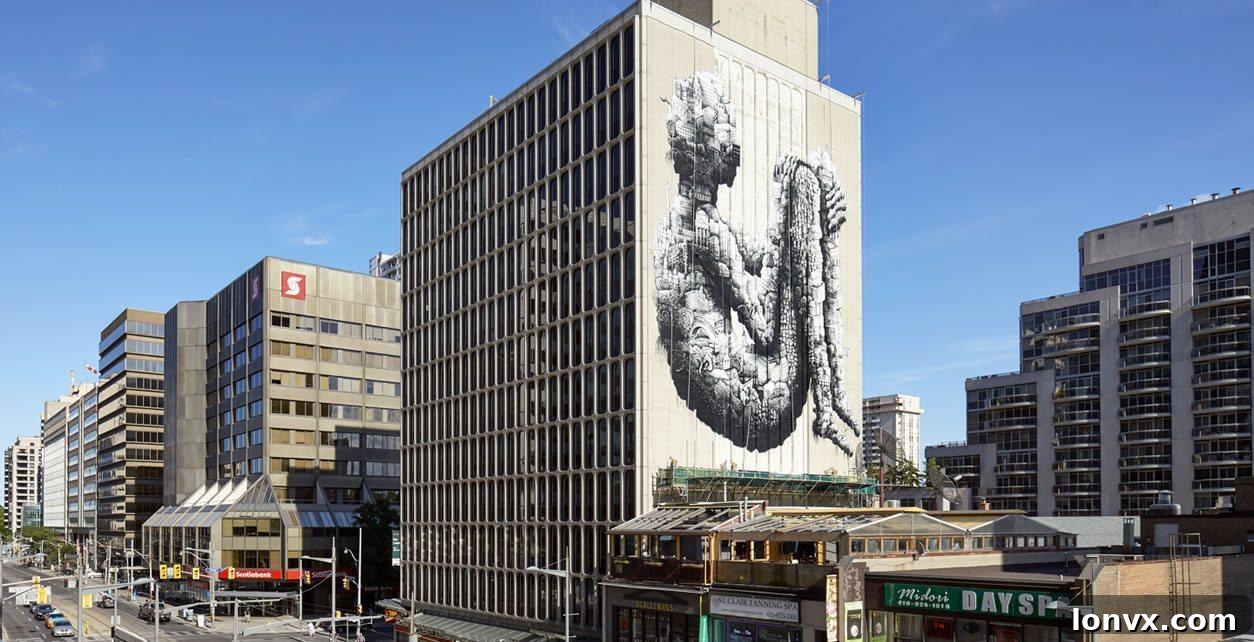
The journey of transformation commenced incrementally in 2016, with a strategic and visually striking public art installation designed to immediately capture attention and spark dialogue. Slate commissioned internationally renowned street artist Phlegm to create an monumental eight-storey mural on the west-facing façade of a commercial building at 1 St. Clair Ave. W. Phlegm, known for his intricate, surrealistic narratives, literally rappelled down the building to bring his vision to life—a vision carefully crafted to represent the authentic spirit of the neighborhood. This project marked Slate’s inaugural venture into leveraging public art as a catalyst for community engagement and revitalization. Undertaken in a collaborative spirit with the STEPS Initiative and the City of Toronto’s StreetARToronto program, the month-long artistic endeavor actively sought input and participation from local residents, setting a precedent for community-centric development.
The collaborative process behind the mural was meticulously designed to ensure community input. Anjuli Solanki, Director of Community Programs with the STEPS Initiative, explained their outreach methods: “We canvassed a lot of people through the streetcar stops. We had both a physical survey that was handed out to passersby and an online survey sent to Slate’s listserv of businesses in the area.” The overwhelming consensus from these surveys was clear: art was perceived as the most effective means to elevate the cultural profile and aesthetic appeal of the vicinity. Solanki elaborated on the community’s desire: “A number of people felt that the neighbourhood had seen better days and wanted some sort of revitalization to bring more current street-life to the area.” This insight confirmed that public art was not just decorative but a powerful tool to inject new energy and identity into the urban fabric of Yonge and St. Clair, signaling a vibrant future.
Visitors enjoy the ravine bench.
Building on the resounding success of the Phlegm mural, Slate’s revitalization efforts expanded to a series of strategic public space improvements, meticulously designed to enhance pedestrian experience and foster community interaction. A particularly innovative concept emerged in the form of the “ravine bench,” a creation of the esteemed design firm Gensler, who partnered with Slate to unearth and highlight Yonge and St. Clair’s often-overlooked natural amenities. The inception of this unique outdoor bench was a direct response to a critical urban challenge: the narrow sidewalks that had long impeded public engagement and activity within the bustling district. Extensive research identified TD Bank’s storefront on the east corner of the intersection as having the only sidewalk “wide enough to do something meaningful to the streetscape, so it became an important area of focus,” noted Gensler architect Steven Paynter.
The project presented inherent design challenges, primarily due to the varying ground levels between the store interiors and the public sidewalk. However, Gensler ingeniously transformed this obstacle into an opportunity, conceiving a distinctive bench that also functions as an accessible ramp. This dual-purpose design not only improved pedestrian flow but also added an intriguing architectural element to the streetscape. The “ravine bench” was strategically named and designed with a larger mission in mind. As Paynter explained, “We hope to be able to attract people more toward the ravine. It’s called the ‘ravine bench’ because people don’t know about the ravine. We’re trying to build these connections in their minds.” This thoughtful naming convention serves as an educational prompt, subtly guiding residents and visitors to acknowledge and explore the hidden natural beauty of the ravine, fostering a deeper connection to the local environment and integrating nature into the urban experience.
The revitalization efforts are not confined to exterior enhancements; significant improvements are also underway within the St. Clair Centre itself. Work is currently progressing to remove the confusing mazes and outdated flags that had long obscured the interior skylight, diminishing the natural light and sense of openness. The completion of Phase 2 of this interior overhaul is poised to dramatically transform the retail experience by reopening the skylight, allowing natural light to flood the space, and seamlessly reconnecting it with the surrounding retail environments. This structural change is expected to create a more inviting, intuitive, and modern interior, encouraging greater foot traffic and enhancing the overall shopping and leisure experience for visitors.
Kicking off 2018 with another bold statement, Slate Asset Management proudly sponsored the Toronto Design Off Site (TO DO) Festival, transforming the Yonge and St. Clair intersection into a dynamic canvas for innovation and creativity in celebration of the city’s design week. As a highlight of the festival’s extensive roster of over 100 exhibits, Slate unveiled three captivating public art installations. These installations, each a testament to contemporary design and artistic expression, were conceptualized and brought to life by leading architecture and design firms: Gensler, IBI Group, and Superkül. This strategic partnership with TO DO Festival further cemented Yonge and St. Clair’s emerging identity as a hub for cultural and artistic expression, drawing diverse audiences to experience its ongoing transformation.
Among these celebrated installations, “The Space Between” by the IBI Group offered a profound visual narrative housed within the foyer of an office building at 55 St. Clair W. This mesmerizing art piece is an intricate interplay of light and an astonishing 6,000 meters of colored yarn, meticulously arranged in layers of horizontal and vertical patterns. The exhibit masterfully combines both digital and analogue components, creating a dynamic visual experience that explores the intricate ways people navigate and interact with urban spaces. Conceptually, “The Space Between” thoughtfully reflects on the unique challenges and experiences of city life, particularly acknowledging Toronto’s long and often cold winters, by illustrating how human movement and connection persist even amidst environmental constraints. Its presence transforms a conventional office lobby into a space for contemplation and artistic appreciation.
The #ohdeer installation at 2 St. Clair W.
Perhaps the most visually arresting and conversation-starting installation, however, was “#ohdeer”, strategically placed at 2 St. Clair W., commanding attention in the northwest corner of the bustling intersection. This remarkable indoor structure was conceived with a delightful purpose: to serve as a whimsical yet poignant reminder of the area’s rich historical nomenclature. It playfully pays homage to Deer Park, the neighborhood’s original name, evoking a bygone era when deer freely roamed these very lands. “#ohdeer” is more than just art; it is a narrative piece, connecting the present urban landscape with its natural heritage, inviting viewers to reflect on the layers of history beneath their feet.
Steven Paynter, a key figure in the design of “#ohdeer”, articulated the playful intent behind the installation. “We wanted people to walk into the building and see #ohdeer, smile and say, ‘Okay, this isn’t someone trying to impose a serious piece of art in an office lobby saying how grand and important they are.’ This is a fun and frivolous piece of art – it’s pink and papery and is a real giant deer piñata.” His description captures the essence of the piece: a deliberate departure from staid corporate art, opting instead for joy and surprise. Paynter further envisioned the public’s reaction, “When people come into work on Monday at 9 a.m., the first reaction will be, ‘What the hell happened’? It’s supposed to be a whimsical piece.” This sense of delightful disorientation and lightheartedness perfectly encapsulates Slate’s broader strategy: to infuse Yonge and St. Clair with a sense of wonder, community, and contemporary relevance, ensuring the area feels accessible, engaging, and genuinely enjoyable for all who pass through.
The comprehensive and thoughtfully executed revitalization spearheaded by Slate Asset Management is already yielding tangible results, transforming Yonge and St. Clair into a highly desirable destination for premier businesses and culinary experiences. The area’s renewed vibrancy and enhanced public spaces have successfully attracted a cadre of high-end restaurants and lifestyle brands, signalling a significant upgrade in the local amenities. Esteemed establishments such as Buca, renowned for its exquisite Italian cuisine; Greenhouse Juice, a leader in health-conscious beverages; and Mary Be Kitchen, offering fresh, wholesome fare, are all slated to open their doors soon. Their arrival not only enriches the dining landscape but also acts as a powerful magnet, drawing increased foot traffic and fostering a dynamic, sophisticated urban environment. This influx of high-caliber businesses underscores the success of Slate’s vision, proving that thoughtful urban renewal can indeed cultivate a thriving, attractive, and genuinely desirable community hub.