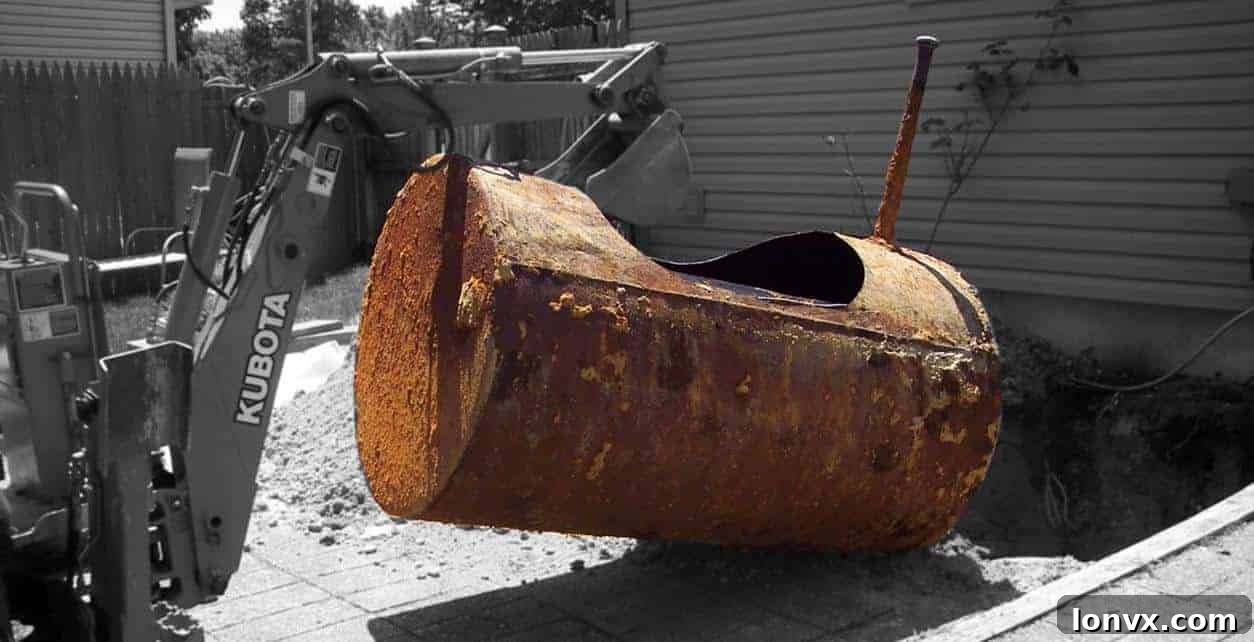
Unearthing Hidden Risks: The Peril of Buried Oil Tanks in Real Estate Transactions
Imagine purchasing your dream home, settling in, and years later discovering a ticking financial time bomb buried beneath your meticulously landscaped garden. This startling reality faces many homeowners, particularly those buying older properties in regions where heating oil was once commonplace. The discovery of an underground oil tank can transform a homeowner’s joy into a nightmare of costly cleanup operations, environmental remediation, and complex legal disputes. Understanding the risks, liabilities, and necessary due diligence is paramount for both buyers and sellers in today’s real estate market.
Rhonda and Michael Honing’s experience in North Vancouver is a stark cautionary tale. In 2016, fifteen years after moving into their home, they were blindsided by the unexpected discovery of an oil tank buried in their garden. This came as a significant shock, especially since previous owners had explicitly disclosed the removal of an internal oil tank in 1977 when the property transitioned to natural gas. Crucially, no mention was ever made of any additional, external tanks. The Honings, aiming to prevent future complications and mitigate potential issues, proceeded with the tank’s removal. However, the empty hole in their garden left a much larger void: a pressing question about what the previous owners truly knew regarding this hidden hazard, and who bore ultimate responsibility.
The Buried Threat: Why Hidden Oil Tanks Are a Major Concern for Property Owners
The primary concern with a buried oil tank extends far beyond its mere presence; it lies in its inherent potential to leak. Over time, buried steel tanks are highly susceptible to corrosion, a process accelerated by interaction with soil moisture, varying pH levels, and diverse chemical reactions. As tanks age, pitting and holes inevitably develop, allowing residual heating oil to seep into the surrounding soil. This insidious leakage can then migrate, potentially contaminating groundwater, impacting neighboring properties, and creating a cascade of serious problems. This contamination doesn’t just create an environmental hazard; it can lead to:
- Extensive Environmental Damage: Oil leaks can severely harm local ecosystems, impair plant life, and pollute vital water sources, including wells and public water systems.
- Massive Cleanup Costs: Remediating contaminated soil and groundwater is an extremely complex and expensive endeavor. It involves extensive excavation, specialized disposal of hazardous waste (often requiring transport to designated facilities), rigorous environmental testing, and ongoing monitoring. These costs can easily escalate to tens or even hundreds of thousands of dollars, placing an enormous financial burden on the property owner.
- Decreased Property Value and Marketability: A property with known contamination or even the risk of a buried tank can be significantly devalued. Lenders may be hesitant to finance, and potential buyers often shy away from such perceived liabilities, making the property difficult to sell.
- Health Risks for Occupants: Volatile organic compounds (VOCs) from leaking heating oil can vaporize and migrate through the soil, entering basements, crawl spaces, or even living areas. These fumes can pose serious health risks to occupants, including respiratory issues, headaches, and other long-term health concerns.
- Complex Legal Ramifications: Homeowners can face a variety of legal challenges, including enforcement actions and fines from environmental regulatory bodies, lawsuits from affected neighbors, or claims from future buyers seeking damages.
Navigating these multifaceted issues requires immediate action and expert guidance from environmental specialists and legal professionals, making the initial discovery of a tank just the beginning of a potentially long, costly, and emotionally draining journey.
Buyer Beware: The Principle of Caveat Emptor in Oil Tank Liability
In most jurisdictions, the legal principle of caveat emptor, or “buyer beware,” largely governs liability for hidden defects like buried oil tanks. This legal doctrine places the primary onus on the buyer to conduct thorough due diligence before finalizing a property purchase. Relying solely on a seller’s disclosure might not be sufficient, especially if the seller genuinely had no knowledge of a hidden tank. Therefore, a crucial and often overlooked step in the home buying process, particularly for older properties or those in areas with a history of oil heat, involves commissioning a professional subsurface scan.
“They can,” confirms Joseph Salazar of GeoScan Subsurface Surveys, when asked if buyers can solely rely on a seller-provided report stating no oil tank exists. “Provided they understand the limitations of the report.” This caveat is absolutely critical. A report is only as robust and reliable as the scope and methodology of the scan it represents. Buyers must scrutinize these reports carefully and consider their own independent verification.
A technician performing a GPR scan for a buried oil tank (Photo: GeoScan).
Advanced Detection Techniques: Ground Penetrating Radar (GPR) and Beyond
To provide the most accurate assessment for buried oil tank detection, leading subsurface surveying companies like GeoScan utilize a multi-faceted approach, combining several cutting-edge technologies for maximum efficacy and confidence:
- Ground Penetrating Radar (GPR): This non-invasive, state-of-the-art technology emits high-frequency radio waves into the ground. As these waves encounter different subsurface materials, they reflect back, creating a detailed profile or image of what lies beneath. GPR can effectively detect metallic and non-metallic objects, including buried tanks, pipelines, and utility lines, up to eight feet (approximately 2.4 meters) below the surface. Its ability to differentiate between various materials makes it exceptionally adept at identifying anomalies indicative of a buried tank.
- Metal Detection: This traditional yet highly effective method is employed to identify metallic objects beneath the surface. While a valuable tool for locating potential tanks, it cannot distinguish between a buried oil tank and other metallic debris like pipes, rebar, or scrap metal, necessitating further investigation.
- Electromagnetic (EM) Detection: This technique complements GPR and metal detection by identifying conductive and magnetic objects. EM surveys provide another crucial layer of data, helping to confirm or rule out suspicious anomalies found by the other methods, thereby increasing the overall accuracy of the assessment.
Salazar emphasizes the critical importance of a clear and unobstructed scanning environment: “You need to know if the entire site was clear on the day of the scan. For example, was there a car parked in the driveway? An oil tank could’ve been perfectly placed underneath. Is there a raised deck? GPR relies on contact with the ground so raised decks can be problematic, and they’re usually close to the house, which is prime oil tank territory.” Such obstructions can create significant blind spots, underscoring why a comprehensive, unhindered scan performed by certified professionals is absolutely vital for a reliable assessment.
While no detection method offers a 100% fail-safe guarantee without resorting to a full excavation, GPR is widely regarded as the most effective and conclusive non-invasive technique available for buried tank detection. “But finding an oil tank is like searching for clues to piece together a puzzle,” Salazar explains. “That might be visual clues like vent or supply pipes, staining on foundations, and importantly, scan data from GPR and metal detection. Every technology has its capabilities and limitations, and the accurate interpretation of the data relies heavily on the skill, experience, and training of the technician. That said, with our combined methods and expert analysis, we can tell you with about 99 percent confidence whether you have a tank or not.” This high confidence level underscores the immense value of engaging experienced and reputable professionals in subsurface surveying.
How Common Are Buried Oil Tanks in Modern Real Estate?
Despite the widespread transition to natural gas and other modern heating sources, buried oil tanks remain surprisingly common, especially in older, established neighborhoods. “We’ve done about 200-300 scans a year for the last 10 years, and we find a tank in about one out of four properties,” reveals Salazar. This compelling statistic alone highlights the significant, persistent risk and the critical need for robust pre-purchase inspections, especially when considering properties constructed before the 1980s or located in regions with a historical reliance on heating oil.
When Things Go Wrong: Contamination, Costly Remediation, and Legal Fallout
The discovery of an intact, non-leaking oil tank is not necessarily a deal-breaker for a property transaction. In fact, removing an undamaged tank can be a relatively straightforward and affordable process, often costing a couple of thousand dollars and typically requiring just a day’s work, provided everything proceeds smoothly and without complications. This was the initial positive experience of Seamus and Aleesha Connolly. When they discovered an oil tank on a Kamloops, B.C., property they intended to buy in August 2009, they simply requested the sellers to remove it before closing the deal. The sellers, who had owned the property since 1988 and claimed to be completely unaware of the tank, readily complied. All seemed well, and the sale proceeded.
However, the Connollys’ relief was tragically short-lived. A mere few months after moving into their new home, Aleesha noticed an unusual and unsettling smell emanating from the basement. The sheets on the bed she was changing carried a distinct scent of fuel, immediately triggering alarm bells. Their subsequent investigation led them to dark, tell-tale stains discovered behind wall panels in the basement room. It was soon tragically confirmed: the soil surrounding their house was severely contaminated with oil. What began as a simple tank removal quickly escalated into a complex, disruptive, and immensely expensive environmental remediation project, turning their dream home into a stressful ordeal.
The cleanup involved excavating approximately 80 cubic meters of contaminated soil, a process that required significant time, specialized equipment, and disruption to their property. Only after this extensive and disruptive process did the Connollys finally receive the all-clear from their environmental engineer, confirming that contamination levels were within permissible thresholds. The unexpected and substantial bill of $14,000 for this remediation understandably left the Connollys feeling profoundly aggrieved, leading them to pursue legal action against both the previous owners and the contractor responsible for the initial tank removal.
After a protracted and arduous legal battle, the courts ultimately ruled against the contractor. The judgment highlighted a critical failure during the removal process: an estimated five liters of fuel had inadvertently escaped from the tank. While seemingly a small quantity, this was more than sufficient to cause significant environmental contamination and profound financial distress for the Connollys. This pivotal case underscores a crucial point: even a professionally executed tank removal, if not performed with absolute precision and meticulous care, can lead to devastating long-term consequences and substantial liabilities.
Shifting the Blame: Circumventing Caveat Emptor and Establishing Liability
While caveat emptor often protects sellers from liability for hidden tanks they genuinely didn’t know about, it’s far from an impenetrable shield. Sellers are legally obliged to disclose any “material latent defects” known to them on a Property Disclosure Statement. This requirement, however, hinges on their actual knowledge. If a seller is truly unaware of a buried oil tank, they are generally absolved of responsibility if one is discovered post-completion, leaving the buyer to bear the potentially enormous costs of removal and remediation. The tide turns dramatically, however, if it can be unequivocally *proven* that the sellers had reason to believe a buried oil tank existed on the property. In such instances, liability can shift dramatically back to the seller, compelling them to cover the costs incurred by the buyer.
Proving Seller Knowledge: The Honing’s Precedent and Legal Victory
The Honings’ case in North Vancouver provides a compelling and insightful example of how meticulous buyer diligence and astute legal strategy can successfully overcome a seller’s claim of ignorance. Their legal team meticulously presented evidence arguing that the previous owner, who was not only a homeowner but also a retired plumber and gasfitter, had installed an irrigation system and a sewer line mere inches from what was later confirmed to be the oil tank’s vent pipe. During testimony, the judge made a critical observation, noting how the seller “artfully” dodged direct questions about the oil tank, skillfully avoiding an outright denial of his knowledge while simultaneously failing to fully disclose. This pattern of evasive behavior and circumstantial evidence was deemed sufficient to convince the court that the seller knew more than he admitted. The court ultimately concluded that the seller either knew, or had substantial reason to believe, an oil tank was buried in the garden, and subsequently ordered him to reimburse the Honings a significant $37,000 for their expenses.
The Strategic Power of Contractual Addendums in Real Estate
Another powerful and proactive strategy to navigate past the limitations of caveat emptor lies in the precise wording of the contract of purchase and sale. A notable 2018 case in Esquimalt, B.C., clearly demonstrated this efficacy, resulting in a substantial $45,000 award against the sellers of a property where a leaky tank was discovered. In this instance, the purchasers’ Realtor played an instrumental role by proactively including a specific addendum within the purchase contract. This crucial clause effectively held the sellers responsible for any oil tank found on the property at any point in the future, regardless of when it was discovered or if they had prior knowledge. While securing seller agreement to such a broad and protective addendum isn’t always guaranteed, especially in highly competitive real estate markets, attempting to include one is a highly advisable and powerful protective measure for buyers seeking to minimize future financial and environmental risks associated with buried tanks.
Protecting Your Investment: Essential Advice for Home Buyers and Sellers
Given the inherent complexities, significant financial implications, and potential environmental devastation associated with buried oil tanks, both buyers and sellers must adopt proactive, informed strategies to mitigate risks and ensure transparency throughout real estate transactions. Diligence and foresight are your strongest allies.
Comprehensive Advice for Home Buyers:
- Prioritize Professional Subsurface Scans: Never skip a professional oil tank scan, especially for properties built before the 1980s or those in areas historically reliant on oil heat. This is arguably the most critical step in uncovering hidden tanks and preventing future liabilities.
- Thoroughly Understand Report Limitations: Be aware that even professional scans are not 100% foolproof in all scenarios. Critically review any provided reports to understand what areas were covered, any obstructions encountered during the scan, and the specific technology utilized. A seller-provided “clear” report might have geographical gaps or methodological limitations.
- Engage a Knowledgeable Real Estate Agent: Work diligently with a real estate agent who possesses specialized experience and knowledge regarding properties with historical oil heat. Such an agent can provide invaluable advice on local regulations, necessary contractual protections, and potential red flags.
- Request a Specific Oil Tank Addendum: Always ask your Realtor to include a robust clause in the purchase agreement that clearly assigns liability for future tank discoveries to the seller, if at all possible. This contractual safeguard can offer substantial protection.
- Verify Tank Removal and Remediation Documentation: If a tank is found and subsequently removed, insist on receiving and thoroughly reviewing full documentation. This includes all necessary permits, comprehensive soil sample results (pre- and post-removal), and critically, a “certificate of completion” or “no further action” letter from the relevant environmental authority.
- Act Immediately if Contamination is Suspected: If you notice unusual odors, visible stains, or any other signs that raise suspicion of contamination after moving into your new home, contact a qualified environmental engineer immediately for a professional assessment. Swift action can often mitigate more severe and costly damage.
- Seek Legal Counsel Promptly: If a tank or, worse, contamination is found post-purchase, do not hesitate to seek legal advice promptly. An experienced real estate lawyer can help you understand your rights, potential avenues for recourse, and navigate the complex legal landscape.
Key Advice for Home Sellers:
- Be Transparent and Proactive: If you know or even suspect a tank exists on your property, disclose it fully and honestly. Being proactive by having the tank properly removed and the site remediated (with meticulous documentation) can prevent future legal issues, expedite your property sale, and make your home significantly more attractive to prospective buyers.
- Consider a Pre-Listing Scan: A pre-listing oil tank scan can provide immense peace of mind to potential buyers and often speeds up the selling process. If the scan confirms no tank exists, it provides valuable assurance. If a tank is found, you can address it proactively on your own terms.
- Maintain Meticulous Records: If a tank has been previously removed from your property, retain all permits, comprehensive reports, environmental clearance certificates, and any “no further action” letters indefinitely. Provide these critical documents to prospective buyers during the disclosure phase.
- Understand and Fulfill Your Disclosure Obligations: Be unequivocally honest and thorough on your Property Disclosure Statement. Misrepresentation or omission, even if unintentional, can lead to severe legal liabilities and financial penalties.
Conclusion: Navigating the Complexities of Hidden Oil Tanks with Confidence
The world of buried oil tanks in real estate transactions is rarely black and white; instead, every situation presents its unique challenges and intricate complexities. There are no “hard and fast rules” that universally apply, making vigilance, meticulous due diligence, and expert consultation indispensable for all parties involved. For both buyers and sellers, the overarching goal should be to unearth the truth about any potential buried tanks as early as possible in the transaction process. Proactive measures, comprehensive due diligence, transparent communication, and appropriate contractual safeguards are the absolute best defenses against the hidden surprises that can otherwise lead to incredibly expensive, emotionally draining, and protracted court proceedings.
Court battles, as vividly demonstrated by the experiences of the Honings and Connollys, are not only financially burdensome and immensely time-consuming but also inherently unpredictable, often feeling like a roll of the dice for those involved. A judge’s ruling can be swayed by minute details, the strength of circumstantial evidence, and the persuasiveness of arguments, making the ultimate outcome uncertain for all parties. Therefore, investing wisely in thorough professional inspections, obtaining proper environmental assessments, and seeking timely legal counsel upfront is a far wiser and more cost-effective course of action than facing the daunting prospects of litigation down the line. Protecting your significant investment and securing your peace of mind truly begins with understanding, proactively addressing, and effectively mitigating the hidden perils lurking beneath the surface of your potential property.