
Navigating the Calgary Real Estate Market: A Comprehensive 2024 Review and Outlook
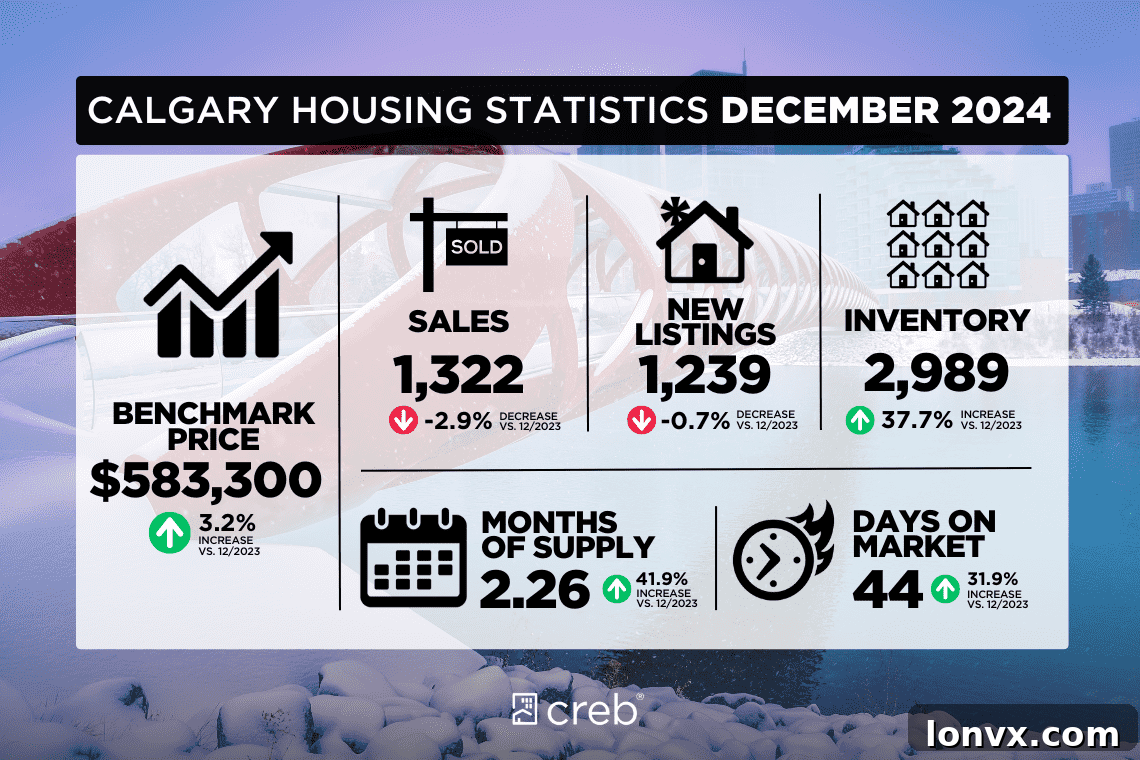
The Calgary real estate market demonstrated remarkable resilience and dynamic shifts throughout 2024, concluding the year with December sales figures that, while slightly lower than the previous year, significantly surpassed long-term trends. According to the Calgary Real Estate Board (CREB), December saw 1,322 residential property sales, marking a three percent decline compared to December 2023. However, this figure was almost 20 percent higher than historical averages, underscoring a persistently robust demand within the city. Overall, the total sales volume for 2024 remained strong, nearly matching the impressive levels recorded in 2023, a testament to Calgary’s sustained appeal and economic vitality.
Ann-Marie Lurie, CREB’s chief economist, highlighted the pivotal role of population growth in sustaining this elevated sales activity. “Population gains over the past several years have supported sales activity that has outperformed long-term trends. In 2024, sales would likely have been higher if there was more supply choice, especially in the lower price ranges,” she stated in a recent press release. This insight points to an underlying demand that, if met with adequate supply, could have pushed sales even higher. The challenges of limited inventory, particularly for more affordable homes, became a defining characteristic of the market for much of the year, influencing pricing and buyer behavior across various segments.
Despite these challenges, the latter half of 2024 brought encouraging developments. Lurie observed, “That being said, we did start to see shifts occurring in the market in the second half of the year as supply levels started to improve for higher priced homes.” This indicates a nascent rebalancing, where increased options at the upper end of the market began to alleviate some of the pressures that characterized the earlier months. Understanding these intricate dynamics is crucial for anyone looking to buy, sell, or invest in Calgary’s ever-evolving property landscape, as different housing types and price points experienced unique trajectories.
Calgary’s Market Dynamics: Resilience Amidst Evolving Conditions
The consistent outperformance of Calgary’s housing market against long-term trends is not accidental; it is deeply rooted in several interconnected economic and demographic factors. Foremost among these is the city’s significant population influx. Calgary has experienced substantial growth in recent years, driven by interprovincial and international migration, attracted by economic opportunities, a relatively lower cost of living compared to other major Canadian cities, and a high quality of life. This sustained population expansion creates an inherent and ongoing demand for housing that continuously tests the market’s supply capabilities, putting upward pressure on both sales volume and prices.
While the overall sales for 2024 nearly mirrored 2023’s strong performance, the underlying narrative was one of a market grappling with persistent supply shortages, particularly within the entry-level and mid-range price brackets. This imbalance meant that many potential buyers, especially first-time homeowners or those seeking more affordable options, faced intense competition and limited choices. The impact of this restricted supply was a primary constraint on overall sales volume, suggesting that the true, latent demand for Calgary real estate was, in fact, even higher than the reported figures, with many would-be buyers waiting for more favorable conditions or greater inventory.
However, the second half of the year brought a crucial shift that hints at future trends. As Ann-Marie Lurie noted, there was a noticeable improvement in supply levels, albeit predominantly in the higher-priced segments. This suggests a multi-faceted market where different segments respond to economic stimuli and supply additions at varying rates. For instance, new luxury home constructions, more listings of premium properties, and an increase in resale activity within the luxury sector might have contributed to this shift. This provided more options for buyers with higher purchasing power and potentially freed up some mid-range properties as existing homeowners moved up the ladder. These evolving conditions highlight the need for a nuanced understanding of Calgary’s dynamic housing market, where general trends can mask distinct movements within specific segments.
Inventory Levels and Price Stabilization: A Balancing Act in Calgary Real Estate
Inventory is the lifeblood of any real estate market, representing the available homes for sale, and Calgary’s market in 2024 was characterized by a delicate balance between persistent low levels and signs of gradual improvement. December saw 2,989 units of inventory available, a figure still below long-term trends for the month, but notably higher than December 2023 and early 2024 levels. This incremental improvement, though modest, was a welcome development, signaling a potential easing of the severe supply crunch that had defined much of the year and offering a glimmer of hope for a more balanced market ahead.
Several factors contributed to this modest boost in housing options across Calgary. An increase in rental market availability, driven by new purpose-built rental constructions and investors re-evaluating their portfolios, offered an alternative for some residents, subtly reducing immediate pressure on the ownership market. When more people find suitable rental housing, it can indirectly alleviate some demand for purchase, particularly among those who might otherwise be forced into homeownership due to lack of rental options. Additionally, a steady stream of new home construction activity, while not always meeting the full breadth of demand, gradually added to the overall housing stock. These combined influences provided some much-needed relief to a market that had been operating under intense pressure for an extended period, creating a slightly less frantic environment for buyers.
The relationship between inventory and home prices is direct: when supply is scarce and demand is high, prices tend to surge. This dynamic was clearly observed in Calgary during the spring of 2024, when prices reached their peak amid fiercely competitive conditions. However, as inventory levels began to inch upwards in the second half of the year, this pressure on home prices started to stabilize. While the market remained robust, the frenetic pace of price appreciation began to temper, shifting from a seller’s absolute stronghold to a slightly more equitable playing field. Annually, Calgary’s total residential benchmark prices improved by over seven percent, a significant gain that reflects the underlying strength of the market despite the stabilization experienced in the latter months. This stabilization is a healthy sign, preventing unsustainable price bubbles and fostering a more predictable environment for both buyers and sellers, moving towards a more sustainable growth trajectory.
Detached Homes: A Resurgence in the Higher Tiers of Calgary Property
The detached home segment, traditionally the most sought-after and often the most expensive in Calgary, experienced a notable resurgence in the final quarter of 2024. Sales of detached properties improved significantly year-over-year during this period, particularly for homes priced over $600,000. This upward trend was substantially supported by easing lending rates. As mortgage rates became slightly more favorable, potential buyers who had been on the sidelines found renewed confidence and improved affordability, especially those looking at higher-value properties where even marginal rate drops can translate into significant savings on monthly payments. This psychological and financial boost played a critical role in unlocking demand that had been pent up earlier in the year due to higher interest rates.
Inventory levels within the detached category also showed an increase across the city, although this varied considerably across different districts. In some established, highly desirable neighborhoods, limited new construction opportunities meant supply remained tight, leading to continued competition and strong price retention. Conversely, in developing areas or districts with more active sellers and perhaps new builds coming online, inventory saw greater improvement, offering buyers more choice. This district-specific variation underscores the hyper-local nature of real estate; general city-wide trends may not fully capture the nuances of individual communities. Buyers and sellers alike needed to pay close attention to the specific dynamics of their desired or current neighborhoods, as market conditions could differ significantly even within a few kilometers.
Despite the end-of-year stabilization, detached home prices in Calgary recorded an impressive annual increase of almost 11 percent in 2024. The majority of this appreciation occurred during the spring market, a period characterized by exceptionally low inventory and intense buyer competition. Homes were often selling quickly, sometimes with multiple offers well above asking price, driving prices upward at a rapid pace. As supply gradually improved later in the year, the pace of price growth slowed, but the substantial gains from the earlier part of the year ensured a strong annual performance. This segment continues to represent a significant investment in the Calgary housing market, often seen as a benchmark for overall market health and consumer confidence.
Semi-Detached Homes: Consistent Growth and Expanding Options in Calgary
The semi-detached home category demonstrated consistent strength in Calgary’s real estate market throughout 2024, recording 2,355 sales over the year, an annual gain of five percent. This steady demand highlights the segment’s appeal to a broad range of buyers, from those seeking more space than a condominium without the higher price point of a detached home, to young families and professionals looking for urban convenience. Semi-detached properties often strike an ideal balance between affordability, space, and desirable locations, making them a popular choice for those navigating Calgary’s competitive housing landscape.
Inventory levels for semi-detached homes saw a welcome increase, primarily attributed to a rise in new listings relative to sales. This improvement in supply was particularly pronounced in the higher-priced City Centre district. The City Centre, with its mix of modern infills, redevelopment projects, and unparalleled proximity to urban amenities, business districts, and cultural hubs, continues to attract buyers willing to invest in a premium, centrally located lifestyle. The increased listings here suggest builder confidence in the sustained demand for higher-density, well-located housing, as well as potentially some homeowners leveraging the strong market to upgrade or relocate, further contributing to market liquidity.
The annual average benchmark price for semi-detached homes in 2024 climbed by nearly 11 percent, reaching an average of $669,042. What is particularly significant and indicative of the segment’s robust health is that prices improved across all districts, indicating a broad-based demand and appreciation for this housing type across the entirety of the city. This widespread growth suggests that semi-detached homes are not just a niche market but a fundamental component of Calgary’s housing ecosystem, offering an attractive balance of space, location, and value that resonates with a diverse demographic of homebuyers, from established professionals to growing families.
Row Homes: Achieving Record-Breaking Momentum in Calgary Real Estate
Row homes emerged as a standout performer in the Calgary real estate market in 2024, reflecting a growing preference for more affordable yet spacious housing options amidst a tightening market. The year saw an impressive 4,647 row homes sold, representing an over two percent increase from the previous year and achieving the second-highest total on record for this housing type. This exceptional performance was largely fueled by a substantial 18 percent gain in new listings, signaling increased development activity and seller confidence in this segment, as builders and homeowners responded to the strong demand.
The surge in new listings for row homes played a crucial role in alleviating some of the intense price pressures that characterized the earlier months of the year. While improved supply helped to create more balanced conditions by the end of 2024, offering buyers more choice and tempering the frantic pace of sales, the segment still recorded a significant annual benchmark price increase of 14 percent. This robust price appreciation, even in the face of increased inventory, underscores the strong and consistent demand for row homes across the city, highlighting their perceived value and desirability among a wide range of buyers.
The enduring appeal of row homes lies in their ability to offer a compelling blend of relative affordability, typically lower than detached or semi-detached homes, with functional living spaces and often desirable locations. They frequently feature modern designs, private outdoor areas, and access to community amenities, making them particularly attractive to first-time buyers, young families, and those seeking a low-maintenance lifestyle without sacrificing the feeling of a standalone home. The fact that prices rose across all districts for row homes further emphasizes their widespread popularity and the integral role they play in meeting Calgary’s diverse housing needs, particularly as urbanization continues and space becomes a premium.
Apartment Condominiums: A Market of High Demand and Balancing Supply in Calgary
The apartment condominium segment in Calgary continued its strong run in 2024, albeit with a slight moderation compared to the previous year’s record-breaking pace. While sales slowed by four percent against the exceptional activity of 2023, the 7,568 transactions still marked the second-highest year on record for apartment condominiums. This indicates a sustained, high level of activity, reinforcing the segment’s critical role in providing accessible homeownership options within the city, particularly for those looking for entry points into the market or seeking urban convenience.
A significant development in the apartment condo market was the substantial increase in new listings. This improved supply played a crucial role in creating more balanced market conditions, a welcome change for both buyers and sellers. For buyers, it meant more choice and slightly less intense competition, allowing for more considered decisions. For sellers, it offered clearer pricing signals and opportunities to list confidently, knowing there was a strong pool of interested buyers. These more balanced conditions are essential for a sustainable real estate market, preventing overheating and allowing for more thoughtful, less rushed transactions, which benefits the overall health of the market.
Despite a decline in prices during the final quarter of the year, this modest dip did not offset the robust gains achieved earlier in 2024. The annual benchmark price for apartment condominiums soared by an impressive 15 percent, making it one of the strongest performing segments in terms of price appreciation across the Calgary market. This reflects the intense demand seen throughout the year, driven by affordability concerns in other housing types, the ongoing appeal of urban living, and a strong investor presence seeking rental income opportunities in a growing city. Apartment condos continue to be a vital entry point into Calgary’s ownership market, catering to a diverse demographic including first-time buyers, downsizers, and investors seeking relatively accessible investment options.
Regional Insights and The Road Ahead for Calgary Real Estate
Understanding Calgary’s comprehensive real estate landscape requires not only a detailed look at city-wide trends but also an appreciation for regional variations. The dynamics within Calgary’s city limits are often influenced by, and in turn influence, the surrounding regional areas. Detailed reports, such as those provided by CREB, offer invaluable insights into these broader regional market conditions, which can reveal commuter patterns, development hotspots, and alternative housing opportunities for those priced out of the core city market. Prospective buyers, sellers, and investors are strongly encouraged to consult these comprehensive resources for a complete picture, as regional distinctions can significantly impact local market strategies.
Review the full December 2024 report for Calgary’s city and regional area.
Looking ahead, the Calgary real estate market is expected to remain dynamic. Key factors such as potential interest rate fluctuations, continued robust population growth, and the pace of new housing construction will largely dictate its trajectory. Affordability will likely remain a central theme, continuing to drive demand towards multi-family housing options like row homes and apartment condominiums. For sellers, strategic pricing, professional staging, and effective marketing will be paramount to standing out in a slightly more balanced market, while buyers will benefit from staying informed about inventory changes, lending conditions, and local neighborhood specificities.
Calgary’s economic fundamentals, including its diverse job market, strong energy sector, and continued investment in infrastructure, suggest a resilient housing market capable of adapting to changing conditions. While challenges such as supply constraints persist, the gradual improvements seen in 2024 offer a hopeful outlook for a more balanced and sustainable market in the coming year. Staying abreast of these developments is crucial for anyone involved in the vibrant Calgary property scene, ensuring informed decisions in a competitive environment.
Enjoying this comprehensive market analysis?
Stay ahead of the curve! Get the latest insights, trends, and reports on the Canadian real estate industry delivered directly to your inbox three times a week. Don’t miss out on crucial market updates that can inform your next real estate decision.