The dynamic landscape of Canada’s rental market continues to capture national attention, with the latest data revealing significant shifts in rent prices. According to the comprehensive National Rent Report published by Rentals.ca and Urbanation, February marked a notable period for Canadian renters and landlords alike. The report highlights that average rent prices across the country experienced a year-over-year increase of 9.7 percent. This figure represents a crucial turning point, being the first instance since June that rental inflation has not surged into double-digit percentages, signaling a potential deceleration in the rapid rent growth that characterized much of the previous year. This tempering trend suggests a cooling from its peak of 12.4 percent observed in November.
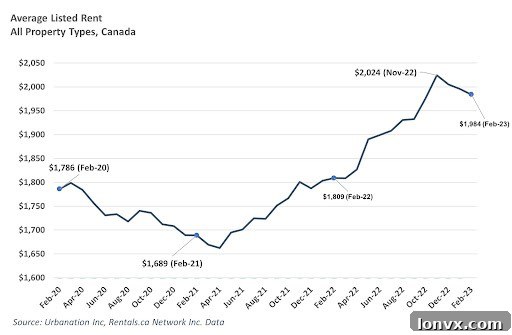
Further analysis of the data indicates a slight retreat in rental costs on a monthly and quarterly basis. Rents saw a marginal decrease of 0.6 percent from January and a more pronounced decline of 2.0 percent over the past three months. While these shifts might offer a glimmer of relief to renters grappling with escalating costs, the overall average asking rent for all property types in Canada remains substantial, currently standing at $1,984. This figure underscores the ongoing affordability challenges faced by many Canadians in a highly competitive housing market. Understanding these trends is vital for anyone invested in or affected by Canada’s evolving rental ecosystem.
Shaun Hildebrand, president of Urbanation, offered valuable insights into these recent market dynamics. “The rental market experienced a pullback over the past three months following record-breaking rent growth in 2022,” Hildebrand stated. This “pullback” can be attributed to a confluence of factors. Primarily, the exceptionally high rental costs reached new ceilings, pushing the limits of affordability for a significant portion of the population. As rental prices soar, a natural tempering occurs as fewer individuals can afford the asking rates, leading to a stabilization or slight decrease in demand at the very top end of the market. Secondly, an increase in new housing supply, particularly from completed apartment projects, has begun to alleviate some of the pressure on the market. While supply additions are always a welcome development, their impact is often localized and may take time to fully propagate across the national market.
Despite the national slowdown, Hildebrand also noted a critical nuance: “However, several key markets experiencing high demand continued to see rents trend higher last month.” This observation highlights the regional disparities within the Canadian rental landscape, where localized economic conditions, population growth, and housing policies can create micro-markets that defy broader national trends. These regions, often characterized by robust job markets and limited housing supply, remain hotspots for rental demand, perpetuating upward pressure on prices. The interplay of these national and regional forces creates a complex picture for renters and investors, demanding a closer look at specific geographic areas to fully grasp the intricacies of the Canadian rental market in February.
Regional Rental Market Insights Across Canada
Delving into the regional specificities of Canada’s rental market reveals a landscape of varied growth rates and affordability challenges. The National Rent Report meticulously tracks the performance of 35 major cities, providing a granular view of where rental costs are soaring and where they offer a relative respite. As expected, two of Canada’s largest metropolitan areas continue to dominate the list for average monthly rent, underscoring the persistent demand and limited supply in these economic powerhouses.
Leading Major Cities: Vancouver and Toronto Maintain Top Spots
Vancouver once again asserted its position as the most expensive city for renters, followed closely by Toronto. In February, the average monthly rent for a one-bedroom residence in Vancouver reached an astonishing $2,640. Toronto, not far behind, reported an average of $2,501 for a one-bedroom unit. These figures are not just high in absolute terms but also represent substantial year-over-year increases, reflecting intense market pressure. Vancouver experienced a 15.3 percent surge, while Toronto saw an even more dramatic rise of 21.5 percent. These significant increases are driven by factors such as strong provincial economies, continuous population growth fueled by immigration, and a chronic shortage of available housing, making these cities particularly challenging for renters seeking affordable options.
Calgary’s Surging Market: A New Growth Leader
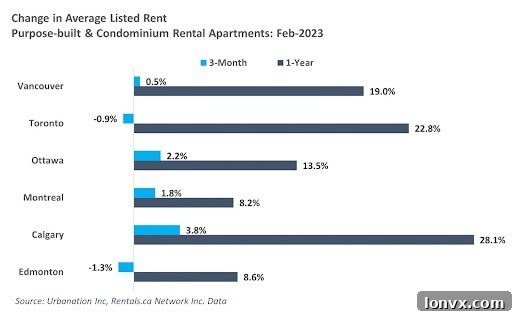
While Vancouver and Toronto remain the most expensive, Calgary emerged as the city with the fastest-increasing rents among Canada’s largest urban centers in February, specifically for condo rentals and apartments. Average rents in Calgary escalated by an impressive 28.1 percent annually. Over the past three months, rents increased by 3.8 percent, bringing the average to $1,862. This rapid growth in Calgary can be attributed to a rejuvenated energy sector, interprovincial migration, and relatively stronger affordability compared to its coastal counterparts. Despite this substantial growth, Calgary rents remain below the national average, with one-bedroom units averaging $1,652, making it an attractive destination for those seeking a balance between economic opportunity and manageable living costs compared to other major Canadian cities.
Toronto and Vancouver: Sustained Highs Amidst Fluctuations
Despite national and some three-month cooling trends, Toronto’s condo rental and apartment market recorded the second-fastest annual rent growth, reaching 22.8 percent in February. This was despite a slight 0.9 percent decline over the past three months, indicating short-term fluctuations within a strong long-term growth trajectory. The average rent for these property types in Toronto stood at $2,838, reflecting the city’s status as a prime economic hub. Similarly, Vancouver, despite its already prohibitive prices, saw average rents for condo rentals and apartments climb by 19 percent annually to $3,120 in February, reinforcing its reputation as Canada’s most expensive rental market. These figures highlight the enduring appeal and demand for housing in Canada’s largest economic centres, where competition among renters remains fierce.
Montreal’s Relative Affordability and Other Key Cities
In contrast to the scorching markets of Vancouver and Toronto, Montreal continues to offer a degree of relative affordability within Canada’s major cities. The average monthly rent for a one-bedroom home in Montreal was $1,623, representing a 7.1 percent increase year-over-year. While still an increase, this growth rate is significantly more modest than those seen in the country’s most expensive markets, making Montreal an appealing option for many. Factors contributing to Montreal’s more stable rent environment include a different urban development trajectory, varied economic drivers, and potentially more accessible housing stock compared to Toronto and Vancouver. Other significant cities also experienced notable rent increases for condo rentals and apartments in February: Ottawa saw a 13.5 percent rise, Edmonton an 8.6 percent increase, and Montreal itself a 8.2 percent increase (for purpose-built and condominium apartments specifically, differentiating from the overall one-bedroom average). These regional updates underscore the diverse forces shaping Canada’s rental landscape, providing a nuanced picture for current and prospective renters alike.
Medium-Sized Rental Markets: Emerging Hotspots
Beyond the well-documented trends in Canada’s largest cities, medium-sized markets are increasingly becoming focal points for significant rent growth and evolving affordability challenges. These cities, often located within the orbit of major metropolitan areas, offer a unique blend of urban amenities and sometimes slightly lower living costs, attracting both residents and investors. The February report from Rentals.ca and Urbanation shed light on these burgeoning markets, revealing concentrated areas of rapid escalation.
Southwestern Ontario Leads Growth in Mid-Sized Cities
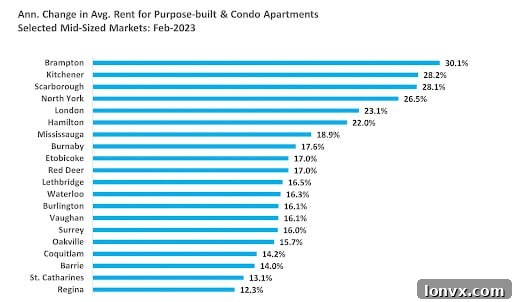
A striking trend highlighted in the report is the dominance of southwestern Ontario in terms of rapid rental price appreciation. The seven fastest-growing medium-sized markets for purpose-built and condominium rentals were all situated in this region. This concentration points to strong economic activity, population spillover from the Greater Toronto Area (GTA), and a persistent supply-demand imbalance in these communities. Brampton, a key city in the Peel Region, led this impressive growth with an astounding 30.1 percent increase in rent, reflecting its attractiveness and the intensifying competition among renters. Other cities in this corridor, such as London, Kitchener, and Hamilton, are also experiencing similar pressures, as individuals and families seek more attainable housing options outside of the hyper-expensive core of Toronto, yet still within commuting distance to employment centers.
Expensive Mid-Sized Markets: Metro Vancouver and GTA’s Reach
While southwestern Ontario leads in growth rate, the absolute most expensive mid-sized rental markets remain firmly anchored within Canada’s two most prominent metropolitan regions. In February, the twelve most expensive mid-sized rental markets were exclusively found in Metro Vancouver and the Greater Toronto Area. This indicates that the gravitational pull of these major economic engines extends significantly into their surrounding suburban and satellite communities. These areas often benefit from robust infrastructure, diverse employment opportunities, and a high quality of life, which translates into sustained demand for rental housing.
Specifically, average rents for purpose-built and condominium apartments in these medium-sized cities were highest in February in a cluster of Metro Vancouver municipalities. Burnaby, known for its rapid development and proximity to downtown Vancouver, recorded an average of $2,902. Coquitlam followed with $2,726, and Richmond with $2,545. These cities often feature new, high-density developments and excellent transit links, making them desirable alternatives to living directly in Vancouver’s core. Similarly, within the GTA, cities such as Oakville and Vaughan both registered average rents of $2,579, closely followed by Etobicoke at $2,546. These GTA locales offer a blend of suburban tranquility and urban convenience, attracting families and professionals alike, and thereby sustaining high rental costs. The consistent presence of these cities at the top of the expensive mid-sized market list underscores the enduring challenge of affordability across Canada’s most economically vibrant regions, extending far beyond the traditional downtown cores.
Provincial Rental Market Dynamics
Understanding rental market trends at the provincial level provides a crucial macro perspective, revealing which regions are experiencing the most intense pressures and shifts. The February National Rent Report offered a clear breakdown of provincial performance for purpose-built and condominium apartments, highlighting divergent trajectories across Canada.
Ontario Leads Annual Rent Growth
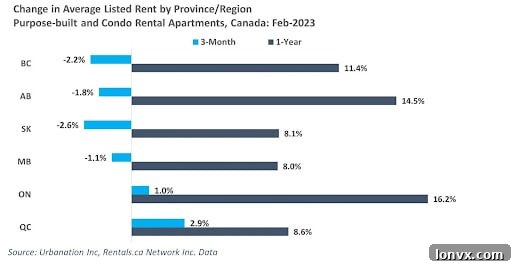
Ontario, Canada’s most populous province and economic powerhouse, continued to lead the country with the highest year-over-year rent increase in February, recording a substantial 16.2 percent surge for purpose-built and condominium apartments. This sustained growth reflects a combination of factors including robust job creation, high levels of immigration, and a persistent housing supply deficit, particularly in the Greater Toronto Area and surrounding regions. The intense competition for available units, coupled with elevated population growth, continues to push rental prices upward across the province, impacting affordability for a broad spectrum of residents. This trend underscores the challenges provincial policymakers face in balancing economic growth with housing accessibility.
Alberta and British Columbia Follow Closely
Following Ontario, Alberta and British Columbia also demonstrated significant annual rent increases. Alberta experienced a 14.5 percent rise, signaling a strong resurgence in its rental market. This can be attributed to a recovering energy sector, interprovincial migration, and a comparatively lower cost of living than provinces on the West Coast or central Canada, which attracts new residents. British Columbia, despite having some of the highest absolute rents in the country, saw annual rents increase by 11.4 percent. While this is a substantial increase, it’s slightly lower than Ontario and Alberta’s growth rates, potentially indicating a slight easing from its peak pressures, although the market remains incredibly tight and expensive, particularly in Metro Vancouver and Vancouver Island communities.
Recent Short-Term Shifts: Quebec and Ontario on the Rise
Looking at the more recent, short-term trends over the past three months, the report reveals interesting shifts. Quebec emerged as the province with the most significant increase during this period, with rents rising by 2.9 percent. This recent acceleration in Quebec’s rental market, particularly in Montreal, suggests growing demand and potentially tighter supply conditions, although its overall annual growth remains more modest compared to the leading provinces. Ontario also continued its upward trajectory, recording a 1.0 percent increase over the last three months, affirming the ongoing demand pressure despite the slight national pullback. These short-term increases in Eastern Canada contrast with the trends observed in other regions.
Declines in Other Provinces
Conversely, all other provinces recorded three-month rent declines for purpose-built and condominium apartments. This broad-based short-term decline across multiple provinces points to a nuanced national market where localized factors and seasonal variations play a role. It could reflect a temporary softening of demand, an influx of new rental units coming online, or a natural market correction after periods of rapid growth. While these short-term dips might offer a momentary reprieve for renters in those specific provinces, the broader annual trends indicate that the Canadian rental market is still experiencing significant upward pressure overall. These provincial variations highlight the complex interplay of economic forces, demographic shifts, and housing supply dynamics that continue to shape Canada’s diverse rental landscape.