Don’t miss out—join us online for REM’s monthly market breakdown on March 25 at 2 PM Eastern. Renowned columnist Daniel Foch will provide a comprehensive analysis of CREA’s latest statistics, dissecting the current market slowdowns and interpreting what shifting buyer sentiment truly means for Realtors across Canada. This is a crucial opportunity to gain insights into navigating an evolving landscape. Registerhere.
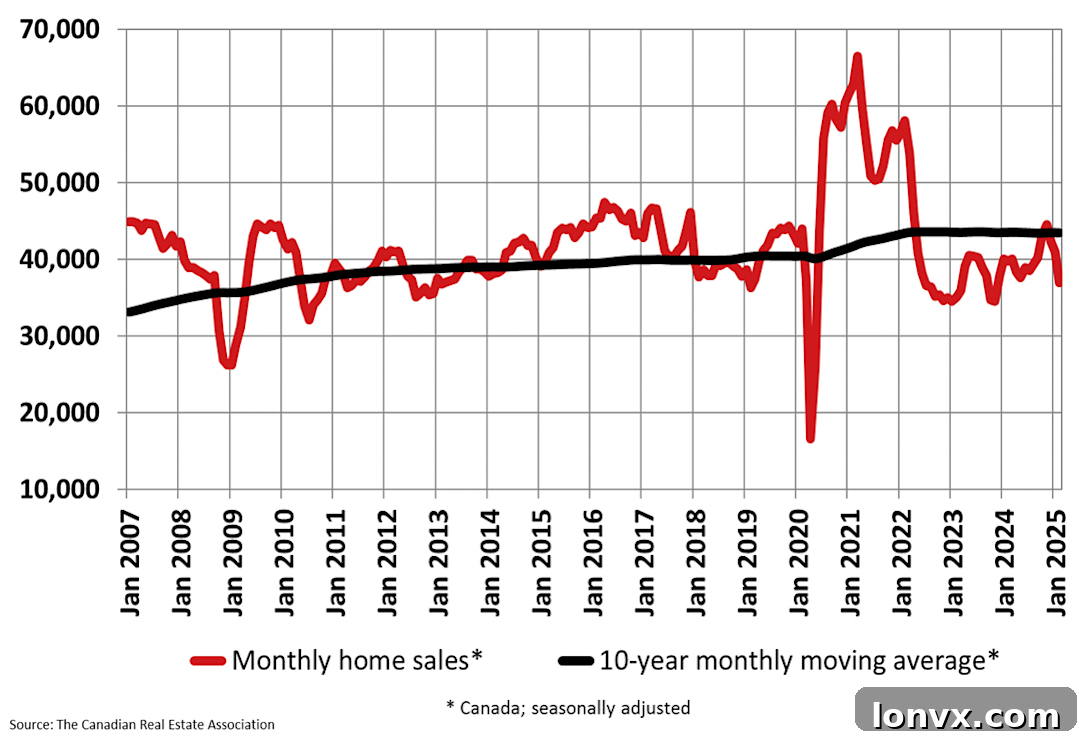
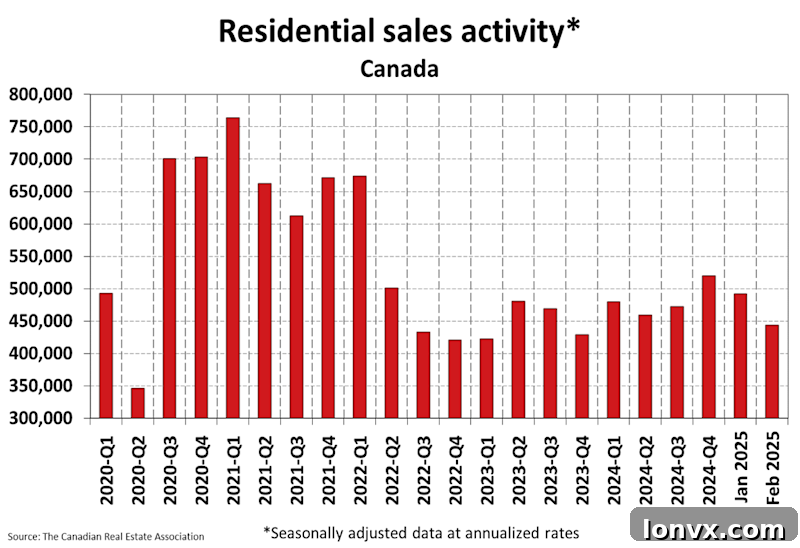
For years, the Canadian housing market has stood as a beacon of resilience, often defying global economic headwinds and local predictions of a significant downturn. Characterized by robust demand, steadily appreciating values, and an unwavering sense of confidence, it seemed almost immune to external pressures. However, recent data suggests this remarkable fortitude is finally being tested by a formidable storm it can no longer immediately weather. According to the latest February 2025 data released by the Canadian Real Estate Association (CREA), the market has experienced a dramatic and widespread plunge in home sales, almost as if the entire sector collectively paused to reassess its trajectory.
Is this sudden shift truly surprising? For many market observers and economists, the answer is a resounding “not really.” This deceleration is largely seen as a predicted, albeit impactful, reaction to escalating geopolitical tensions, particularly the ongoing and intensifying trade dispute with the United States. The ripple effects of this trade war, which has been a topic of serious discussion and concern since the U.S. presidential election victory in November, are now unmistakably manifesting in Canada’s economic landscape, casting a long shadow of uncertainty over previously assured economic certainties and, by extension, the real estate market.
Canadian Homebuyers: Navigating the Crossroads of “Wait-and-See” and “Panic Mode”
The nearly 10 percent month-over-month drop in national home sales isn’t just another statistical blip on the radar; it’s a profound and unequivocal message that potential homebuyers are choosing to hit the pause button. What makes this particular pause so noteworthy is its timing: it coincides with what is historically one of the most vibrant and active periods for real estate—the very beginning of the spring market. This is a time when activity typically surges, fueled by improving weather, renewed buyer enthusiasm, and a fresh wave of listings. Yet, instead of bustling open houses and competitive bidding wars, potential homeowners across the nation appear content to observe the market from the sidelines.
Shaun Cathcart, CREA’s senior economist, aptly described this widespread hesitation as “hardly surprising,” acknowledging the prevailing economic anxieties. However, this raises a critical question for prospective buyers: Is this current caution a prudent response to genuine risks, or a collective step towards panic that could lead to missed opportunities? The answer likely lies in a nuanced understanding of the economic currents.
Regions traditionally seen as economic bellwethers are feeling this pinch most acutely. Ontario’s Greater Golden Horseshoe (GGH) area, encompassing the dynamic Toronto market and its surrounding bustling communities, is a prime example. Usually a vibrant pulse point of market activity, the significant decline observed in this region is more than just a localized concern; it serves as a powerful symbol of the broader uncertainty now gripping Canada’s major urban real estate markets. The GGH’s sensitivity to market shifts makes its current struggle particularly indicative of nationwide trends.
Prices Cooling: Unpacking the Initial Tremors of a Potential Market Correction
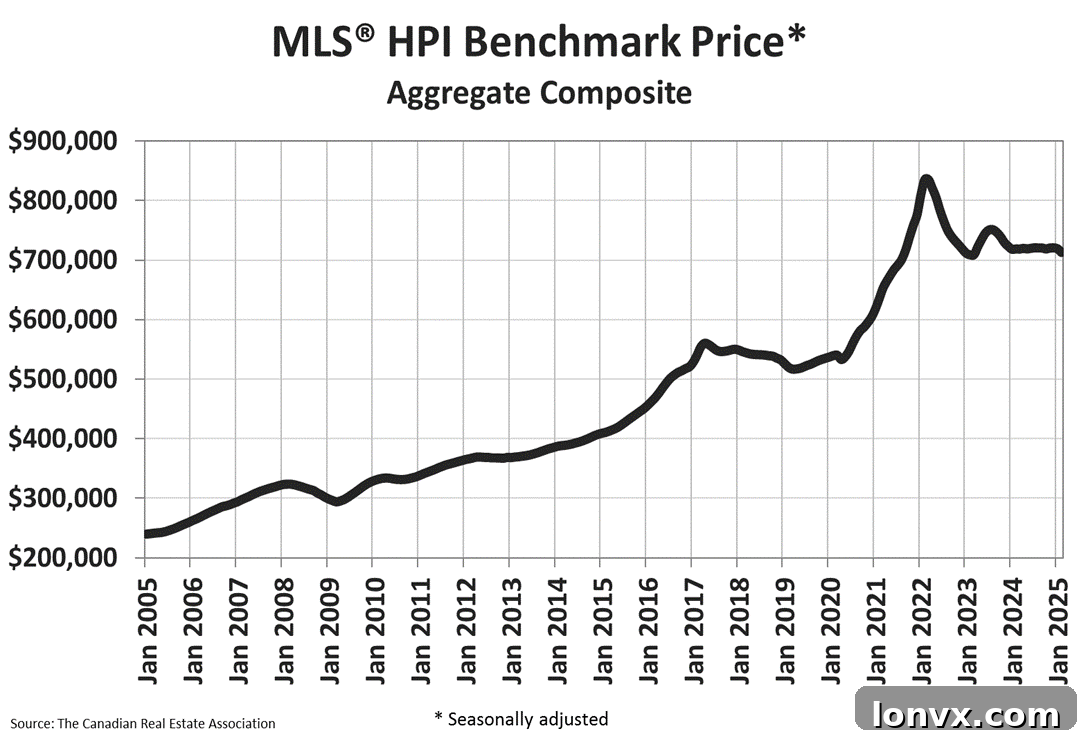
With a noticeable reduction in transaction volumes, the market has inevitably begun to experience a predictable domino effect on property pricing. The 0.8 percent month-over-month decline in the MLS® Home Price Index (HPI) might, at first glance, appear modest. However, its significance should not be underestimated: it marks the sharpest monthly dip recorded since December 2023, signaling a break from recent trends and hinting at an accelerating downward trajectory.
Even more telling is the 1 percent year-over-year decrease in the HPI, which when combined with a notable 3.3 percent year-over-year drop in the actual (not seasonally adjusted) national average sale price, paints a clearer, more compelling picture. This dual significant downward shift doesn’t merely suggest a gentle market cool-down, a healthy moderation after periods of rapid appreciation. Instead, these figures could very well represent the initial tremors of a deeper, more profound market correction taking root within Canadian real estate. A correction typically implies a return to more sustainable, long-term valuation trends after periods of unsustainable growth.
Some market optimists might be inclined to view these lower average prices as a much-needed reprieve from the relentless price escalation that characterized previous years. They might argue that this offers crucial affordability breathing room for many prospective buyers who have been priced out of the market. And indeed, from a purely purchasing power perspective, lower prices do make homes more accessible.
However, it would be imprudent and potentially misleading to interpret this solely as good news. Price drops that are primarily prompted by widespread caution and underlying economic unease rarely remain neatly confined to isolated segments of the market. Such shifts can quickly spill over, triggering broader market disruptions and impacting not only buyers but also existing homeowners and sellers. The perceived silver lining is clear: more affordable homes theoretically increase the likelihood of purchases. Yet, this positive factor is heavily outweighed by growing economic anxieties. People are considerably less likely to make significant financial commitments like buying a home if they are apprehensive about potential job losses, business failures, or substantial investment devaluations. These recessionary fears, amplified by the uncertainty surrounding the trade war, seem more pervasive now than Canada has experienced in recent memory, profoundly influencing consumer behavior.
Listings Follow Suit: A Delicate Equilibrium Despite Falling Numbers
It appears that the “wait and see” mentality isn’t exclusive to buyers. Sellers, too, are exhibiting a similar cautious approach, seemingly holding back on listing their properties in an uncertain market. February witnessed a dramatic reversal in the number of newly listed homes, which plummeted by an significant 12.7 percent. This sharp decline effectively negated the unusual and unexpected spike in listings that had characterized the market in January, indicating a swift shift in seller sentiment.
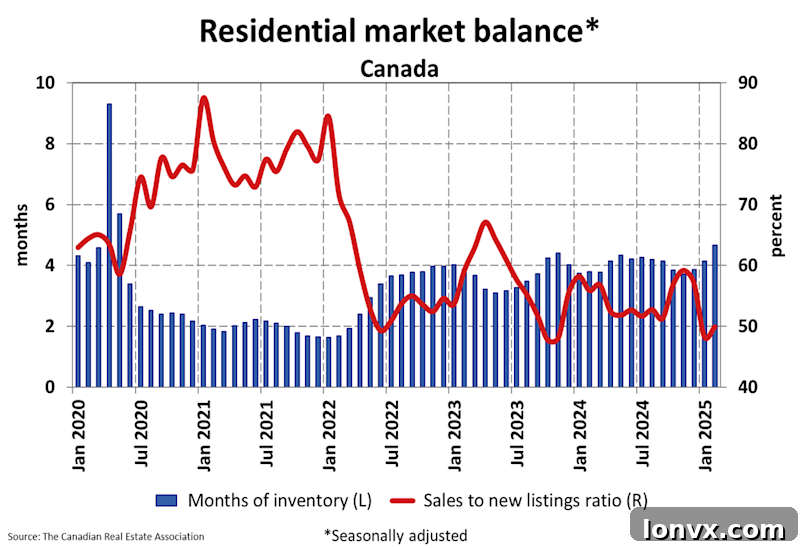
Intuitively, one might expect a reduction in new listings to create a tighter, more competitive market, potentially pushing prices up due to scarcity. However, in this peculiar market environment, sales also experienced a significant decline, resulting in an oddly balanced, albeit subdued, state. The sales-to-new listings ratio, a key indicator of market balance, crept up slightly to 49.9 percent. This figure, falling comfortably within the “balanced” range (typically between 40% and 60%), suggests that despite the dramatic shifts, supply and demand are moving in a synchronized fashion. Yet, this equilibrium is inherently fragile, prone to disruption if either buyers or sellers collectively decide they’ve had enough of the current ambiguity and make a decisive move, whether to flood the market with listings or aggressively pursue purchases.
The Pervasive Fear of the Unknown: Economic Anxiety Driving Housing Decisions
An increase in housing inventory, measured by the number of months it would take to sell all available homes at the current rate of sales, typically signals more choice for buyers and less urgency to commit. The rise from 4.1 to 4.7 months suggests precisely this. However, this seemingly positive development comes with an uncomfortable undertone. Buyers are not enthusiastically choosing to wait for better opportunities; rather, they are hesitantly stepping back, driven by apprehension. A truly healthy market thrives on active participation, characterized by eager buyers and confident sellers. What we are witnessing instead is widespread hesitation, a profound reflection of the growing uncertainty pervading the broader economic outlook.
CREA Chair James Mabey accurately encapsulates the prevailing sentiment, noting, “The uncertainty of the last few weeks seems to be causing some buyers to think twice about big financial decisions right now.” This highlights a crucial shift: housing decisions are no longer purely driven by economic fundamentals like interest rates or supply levels. They are increasingly influenced by psychology. Every headline reporting on the escalating Canada-U.S. trade dispute, with its potential implications for tariffs, supply chains, and job security, chips away at consumer confidence. This erosion of confidence leaves buyers hesitant to commit to major investments, particularly property, for fear that today’s political and economic tensions could swiftly spiral into tomorrow’s full-blown economic crisis. The psychological weight of this uncertainty is proving to be a powerful deterrent.
Navigating Uncertainty: The Bumpy Road Ahead for Canadian Real Estate
The undeniable truth is that no one possesses a crystal ball to accurately predict how long the shadow of the ongoing trade war will hang over Canada’s real estate market. However, what appears almost certain is that short-term volatility will be unavoidable. The market feels precariously perched at a tipping point; a single strong gust of economic news, whether positive or negative, has the potential to tip it sharply in either direction. This means that both buyers and sellers should prepare for a period of heightened unpredictability.
It is prudent for all market participants—from first-time homebuyers to seasoned investors and developers—to brace themselves for what could be a significantly bumpy ride. Flexibility, caution, and a deep understanding of local market nuances will be paramount. For buyers, this might mean opportunities for less competitive purchasing, but also the risk of further price depreciation. For sellers, it could necessitate realistic pricing strategies and patience.
To be fair, the Canadian housing market has experienced its share of turbulence in the past, and many are accustomed to its cyclical nature. However, the current situation is distinct due to the overriding influence of geopolitical factors. After what momentarily looked like a glimmer of hope for a rebound in monthly home sales, the latest figures firmly place market activity below the 10-year average. This historical context suggests that the current slowdown isn’t merely a temporary blip but could be indicative of a prolonged period of adjustment as the market recalibrates in response to unprecedented external pressures and shifting national sentiment. Staying informed and adaptable will be key to navigating these challenging waters.