
The Canadian housing market has entered 2023 much as it concluded 2022: with a pronounced sense of calm and a notable deceleration in activity. This trend, signaling a significant shift from the frenetic pace of recent years, is meticulously detailed in a new report from RBC. Robert Hogue, RBC’s assistant chief economist, highlights that January’s real estate data across Canada largely reinforces a narrative of persistent weak activity and widespread price declines, with only a handful of markets exhibiting remarkable resilience.
At the heart of this widespread slowdown lies the aggressive interest rate hike campaign initiated by the Bank of Canada. These decisive monetary policy adjustments have profoundly impacted the housing landscape, creating substantial headwinds for prospective homebuyers. Many individuals who once qualified for mortgages now find themselves unable to meet the revised lending criteria, while others face significantly reduced purchasing power, necessitating a re-evaluation of their housing budgets and expectations.
While the national picture reflects a general cooling, Calgary stands out as a notable exception. This vibrant Western Canadian city has maintained remarkably tight demand and supply conditions, a testament to its unique economic drivers and demographic patterns. Although sales volumes have tempered from the “sky-high” levels recorded in the previous year, Calgary’s market resilience provides a fascinating counterpoint to the broader national trend of softening demand.
Decoding the Downturn: The Impact of Bank of Canada’s Rate Hikes on Canadian Real Estate
The trajectory of Canada’s housing market in late 2022 and early 2023 is undeniably shaped by the Bank of Canada’s proactive efforts to curb inflation through a series of rapid and substantial interest rate increases. This campaign, unprecedented in its speed and scale, has had a direct and immediate impact on mortgage rates, fundamentally altering the financial landscape for both current homeowners and aspiring buyers. The cost of borrowing has surged, leading to a significant tightening of mortgage qualification criteria and a corresponding erosion of affordability across the country.
As mortgage rates climbed, the monthly cost of servicing a home loan increased dramatically, pushing many potential buyers out of the market entirely. For those still able to qualify, the amount they can comfortably borrow has diminished, forcing them to either scale back their housing aspirations or delay their purchase plans. This reduction in purchasing power has been a primary catalyst for the decline in sales activity, as fewer buyers are capable of transacting at previous price points. Furthermore, the psychological effect of rising rates has fostered a wait-and-see attitude among many, with prospective buyers hoping for further price corrections or a stabilization of interest rates before making a significant investment.
The ripple effect extends beyond new purchases, influencing homeowners with variable-rate mortgages or those approaching renewal. The increased financial burden on these groups can impact consumer spending and broader economic confidence, adding another layer of complexity to the housing market’s outlook. RBC’s analysis underscores that the Bank of Canada’s decisive actions, while necessary for inflation control, have undeniably recalibrated expectations and market dynamics within the real estate sector, initiating a period of recalibration and adjustment for all stakeholders.
A Tale of Two Markets: Rapid Ascent and Subsequent Correction in High-Priced Regions
The housing boom witnessed during the pandemic era was characterized by unprecedented price appreciation and surging demand, particularly in Canada’s most populous and economically dynamic urban centres. Regions like Vancouver, Toronto, and their surrounding metropolitan areas experienced stratospheric growth, fueled by low interest rates, increased disposable income, and a desire for more living space. However, these very markets, which ascended most rapidly, have consequently endured the most significant and abrupt corrections as interest rates began their sharp climb.
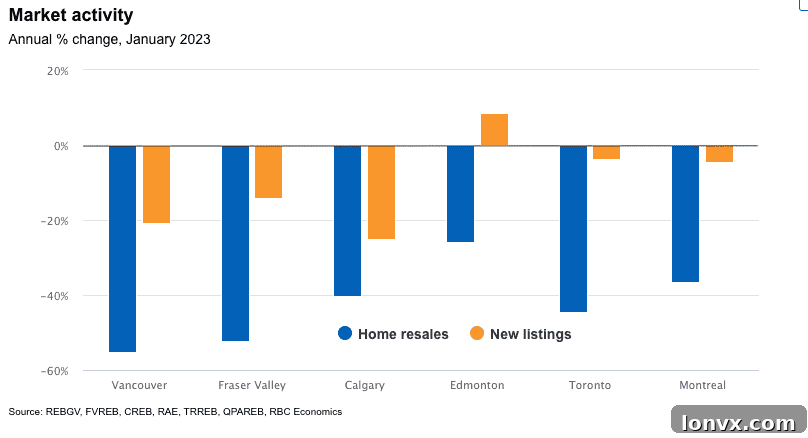
RBC’s report reveals a stark reality for these high-priced zones: home resales have plummeted by at least 45 percent over the past year in Vancouver, Toronto, and their expansive surrounding regions. This dramatic reduction in transaction volumes highlights a significant retreat of buyer demand, a direct consequence of eroded affordability and cautious market sentiment. The price declines in these areas have also been the most pronounced, effectively unwinding a portion of the gains accumulated during the peak of the pandemic frenzy. This demonstrates the sensitivity of these overheated markets to shifts in economic fundamentals, particularly interest rate policy.
Easing Corrections and the Path to Stability
Despite the severity of the downturn in these previously red-hot markets, there are nascent signs that the pace of correction may be moderating. According to Robert Hogue, the monthly rates of decline have shown signs of slowing in recent months, particularly in key regions like Ontario (encompassing the Toronto market) and British Columbia (including Vancouver), alongside several other Canadian markets. This deceleration in the speed of price drops suggests that the initial shock of rising interest rates may be dissipating, and the market could be moving towards a period of greater equilibrium.
While prices are still trending downwards, the less precipitous month-over-month declines indicate a potential shift from a rapid freefall to a more gradual adjustment. This easing of the correction is a crucial development, offering a glimmer of hope for a more predictable and stable market environment in the near future. It also provides a foundation upon which future recovery can be built, albeit a gradual one, as the market begins to absorb the cumulative impact of economic shifts and adapt to new affordability benchmarks.
On the Horizon: A Cyclical Bottom and Gradual Recovery for Canadian Housing
Optimism is cautiously emerging regarding the future trajectory of Canada’s housing market, with many economists, including those at RBC, anticipating a cyclical bottom in the spring or summer of 2023. This forecast is largely predicated on the expectation that the Bank of Canada has concluded its aggressive campaign of interest rate hikes. With the central bank signalling a potential pause in further rate increases, the market can begin to establish a clearer baseline for affordability and borrowing costs, reducing the uncertainty that has plagued both buyers and sellers.
While the precise timing of this bottom may exhibit regional variations, the general consensus points towards a period of stabilization on the horizon. However, RBC economists temper expectations by emphasizing that the subsequent recovery is likely to be gradual rather than a sharp rebound. The enduring impact of higher interest rates will continue to exert downward pressure on housing activity and limit purchasing power for an extended period. This means that even after the market finds its floor, a return to pre-correction levels of sales and prices will not be instantaneous, necessitating patience and strategic planning from all market participants.
The path to recovery will be characterized by a delicate balance between persistent affordability challenges and the gradual rebuilding of buyer confidence. As interest rates stabilize, and potentially, if economic conditions improve, a slow but steady re-engagement from buyers might be observed. However, the lessons learned from the rapid corrections in 2022 will likely instill a more cautious approach, favouring sustainable growth over speculative surges. The forthcoming period will therefore be one of adjustment, as the Canadian housing market recalibrates to a new normal dictated by higher borrowing costs and a more balanced supply-demand dynamic.
Regional Spotlight: Navigating Diverse Housing Landscapes Across Canada
Beneath the national averages and general trends, Canada’s vast and diverse geography translates into vastly different real estate experiences. While the overarching narrative is one of cooling, the specifics of market performance vary significantly from one major urban centre to another. RBC’s report provides crucial regional insights, revealing how local economic conditions, supply dynamics, and historical growth patterns are influencing the current downturn and shaping the prospects for recovery.
Toronto’s Housing Market: A Prolonged Price Correction Ahead?
The Toronto area housing market, once a paragon of relentless appreciation and intense competition, has experienced an intense cooldown, resulting in its quietest resale activity in 14 years, excluding the unique circumstances of the pandemic lockdown period. This dramatic deceleration in transactions has naturally led to a significant slowdown in price appreciation, transitioning into outright declines. For a market that has historically seen robust growth, this period marks a profound shift, challenging long-held expectations of continuous escalation.
While RBC’s analysis notes a moderation in the slide of activity over the past few months, indicating a potential stabilization in transaction volumes, economists anticipate that the price correction in the Toronto area may still have further to run. The MLS Home Price Index (HPI) has declined for 11 consecutive months, yet it has only reversed approximately one-third of its substantial 57 percent gain achieved during the pandemic era. This considerable discrepancy suggests that prices, despite their recent drops, may still be elevated relative to current affordability metrics and long-term sustainable growth trajectories. RBC economists project that buyers, facing persistent affordability challenges and higher borrowing costs, will continue to actively seek more affordable housing options, which will likely exert continued downward pressure on prices as the market adjusts to align with revised budget realities.
Montreal’s Real Estate: From Seller’s Advantage to Buyer’s Caution
Montreal’s housing market has witnessed a significant pickup in its slowdown since late summer, with January 2023 recording the weakest resale activity since 2009. On a seasonally adjusted basis, resales in January dipped by a further 11 percent from December, underscoring a deepening market contraction. This deceleration is directly reflected in pricing, with median prices for both condos and single-family homes declining by 10 percent and 14 percent, respectively, since April of the previous year. RBC economists anticipate that this trend of price erosion is likely to continue in the near term, as the market seeks a new equilibrium.
A crucial shift in Montreal’s market dynamics has been the noticeable increase in inventory. This rise in available homes has fundamentally altered the demand-supply balance, moving away from a protracted seller’s market towards one that no longer distinctly favours sellers. Compounding this, the persistent decline in affordability, driven by higher interest rates, has put prospective buyers on edge, fostering a sense of caution and hesitation. Furthermore, a weakening broader economy introduces another layer of concern, impacting consumer confidence and employment prospects. RBC expects that it will take a considerable period for buyer confidence to fully rebuild and for market trends in Montreal to stabilize, indicating a prolonged adjustment phase for the region’s real estate sector.
Vancouver Housing: Bargaining Power Shifts Amidst Persistent Declines
Vancouver, another bellwether for Canada’s high-cost housing markets, is actively experiencing a synchronized decline in both prices and resale activity. RBC economists point to a continuous 10-month decline in prices, a stark indicator of the market’s response to elevated interest rates and diminished buyer confidence. Resales in Vancouver are currently hovering near their lowest point since the global financial crisis, excluding the unique and transient impact of the pandemic lockdown period, highlighting the severity of the current market contraction.
Despite an increase in new listings, which typically signals more choice for buyers, resales surprisingly dropped another seven percent month-over-month in January, culminating in a significant 55 percent decline over the past year. This persistent drop in transactions, even with more homes on the market, underscores a profound lack of buyer urgency and purchasing capacity. Robert Hogue explains that the rise in new listings directly translates into enhanced bargaining power for buyers, as sellers are compelled to compete more aggressively for fewer active purchasers. He anticipates that this shift in leverage will continue to drive prices down in the coming months.
The MLS HPI for Vancouver has already fallen by 12 percent since March 2022. Looking ahead, RBC specifically identifies single-detached homes as most vulnerable to further value erosion, given their higher price points and sensitivity to interest rate changes. Conversely, condo prices are expected to exhibit greater resilience, supported by relatively stronger demand from first-time buyers and those seeking more affordable entry points into the Vancouver market.
Calgary’s Resilient Real Estate: A Western Canadian Anomaly
In stark contrast to the prevailing national trends, Calgary continues to buck the slowdown, asserting its position as a unique and remarkably resilient market. Robert Hogue characterizes Calgary as the tightest market in Western Canada, a testament to its robust local economy, sustained population growth, and comparatively more affordable housing landscape. While the city has experienced 11 consecutive months of declining home resales, including an eight percent dip in January, this activity still remarkably remains 32 percent above pre-pandemic levels. This divergence highlights Calgary’s fundamental demand strength even in a cooling national environment.
Hogue notes that a sharp drop in new listings during the last month may have inadvertently contributed to the recent decline in resales, as it limited available inventory despite healthy demand. The MLS HPI in Calgary currently remains above year-ago levels, a rare feat in the current national climate. However, RBC cautions that this may not persist for much longer, as the index has generally trended lower since May 2022. Hogue anticipates that this gradual downward trend in the HPI will continue in the near term, suggesting that even Calgary, despite its resilience, is not entirely immune to the broader market forces. Nevertheless, its performance continues to stand out, offering a compelling case study of a market navigating challenging times with remarkable stability and demand.
Future Outlook and Key Takeaways for Canadian Homeowners and Buyers
The latest RBC Special Housing Report paints a comprehensive picture of a Canadian real estate market undergoing a significant recalibration. While the era of rapid price growth and intense competition has largely subsided, the transition to a more balanced and sustainable market is expected to be gradual and uneven across different regions. The overarching theme for 2023 remains one of caution, with affordability challenges and elevated interest rates continuing to shape buyer behaviour and market activity.
For homeowners, particularly those with variable-rate mortgages or upcoming renewals, prudent financial planning and an understanding of evolving market values will be crucial. For prospective buyers, the current market presents both challenges and opportunities. While higher borrowing costs necessitate revised budgets, the increasing inventory and softening prices in many areas could eventually offer entry points that were unimaginable during the pandemic peak. The key lies in patience, thorough research, and a clear understanding of local market dynamics.
As the Bank of Canada concludes its rate hike cycle, the market is poised to find its cyclical bottom, paving the way for a recovery that is anticipated to be slow but steady. This period of adjustment, though challenging, is a necessary phase for the Canadian housing market to move towards a more sustainable trajectory, ensuring long-term stability and accessibility. Monitoring expert analyses, such as those provided by RBC, will be vital for all stakeholders navigating this evolving landscape.
For a more detailed analysis and further insights into these market dynamics, you can download the latest RBC special housing report here.