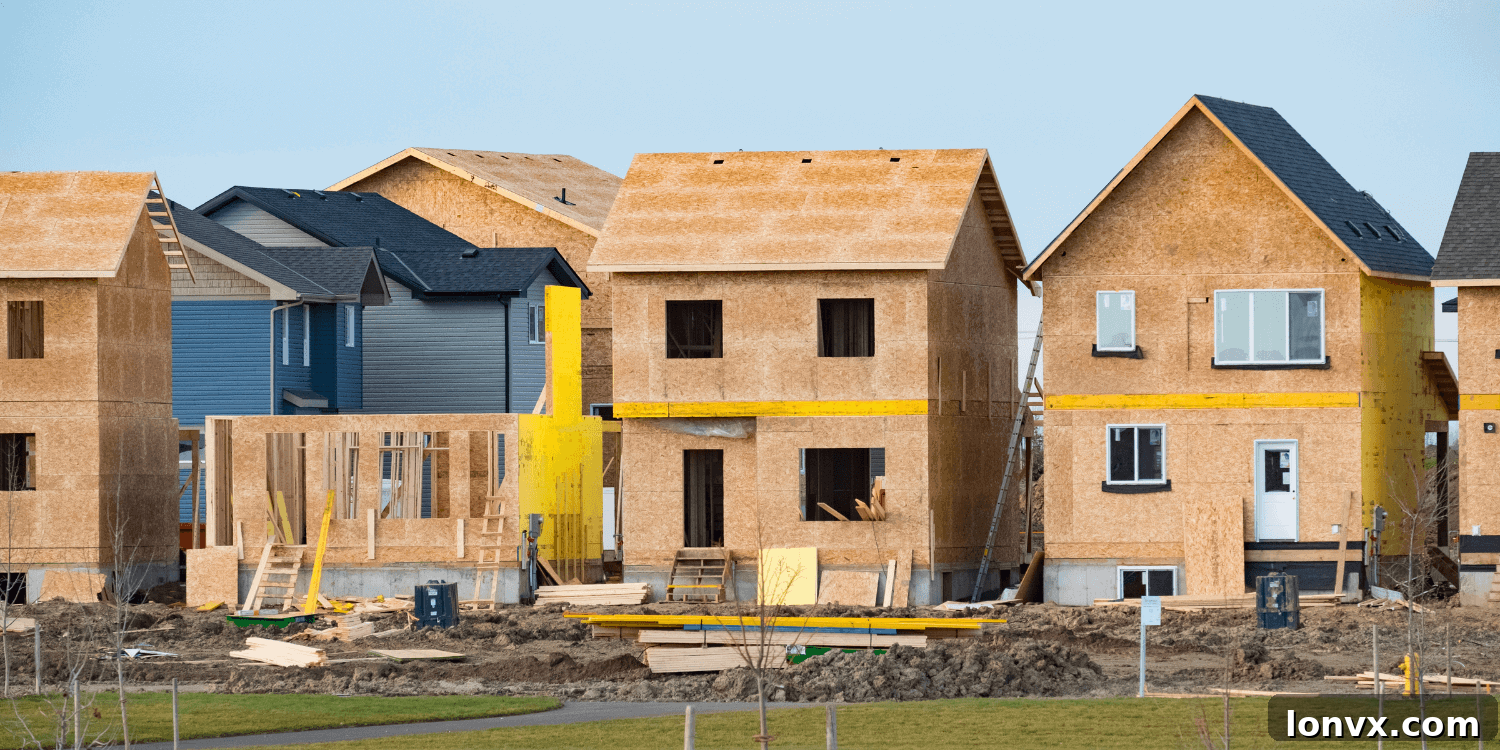
Canadian Housing Market Experiences Notable Surge in April Housing Starts
The Canadian real estate landscape demonstrated a robust performance in April, with housing starts recording a substantial month-over-month increase. This positive momentum signals a dynamic period for the nation’s housing sector, prompting a closer look at the underlying drivers and future implications. According to the latest data released by the Canada Mortgage and Housing Corporation (CMHC), the standalone monthly seasonally adjusted annual rate (SAAR) of total housing starts escalated by an impressive 22 per cent in April, reaching a total of 261,559 units.
This significant uplift offers a glimmer of optimism amidst ongoing discussions about housing supply and affordability across the country. While a single month’s data doesn’t define a long-term trend, it provides valuable insights into the immediate responsiveness of the construction industry to prevailing market conditions and demand signals.
Multi-Family Sector Propels National Growth
The primary catalyst behind this nationwide surge in housing starts was unequivocally the multi-family sector. This segment witnessed a remarkable 33 per cent month-on-month increase, culminating in 201,621 units. This dramatic expansion in multi-unit dwellings underscores a continuing shift in development strategies and buyer preferences, often driven by factors such as urban densification, land scarcity, and the increasing demand for more affordable housing options in bustling metropolitan areas.
Multi-family constructions, encompassing condominiums, townhouses, and rental apartments, are becoming increasingly vital in addressing Canada’s housing supply challenges. Their development allows for higher population densities, efficient use of urban land, and the potential to offer more diverse housing types at varying price points, thereby catering to a broader spectrum of the population, including first-time homebuyers and renters.
Single-Detached Starts See Modest Decline
Conversely, the single-detached urban starts experienced a slight contraction, decreasing by 2.0 per cent to approximately 40,000 units. This decline in single-family home construction reflects a different set of market dynamics. High land costs, elevated construction expenses, and the impact of rising interest rates have collectively made single-detached housing a more challenging and expensive proposition for both developers and prospective homeowners.
Furthermore, the shift away from single-detached homes is a trend observed in many developed urban centers globally, as cities strive for more sustainable growth models and residents increasingly opt for the convenience and amenities offered by multi-unit living close to urban cores. This segment’s performance highlights the ongoing evolution of the Canadian housing market, where affordability and urban planning increasingly favor higher-density living.
Regional Performance: Urban Centers Lead the Way
The April data revealed distinct regional variations, with several major urban centers posting exceptional gains in total SAAR housing starts. These cities are often at the forefront of Canada’s economic activity and population growth, making their housing market performance a key indicator of national trends.
- Vancouver experienced a substantial increase of 36 per cent, reflecting the persistent demand and robust development activity in one of Canada’s most competitive real estate markets. The city’s growth in both multi-unit and single-detached segments speaks to its unique market resilience and diverse buyer pool.
- Toronto saw an even more impressive jump of 54 per cent. As Canada’s largest metropolitan area, Toronto’s housing market is a crucial barometer for the entire country. The significant increase here, primarily propelled by multi-unit starts, underscores efforts to boost housing supply in a region grappling with severe affordability issues and rapid population expansion.
- Montreal also recorded a strong performance with a 43 per cent increase. Montreal’s dynamic growth points to a thriving real estate market in Quebec, attracting both domestic and international interest. Like Toronto, its gains were predominantly fueled by the multi-unit sector.
While Toronto and Montreal recorded declines in single-detached starts, these were more than compensated by substantial increases in multi-unit starts, highlighting a concentrated effort to deliver higher-density housing. Vancouver, however, showcased a comprehensive expansion, posting increases in both single-detached and multi-unit segments, indicating a broad-based strength in its construction sector.
Atlantic Region Shows Remarkable Percentage Gain
Beyond the major urban centers, the Atlantic Region emerged as a significant player, witnessing the largest monthly percentage gain in housing starts. The region saw an increase of 4,000 units, reaching a healthy 10,200 units. This surge reflects the ongoing economic revitalization and population growth observed across Atlantic Canada, making it an increasingly attractive destination for residents and developers alike. The comparatively lower cost of living and strong community ties continue to draw new residents, fueling demand for new housing.
Contribution of Rural Starts
In terms of rural starts, the monthly SAAR estimate stood at 19,974 units. While often overshadowed by urban developments, rural housing starts play an important role in contributing to the overall housing supply across Canada, addressing the needs of communities outside major metropolitan areas and supporting local economies.
Decoding the Trend: Short-Term Surge vs. Long-Term Stability
Despite the pronounced short-term positive momentum observed in April, the broader trend in housing starts remained relatively stable, experiencing a modest 0.2 per cent decrease from March. The trend measure, which represents a six-month moving average of the monthly SAAR of total housing starts, stood at 240,403 units in April. This distinction between the monthly SAAR and the six-month moving average is crucial for understanding the market’s true direction. The monthly SAAR can be volatile, reflecting short-term bursts or slowdowns, while the trend measure provides a more smoothed-out view of the underlying trajectory, filtering out month-to-month fluctuations.
The slight dip in the trend measure suggests that while April saw an impressive surge, it followed periods of slower activity, resulting in a more tempered outlook when viewed over a longer span. This highlights the importance of analyzing both short-term performance and long-term trends to gain a comprehensive understanding of the Canadian housing market’s health.
Economic Perspectives and Future Forecasts
Leading economic institutions are closely monitoring these trends and offering their perspectives on the future trajectory of housing starts.
TD Economics’ Outlook
According to TD Economics, the decline in the overall trend, despite April’s monthly surge, is largely attributable to single-detached units. Economists at TD suggest that sales of these homes unwound their significant pandemic-era gains last year. This unwinding is now translating into slower construction activity for single-detached dwellings. TD economists anticipate that housing starts will continue to trend lower in the near future, attributing this to past declines in home sales gradually passing through to weaker homebuilding activity across the country. This perspective indicates that the market is still adjusting to the post-pandemic reality, marked by higher interest rates and a re-evaluation of housing preferences.
CMHC’s Expert Insights and Challenges Ahead
Aled ab Iorwerth, CMHC’s Deputy Chief Economist, provides a nuanced perspective on the recent surge and future expectations. He explains that while the recent surge in housing starts reflects a welcome return to pre-pandemic levels, the outlook for the immediate future remains challenging. “Housing starts are expected to drop significantly in 2023, before seeing some recovery in 2024 and 2025, according to our latest forecast,” states ab Iorwerth. This forecast suggests that the April surge, while positive, may be an anomaly within a broader context of impending challenges.
The expected decline in 2023 is attributed to a confluence of significant constraints impacting new construction. These include:
- Labour shortages: A persistent lack of skilled tradespeople and construction workers continues to hamper the industry’s ability to scale up production, leading to project delays and increased costs.
- Higher construction costs: Escalating prices for building materials, transportation, and other inputs contribute significantly to the overall cost of new homes, making projects less feasible for developers and more expensive for buyers.
- Increased borrowing costs for housing developers: With central banks raising interest rates to combat inflation, developers face higher costs for financing their projects, which can deter new ventures and slow down existing ones. This financial burden inevitably translates to higher prices for consumers.
These supply-side challenges, coupled with economic uncertainties, paint a complex picture for the Canadian housing market in the short to medium term. The projected recovery in 2024 and 2025 will likely hinge on the alleviation of these constraints, potentially through government initiatives, stabilization of interest rates, and a more robust supply chain for construction materials.
Broader Implications for the Canadian Real Estate Market
The interplay of these factors has profound implications for various stakeholders in the Canadian real estate market, from prospective homeowners to policy makers and investors.
Impact on Housing Affordability
While the surge in multi-family starts is a positive step towards increasing housing supply, the overall challenges highlighted by CMHC suggest that affordability issues may persist. If new construction significantly slows in 2023 as forecasted, it will further exacerbate the supply-demand imbalance, potentially pushing prices higher in an environment where many Canadians are already struggling to enter the market.
Policy Considerations and Government Response
The insights from CMHC and TD Economics underscore the urgent need for comprehensive policy responses. Governments at all levels may need to address labor shortages in the construction sector through training and immigration initiatives, streamline permitting processes to reduce delays, and explore mechanisms to mitigate rising construction and borrowing costs for developers. The goal must be to foster an environment conducive to sustainable housing development that can meet the needs of a growing population.
Investor Sentiment and Market Dynamics
For investors and developers, the forecasts suggest a period of cautious optimism mixed with strategic planning. While strong demand persists, the operational and financial hurdles outlined by CMHC will require innovative approaches to project management and financing. The focus on multi-family developments is likely to continue, given its greater potential for profitability and alignment with urban planning objectives.
Conclusion: A Market at a Crossroads
April’s significant surge in Canadian housing starts, particularly in the multi-family sector, provides a positive, albeit complex, signal for the nation’s real estate market. While the monthly data offers a snapshot of robust activity, particularly in key urban centers and the Atlantic Region, the underlying trend and expert forecasts point to a more challenging outlook for the remainder of 2023. Supply-side constraints, including persistent labor shortages, escalating construction costs, and higher financing expenses for developers, are expected to temper construction activity before a potential recovery in 2024 and 2025.
The Canadian housing market is clearly at a crossroads, balancing strong demand and the urgent need for increased supply against a backdrop of economic headwinds and structural challenges. Monitoring future data, understanding the interplay between economic policies and market dynamics, and fostering collaborative solutions will be crucial in navigating the complexities of Canada’s evolving real estate landscape.