
The Canadian housing market exhibited a remarkably stable, almost stagnant, performance in March 2024. Data from Canadian MLS systems revealed a modest 0.5 percent uptick in home sales month-over-month, a figure that nonetheless left activity considerably below the long-term 10-year average. Concurrently, the national composite MLS Home Price Index (HPI) saw a marginal dip of 0.3 percent from the previous month, maintaining an overall flat trajectory.
This period of minimal change signals a market caught in a delicate balance. While many forecasts anticipate a resurgence later in the year, current conditions appear heavily influenced by persistently high interest rates and the pervasive anticipation of impending rate cuts by the Bank of Canada. Buyers and sellers alike seem to be holding their breath, creating a cautious environment where significant movements in either direction are rare.
Canadian Consumers Tapped Out: Is a Buyer’s Market on the Horizon?
The prevailing flat market behavior strongly suggests that Canadian consumers are currently “tapped out,” struggling under the weight of record-high housing unaffordability. It’s unlikely that the market will experience substantial growth until affordability levels improve significantly.
Affordability in real estate is a complex interplay of three primary factors: home prices, prevailing interest rates, and household income levels. To illustrate the severity of the current affordability crisis, Bloomberg data indicates that restoring pre-COVID affordability in Canada would necessitate either a drastic 33 percent reduction in home prices, a substantial 55 percent increase in average incomes, or an aggressive 350 basis point drop in interest rates. While such dramatic shifts in any single factor are improbable, a gradual combination of these adjustments is expected to pave the way for a recovery in the Canadian real estate market.
Interestingly, recent data suggests a potential shift towards a buyer’s market. An increase in new properties listed for sale could help alleviate some of the existing demand pressure. A more balanced market, or even one favoring buyers, could lead to what economists refer to as “negative price discovery”—a scenario where prices adjust downwards as sellers compete for fewer active buyers. The full extent of these dynamics and their impact on the Canadian housing market will become clearer with the release of April’s data, which will provide further insight into the spring market’s true direction.
Navigating Transaction Trends in the Canadian Housing Market
Transaction volume is a crucial indicator of market health, reflecting the overall activity and confidence among buyers and sellers. In March 2024, the unadjusted transaction count through Canadian MLS systems edged up by a mere 0.5 percent compared to February. This modest growth, while positive, continued a trend of underperformance when juxtaposed with historical averages. For example, while March 2023 saw a 1.7 percent increase in unadjusted transactions over the prior month, this growth was still considered subdued, partly attributed to the timing of the Easter weekend.
The persistent inability of monthly home sales to return to their 10-year average serves as a stark reminder. It underscores how deeply unaffordability and broader economic factors are preventing Canadians from engaging in homeownership at the levels seen in previous decades. This ongoing trend highlights a fundamental shift in consumer behavior, where prospective buyers are either priced out, unwilling to commit at current interest rates, or adopting a wait-and-see approach. This hesitancy significantly dampens overall market vitality, leading to fewer transactions despite underlying demand.
The following illustration provides a visual representation of transaction volumes over time, showcasing the divergence from the 10-year average:
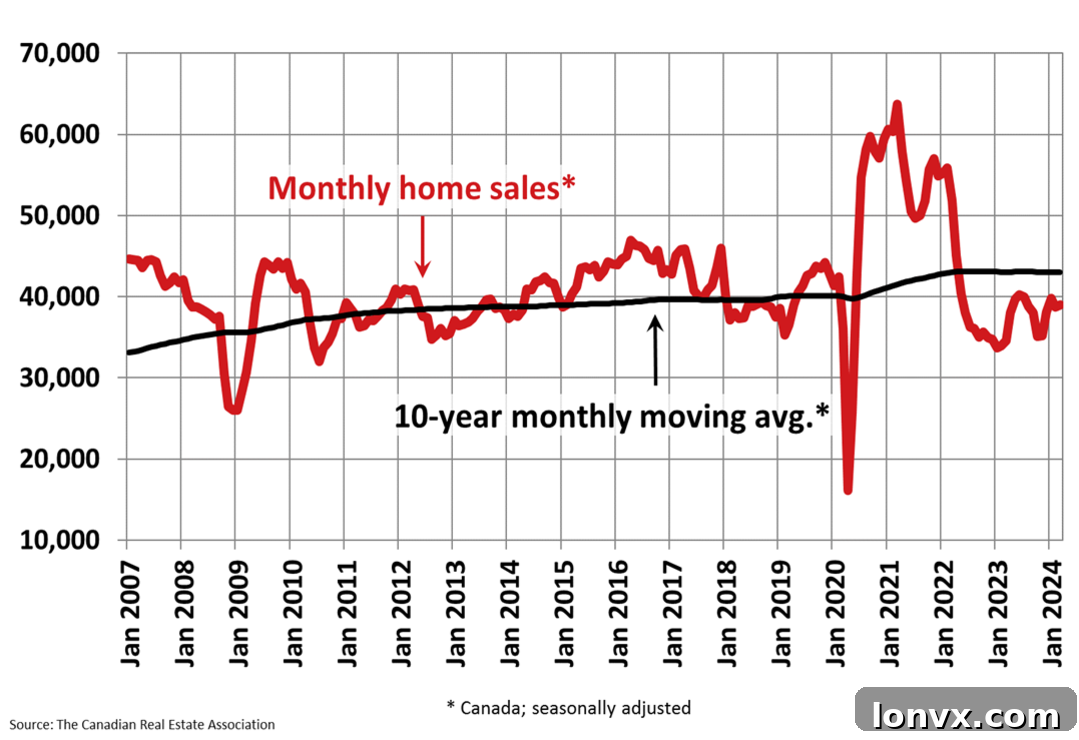
Understanding these transaction patterns is key to anticipating future movements in the Canadian housing market. A sustained period below average sales volumes typically precedes price adjustments or a significant rebalancing of supply and demand.
Price Dynamics: A Sideways Spring for Canadian Home Values
The price performance in the Canadian real estate market during February and March 2024 was notably underwhelming, with national prices largely moving sideways, or even experiencing a slight downward tilt. This behavior stands in stark contrast to typical spring market trends, where these months almost invariably witness upward price momentum as demand traditionally increases.
This unusual stagnation suggests a cautious market, where seller expectations are meeting buyer resistance. While national averages remained flat, a closer look reveals significant regional variations, indicating localized market conditions continue to play a crucial role. The following illustration provides a historical perspective on price trends, highlighting the recent deviations from typical seasonal patterns:
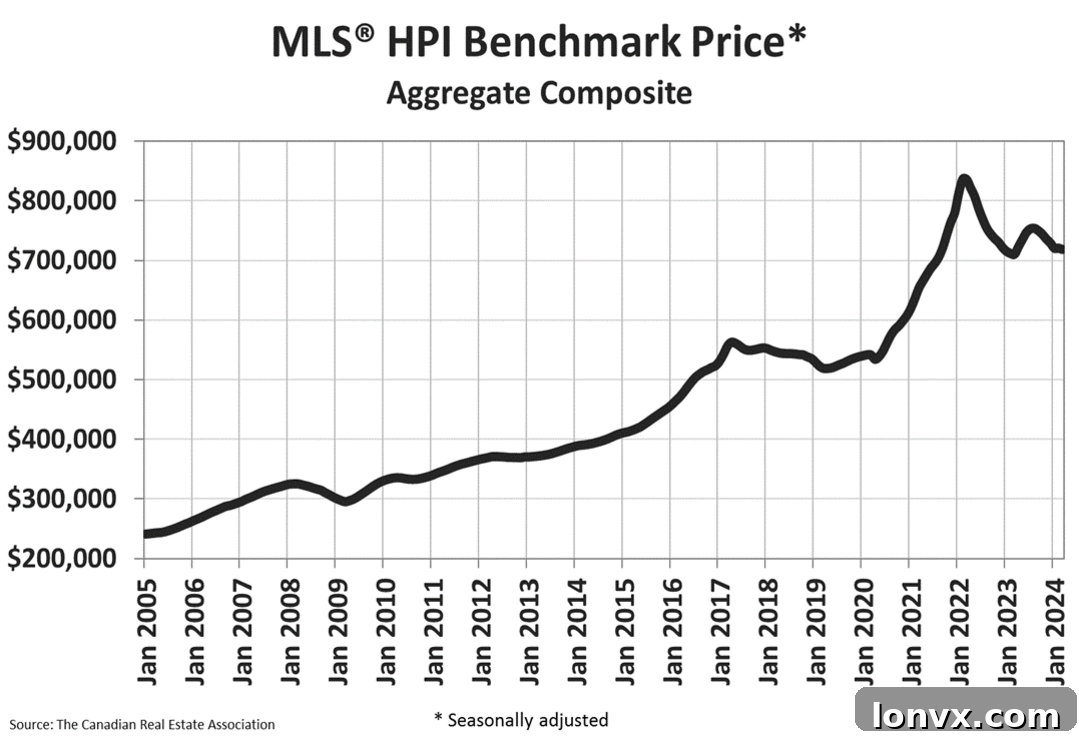
Examining regional data provides a more nuanced picture of where prices are experiencing pressure or resilience:
Regions with Notable Price Increases:
- Greater Moncton, New Brunswick: +5 percent
- Estrie, Quebec: +3.5 percent
- Prince Edward Island: +2.7 percent
- Sault Ste. Marie, Ontario: +2 percent
- Chilliwack, British Columbia: +1.9 percent
These areas, often characterized by relatively lower entry points or specific local economic drivers, demonstrate pockets of stronger demand. For instance, Moncton and PEI continue to attract buyers seeking more affordable options compared to larger urban centers, benefiting from interprovincial migration and a robust local economy.
Regions with Notable Price Decreases:
- Simcoe & District, Ontario: -2.3 percent
- Mauricie, Quebec: -3 percent
- Halifax, Nova Scotia: -1.7 percent
- British Columbia’s Interior region: -1.6 percent
- Owen Sound, Ontario: -1.2 percent
Conversely, regions experiencing price declines might be grappling with factors such as an influx of listings, localized economic slowdowns, or a more pronounced impact of higher borrowing costs on buyer sentiment. The decline in areas like Simcoe & District and Halifax suggests that even previously hot markets are not immune to the broader economic headwinds impacting Canadian real estate.
CREA’s 2024 Forecast: A Path Towards Recovery for Canadian Real Estate
The Canadian Real Estate Association (CREA) recently released its quarterly forecast, offering a forward-looking perspective on the nation’s housing market. The forecast anticipates a gradual return to the 10-year average sales volume growth trajectory by 2025, signaling optimism for a market recovery after a period of significant volatility.
CREA emphasizes that interest rates will remain a pivotal factor shaping Canadian housing markets throughout 2024 and extending into 2025. The market has been noticeably subdued since the Bank of Canada’s aggressive rate hikes in 2023, which effectively cooled buyer enthusiasm and affordability. Consequently, prices in many markets across the country are still considerably below their historic peaks observed in 2021 and 2022, reflecting the ongoing adjustment to higher borrowing costs.
The following chart illustrates CREA’s projections for sales and average prices:
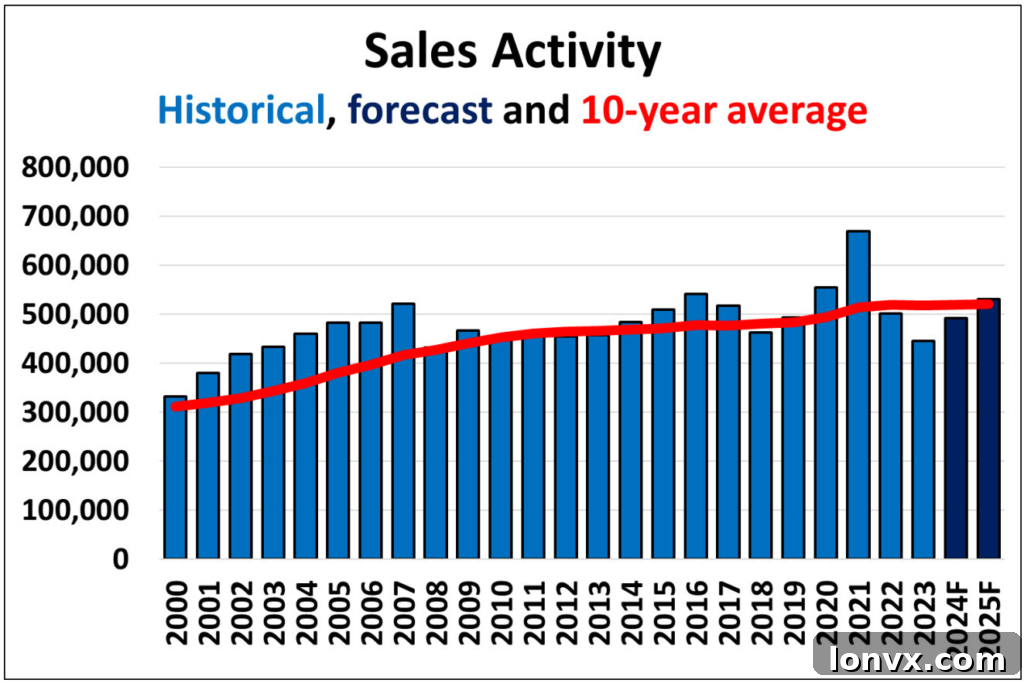
Source: CREA
Expectations are building for the first interest rate cut of 2024 to occur in the latter half of the year, with financial markets currently pricing in approximately 50 basis points of cuts by year-end. However, a significant number of economists believe that the Bank of Canada will likely delay any rate reductions until the United States Federal Reserve makes similar moves. This dependency on the U.S. Fed introduces a layer of uncertainty, as the Fed’s next Federal Open Market Committee meeting might not yield a cut, potentially pushing Canadian rate reductions further into the future.
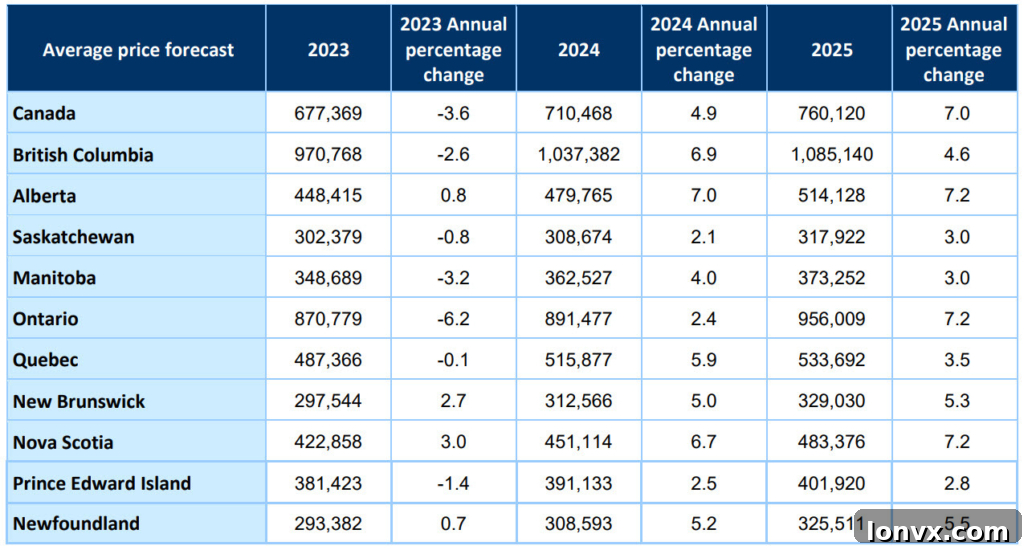
Despite these uncertainties, CREA’s statistics point to a promising bounce in new supply, sales, and listings, suggesting that the Canadian housing market may indeed be gearing up for a sustained recovery. The association projects that approximately 492,083 residential properties will change hands in 2024, representing a substantial 10.5 percent increase from 2023. Alongside this rise in activity, the national average home price is forecast to increase by 4.9 percent, reaching an estimated $710,468 in 2024.
Looking further ahead into 2025, CREA anticipates even stronger growth. National home sales are expected to climb by an additional 7.8 percent, totaling 530,494 units. Concurrently, the national average home price is projected to rise by another 7 percent, reaching an impressive $760,120. These optimistic projections are predicated on improving affordability as rates stabilize or decrease, coupled with continued population growth and a resilient Canadian economy.
Projected Increases in Sales Volume Across Canada
CREA’s 2024 forecast highlights specific regions poised for the most significant increases in the number of homes sold, indicating where market activity is expected to pick up pace:
- Alberta: Projected increase of 13.6 percent
- Nova Scotia: Projected increase of 12.7 percent
- Ontario: Projected increase of 12.6 percent
- Quebec: Projected increase of 11 percent
Alberta’s strong projected growth in sales volume can be attributed to its relatively more affordable housing market compared to provinces like Ontario and British Columbia, alongside robust interprovincial migration. Nova Scotia also benefits from an influx of new residents, driving demand. While Ontario and Quebec face higher average prices, their sheer market size and continued population growth ensure substantial increases in transaction volumes as conditions improve.
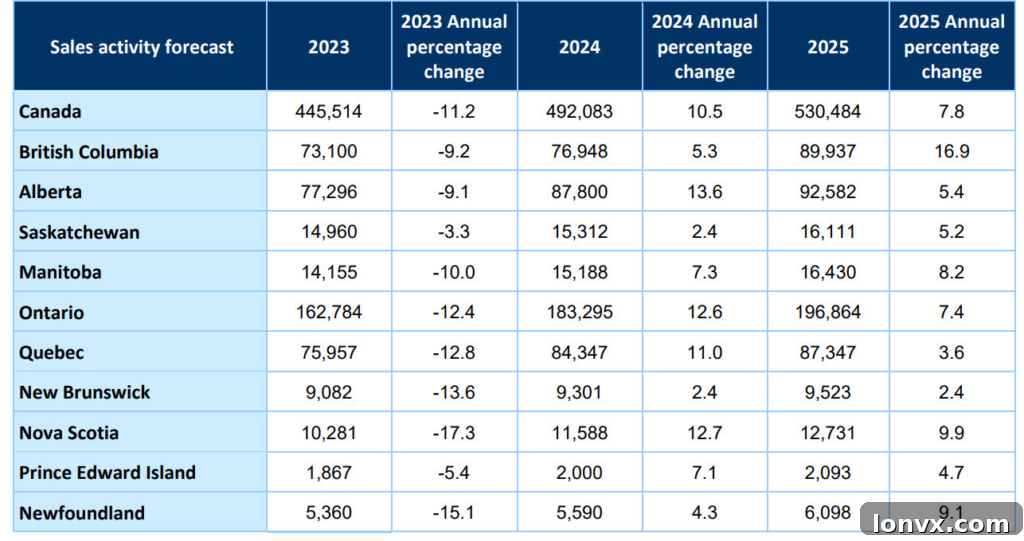
Source: CREA
Anticipated Increases in Home Prices by Province
Beyond sales volume, CREA’s 2024 forecast also outlines expectations for the largest increases in home prices across various Canadian provinces, reflecting areas where demand is expected to outstrip supply or where unique market dynamics are at play:
- Alberta: +7 percent, with an average price reaching $479,765
- British Columbia: +6.9 percent, with an average price reaching $1,037,382
- Nova Scotia: +6.7 percent, with an average price reaching $451,114
- Quebec: +5.9 percent, with an average price reaching $515,877
British Columbia continues to demonstrate strong price growth, driven by perennial demand, limited supply, and its desirable lifestyle, despite already having the highest average prices. Alberta’s projected price increase, coupled with its sales volume growth, underscores its burgeoning attractiveness as an affordable alternative for many Canadians. Nova Scotia’s market, similar to its transaction forecast, benefits from sustained migration and a growing economy, leading to solid price appreciation. Quebec, with its diverse market and increasing urban density, is also expected to see significant price increases.
Source: CREA
Enjoying this article?
Get the latest real estate articles in your inbox 3x a week so you stay up to date on the latest in the Canadian real estate industry.