
Understanding Canada’s Evolving Homeownership Landscape: A Deep Dive into National and Provincial Trends
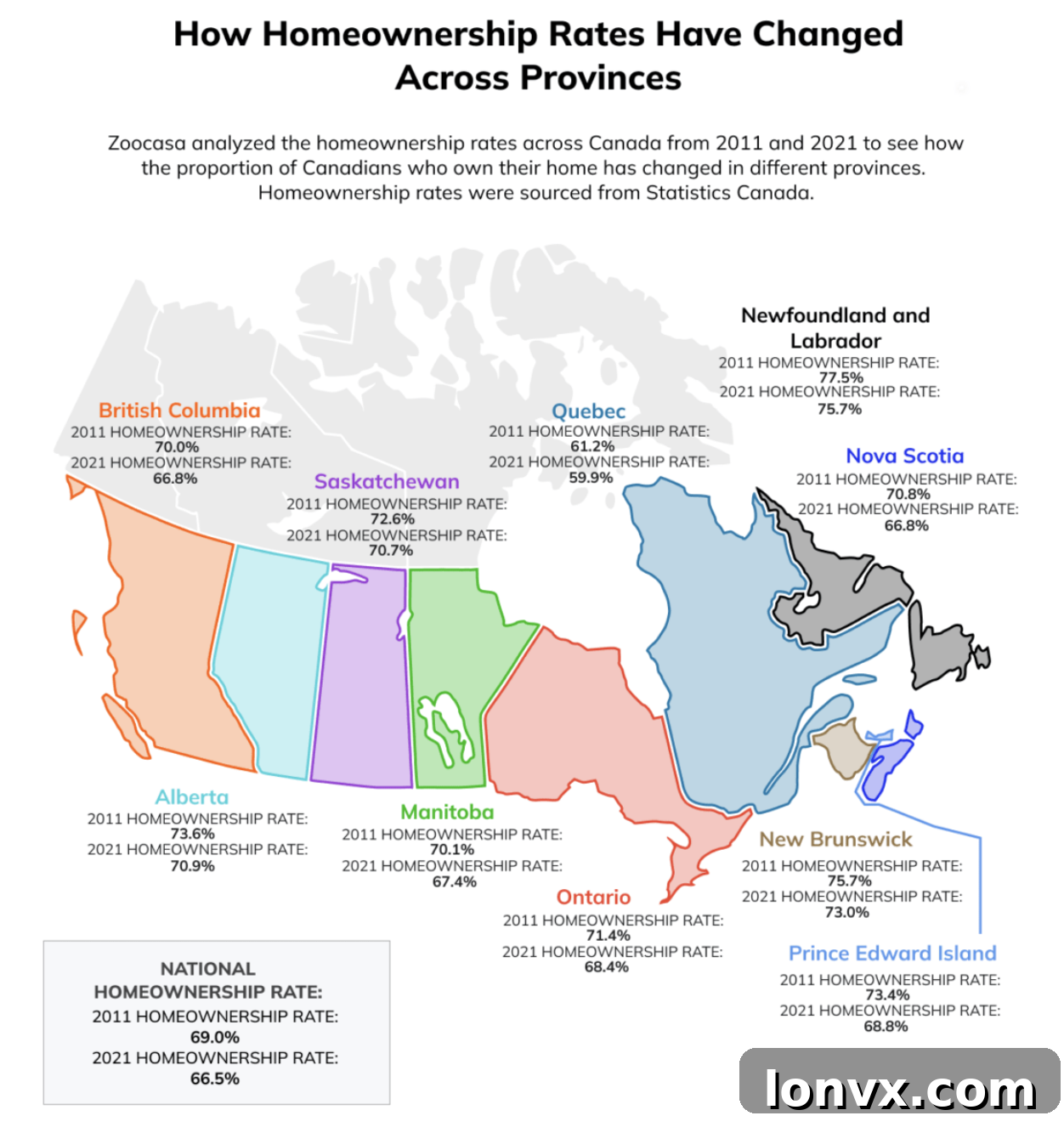
The dream of homeownership, long considered a cornerstone of the Canadian identity, appears to be shifting. Recent data from Statistics Canada reveals a notable decline in the national homeownership rate, dropping from 69% in 2011 to 66.5% in 2021. This decrease, though seemingly modest, represents hundreds of thousands of Canadians for whom owning a home has become an increasingly distant prospect. This comprehensive analysis, drawing insights from Zoocasa, explores the multifaceted factors contributing to this trend, examining provincial disparities, generational challenges, and the economic forces at play across the country.
The journey to homeownership is complex, influenced by a myriad of factors ranging from individual preferences and life stages to broader economic conditions and the availability of suitable dwelling options. Understanding these dynamics is crucial for grasping the current state and future trajectory of the Canadian housing market.
Source: Zoocasa
Affordability Champions: Provinces with High Homeownership Rates
Unsurprisingly, the provinces where homeownership remains most accessible are often those with the most affordable housing markets. These regions stand in stark contrast to the national trend, boasting significantly higher rates of property ownership, largely due to lower entry costs and more stable price growth.
Newfoundland and Labrador: A Leader in Homeownership
At the forefront of Canadian homeownership is Newfoundland and Labrador, a province that consistently registers the country’s highest rates. In 2011, an impressive 77.5% of residents owned their homes, a figure that, while slightly decreasing, remained robust at 75.7% in 2021. This strong prevalence of homeownership is directly linked to the province’s remarkably affordable housing market. In 2021, Newfoundland and Labrador recorded the second-lowest average home price in Canada, at just $263,900. Crucially, the province experienced the smallest price increase of any Canadian province since 2011, with only a modest 9.3% rise. This trend of stable and manageable growth continued post-2021, with the average home price reaching $295,400 in September 2023, avoiding the aggressive escalations seen elsewhere. This stability allows more residents to enter the market and retain their properties, fostering a strong sense of community and rootedness.
New Brunswick: Emerging as an Affordable Hub
New Brunswick has emerged as another beacon of affordability, securing the second-highest homeownership rate in Canada at 73% in 2021. The province’s appeal is underscored by its lowest average home price in 2021, at $239,900. This affordability continued into recent years, with the average home price standing at $292,600 in September 2023, making it Canada’s most affordable province at that time. However, this accessibility is now fueling significant demand, evidenced by a staggering 22% price increase from September 2021 to September 2023. While still affordable compared to national averages, this rapid appreciation signals a growing interest in New Brunswick’s real estate market, potentially impacting future affordability if supply doesn’t keep pace with demand.
The Prairies: Saskatchewan and Alberta Hold Strong
Saskatchewan and Alberta, the two major prairie provinces, also reported homeownership rates above 70% in 2021, at 70.7% and 70.9% respectively. While both experienced slight declines from their 2011 figures (Saskatchewan by 1.9% and Alberta by 2.7%), they continue to offer a more attainable path to homeownership than the country’s major urban centers. Alberta, in particular, has witnessed a significant influx of inter-provincial migrants, notably from Ontario and British Columbia, attracted by its relatively lower housing costs and strong job market. However, a persistent low inventory of homes for sale is creating competitive conditions and keeping many prospective buyers in the rental market, suggesting that even in more affordable provinces, the balance between supply and demand is a delicate one.
Major Canadian Markets: A Squeeze on Prospective Buyers
In stark contrast to the more affordable provinces, Canada’s economic powerhouses and major population centers are experiencing severe affordability challenges, leading to significant declines in homeownership rates. These regions are characterized by rapidly appreciating home prices that have far outpaced wage growth, creating an increasingly insurmountable barrier for many aspiring homeowners.
Ontario: The Epicenter of Price Surges
Ontario stands out as the province where the average home price witnessed an astronomical surge of 135.4% between 2011 and 2021. This unprecedented growth has created a “perfect storm” for prospective buyers, as average incomes have failed to keep pace. The result is a substantial 3.1% drop in Ontario’s homeownership rate over the decade, reflecting the immense pressure on affordability, particularly in the Greater Toronto Area (GTA) and other major urban centers. Sky-high prices, coupled with intense competition and the need for increasingly large down payments, have pushed the dream of homeownership out of reach for a significant portion of the population, leading to a generational shift where renting is becoming a long-term reality rather than a temporary solution.
British Columbia: High Demand, Exorbitant Prices
British Columbia, renowned for its stunning natural beauty and vibrant cities, also grapples with some of the highest housing costs globally. Its homeownership rate saw a significant 3.2% drop since 2011, placing it among the lowest in the country. The provincial average home price soared from $506,100 in 2011 to a staggering $910,800 in 2021 – an 80% increase in just ten years. By September 2023, this figure climbed further to $988,300. The confluence of high demand, limited developable land, and strong international and inter-provincial migration has created an incredibly competitive and expensive market, making it exceedingly difficult for local residents, especially first-time buyers, to secure a home.
Nova Scotia: Unexpected Price Spikes
Nova Scotia also recorded one of the lowest homeownership rates, experiencing a substantial 4% drop since 2011. Historically more affordable than its larger provincial counterparts, Nova Scotia has recently seen significant price jumps, especially in its capital, Halifax, and popular coastal areas. This surge is partly attributed to an increase in inter-provincial migration, with individuals and families seeking a better quality of life and remote work opportunities in less densely populated regions. While this migration brings economic benefits, it has also rapidly inflated housing prices, pushing homeownership out of reach for some long-time residents and contributing to the decline.
Quebec: A Unique Market Dynamic
Despite having relatively lower home prices compared to Ontario and British Columbia, Quebec’s homeownership rate remains comparatively low, just under 60%. The province experienced the smallest change in homeownership from 2011 to 2021, declining by only 1.3%. This unique trend can be attributed to several factors, including a strong cultural preference for renting in urban centers like Montreal, a robust and often more affordable rental market, and different urban planning and housing development philosophies. While prices have risen, the market dynamics in Quebec often present a different set of challenges and opportunities for residents, emphasizing the diversity within Canada’s housing landscape.
The Generational Divide: Millennials Face an Uphill Battle
The declining national homeownership rate is not evenly distributed across all demographics. A closer look reveals a pronounced generational disparity, with Millennials bearing the brunt of the current market challenges. This generation, generally born between 1981 and 1996, exhibits the lowest homeownership rate among all adult age groups, highlighting a significant shift in wealth accumulation and life milestones.
Millennials: The Most Challenged Demographic
For Millennials, the path to homeownership has become increasingly arduous. Their collective homeownership rate is the only one below Canada’s average of 66.5%. This demographic has also experienced the largest drop in homeownership rates across the board. The struggle is particularly acute for younger Millennials. For instance, individuals in the 25-29 age group saw their homeownership rate plummet from 44.1% in 2011 to a mere 36.5% in 2021. This represents a significant cohort being priced out of the market during critical years when previous generations typically began establishing equity.
Compounding Challenges for Millennial Buyers
Several interconnected factors contribute to the challenges faced by Millennials:
- Student Debt Burden: Many Millennials entered the workforce burdened by substantial student loan debt, which directly impacts their ability to save for a down payment and qualify for mortgages.
- Stagnant Wage Growth: Real wage growth has largely failed to keep pace with the soaring cost of living and, more specifically, the exponential rise in housing prices. This creates a widening gap between income and housing affordability.
- Rising Cost of Living: Beyond housing, the cost of everyday necessities, from groceries to transportation, continues to climb, eroding discretionary income that could otherwise be allocated to savings.
- Larger Down Payment Requirements: With escalating home prices, the required down payment has grown exponentially, making the initial hurdle to entry significantly higher than for previous generations.
- Competitive Markets: Even when Millennials manage to save a down payment, they often face intense competition from multiple bidders, including experienced investors, exacerbating the difficulty of securing a property.
- Delayed Milestones: The delay in homeownership can have broader implications, impacting other life milestones such as starting a family, accumulating wealth through equity, and planning for retirement. The traditional pathway to financial stability is being re-routed for this generation.
Looking Ahead: Navigating Canada’s Evolving Housing Market
The landscape of Canadian homeownership is undeniably in flux. While provinces with greater affordability continue to provide pathways to property ownership, the country’s major economic hubs present increasingly formidable barriers. The distinct challenges faced by Millennials underscore a significant generational shift in how Canadians interact with the housing market, potentially redefining the “Canadian dream.”
Understanding these trends is critical for policymakers, industry stakeholders, and individuals alike. Addressing the underlying issues of affordability, supply, and income disparity will be essential in shaping a housing market that is more equitable and accessible for all Canadians. As demand continues to evolve and demographic shifts unfold, the nation’s housing sector will require innovative solutions and strategic planning to ensure that the dream of homeownership, in some form, remains within reach for future generations.
The discussions around interest rates, government incentives for first-time buyers, and urban development policies will undoubtedly play a crucial role in determining the direction of Canada’s housing market in the coming years. The current trends signal a need for careful consideration and proactive measures to prevent further widening of the gap between housing aspirations and market realities across the diverse regions of this vast country.
Enjoying this article?
Get the latest REM articles in your inbox 3x week so you stay up to date on the latest in the Canadian real estate industry