
Navigating the Canadian Housing Market: Trends, Inventory, and the Impact of Interest Rate Adjustments
The Canadian housing market continues to demonstrate a nuanced dance between buyer demand and available supply, influenced heavily by shifting economic conditions and central bank policies. Recent data for May reveals a market characterized by a slight dip in sales activity, yet a notable increase in new listings, painting a picture of evolving dynamics across the nation. Understanding these trends is crucial for both prospective homebuyers and sellers looking to navigate the complexities of Canadian real estate.
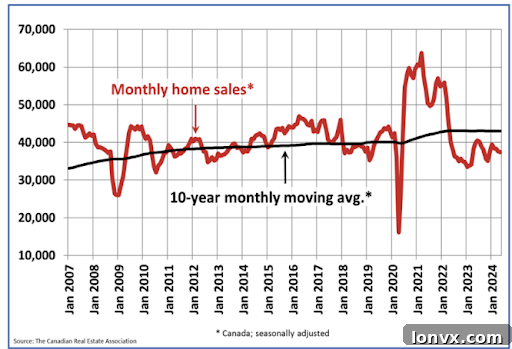
In May, national home sales in Canada experienced a marginal month-over-month decrease of 0.6 percent. This slight cooling in activity saw actual monthly sales come in 5.9 percent below the levels observed in May 2023, indicating a continued cautious approach by many market participants. Despite the minor dip, sales activity consistently remained below its 10-year average, a persistent trend that underscores a period of adjustment for the housing sector. Conversely, the number of newly listed properties saw a modest increase of 0.5 percent month-over-month in May, signaling a potential shift in inventory levels that could benefit prospective buyers.
An Evolving Landscape: More Homes for Sale Emerge Amidst Slowed Activity
The combination of an increase in new listings and a concurrent slowdown in sales has led to a welcome expansion in the number of homes available for sale across most Canadian markets. This development offers a broader selection for buyers who have faced constrained choices in recent years. By the end of May 2024, approximately 175,000 properties were listed for sale nationally. This represents a significant 28.4 percent increase from the inventory levels recorded a year prior, providing a much-needed boost to market supply. However, it is important to note that despite this increase, current inventory levels still remain below historical averages, suggesting that the market is still catching up after years of tight supply.
A key indicator of market balance, the “months of inventory,” rose to 4.4 months nationally in May, up from 4.2 months in April. This metric, which represents the number of months it would take to sell all current listings at the present rate of sales, reached its highest level since the fall of 2019. A higher months of inventory figure typically points towards a more balanced or even buyer-friendly market, as it signifies more choices and potentially less intense competition for properties. For buyers, this translates into more negotiation power and a less rushed decision-making process. For sellers, it emphasizes the importance of competitive pricing and strategic marketing to stand out in a growing pool of listings.
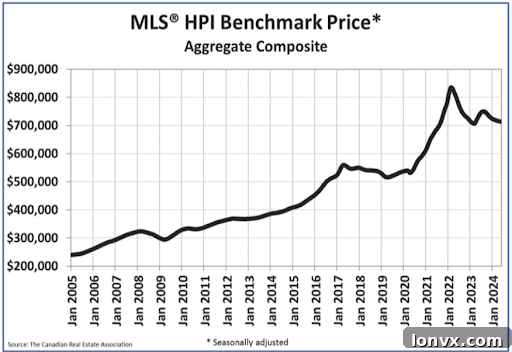
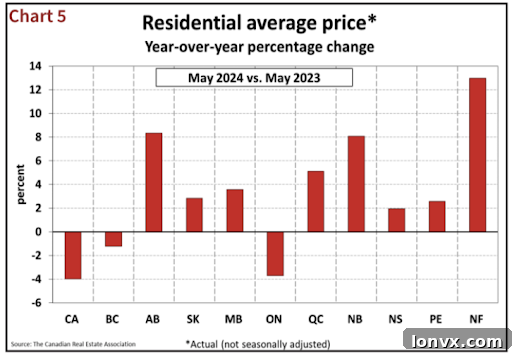
Amidst these supply-demand shifts, property price movements have been largely subdued. The MLS Home Price Index (HPI), a more accurate measure of price trends due to its adjustment for various property types, registered a minor dip of 0.2 percent month-over-month in May. On a non-seasonally adjusted basis, the national average sale price saw a 4.0 percent decrease year-over-year, settling at $699,117. This decline in the average sale price can be attributed to several factors, including a higher proportion of sales occurring in less expensive markets or an overall adjustment in buyer expectations in response to prevailing economic conditions and borrowing costs.
Price Stability with Notable Regional Variations
While the national data suggests largely flat home prices across most markets, a closer look reveals specific regions defying this trend. Calgary, Edmonton, and Saskatoon have experienced steady increases in home prices, standing out as anomalies in the broader Canadian landscape. These Western Canadian cities, particularly in Alberta and Saskatchewan, often benefit from strong local economies, robust employment markets driven by the resource sector, and comparatively lower affordability barriers than major metropolitan centers like Toronto and Vancouver. The sustained demand in these areas, coupled with a more stable influx of new residents, helps to buoy property values even when other parts of the country see stagnation or modest declines.
Understanding these regional variations is crucial for anyone involved in the Canadian real estate market. Factors such as local economic growth, migration patterns, and the availability of new construction can significantly influence supply and demand dynamics, leading to divergent price trends across provinces and even within cities. What might be a buyer’s market in one region could remain a seller’s market in another, highlighting the importance of localized data and expert insights.
The national sales-to-new listings ratio, another vital health indicator for the market, eased slightly to 52.8 percent in May. This figure remains comfortably within the 45-65 percent range, which typically defines balanced market conditions. A balanced market implies that neither buyers nor sellers have a significant advantage, fostering more stable price movements and a more predictable transaction environment. When the ratio falls below 45 percent, it generally indicates a buyer’s market, characterized by more listings than buyers and downward pressure on prices. Conversely, a ratio above 65 percent points to a seller’s market, where high demand and limited supply often lead to competitive bidding and upward price pressure. The current balanced state suggests a healthy equilibrium, allowing for thoughtful decision-making on both sides of a transaction.
Interest Rate Adjustments and the Psychological Shift Among Homebuyers
Perhaps the most significant development impacting the Canadian housing market outlook is the Bank of Canada’s recent 25-basis-point rate cut. This move, the first in several years, is widely anticipated to have a profound psychological effect on potential homebuyers who have been hesitant to enter the market. Many prospective buyers have been “sitting on the sidelines,” waiting for a clear signal that borrowing costs would begin to decline. This pent-up demand represents a considerable pool of buyers ready to act once they perceive more favorable conditions.
The psychological impact extends beyond just the immediate reduction in mortgage payments. It fosters renewed confidence, signaling a pivot in monetary policy that could lead to further rate cuts in the future. For many, this cut confirms that the era of rapidly rising interest rates is over, and a period of easing has begun. This shift in sentiment can invigorate market activity, encouraging individuals and families to resume their homeownership plans, which may have been deferred due to affordability concerns and economic uncertainty. The prospect of lower monthly mortgage payments makes homeownership more attainable for a segment of the population, thereby bringing much-needed energy back into the market.
However, the full extent and pace of future rate cuts will be critical in determining the actual impact on the housing market. While the initial cut is a positive step, sustained market momentum will likely depend on additional reductions from the Bank of Canada. Economic indicators such as inflation rates, employment figures, and global economic stability will continue to influence the central bank’s decisions. If inflation remains stubborn or global economic conditions worsen, the pace of further cuts could slow, potentially dampening the nascent optimism in the housing market. Conversely, a continued trend of easing inflation could pave the way for more aggressive rate reductions, providing a stronger tailwind for housing activity and affordability.
Looking Ahead: A Revival on the Horizon?
After several quiet months characterized by cautious activity and a gradual rebalancing, the Canadian housing market appears poised for a potential revival. May’s data, with slightly lower sales but increased listings, reflects a market in transition. The pivotal factor moving forward will undoubtedly be the ripple effect of the Bank of Canada’s interest rate cut. As the psychological and practical benefits of reduced borrowing costs filter through the economy, there is a strong expectation that pent-up demand will re-enter the market, potentially leading to increased sales activity in the coming months. This could be the catalyst needed to transition from a period of subdued performance to one of renewed vigor.
Market observers will be keenly watching for signs of this anticipated resurgence. Key indicators such as sales volumes, average prices, and the sales-to-new listings ratio will provide crucial insights into whether the rate cut has indeed stimulated the desired market response. Additionally, regional disparities will continue to be a significant narrative, with some markets likely to respond more robustly than others, depending on their unique economic fundamentals and demographic trends. While caution remains prudent, the recent policy shift offers a promising outlook for the Canadian real estate landscape, hinting at a more dynamic and active market as the year progresses.