
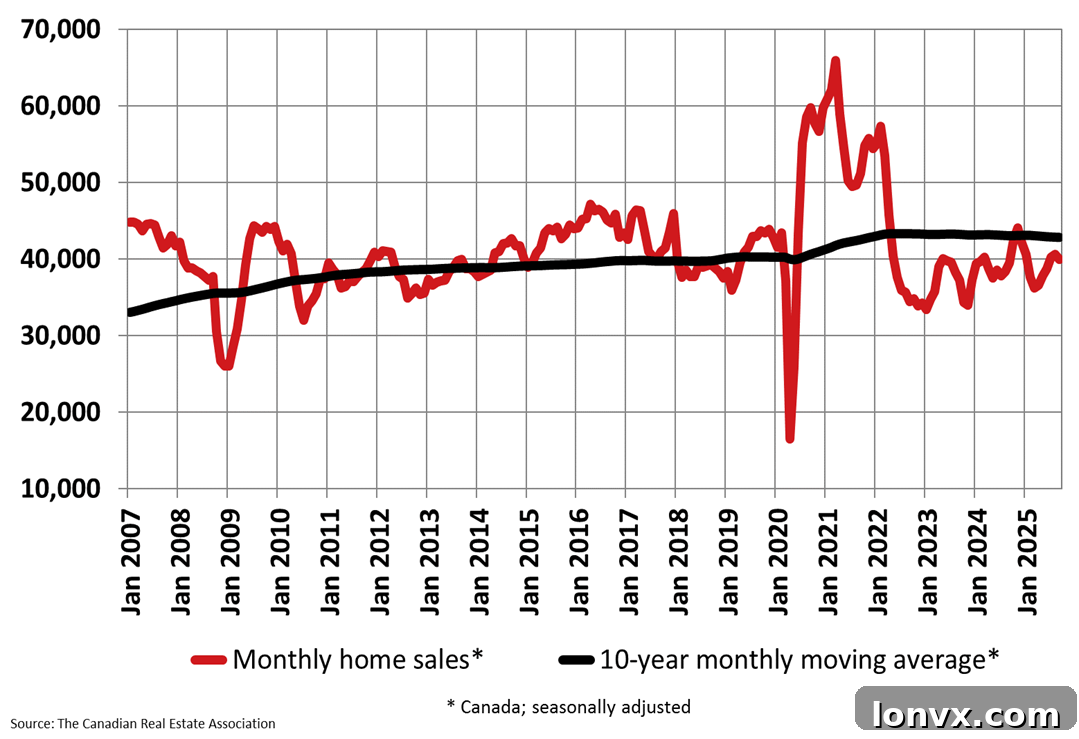
The Canadian real estate market is currently navigating a complex and often contradictory landscape. While the Canadian Real Estate Association (CREA) recently hailed September 2025 as the strongest September for home sales since 2021, a deeper dive into the data reveals a more nuanced and less optimistic picture. This seemingly positive headline, though technically accurate, overshadows the underlying challenges and an overall performance that, when viewed through a broader historical lens spanning two decades, places this year’s September activity firmly in the lower echelons of market outcomes. It signifies a modest recovery relative to the notably subdued activity of the preceding three years, but by no means signals a robust return to the market’s historical vibrancy or strength.
Adding to this complexity, September defied typical seasonal patterns that usually see an uptick in real estate activity as fall approaches. Instead of the anticipated acceleration, national home sales experienced an uncharacteristic decline of 1.7 percent from August to September. This reversal is particularly unusual for a period traditionally marked by renewed buyer interest and a busy fall market. Major urban centers, including the bustling markets of Vancouver, Calgary, Edmonton, Ottawa, and Montreal, all reported a noticeable slowdown in sales. Only Toronto and Winnipeg managed to buck this trend, registering slight increases. Far from initiating a period of renewed momentum, the September figures instead painted a picture of a housing market grappling to generate even the modest seasonal uplift that typically accompanies the autumn season, suggesting deeper structural challenges at play.
Understanding the Dynamics: Supply, Demand, and the Emerging Buyer’s Advantage
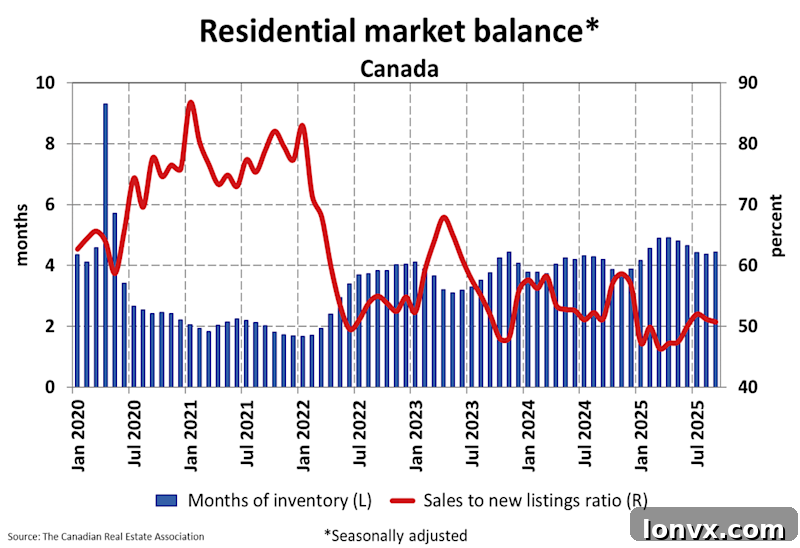
The fundamental forces shaping any real estate market are the intricate interplay between supply and demand. While national sales volumes did show a year-over-year increase of 5.2 percent in September, this growth was unfortunately overshadowed by an even faster acceleration in new listings. Active listings surged to nearly 200,000 properties across Canada in September, marking a substantial 7.5 percent rise compared to the previous year. This level of active inventory is largely consistent with long-term historical averages, indicating a healthy influx of properties on the market. In stark contrast, sales volumes continue to linger significantly below these same long-term averages, creating a notable imbalance.
This widening divergence is crucial for understanding the current market direction. A housing market inevitably shifts its equilibrium toward whichever side – supply or demand – expands more rapidly. In the current scenario, the supply of available listings is demonstrably outpacing the pace of sales. This dynamic invariably puts pressure on sellers, compelling them to adjust their expectations downward to align with buyer bids and more competitive market conditions. Buyers, therefore, find themselves with more options and greater leverage in negotiations, a significant shift from the frenzied seller’s markets of recent years.
CREA’s sales-to-new listings ratio, a key indicator of market balance, further underscores this trend. It fell to 50.7 percent in September, positioning it below the long-run mean of 54.9 percent. Similarly, the “months of inventory” metric, which calculates how long it would take to sell all current listings at the prevailing sales rate, stood at 4.4 months. While slightly below the traditional historical benchmark of five months (which is often seen as a balanced market), these readings, according to conventional definitions, might still describe a market teetering on the edge of balance. However, these traditional conventions are increasingly becoming outdated in an era characterized by rapid technological advancements that significantly accelerate transaction speeds and drastically shorten the typical “days on market” for properties. By older, less agile standards, the market might appear stable; however, when viewed through the lens of contemporary market dynamics and the speed of modern real estate transactions, the market is unequivocally leaning distinctly toward buyers, granting them more choice and negotiation power.
Pricing Stability Amidst Fragile Confidence
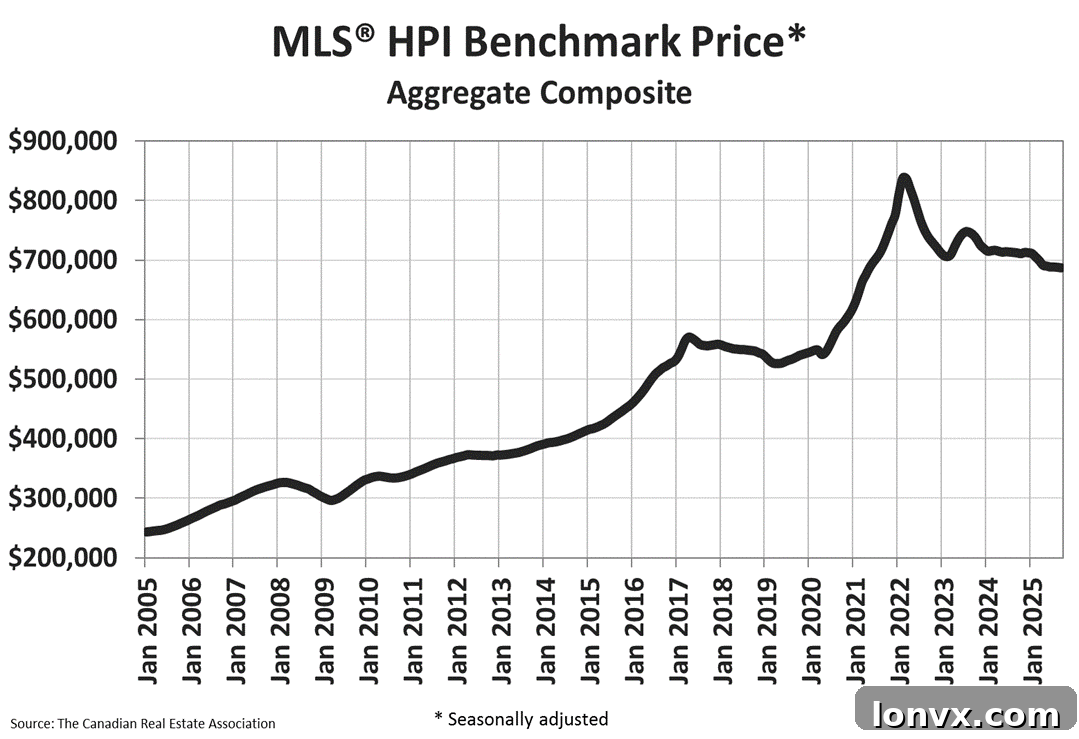
On the surface, home prices appear to have found a degree of stability after a tumultuous period. The MLS Home Price Index (HPI), Canada’s most comprehensive measure of home price trends, remained effectively unchanged in September, registering only a fractional slip of one-tenth of a percentage point from August. On a year-over-year basis, the decline was a modest 3.4 percent. This apparent stability might suggest that the intense and often “violent” price correction experienced throughout 2022 and much of 2023 has now given way to a slower, more gradual adjustment phase. However, it is crucial to recognize that stability reflected in mere numerical data does not automatically translate into a stable or confident market sentiment among potential buyers and sellers.
Beneath this veneer of price stability, the Canadian labor market has begun to show clear signs of fraying, acting as a significant dampener on consumer confidence. Recent notable events, such as the closure of Stellantis operations in Brampton, which resulted in the elimination of 3,000 jobs, have sent ripples through the manufacturing sector. Broader manufacturing layoffs are increasingly impacting communities across Ontario, a key economic engine for the country. Consequently, unemployment rates are on the rise in most Canadian cities, with Alberta standing out as a notable exception due to its robust energy sector. While GDP growth and overall job creation figures have been somewhat flattered by an increase in public sector hiring and substantial government fiscal spending, households are acutely aware that true economic security and stable employment are the bedrock upon which the confidence to make a significant purchase like a home is built. Without a strong conviction about future income stability and job security, families are understandably hesitant to assume substantial long-term debt, even if mortgage rates show signs of edging lower. The psychological impact of economic uncertainty often outweighs minor fluctuations in financing costs.
This prevailing fragility of confidence is precisely why CREA’s invocation of “three years of pent-up demand” for housing rings increasingly hollow in the current climate. Demand, in an economic context, is only truly meaningful if it is actionable and backed by purchasing power. The sheer desire or aspiration to own a home, while widespread, does not translate into actual transactions when the fundamental issue of affordability remains largely out of reach for a significant portion of the population. For this “pent-up demand” to become real and translate into tangible sales, a confluence of factors must occur: wages must see a robust and sustained increase, interest rates must fall further to meaningfully reduce borrowing costs, or, perhaps most realistically, home prices must adjust downward more significantly to meet what buyers can genuinely afford. Until these conditions materialize, demand will remain largely theoretical.
The Complex Interplay of Policy and a Perceived Political Void
For many years, robust population growth, primarily driven by ambitious immigration targets, served as the fundamental bedrock of Canada’s housing demand. This consistent influx of new residents sustained a bullish narrative for the real estate market, even in periods when affordability began to erode and home ownership became increasingly challenging for many. However, that powerful tailwind has now visibly slackened. The political appetite for a renewed acceleration in population growth appears significantly weaker, as governments grapple with the visible strain on existing infrastructure and services, including housing. Without the sustained high levels of immigration that once fueled demand, a key pillar supporting long-term housing market growth has been diminished, introducing a new layer of uncertainty into future demand projections.
Further adding to the national economic uncertainty is the looming renegotiation of the Canada-United States-Mexico Agreement (CUSMA) in 2026. The prospect of trade disruption, even a minor one, casts a significant shadow over Canada’s broader economic trajectory. Such uncertainty can impact business investment, employment, and overall economic confidence, all of which indirectly but powerfully influence the housing market’s outlook for demand.
Compounding these challenges is the observable reality that Canada’s fiscal and monetary policies appear to be operating at cross purposes. On one hand, bond markets are already pricing in the distinct possibility of higher fixed mortgage rates towards the end of next year, signaling expectations of persistent inflationary pressures or tighter monetary conditions. This expectation stands in contrast to the Bank of Canada’s signals of a more restrained approach, attempting to balance inflation control with economic stability. On the other hand, substantial government spending continues to prop up GDP growth in the short term. While this spending offers temporary relief and stimulates certain sectors, many economists argue that it masks deeper, structural vulnerabilities within the economy, preventing a true and organic recovery. Signs of this underlying fragility are becoming increasingly evident, with insolvencies and delinquencies on the rise across various sectors. The foundations of household balance sheets are showing signs of deterioration, reflecting increased debt burdens and reduced financial resilience among Canadian families.
It is against this complex and often contradictory economic backdrop that CREA’s somewhat optimistic assessment must be carefully scrutinized. The association and its economists are correct in noting that interest rates have normalized to some extent compared to the historically low levels of the recent past, which were an anomaly. However, they are less convincing in their suggestion that this normalization alone will be sufficient to unleash a significant wave of latent demand. A true and sustainable recovery in the housing market requires not only more favorable financing costs but, crucially, a robust and widespread sense that the broader economy is resilient and strong enough to sustainably support households over the long term. Without that fundamental economic confidence, lower rates alone may not be enough to spur significant buying activity.
An Extended Holding Pattern: The New Reality for Canadian Housing
Canada’s housing market now finds itself in an awkward and prolonged middle ground. It is neither in a state of outright collapse, characterized by a rapid and widespread depreciation of asset values, nor is it experiencing a robust recovery with surging sales and renewed price appreciation. Instead, the intense correction phase, which saw significant price adjustments and a dramatic cooling of buyer enthusiasm, has largely concluded. However, the subsequent phase of genuine market renewal, marked by sustainable growth and strong buyer confidence, has yet to truly begin. The market is currently defined by flat prices, consistently weak sales volumes, and a delicate balance between supply and demand that is gradually, yet discernibly, tipping in favor of buyers.
The system appears stalled, stuck in a holding pattern, patiently waiting for either a significant surge in consumer and economic confidence or a substantial improvement in housing affordability to break the existing deadlock. This persistent limbo should serve as a stark warning for policymakers at all levels of government. In the absence of robust and sustained wage growth that outpaces inflation, stable and secure employment opportunities across diverse sectors, or fundamental structural improvements to housing supply (such as accelerated construction, reduced regulatory hurdles, and innovative housing solutions), the market will struggle to find a natural and sustainable path back to a healthy equilibrium. Relying solely on interest rate adjustments or temporary spending measures will likely prove insufficient to address these deep-seated issues.
For Canadian households, the message emanating from the current market conditions is equally stark and important: perceived stability in prices is not synonymous with genuine financial security. The ongoing risks of potential job loss, persistent inflationary pressures eroding purchasing power, and unpredictable policy drift from various levels of government weigh heavily on monumental financial decisions such as buying or selling a home. These uncertainties compel a cautious approach, delaying significant housing commitments.
Therefore, the September report, contrary to CREA’s optimistic framing, is not the much-anticipated turning point that many might hope for. Instead, it represents another entry in a long and growing sequence of data points that collectively illustrate the same underlying reality: Canada’s housing market is fundamentally stuck. The critical question moving forward is not whether an imminent boom or bust is on the horizon. Rather, it is whether policymakers, market participants, and households are adequately prepared for the prolonged period of stasis and careful adjustment that appears to lie ahead. Navigating this extended period will require resilience, adaptability, and a clear-eyed understanding of the complex forces at play.