
The Resilient Spirit of Canadian Homeownership: A Positive Outlook for 2024
Despite a landscape fraught with significant housing market challenges and persistent financial pressures, including a critical housing shortage and consistently high interest rates, the sentiment among many Canadians regarding homeownership remains surprisingly optimistic. A recent report from Re/Max Canada sheds light on this intriguing resilience, suggesting that the dream of owning a home continues to thrive even amidst adversity.
The report underscores a profound and unwavering belief in real estate, revealing that a substantial 73 percent of Canadians still view homeownership as the most astute long-term investment. This figure remarkably mirrors the confidence levels observed in the previous year, demonstrating a deeply ingrained trust in the enduring value and security that property ownership provides within the Canadian context. This steadfast confidence acts as a powerful counterbalance to the prevailing economic headwinds and underscores the long-term perspective many Canadians hold towards their property assets.
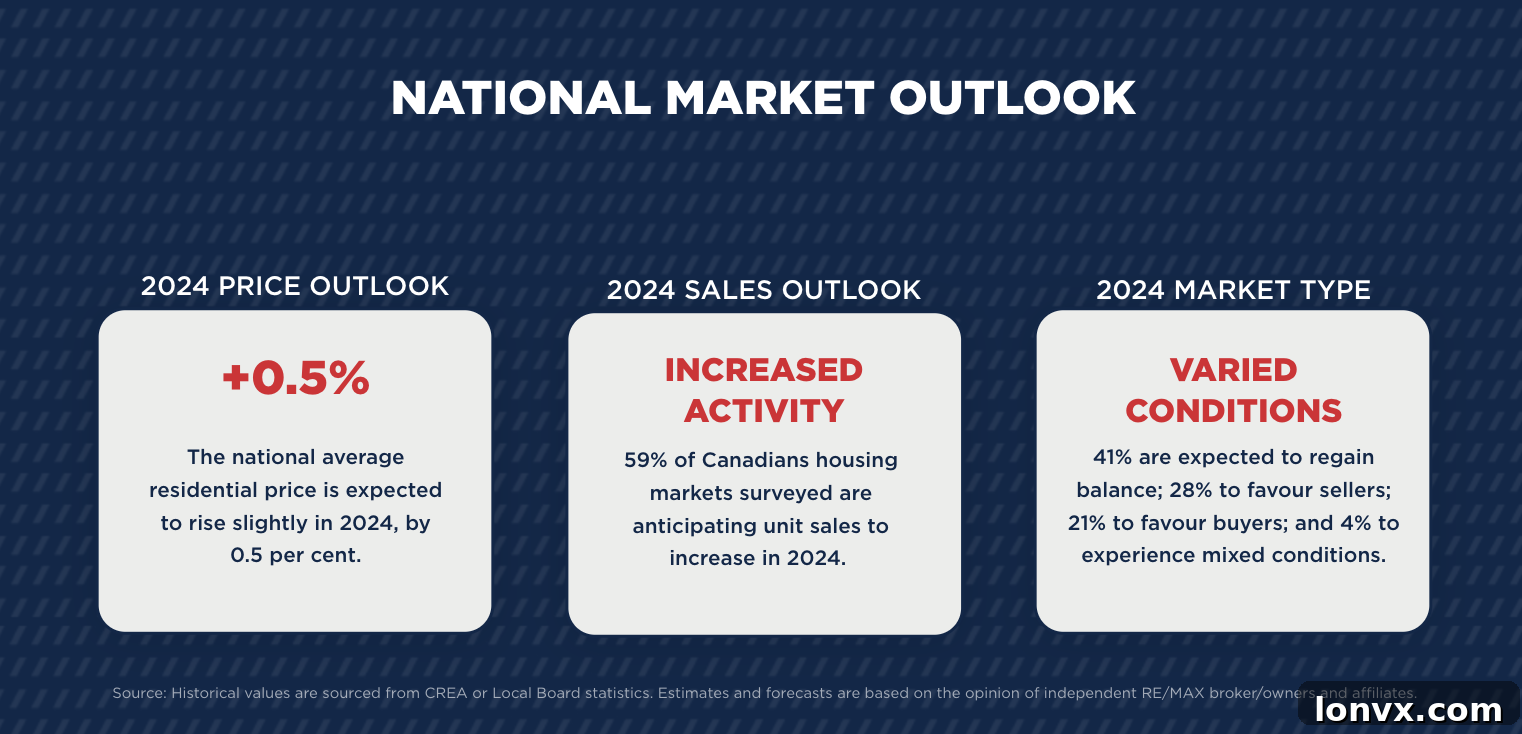
Looking ahead, Re/Max brokers and agents anticipate a cautiously more active Canadian housing market in the coming year. Their projections suggest a modest national average increase in residential sale prices, expected to rise by approximately 0.5 percent. This slight uptick hints at a stabilizing market rather than a booming one, offering a potential reprieve from the volatility of recent years. More encouragingly, 61 percent of the regions surveyed by Re/Max foresee a discernible increase in 2024 unit sales, with growth ranging from 2 to 7.5 percent. While 18 percent of the analyzed markets anticipate a slight decrease of 2 to 5 percent and another 18 percent expect market conditions to remain largely consistent, these figures collectively point towards a diverse, regionally nuanced housing market rather than a uniform national trend, suggesting opportunities may vary greatly by location.
Christopher Alexander, President of Re/Max Canada, encapsulates this sentiment perfectly. “It’s been an undeniably challenging year for Canadian homebuyers and sellers, who have grappled with the compounding effects of a severe housing shortage and the escalating cost of living. Yet, much like Canada’s dynamic housing market itself, Canadians have demonstrated remarkable resilience,” Alexander states. He emphasizes the historical performance of real estate, noting, “Historically, real estate has consistently offered owners excellent returns and robust financial security – a fundamental truth that remains unchanged, reinforcing its position as a preferred investment vehicle.”
Alexander further elaborates on the current market dynamics, suggesting, “The slower market activity we’ve observed across the country this fall could indeed be an early harbinger of a more active 2024. This outlook is reflected in the modest price increases and sales forecasts for the upcoming year, alongside a notable balancing of conditions emerging in several key regions across the nation. This anticipated stabilization offers a glimmer of hope for both buyers and sellers seeking greater predictability and less frantic competition in the real estate landscape.”
Understanding the Undercurrents of Canadian Housing Confidence
The enduring confidence in homeownership, even in the face of affordability crises and high borrowing costs, speaks volumes about the perceived stability and wealth-building potential of real estate in Canada. For many, a home is not just a dwelling but a cornerstone of their financial future, a hedge against inflation, and a legacy to pass on. The relatively modest projected price increase for 2024, following a period of rapid fluctuations, might be interpreted by some as a sign of a more sustainable market, allowing potential buyers to plan with greater certainty. Similarly, the anticipated increase in unit sales in a majority of regions could signal a gradual re-engagement of both buyers and sellers who have been on the sidelines, waiting for more favorable conditions to emerge or adapting to the new interest rate environment.
Mortgage rates, dictated by the Bank of Canada’s policy decisions, remain a critical determinant of housing affordability. While rates have stabilized somewhat, they are still elevated compared to the ultra-low levels seen during the pandemic. This has significantly impacted purchasing power, particularly for first-time homebuyers and those looking to upgrade. However, if inflation continues to cool as anticipated, there is potential for the Bank of Canada to consider rate cuts later in 2024. Such a move could further stimulate buyer activity, reduce monthly mortgage payments, and alleviate some of the financial strain currently experienced by homeowners and prospective buyers.
Source: Re/Max Canada
The Crucial Role of Diversity in New Housing Supply
A significant finding from a Leger survey, commissioned as part of the Re/Max report, highlights a strong public consensus on the nature of future housing development. A vast majority of Canadians, 72 percent, firmly believe that as all levels of government—federal, provincial, and municipal—strategize to increase housing supply, it is paramount that they prioritize the diversity of the new housing being developed. This isn’t merely about building more units; it’s about building the *right* kind of units for a diverse population with evolving needs and preferences.
This call for diversity encompasses a wide spectrum of housing types. It includes, but is not limited to, the development of more affordable housing options, such as subsidized units, co-operative housing, and purpose-built rental properties, to address the needs of lower-income households and renters struggling in competitive markets. It also extends to ensuring a mix of housing forms: from traditional detached homes to townhouses, duplexes, multi-unit residential buildings, and innovative mixed-use developments. Such a varied approach can cater to different family sizes, income levels, age groups, and lifestyle preferences, fostering more inclusive and sustainable communities. Moreover, “diversity” can also imply geographical distribution, ensuring that new housing is not solely concentrated in existing urban centres but also strategically developed in suburban and rural areas where demand may be growing due to factors like remote work trends and lifestyle shifts.
Considering the diversity of new housing is essential for several reasons. Firstly, it directly addresses the varying affordability challenges across different demographic segments, ensuring that solutions are not one-size-fits-all. Secondly, it can lead to more resilient and vibrant communities by preventing over-reliance on a single housing model and promoting a wider range of services and amenities. Thirdly, it aligns with environmental goals by encouraging higher-density, transit-oriented developments where appropriate, thereby reducing urban sprawl and carbon footprints. Governments face the complex task of balancing rapid supply increases with the thoughtful planning required to build truly diverse, equitable, and future-proof communities that can adapt to changing demographic and economic realities.
Emerging Trends Shaping Canadian Homeownership
Beyond traditional market indicators, several evolving societal and environmental factors are beginning to reshape Canadians’ home buying decisions and expectations for the future of the housing market. These trends highlight a shift towards more conscious and adaptive approaches to property ownership.
Climate Change as a Deciding Factor
A notable trend highlighted in the report indicates that 41 percent of Canadians believe climate change will directly influence their decision on where to purchase a home next year. This marks a growing awareness of environmental risks and their potential impact on property values, insurance costs, and overall livability. Factors such as the proximity to flood plains, risk of wildfires, susceptibility to severe weather events, and access to sustainable infrastructure (e.g., public transport, green spaces) are increasingly coming into play. Homebuyers are becoming more discerning, prioritizing locations and properties that offer greater resilience against climate-related threats, or those that boast energy-efficient features to reduce utility costs and environmental impact. This shift could lead to increased demand for homes built with sustainable materials or located in less vulnerable regions, potentially impacting property values and development patterns in areas perceived to be at higher risk.
Exploring Alternative Paths to Homeownership and Mobility
In response to persistent affordability challenges, 21 percent of Canadians are actively exploring alternative homeownership models or considering inter-provincial or inter-city relocations. This significant minority reflects a growing willingness to think outside the traditional box to achieve homeownership or to find better value. Alternative ownership models might include co-ownership with friends or family, fractional ownership, co-housing communities, or innovative rent-to-own programs designed to ease the transition from renting to owning. These options seek to lower the barrier to entry by reducing initial capital outlay or monthly carrying costs, making homeownership accessible to a broader segment of the population.
Simultaneously, the trend of moving provinces or cities for “better affordability in a neighbourhood they love” underscores the ongoing demographic shifts driven by housing costs. This often means urban flight to more affordable suburban or rural areas, or even migrations between provinces, such as from Ontario or British Columbia to Alberta or the Maritimes, where housing prices are relatively lower. The rise of remote work has further enabled this mobility, allowing individuals to pursue career opportunities without being geographically tied to expensive metropolitan centres, thereby distributing housing demand more widely across the country and impacting regional economies in often unpredictable ways.
Varied Expectations for Market Conditions
The outlook on future market conditions among Canadians is diverse, reflecting the inherent complexities and regional disparities of the housing market. Approximately 42 percent of respondents anticipate that housing conditions will balance out, signifying a state where neither buyers nor sellers hold a distinct advantage, and supply generally meets demand. This could lead to more stable prices and a more predictable transaction environment, beneficial for long-term planning.
Conversely, 29 percent expect conditions to favor sellers, suggesting a continued tight market with high demand and limited inventory, potentially leading to competitive bidding and upward pressure on prices in certain sought-after areas. On the other hand, 21 percent believe the market will swing in favor of buyers, implying an increase in inventory, slower sales, and potentially more room for negotiation on price. A small segment, 4 percent, foresees mixed conditions, acknowledging the localized and segmented nature of real estate markets where different areas within a city or province might experience varying dynamics simultaneously, making a blanket forecast difficult.
This divergence in expectations highlights the challenge of predicting the market and the importance of localized data. Factors such as specific regional economic growth, migration patterns, local government policies, and the influx of new housing supply can significantly sway market conditions in one direction or another, making a national generalization often less relevant than a micro-market analysis for individual buying or selling decisions.
The Canadian housing market in 2024 is poised for a period of cautious optimism and nuanced growth. While affordability challenges and high interest rates persist, the underlying confidence in homeownership, coupled with an anticipated stabilization and modest growth in sales, suggests a resilient market. The emphasis on diverse housing supply and the growing influence of climate considerations underscore a shift towards more thoughtful and sustainable development. As Canadians navigate these evolving dynamics, staying informed about regional specifics and broader trends will be crucial for both prospective buyers and sellers in making strategic decisions.
For a comprehensive understanding, including detailed regional highlights and specific market analyses, readers are encouraged to review the full Re/Max Canada report available here.
Enjoying this article?
Get the latest REM articles in your inbox 3x week so you stay up to date on the latest in the Canadian real estate industry