
Calgary Real Estate Market: Navigating 2024 Amidst Shifting Tides
The Calgary real estate market is poised for another dynamic year in 2024, according to the latest Forecast Calgary and Region Yearly Outlook Report released by the Calgary Real Estate Board (CREB). The report offers crucial insights into a market grappling with the dual forces of rising interest rates and persistent demand. While elevated lending costs have prompted some buyers to reassess their options and sellers to delay listings, the underlying strength of Calgary’s economy, coupled with robust population growth, continues to fuel activity, keeping sales figures above long-term averages.
This comprehensive forecast details the intricate balance between limited housing supply and an unyielding appetite from buyers, setting the stage for what promises to be a nuanced and competitive year for properties across the Calgary region.
Resilience in 2023: Sales Surged Despite Headwinds
Despite the significant headwind of increased lending rates throughout 2023, Calgary’s housing market demonstrated remarkable resilience. A key factor driving this sustained demand was a strong influx of both international and interprovincial migration. Individuals and families, drawn by Calgary’s relative affordability and robust job market compared to pricier major centers like Vancouver and Toronto, flocked to the city, creating consistent pressure on housing supply.
Ann-Marie Lurie, CREB’s chief economist, highlighted this trend: “Despite higher rates, 2023 was a year of relatively strong sales thanks to a robust labour market and strong migration. The challenge was limited supply, especially for low-priced homes with the strongest demand. This resulted in significant price growth with the largest gains in our lowest-priced homes.” This statement underscores a critical characteristic of the 2023 market: while overall sales remained healthy, the severe imbalance between supply and demand, particularly at the more affordable end of the spectrum, led to accelerated price appreciation in those segments.
The interprovincial migration trend, in particular, saw a significant boost from Ontario and British Columbia. Buyers from these provinces, often selling properties in significantly more expensive markets, found Calgary’s real estate offering superior value, enabling them to transition into higher-priced market segments within the Calgary region. This influx of demand, combined with investor interest spurred by rising rental rates, maintained sales growth even as borrowing costs increased.
Key Drivers: Labour Market and Migration Fuel Demand
The strength of Calgary’s labour market remains a cornerstone of its real estate resilience. A growing economy means more jobs, higher wages, and greater consumer confidence, all of which translate into stronger housing demand. Calgary has seen consistent job creation in various sectors, attracting skilled workers and contributing to its vibrant economic landscape. This robust employment picture provides a stable foundation for the housing market, reassuring potential buyers about their financial prospects.
Parallel to the labour market’s strength is the significant role of migration. Calgary has consistently been a magnet for both international and interprovincial migrants. International immigration, driven by national policies and Calgary’s welcoming environment, contributes directly to population growth and the need for housing. Meanwhile, the ongoing trend of interprovincial migration from coastal and central Canadian provinces seeking more affordable living and career opportunities continues to funnel new residents into the Calgary market. These demographic shifts ensure a steady pipeline of prospective buyers and renters, preventing any drastic slowdowns despite economic headwinds.
The synergy between a thriving job market and sustained population growth creates a powerful demand-side force that often offsets the cooling effects of higher interest rates. This unique combination helps explain why Calgary’s sales activity has remained robust, defying expectations in some quarters and setting it apart from other Canadian markets that might be experiencing more pronounced slowdowns.
2024 Outlook: Gradual Supply Improvement and Persistent Seller Conditions
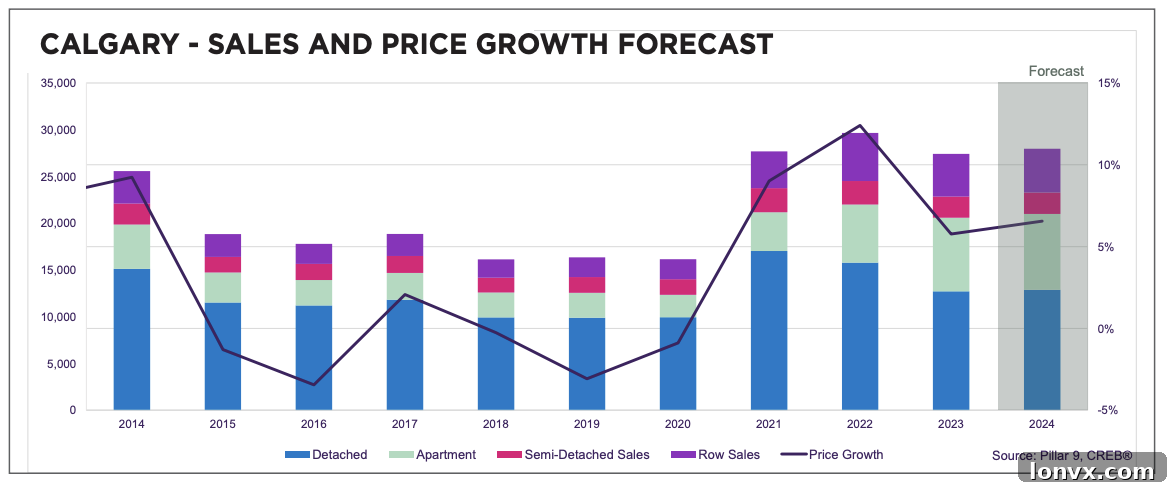
Looking ahead into 2024, CREB anticipates a gradual shift in market dynamics, primarily driven by an expected increase in housing supply. This anticipated boost in listings is projected to come from several sources. Many potential buyers who have been waiting on the sidelines for more inventory or a potential dip in lending rates are expected to re-enter the market. Their renewed activity could encourage more sellers to list their homes, confident in the demand that still exists.
Furthermore, a significant number of existing mortgages are due for renewal this year. As homeowners face potentially higher payments at current interest rates, some may choose to capitalize on the elevated property values in what remains a seller’s market, opting to sell and either downsize, move to a more affordable area, or adjust their housing situation to better suit their financial circumstances. This could lead to a noticeable increase in resale listings, offering much-needed options for buyers.
However, CREB cautions that while supply is expected to improve, it will take considerable time for inventory levels to fully restore market balance. The robust demand, underpinned by Calgary’s strong job market and continued migration, is simply too great to be absorbed quickly. Consequently, the region is expected to remain a seller’s market throughout the spring of 2024, continuing to drive price growth. This growth, however, is projected to occur at a slower pace than the rapid appreciation observed in 2023, particularly for higher-priced properties. Lower-priced segments of the market are expected to remain exceptionally tight, experiencing the most intense competition and sustained price pressure.
Ann-Marie Lurie reinforced this outlook: “Conditions are not expected to be as tight as in 2023, but supply growth takes time, and sellers’ market conditions are expected to persist through the spring, driving further price growth in 2024.” This suggests that while buyers might find slightly more options than last year, the competitive nature of the market, especially for sought-after properties, will likely continue well into the warmer months.
Price Dynamics and Regional Implications
The forecast for price growth in 2024 paints a picture of differentiation across various market segments. While overall prices are expected to continue their upward trajectory, the pace will likely moderate, particularly for properties at the higher end of the market. This moderation can be attributed to several factors, including the increasing interest rate sensitivity of buyers in those segments and potentially a larger pool of available properties as sellers look to capitalize on high valuations.
Conversely, the lower-priced property market is anticipated to remain under extreme pressure. This segment is characterized by the highest demand and the most acute supply shortages, leading to fierce competition among first-time homebuyers, budget-conscious individuals, and investors. As a result, price growth in this category may continue at a relatively faster rate, exacerbating affordability challenges for some prospective buyers.
For sellers, the continuing seller’s market conditions mean they can still expect favorable outcomes, especially if their properties are well-maintained and appropriately priced. However, the expectation of slower price growth means strategic pricing and presentation will be key to attracting the best offers. Buyers, on the other hand, will need to remain agile and prepared for competitive scenarios, particularly if they are targeting entry-level homes. While more choices might emerge, quick decision-making and pre-approved financing will be crucial.
The Calgary region’s diverse communities may also experience these trends differently. Areas with new housing developments might see some relief in supply, while established neighborhoods with limited new construction options could continue to face tighter conditions. Understanding these localized nuances will be vital for both buyers and sellers navigating the 2024 market.
In conclusion, the 2024 Calgary real estate market is set to be a year of transition. While the intense heat of 2023 may subside slightly, particularly in the pace of price growth, the underlying forces of strong demand and gradually improving, yet still constrained, supply will continue to shape a dynamic environment. Prospective participants are advised to consult the full report and work with local real estate professionals to navigate these evolving conditions effectively.
Read the full CREB 2024 Forecast Calgary and Region Yearly Outlook Report here.
Enjoying this article?
Get the latest REM articles in your inbox 3x week so you stay up to date on the latest in the Canadian real estate industry