
Essential Commercial Property Insurance for Canadian Small Businesses: A Comprehensive Guide
In today’s dynamic economic landscape, the role of real estate professionals is evolving beyond transactional sales. They are becoming indispensable, long-term advisors for their small business clients, offering guidance on crucial aspects of commercial property ownership. A fundamental part of this advisory role involves helping clients protect what is often their largest and most significant investment: their commercial property. For entrepreneurs, understanding and securing the right commercial property insurance is not merely a formality; it is a critical safeguard against unforeseen risks that could otherwise devastate their operations.
While insurance provides a vital safety net, the process of navigating intricate policies and ensuring optimal coverage can be daunting for many business owners. Real estate agents, brokers, sales representatives, and board administrators are therefore tasked with addressing their investors’ concerns and directing them toward reliable resources and tailored insurance solutions. This comprehensive guide will delve into common challenges, key policy elements, and leading commercial property insurance providers in Canada, empowering both real estate advisors and small business entrepreneurs to make informed decisions.
Addressing Key Client Concerns About Commercial Properties
Small and medium-sized businesses (SMBs) across Canada frequently encounter specific concerns when it comes to insuring their commercial real estate. Understanding these anxieties is the first step toward providing effective guidance and fostering long-term trust.
1. Fear of Catastrophic Financial Loss
The prospect of a major disaster—such as a fire, flood, severe weather event, or even vandalism—can strike fear into the heart of any business owner. Without adequate insurance, such catastrophic events can spell the end of a business. Entrepreneurs would be forced to bear the full burden of repair costs, property replacement, and the devastating impact of lost income during downtime. A robust commercial property insurance policy mitigates this risk by providing the financial means to rebuild, replace assets, and sustain operations, offering a crucial lifeline when the unexpected occurs.
2. Complexity of Commercial Insurance Policies
Commercial insurance policies are intricate legal contracts, often filled with industry-specific jargon, complex clauses, and subtle wording differences that can have profound implications for coverage. Deciphering these documents requires a keen eye and specialized knowledge. Furthermore, the risk landscape is in constant flux, influenced by factors such as emerging technologies, escalating climate-related events, and evolving legal precedents. Expert advice is therefore not just beneficial but absolutely critical to ensure that a business is adequately protected against both current and future threats.
3. Managing Unaffordable Premiums
The cost of insurance premiums is a significant consideration for SMBs. Premiums are not arbitrary figures; they are meticulously calculated based on a detailed assessment of a property’s unique risk profile. Many business owners worry about high premiums impacting their profitability. However, a knowledgeable insurance partner can help manage costs effectively. They can identify opportunities for risk mitigation (e.g., implementing advanced security systems or fire suppression technologies) or structure a policy with a manageable deductible, balancing premium costs with the business’s financial capacity.
Key Elements to Analyze in a Commercial Property Insurance Policy
To ensure their clients secure the ideal coverage, real estate professionals must guide them through a thorough assessment of commercial insurance policies. A detailed comparison of these key elements is essential for making an informed decision:
1. Coverage Inclusions and Exclusions
It is a fundamental truth that no single insurance policy covers everything. SMB owners must clearly understand what is automatically included in a standard policy and what specific risks require an additional endorsement or separate policy. For instance, standard policies often exclude perils like floods or earthquakes unless specifically added. Modern risks, particularly cyber threats, are rarely covered by traditional property policies.
According to experts like The Shepherd Group, entrepreneurs must secure specialized cyber liability insurance to protect against risks such as “the release of sensitive customer information (e.g., names, addresses, dates of birth, or credit card details); company systems being compromised by malicious actors; and stolen financial or medical records.” This highlights the necessity of considering comprehensive coverage that extends beyond physical property damage to encompass digital assets and business continuity.
2. Coverage Limits and Replacement Cost Value (RCV)
The coverage limit must be set high enough to cover the full cost of rebuilding the property and replacing all damaged or destroyed items with new ones. This crucial step prevents a significant financial shortfall after a major loss, ensuring the business can fully recover without incurring unexpected out-of-pocket expenses beyond the deductible.
Clients must also grasp the critical distinction between Replacement Cost Value (RCV) and Actual Cash Value (ACV). RCV policies pay to replace an item with a new, similar one, without factoring in depreciation. In contrast, ACV policies pay only what the item was worth at the moment it was destroyed, accounting for its age, wear, and tear. For essential business property, RCV is almost universally the recommended option. Choosing ACV might save a small amount on premiums, but it can leave a business severely underinsured and unable to fully replace vital equipment or structures, jeopardizing its ability to resume operations.
3. Deductible and Premium Relationship
Business owners need to fully understand how deductibles function and how they can be leveraged to share risk and manage premium costs. Generally, a higher deductible translates to a lower monthly or annual premium, while a lower deductible results in a higher premium. This relationship allows businesses to tailor their policy to their financial comfort level and risk appetite.
Critically, clients must be financially comfortable with their chosen deductible amount. This sum should be readily accessible in their business savings account, as it must be paid to initiate a claim. Selecting a high deductible that the business cannot afford in a crisis renders the commercial insurance policy practically useless at the very moment it’s most needed. A balanced approach ensures that the business saves on premiums without exposing itself to undue financial strain during a claim.
Top-Rated Commercial Property Insurance for Small Businesses in Canada
When searching for the best protection for their commercial investments, Canadian small businesses have several excellent options. Here’s a look at leading providers known for their comprehensive offerings and commitment to client support:
1. The Shepherd Group — Best for Personalized Service and Comprehensive Solutions
As a Canada-wide independent insurance brokerage, The Shepherd Group distinguishes itself as a comprehensive “one-stop shop” for entrepreneurs. They specialize in crafting custom-made, innovative insurance solutions meticulously tailored to each client’s distinctive risk profile. This client-centric model significantly simplifies the insurance experience, enabling business owners to coordinate their entire insurance portfolio – from commercial property to personal health solutions – seamlessly in one place. Their approach ensures that every aspect of a client’s risk management strategy is integrated and efficient.
Key features of The Shepherd Group:
- Industry-Specific Business Insurance Coverage: The Shepherd Group provides highly specialized solutions for businesses operating in niche Canadian industries. This includes tailored policies for sectors such as roofing, landscaping, snow removal, hospitality, the cannabis industry, and various contractors and trades. Their deep understanding of specific industry risks allows them to offer more precise and effective coverage than generic policies.
- Extensive Commercial Policy Options: They offer a complete spectrum of coverage, encompassing foundational policies like commercial general liability and crucial business interruption insurance. This ensures businesses are protected against a wide array of potential liabilities and can recover lost income during operational shutdowns.
- Commitment to Efficient Service: Clients benefit from a fast, transparent, and highly responsive experience from initial policy selection through to comprehensive claims assistance. This dedication to service excellence minimizes stress and streamlines the insurance process for busy business owners.
Customer testimonial:
“We’re not ‘in a box’ with The Shepherd Group. They’re always looking outside the box for what actually fits our needs. I trust them. They’re a full-service team.” – Jason Deonarain of Guycan.
2. Western Financial Group — Best for Community-Focused Service and Experience
With a rich legacy dating back to 1905, Western Financial Group is a proudly Canadian-owned and operated insurance brokerage built upon a strong foundation of trust and deep community connection. They leverage their extensive network and collaborate with the country’s leading insurance partners to identify and secure the ideal customized coverage for their diverse clientele. Their local presence and long-standing commitment to Canadian communities set them apart.
Key features of Western Financial Group:
- Local Expertise Across Canada: Operating through more than 180 locations with a team of approximately 2,500 insurance professionals, Western Financial Group boasts a deep understanding of local risks and community needs. This widespread presence ensures personalized service and regional insights for clients nationwide.
- Extensive Range of Insurance Products: They provide a comprehensive suite of insurance solutions designed to cover diverse needs. This includes robust commercial property insurance, general liability, and specialized offerings like farm insurance, catering to a broad spectrum of Canadian businesses and individuals.
- Significant Community Investment: Demonstrating a strong commitment to corporate social responsibility, Western Financial Group has invested over $9 million into local community projects, educational bursaries, and emergency relief efforts across Canada since 2001, reinforcing their community-centric values.
Customer testimonial:
“Both my business and home insurance needs are met, and I am confident that I am covered should the unthinkable occur.” – Laurie S. of Medicine Hat, AB
3. Federated Insurance — Best for Association-Endorsed Programs and Risk Management
Operating since 1920, Federated Insurance engages directly with business owners, focusing on cultivating enduring relationships. Their approach involves taking the time to thoroughly understand a company’s operations, both internally and externally, ensuring that the business remains resilient against its specific array of risks. Their commitment extends beyond just policies, emphasizing preventative risk management.
Key features of Federated Insurance:
- Hands-On Risk Services: Federated Insurance provides proactive support through dedicated risk services specialists. These experts work directly with businesses to implement and maintain effective company safety programs, helping to identify and mitigate potential hazards before they lead to claims.
- Exclusive Assist Support Programs: Clients gain access to a valuable suite of value-added services, including Risk Management Assist, Legal Assist, and Trauma Assist. These programs offer direct telephone access to experts and confidential support, providing crucial guidance and resources during challenging times.
- Dedicated Industry Focus: Federated Insurance serves a wide range of Canadian industries with meticulously tailored insurance solutions. They offer dedicated programs for contractors, automotive and equipment dealers, manufacturers, and restaurants, reflecting their deep understanding of the unique risks and requirements of each sector.
Customer testimonial:
“Federated Insurance has been detailed, diligent and transparent with a view to ensuring appropriate cost-effective coverage for our business. On the claims side, responsive and accessible best describe their service. With Federated Insurance, we don’t just have an insurer; we have a real partner in our risk management program.” – Gregory P. Nakonechny, Vice President and Legal and Corporate Secretary, The Brick.
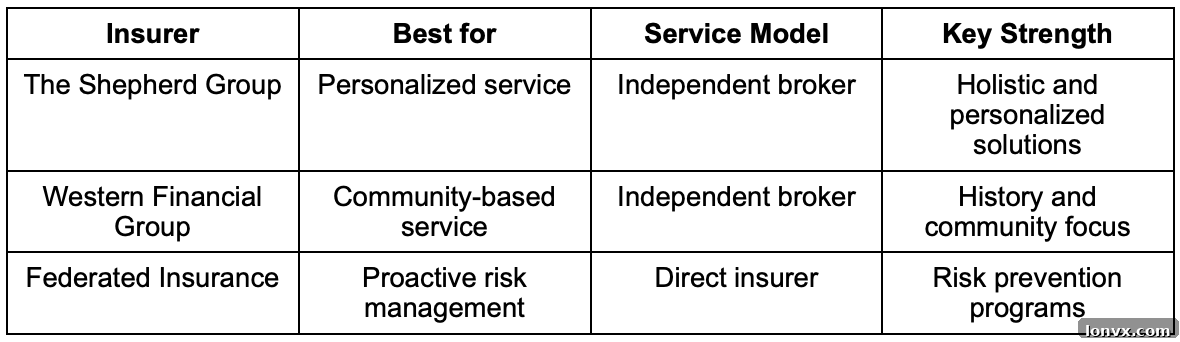
The Commercial Property Insurance Providers at a Glance
For quick comparison, here’s a summary of the key features of these leading commercial property insurance companies in Canada:
Methodology for Assessing Top Commercial Insurers
The commercial insurance providers highlighted in this guide stand out as excellent options for small businesses due to their adherence to a stringent set of criteria:
- Tailored Solutions for Canadian SMBs: These providers demonstrate a clear focus on the unique challenges, opportunities, and regulatory environment faced by small and medium-sized businesses specifically in Canada, rather than offering generic solutions designed for large national corporations. Their policies are crafted with SMB realities in mind.
- Breadth of Offerings: Beyond comprehensive commercial property policies, the chosen insurers possess expertise and provide extensive coverage in other critical areas such as general liability, professional liability, and increasingly vital cyber insurance. This ensures a holistic approach to risk management for businesses.
- Reputation for Client Support: Each provider boasts a strong public reputation for offering expert advice, highly responsive service, and fair, efficient claims processing. Customer testimonials and industry standing consistently reflect their commitment to supporting clients throughout their insurance journey.
- Value-Added Resources: These insurers offer tangible benefits that extend beyond the basic policy. This includes proactive risk management consultations, educational resources to empower business owners, and specialized support services that help prevent incidents and assist clients in navigating complex situations.
Frequently Asked Questions About Commercial Property Insurance
How much does commercial property insurance cost for a small business?
There’s no single “average cost” for commercial property insurance, as premiums are highly individualized and depend on a multitude of factors unique to each business. Various elements contribute to the final price:
- Location: Properties situated in areas prone to specific natural disasters (e.g., floods, wildfires, earthquakes) or regions with higher crime rates will typically face higher premiums. Urban versus rural settings also play a role.
- Construction: The materials used in the building’s construction significantly impact fire risk. Buildings made with fire-resistant materials (e.g., concrete, steel) often incur lower premiums than those built with more combustible materials (e.g., wood frame). The age and condition of roofing, electrical, and plumbing systems are also assessed.
- Protection Features: The presence and proximity of protective measures are crucial. This includes how close the nearest fire hydrant is, the response time of the local fire department, and whether the property has monitored fire and security alarm systems, sprinkler systems, or other loss prevention features.
- Occupancy/Business Type: The nature of the business itself is a major factor. A restaurant utilizing deep fryers and open flames, for instance, poses a significantly greater fire risk than a small accounting office or a retail boutique, directly influencing the premium.
What should you look for in a commercial property insurance policy?
When assessing commercial insurance policies, real estate professionals should advise their clients to diligently check for the following key aspects:
- Replacement Cost Coverage (RCV): Always prioritize policies that cover the cost to replace items with new ones, rather than their depreciated value (Actual Cash Value). This ensures the business can fully rebuild and restock without financial shortfall.
- Business Interruption Insurance: Confirm that this vital coverage is included. Business interruption insurance protects against lost income, ongoing expenses (like payroll and rent), and even temporary relocation costs if the business cannot operate due to a covered peril. Understand its duration limits and scope.
- Relevant Endorsements and Riders: Consider adding specific endorsements for risks unique to the business’s region or type. This might include coverage for flood, earthquake, sewer backup, spoilage of perishable goods, equipment breakdown, or professional liability (Errors & Omissions).
- A True Insurance Partner: Look for a provider that acts as a knowledgeable advisor, not just a policy seller. A good partner will proactively offer risk management advice, respond promptly to inquiries, and provide fair and transparent claims support, helping the business navigate complex situations effectively.
Does a home insurance policy cover a home-based business?
The extent to which a home insurance policy covers a home-based business largely depends on the company’s annual revenue, the type of operations conducted, and the specific terms of the homeowner’s policy. While some home insurance policies may offer extremely limited coverage for certain low-risk home-based businesses (e.g., a small home office without client visits or significant inventory), it is almost always best for entrepreneurs to contact their broker for explicit confirmation and likely separate coverage.
According to Western Financial Group, “If you have customers or employees coming to your home, it is highly recommended that you have a general liability policy. The liability on your home insurance policy will not cover you if a person, such as a client or courier, is injured while on your premises for business-related reasons.” This underscores the critical need for a dedicated commercial policy, even for home-based operations, to protect against potential liability claims and business asset losses.
How Can Small Businesses Get a Quote for Commercial Property Insurance?
To obtain an accurate and competitive quote for commercial property insurance, small business clients must have all essential documentation and information readily available. Real estate professionals should advise their clients to gather the following key details:
- The property’s full address, the year it was built, and its total square footage.
- Detailed information regarding the age and condition of the roof, electrical systems, plumbing, and HVAC systems.
- A comprehensive estimate of the value of the business contents, including inventory, equipment, furniture, and fixtures.
- Information on any previous business insurance claims filed by the company.
- Details on safety and security features, such as alarm systems, sprinkler systems, and fire extinguishers.
- A clear description of the business operations, including industry, revenue, and number of employees.
According to Federated Insurance, “There are several key types of commercial insurance that most businesses should have, as well as policies that cover very specific risks. Businesses can benefit by seeking the advice of an insurance advisor or risk management expert when they are reviewing their insurance needs.” This highlights the invaluable role of an expert advisor in tailoring coverage to the specific needs and risks of each unique business, ensuring optimal protection.
By preparing thoroughly and consulting with experienced insurance professionals, small businesses can secure the right commercial property insurance that provides peace of mind and robust protection for their most valuable assets.