
Canadian Homebuyers Poised for Return to Market as Bank of Canada Holds Rates Steady
After a year marked by unprecedented market shifts, postponed plans, and cautious waiting, Canadian homebuyers are demonstrating a renewed sense of optimism and readiness to re-engage with the housing market. This significant shift follows the Bank of Canada’s pivotal announcement to maintain the overnight lending rate at 4.5 per cent, bringing a much-anticipated period of stability after a series of aggressive rate hikes. Insights from a recent national survey, conducted by Maru/Blue and commissioned by Royal LePage, illuminate this burgeoning sentiment among prospective homeowners across the country.
The comprehensive survey brought to light that a substantial 63 per cent of Canadians who had previously put their home purchase plans on hold over the past year cited rising interest rates as the primary deterrent. However, with the central bank’s decision to pause rate increases, a remarkable 62 per cent of these previously sidelined buyers now express a clear intention to return to the market. This indicates a strong psychological impact of stable rates, offering a crucial signal that many were waiting for before making one of life’s most significant financial commitments.
Delving deeper into buyer intentions, the survey found that a notable 26 per cent of Canadians who postponed their home purchase due to escalating interest rates are specifically planning to resume their property search this spring. This segment represents an immediate injection of demand into the market. Meanwhile, another significant portion, 36 per cent, indicates a plan to proceed with their buying intentions but will exercise a degree of caution, preferring to wait for the Bank of Canada to sustain the current rate for several consecutive months before making their move. This suggests a desire for greater long-term certainty before fully committing. Conversely, about a quarter of those who had put their homebuying goals on hold have stated that they do not intend to resume their plans in the near future, reflecting lingering uncertainty or perhaps a permanent reassessment of their housing objectives.
“On March 8th, 2023, (the Bank of Canada) did nothing and doing nothing was a very big deal,” says Phil Soper, President and CEO of Royal LePage.
The Significance of a Rate Hold: A Turning Point for the Market
The Bank of Canada’s decision on March 8th, 2023, to hold its key interest rate at 4.5 per cent was indeed a monumental event for the Canadian housing market, as articulated by Phil Soper, President and CEO of Royal LePage. Soper emphasized the gravity of this move in a recent press release, stating, “Eight times a year, the Bank of Canada announces changes to its key interest rate, and for eight consecutive meetings, they aggressively raised rates in an effort to tame runaway inflation. On March 8th, 2023, they did nothing and doing nothing was a very big deal.”
This pause, following an unprecedented period of rapid rate hikes, served as a powerful signal. Soper elaborated on its impact, noting, “Based on our just-completed national survey, this was the signal that many Canadians were waiting for – an indication that it was safe to wade back into the housing market to search for the family home they so desperately want or need.” For many, the consistent increases had fostered an environment of apprehension and unpredictability, causing them to retreat from the market. The current stability, even if temporary, provides a window of opportunity and renewed confidence for potential buyers.
Affordability Challenges Persist Despite Rate Stability
While the Bank of Canada’s rate hold has spurred renewed buyer interest, the lingering effects of increased borrowing costs continue to shape purchasing decisions and affordability. The Royal LePage survey highlighted a critical point: among those who postponed their purchasing plans due to the escalating cost of borrowing, a significant 65 per cent reported that higher interest rates have substantially reduced the value of the home they can realistically afford. This means that even with rates now stable, many buyers find their purchasing power diminished compared to a year or two ago, potentially requiring them to adjust their expectations regarding property size, location, or features.
This impact is particularly pronounced among younger demographics. The survey revealed that two-thirds (67 per cent) of those who postponed their home purchase plans were individuals between the ages of 18 and 34. This demographic often comprises first-time homebuyers who are particularly sensitive to shifts in interest rates and affordability, as they may have smaller down payments and fewer accumulated assets. The increased cost of borrowing directly translates into higher monthly mortgage payments, pushing many entry-level homes out of reach and lengthening the time required to save for a sufficient down payment.
Strategic Mortgage Choices in a Changing Landscape
For Canadians gearing up to return to the housing market, strategic decisions regarding mortgage types are becoming increasingly important. With the recent period of interest rate volatility fresh in their minds, many are understandably gravitating towards mortgage products that offer greater payment predictability. The survey found a strong preference for fixed-rate mortgages, which shelter homeowners from the uncertainties of fluctuating interest rates by locking in a consistent payment for a set term.
More than half (53 per cent) of prospective homebuyers indicated they would opt for a four or five-year fixed-rate mortgage, seeking long-term stability in their housing costs. An additional 17 per cent expressed a preference for a short-term fixed-rate mortgage, typically spanning one to three years. This choice might reflect a belief that rates could decline in the near future, allowing them to refinance at a lower rate after a shorter fixed term. In contrast, only 16 per cent of respondents stated they would choose a variable-rate mortgage, which offers lower initial rates but carries the risk of payment adjustments if the Bank of Canada resumes rate changes. This stark contrast underscores a collective desire for financial security and predictable budgeting in the current economic climate.
The Bank of Canada’s Outlook and the Road Ahead
Phil Soper further elaborated on the Bank of Canada’s rationale and future guidance, providing crucial context for the market’s trajectory. He noted, “The Bank of Canada has indicated that it believes the rate hikes completed over the past twelve months are working their way through the economy and that inflation should fall to three per cent by mid-year.” This statement reflects the central bank’s confidence in its monetary policy actions and their anticipated effect on taming inflation towards its target range.
However, the Bank of Canada’s communication was not without caveats. Soper highlighted this nuanced stance: “While stating that they believe this period of rising rates is behind us, the bank qualified the statement, stating that if needed, it will increase rates again…” This demonstrates the central bank’s commitment to its inflation mandate and its readiness to act if economic conditions deviate from projections. Despite this qualification, Soper offered a reassuring perspective for homebuyers and the broader market: “That said, it is unlikely we will see another period of back-to-back rate hikes in the near future.” This suggests that while individual rate adjustments remain a possibility, the era of rapid, consecutive increases may be over, fostering a more predictable environment for financial planning.
“We anticipate that signs of stable economic conditions will lead to a more normalized spring market.”
Canada’s Economic Resilience Amidst Global Headwinds
Adding another layer of confidence to the Canadian housing market outlook is the noted resilience of Canada’s economy, especially when viewed against international challenges. Royal LePage points out that despite the economic turbulence and banking sector concerns recently observed south of the border, Canada’s economy has largely maintained stability throughout this period of correction. This comparative strength is a significant factor in fostering domestic market confidence.
Industry regulators and financial experts share a cautiously optimistic view. While acknowledging that no financial institution is entirely immune to global economic pressures, Canadian financial institutions are widely considered to be more resilient to increased interest rates and economic shocks. This robustness is attributed in large part to the stringent federal regulations imposed upon them, which typically mandate higher capital reserves and more conservative lending practices compared to some international counterparts. This regulatory framework contributes to a more stable banking sector, which is foundational for a healthy housing market.
Forecasting a Normalized Spring Market
With the Bank of Canada holding its rate steady and the Canadian economy demonstrating resilience, the stage appears set for a more balanced and active spring housing market. Phil Soper’s observations on early market activity corroborate this positive outlook. “In recent weeks, well-priced properties in some popular neighbourhoods with low inventory have already seen multiple offers,” Soper commented. This early indication of competitive bidding in desirable areas suggests that buyer demand, though previously suppressed, is beginning to resurface.
The Royal LePage CEO’s forecast is one of normalization rather than exuberance: “We anticipate that signs of stable economic conditions will lead to a more normalized spring market.” A “normalized” market would imply a move away from the frantic, overheated conditions of the pandemic boom and also from the sudden slowdown experienced during the aggressive rate hike cycle. Instead, it suggests a market where supply and demand are more in equilibrium, leading to a more typical pace of sales, potentially more balanced price growth, and greater predictability for both buyers and sellers. This spring could therefore mark a significant turning point, offering a more measured and sustainable environment for Canadians looking to make their move in real estate.
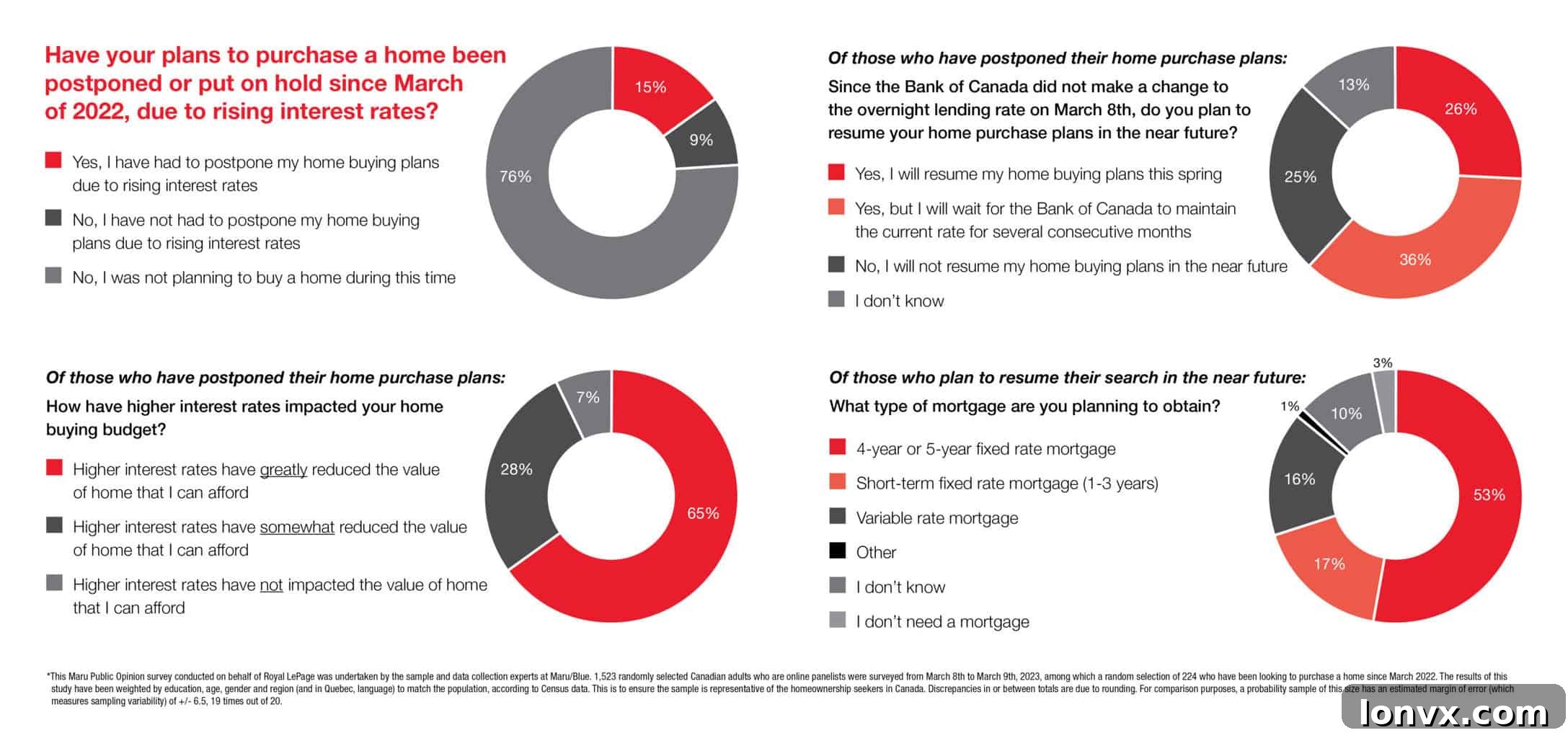
Source: Royal LePage
For a detailed analysis and further insights, find the full report from Royal LePage here.