
Canada finds itself at a critical juncture, grappling with a severe construction labour shortage that threatens to deepen the already pressing housing crisis and exacerbate the national affordability challenge. A recent, comprehensive report by Benjamin Tal, a renowned economist with CIBC Economics, sheds light on the urgency of this multi-faceted problem. The report underscores the immediate need for innovative thinking, decisive policies, and a synchronized effort between governmental bodies and the private sector to avert further economic and social strain. With projections indicating a need for millions of additional housing units across the nation, the chasm between housing demand and available supply continues to widen daily without meaningful, strategic intervention.
The Alarming Scale of Canada’s Housing Shortage: A Multidimensional Problem
Estimating the precise magnitude of Canada’s housing deficit has become a subject of considerable national debate, with various organizations employing diverse methodologies and assumptions, leading to a spectrum of figures. The Canada Mortgage and Housing Corporation (CMHC), for instance, projects that an additional 3.5 million housing units will be essential by 2030 to restore a semblance of affordability across the country. Echoing this urgency, the province of Ontario has set an ambitious target, advocating for a doubling of its annual pace of housing construction to 150,000 units. However, Tal’s report offers a more sobering perspective, arguing that these widely cited figures “grossly undercount” the actual housing demand, particularly from Canada’s burgeoning student population and its significant non-permanent resident community. This overlooked segment of demand suggests that the true gap between housing needs and existing supply is substantially larger than officially acknowledged, making the challenge even more formidable.
The implications of this underestimation are profound. If policymakers base their strategies on underestimated figures, the solutions implemented will inherently fall short of addressing the true scope of the crisis. This persistent shortfall not only inflates housing prices but also contributes to overcrowding, reduced quality of life, and hindered economic mobility for countless Canadians. The housing shortage is not merely an economic indicator; it is a fundamental social issue impacting health, education, and overall community well-being, demanding a holistic and accurately informed approach.
Canada’s Construction Labour Shortage: A Deep Dive into the Crisis
At the core of Canada’s housing dilemma lies a critical impediment: a profound shortage of skilled trades workers within the construction industry. This scarcity directly impacts the sector’s capacity to meet the growing demand for new homes and infrastructure. Currently, Canada’s construction workforce comprises just under 1.6 million individuals, representing approximately 8.0 per cent of the nation’s total employment. While this figure might seem substantial, it falls significantly short of the industry’s burgeoning needs. Data reveals more than 80,000 job vacancies within the construction sector, pushing its vacancy rate to a record high, notably above the national average for all industries.
This deficit is particularly acute among specialty trades contractors, who account for over half of the total demand for construction workers. These highly specialized roles, ranging from electricians and plumbers to carpenters and HVAC technicians, are indispensable for virtually every stage of construction. The escalating demand for these skilled professionals, coupled with their dwindling supply, has driven average wages in construction to rise at a faster pace than in the overall economy. While seemingly beneficial for existing workers, this wage inflation is a stark indicator of the severe labour shortage and contributes directly to increased construction costs, which are ultimately passed on to consumers in the form of higher unit prices, further exacerbating the affordability crisis.
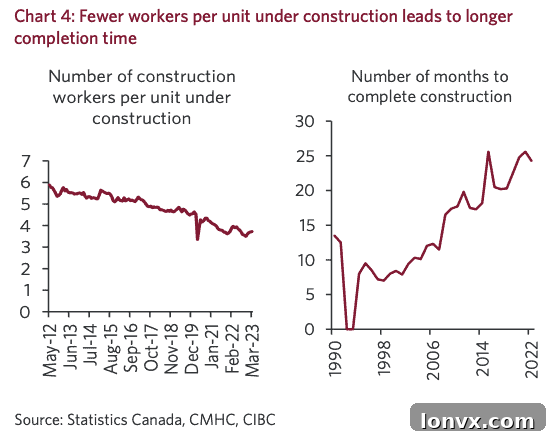
The ripple effects of this labour scarcity extend far beyond mere cost increases. The shortage profoundly impacts the industry’s overall productivity. With an insufficient number of skilled hands, the allocation of labour becomes suboptimal, leading to inefficient processes, prolonged project completion times, and a general slowdown in housing development. This inefficiency is starkly reflected in the fact that productivity growth in the construction sector has significantly lagged behind the national average for an extended period. Furthermore, the pressure to complete projects with fewer qualified workers sometimes results in a greater reliance on untrained or less experienced labour, raising serious safety concerns on job sites and potentially compromising the quality and longevity of new constructions. Without a robust and skilled workforce, Canada’s ambitious housing targets remain largely unattainable, trapping the nation in a cycle of undersupply and unaffordability.
Demographic Tides: An Aging Workforce and Looming Retirements
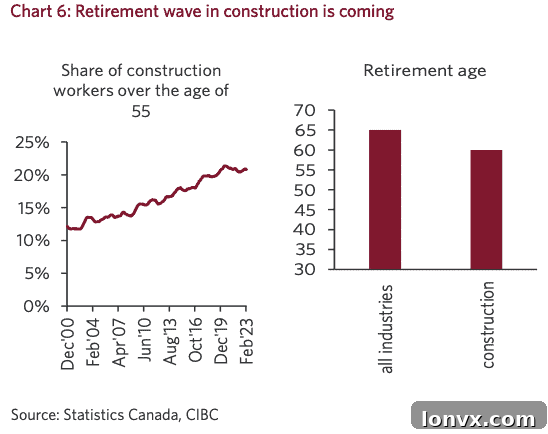
Compounding the urgency of Canada’s construction labour shortage is a significant demographic challenge: an increasingly aging workforce. The construction sector, like many traditional industries, is grappling with a demographic shift where the proportion of workers aged 55 and over has reached an unprecedented high. This trend is particularly problematic in construction, where the average retirement age is typically lower than in many other sectors, often due to the physically demanding nature of the work. This reality means that a substantial portion of the experienced workforce is poised to exit the industry in the coming years, taking with them decades of invaluable knowledge, skills, and expertise.
The CIBC Economics report paints a stark picture of this impending exodus, estimating that approximately 300,000 construction workers are expected to retire within the next decade. This wave of retirements will not only exacerbate the existing labour shortage but also create significant knowledge gaps, making it even harder for new entrants to gain comprehensive on-the-job training and mentorship. By 2033, projections indicate that the labour shortage in skilled trades alone is set to grow by an additional 60,000 positions, a staggering number that underscores the critical need for immediate and sustained action. The departure of these experienced tradespeople represents not just a loss of manpower, but a depletion of institutional memory and a challenge to maintain the high standards of craftsmanship and safety that underpin quality construction. Addressing this demographic imperative requires not only attracting new talent but also implementing robust knowledge transfer programs to ensure that vital skills are passed down to the next generation of Canadian builders.
Untapped Potential: Addressing Labour Supply Gaps Through Diverse Sources
To effectively mitigate the escalating labour shortage in Canada’s construction industry, Benjamin Tal’s report emphatically states that the sector must strategically tap into a broader and more diverse array of labour sources. Traditional avenues for recruitment and training are proving insufficient, necessitating a multi-pronged approach involving domestic training institutions, new immigrants, and foreign workers.
Challenges in Domestic Training and Apprenticeships
A critical concern is the significant decline in domestic talent pipeline. Over the past decade, the number of registered apprentices and trade qualifiers in Canada has plummeted by a troubling 15 per cent. This decline reflects several underlying issues, including a persistent perception gap that often undervalues vocational training compared to university degrees, insufficient promotional efforts in schools, and a lack of accessible and affordable apprenticeship opportunities. Despite efforts to promote diversity, the representation of women in the skilled trades, though increasing, remains disproportionately low, constituting only 7.0 per cent of apprentices and trade qualifiers. This underrepresentation signifies a massive untapped potential, as half of the population is not adequately engaged in addressing a critical national need.
Leveraging the Power of Immigration
Immigration, traditionally a vital engine for Canada’s economic growth and labour supply, represents another underutilized resource for the construction sector. Tal’s meticulous analysis of detailed information from Immigration, Refugees and Citizenship Canada (IRCC) revealed a stark reality: the share of new immigrants entering more than 60 construction-related occupations is alarmingly low, standing at a mere 2.0 per cent. Compounding this issue, this share has been on a downward trend over the last decade. This finding highlights a significant disconnect between Canada’s overall ambitious immigration targets and the specific needs of a critical industry. The report underscores the imperative to dramatically increase the contribution of new immigrants to alleviate the severe shortage, advocating for policies that actively guide and support skilled newcomers into the construction trades.
Optimizing Foreign Worker Programs
While foreign workers currently constitute a more substantial 11 per cent of the construction workforce, this trend is also moving in the “wrong direction,” indicating a potential decrease or insufficient growth relative to demand. While temporary foreign worker programs can offer immediate relief, they often present challenges related to integration, retention, and long-term skill development. A more sustainable strategy would involve better pathways for temporary foreign workers to transition to permanent residency, allowing them to fully integrate into Canadian society and contribute their skills over the long term. Maximizing the potential from all these sources – by revitalizing domestic training, empowering underrepresented groups, and strategically integrating immigrants and foreign workers – is not just an option but a fundamental necessity for rebuilding Canada’s construction capacity.
Charting a New Course: Strategic Solutions and Policy Imperatives
Addressing the profound labour shortage crisis gripping Canada’s construction industry demands a robust, multi-faceted approach encompassing proactive recruitment strategies, fundamental policy changes, and enhanced collaboration across all levels of government and industry. Benjamin Tal’s report strongly advocates for immediate and impactful interventions to stabilize and grow the workforce.
Proactive Recruitment and Retention Strategies
Central to overcoming the shortage is the implementation of proactive recruitment strategies aimed at attracting a wider and more diverse talent pool. Building on the positive, albeit slow, trend of women entering skilled trades is paramount. This requires dismantling stereotypes, fostering inclusive work environments, and promoting the trades as viable and rewarding career paths through targeted outreach in schools and communities. Efforts to reverse the decade-long decline in apprenticeships must be prioritized, including incentivizing employers to take on more apprentices, modernizing training curricula to reflect current industry demands, and providing financial support to individuals pursuing trades education. Initiatives like Nova Scotia’s tax refund program for skilled trades serve as excellent examples of how provincial governments can support and encourage participation, but such programs need to be scaled up and adopted nationwide.
Optimizing Immigration Pathways for Skilled Trades
Recognizing immigration as a critical lifeline, the recent inclusion of skilled trades occupations in Canada’s Express Entry program is a welcome and necessary development. However, Tal believes that more profound changes to the existing immigration points system are imperative to genuinely attract and retain skilled immigrants in the construction sector. This could involve assigning higher points for specific in-demand trades, streamlining the credential recognition process, and providing better settlement support services to help new immigrants integrate quickly into the Canadian labour market and communities. The economist firmly asserts that significantly increasing the share of new immigrants actively participating in the construction labour market will be absolutely crucial in addressing the severe and escalating shortage.
Fostering Government-Private Sector Collaboration
Ultimately, a sustainable solution hinges on unprecedented collaboration. All levels of government must work hand-in-hand with industry associations, educational institutions, and private companies to develop a coherent national strategy. This involves shared responsibilities in funding training programs, forecasting labour needs accurately, and creating a regulatory environment that supports rapid, high-quality construction. By fostering an ecosystem that values skilled trades, encourages innovation, and removes barriers to entry, Canada can not only address its current housing and labour crises but also build a more resilient and prosperous future for all its citizens.
To gain deeper insights into the economic analyses and policy recommendations, readers are encouraged to consult the detailed report from Benjamin Tal and CIBC Economics.