
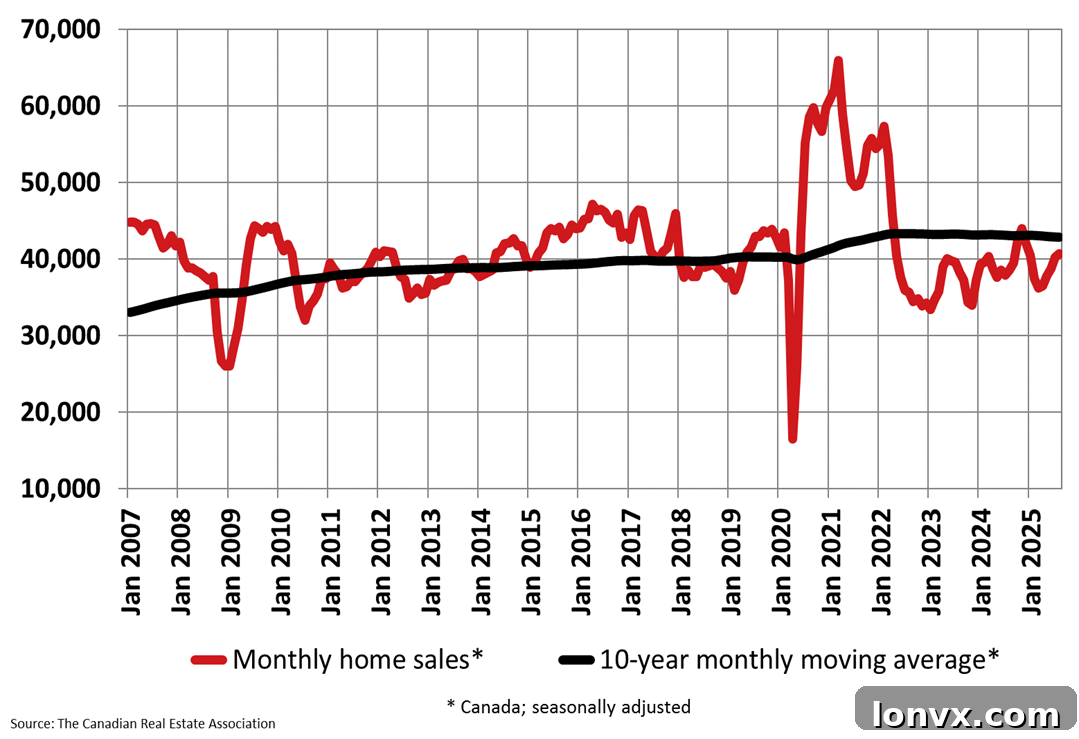
The latest headlines trumpeting a robust recovery in the Canadian housing market often carry a misleading air of triumph. While such pronouncements might offer a glimmer of hope for some, a deeper dive into the underlying data reveals a far more nuanced and, frankly, sobering reality. August did indeed mark the fifth consecutive month of sales gains across the nation, pushing seasonally adjusted transactions up by 1.1 percent and contributing to a cumulative 12.5 percent increase in activity since March. This performance even positioned August 2023 as the strongest August for sales since 2021. However, these figures, while positive on the surface, largely obscure a market still struggling to regain its footing and grappling with fundamental shifts.
The narrative of a market “rebound” is perhaps overstated. Even after half a year of consistent, albeit modest, increases, national sales volumes remain stubbornly well below their long-term historical averages. As the Canadian Real Estate Association (CREA) itself illustrates through its comprehensive data, the so-called resurgence is not indicative of a full restoration of vitality or a return to the peak activity seen in previous years. Instead, it more accurately represents a slow and arduous climb back towards ordinary levels of market activity, following an extended period of significant contraction and uncertainty. This distinction is crucial for anyone attempting to understand the true health and direction of the Canadian housing sector.
For prospective buyers, sellers, and policymakers alike, it’s imperative to look beyond the immediate headlines and appreciate the broader context. The initial surge of optimism can be deceptive if it masks underlying fragilities and shifts in market dynamics. The Canadian housing market is not simply bouncing back; it is undergoing a complex recalibration, influenced by a multitude of factors that demand careful consideration and a cautious outlook. Understanding these deeper currents is key to navigating the future landscape of real estate in Canada, ensuring decisions are based on comprehensive analysis rather than superficial trends.
Supply’s Ascendancy: A Shifting Power Dynamic
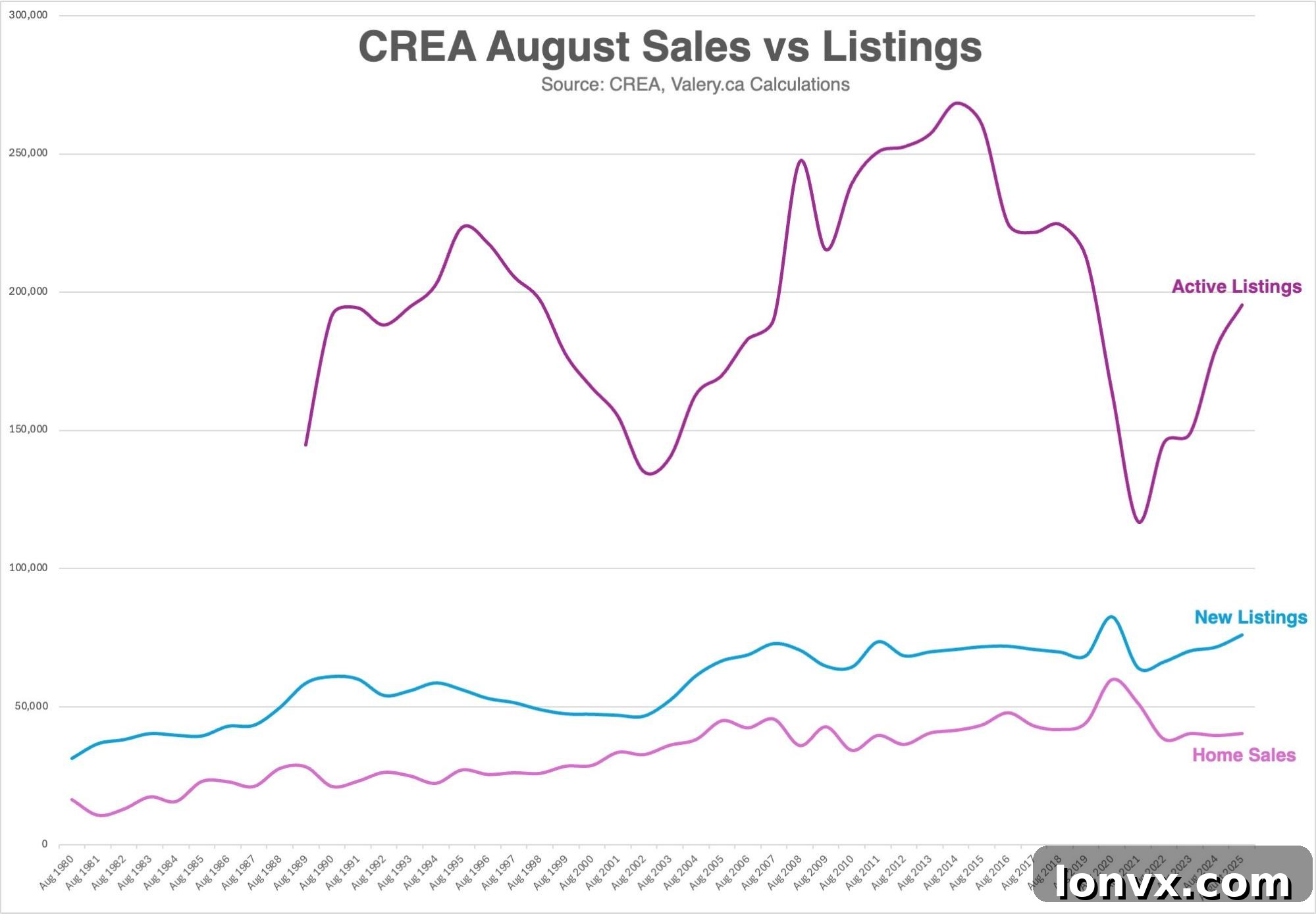
If there is one truly significant story emerging from CREA’s August release, it is the undeniable rise of supply within the market. New listings experienced a notable climb of 2.6 percent month-over-month, a pace more than double that of sales growth. This surge in available properties is profoundly impacting the balance between buyers and sellers, marking a critical shift in the prevailing market psychology. Active listings across Canada stood 8.8 percent higher than they were a year prior, bringing the overall inventory of homes squarely in line with historical norms. This growing pool of available homes signifies a market moving away from the tight conditions that characterized recent years.
Further reinforcing this trend, the sales-to-new listings ratio slipped to 51.2 percent in August. This figure falls beneath its long-term average of 54.9 percent and represents a full percentage point drop from July, as further depicted in Valery’s insightful analysis. This decline clearly indicates that new homes are coming onto the market at a faster rate than they are being sold, directly contributing to increased inventory levels. Such a shift fundamentally alters the dynamics of the Canadian real estate market, moving the balance of power further in favour of supply and, by extension, buyers.
These evolving market dynamics are far from trivial. Policymakers, prospective homeowners, and active market participants must recognize that rising inventories invariably reshape the psychology of both buyers and sellers. With a greater selection of properties available in the marketplace, potential purchasers feel less urgency to make a swift transaction. The pressure to compete fiercely for limited homes diminishes, allowing buyers more time and leverage to negotiate. Conversely, vendors now face significantly greater competition from other sellers vying for buyer attention. This increased competition often necessitates more strategic pricing and greater flexibility from sellers, leading to a crucial mechanism by which price discovery naturally bends downward, not upward, even in the presence of incremental sales growth. This scenario points to a more balanced, if not buyer-favored, market ahead for Canadian housing.
Prices Under Pressure: A Fragile Equilibrium
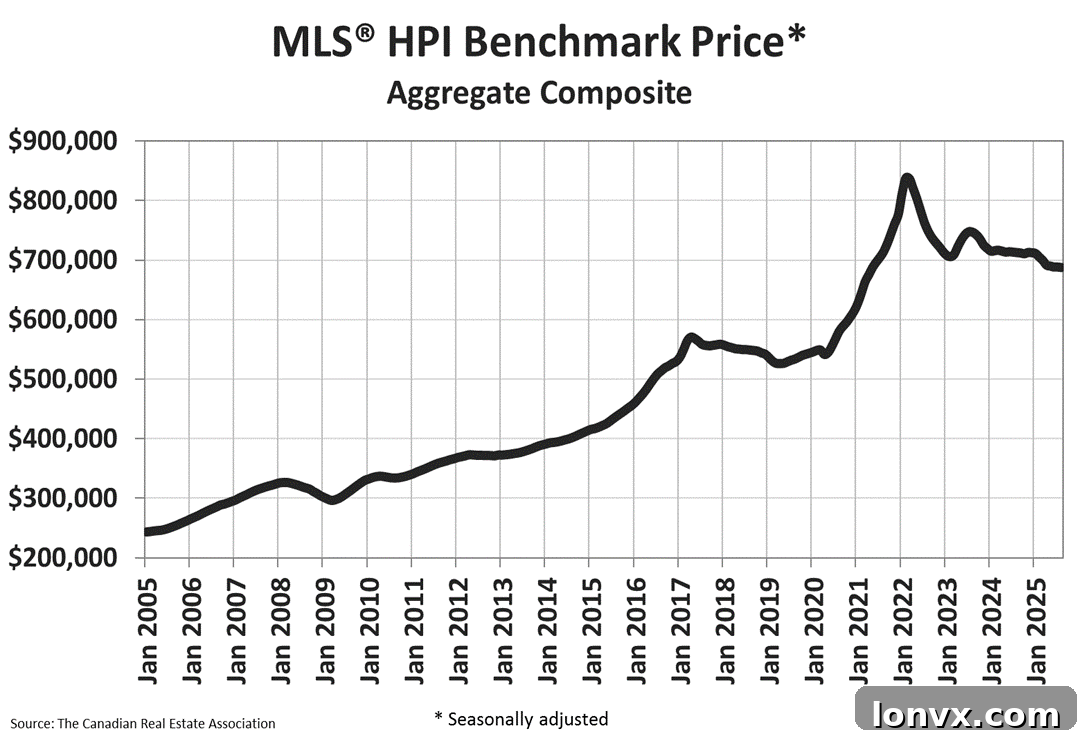
The latest price data for the Canadian housing market strongly reinforces this narrative of underlying fragility and a market under pressure, rather than one in robust recovery. The national Home Price Index (HPI), a key benchmark for property values, remained virtually unchanged in August, registering a marginal slip of 0.1 percent from July. More significantly, it stood 3.4 percent below its level from a year earlier, clearly indicating that despite recent sales activity, actual property values have not seen a meaningful resurgence. While the national average sale price did show an increase of 1.8 percent year-over-year, this figure is largely a reflection of compositional shifts in where transactions occurred, meaning a greater proportion of higher-priced homes were sold, rather than a substantive increase in the valuation of comparable properties across the board.
Benchmark prices have largely remained flat since spring, settling into a plateau that, upon closer inspection, conceals persistent downward pressure in many local markets. This localized pressure is particularly acute in areas where the supply of available homes is rising more rapidly than demand can absorb. For instance, in suburban or less densely populated regions that saw significant price run-ups during the pandemic, the increase in listings combined with cautious buyer sentiment is leading to more pronounced price adjustments. This phenomenon highlights the divergence in market conditions across Canada, where a national average can mask significant regional variations and vulnerabilities.
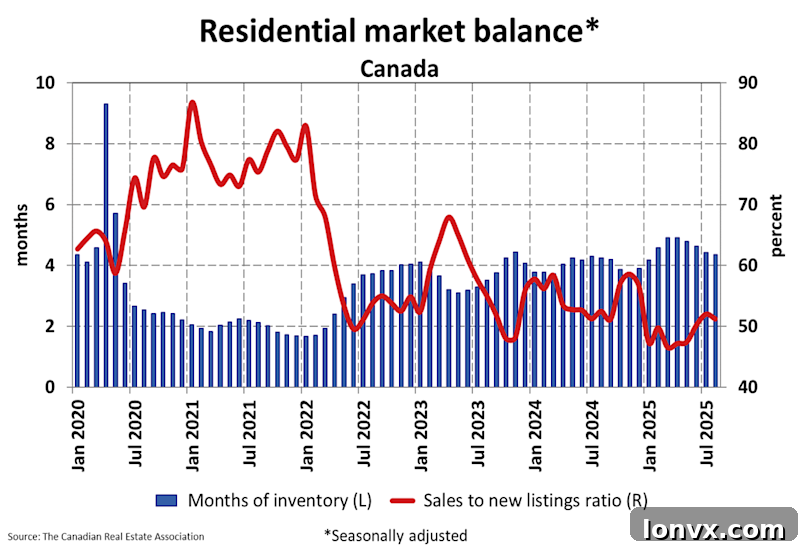
The measure of months of inventory, which currently sits at 4.4, still registers slightly below the long-term average of five months. In isolation, this statistic might superficially suggest a modest degree of seller leverage. However, focusing solely on this single data point without considering its trajectory would be a misinterpretation of the market’s direction. The more telling story lies in the steady and consistent climb of new listings. As new properties flood the market and with the anticipated seasonal surge of autumn supply already upon us, the inherent leverage is rapidly drifting away from sellers and firmly toward buyers. This shifting balance implies that the current months of inventory figure is likely to rise further, putting additional downward pressure on prices as competition among sellers intensifies. This dynamic is a critical indicator for future price trends in the Canadian real estate landscape.
The Policy Lens: Navigating Economic Headwinds
The trajectory of the Canadian housing market in the coming months will largely hinge on the direction of monetary policy. Economists at CREA have openly speculated that a potential rate cut by the Bank of Canada in September or later could entice hesitant buyers back into the market, providing some much-needed stimulus. However, such monetary relief, should it materialize, would not magically erase the structural imbalance that has been created by the recent surge in supply. While monetary easing might indeed lubricate demand by making borrowing slightly cheaper, it cannot extinguish the increased competition that sellers now face due to the greater number of available homes. Interest rate adjustments affect the cost of borrowing, but they don’t fundamentally alter the supply-demand equation when inventory levels are rising significantly.
For governments and regulatory bodies, the lesson from current market trends is even sharper and more profound. The persistent surge of new listings points directly toward an idea of market strain and vulnerability within the Canadian economy. Several factors are converging to push properties onto the market: investors are feeling the acute pressure of higher carrying costs (including elevated mortgage payments and property taxes); existing homeowners are confronting the shock of significantly higher payments upon mortgage renewal; and developers are actively working to clear a backlog of unsold new construction. This confluence of factors contributes substantially to the current flow of listings.
Illustrating this point, Urbanation recently reported that the inventory of completed, developer-held condominium units in the Greater Toronto Area (GTA) reached an alarming record high in Q2 2025. This oversupply in the new construction segment signals significant challenges for developers. Concurrently, STOREYS quoted major developers who highlighted competitive pricing strategies and attractive incentive programs as essential adaptations required to navigate the present challenging market conditions. These industry insights underscore that a substantial portion of current listings is stress-driven, rather than a reflection of a healthy, organically growing market.
Policymakers, therefore, must exercise extreme caution and be wary of mistakenly interpreting higher transaction counts as genuine progress towards housing affordability. A market that achieves equilibrium at lower prices primarily due to an influx of stress-driven listings is not a sign of recovery; it is, in fact, a symptom of underlying economic fragility and distress. Real affordability improvements would stem from sustainable supply growth meeting genuine, stable demand, not from homeowners or investors being forced to sell under financial duress. Understanding this distinction is paramount for crafting effective and sustainable housing policy in Canada.
Outlook: Navigating a Period of Recalibration
The temptation to label August’s market activity as a definitive “turning point” for Canadian housing is undeniably strong. After years of unprecedented volatility, market participants and the general public are understandably eager for any signs of stability or a return to normal. However, the comprehensive evidence available counsels a more cautious and nuanced interpretation. While sales figures are indeed inching upward, they remain subdued when compared to historical standards and previous periods of robust activity. More critically, new listings are climbing at a faster rate than demand can absorb, a trend that is unequivocally shifting the balance of power within the market further towards buyers.
Meanwhile, housing prices across the nation are not demonstrating a clear rebound. Instead, they appear to be treading water, largely stabilized by the significant weight of excess supply. This stagnation in prices, despite some transactional growth, indicates a market struggling to absorb the new inventory without resorting to widespread price reductions. To characterize the current state of the Canadian housing market as a “comeback” would be to fundamentally misunderstand the intricate mechanics and underlying forces at play. This is not a resurgence powered by booming demand or renewed confidence.
Instead, Canada’s real estate sector is currently in a profound phase of recalibration, as some of my previous analyses have alluded to. This period is defined by a necessary adjustment of prices, inventory levels, and buyer/seller expectations in response to higher interest rates, economic uncertainties, and evolving demographic trends. Stakeholders—whether they are individual homebuyers, sellers, investors, or policymakers—who mistake increased transaction volume for genuine market vitality risk profoundly misreading the very forces that will define and shape the Canadian housing landscape in the months and indeed, years, ahead. A clear-eyed understanding of this ongoing recalibration is essential for making informed decisions and navigating the future with prudence and foresight.