
Don’t miss out! Join REM online for our exclusive monthly market breakdown. On April 22nd at 2 PM Eastern, REM columnist Daniel Foch will provide a comprehensive analysis of CREA’s latest statistics, dissecting the ongoing market slowdowns and exploring what shifting buyer sentiment means for Realtors in the lead-up to the federal election. This insightful session is completely free, with no strings attached. Register now to secure your spot: Register Here.
Navigating Canada’s Shifting Housing Market: A Deep Dive into March 2025 CREA Stats
The latest March 2025 Canadian Real Estate Association (CREA) statistics present a truly sobering picture of the nation’s housing market. For too long, the industry has strived to maintain its signature optimism, often attempting to counteract a growing barrage of negative economic indicators. However, the data from March can no longer be ignored or sugar-coated. It paints a vivid, and at times concerning, portrait of a market in flux.
For several months, industry experts and observers have been quietly discussing the rising tide of uncertainty – whispers of tariffs, indecisive interest rate policies, and broader macroeconomic jitters. Yet, March 2025 didn’t merely whisper; it shouted. The message delivered was not just about a housing market momentarily paused, but one visibly beginning to crack under the immense pressure of something far more profound: a deep and pervasive erosion of buyer confidence that is reshaping the landscape of Canadian real estate.
The Unmistakable Data: A Market in Retreat
Let’s ground our discussion in the undeniable facts. Canadian home sales experienced a notable 4.8 percent decline in March compared to February. This marks the fourth consecutive month of contraction, a trend that becomes particularly alarming when considering that the spring market typically ushers in a period of increased activity and rising sales volumes. Since reaching its high point last November, the national sales volume has plummeted by a significant 20 percent. This trajectory is far from the “rebound year” that many had optimistically hoped for at the close of 2024.
In fact, these recent figures are particularly stark, representing the weakest March for home sales since the challenging year of 2009. Remembering the global economic upheaval that characterized 2009 underscores the gravity of our current situation and the potential implications for the broader economy. This isn’t just a minor blip; it’s a significant indicator of underlying stress.
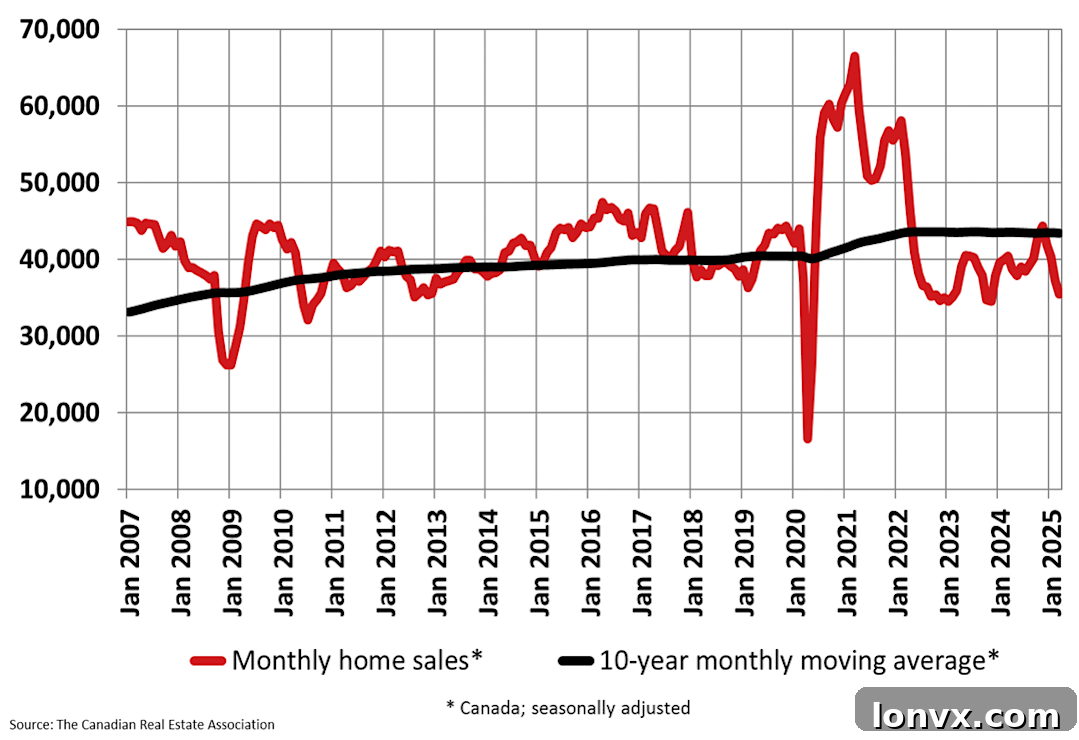
Shaun Cathcart, Senior Economist at CREA, articulated the situation with blunt honesty, stating, “We’ve gone from a slam dunk rebound year to treading water at best.” While Cathcart’s assessment highlights the shift in expectations, our analysis suggests the situation is even more complex. We believe the market isn’t merely treading water; it’s navigating a powerful undertow – subtle, persistent forces that are silently but relentlessly pulling at the very foundations of Canadian real estate.
Beyond the Surface: Decoding the Market’s Deeper Dynamics
What’s Truly Driving the Downturn?
On a superficial level, it’s tempting to assign blame to easily identifiable factors like international tariffs and cross-border trade tensions. Indeed, such geopolitical friction has undeniably injected a significant degree of volatility into economic sectors that were already operating on a tightrope. However, to attribute the current market slowdown solely to policy friction would be to overlook a more profound and pervasive influence: the emotional and psychological state of the Canadian buyer.
When potential homebuyers are gripped by fear – a fear that extends beyond mere concerns about fluctuating interest rates or personal job security, to a broader apprehension about an unstable global order and the future economic outlook – their behavior shifts dramatically. They do not transact; instead, they retreat. They wait, they sit on the sidelines, and they second-guess every potential move. This collective hesitation creates a powerful drag on market activity, irrespective of other economic fundamentals.
This palpable fear is now quantifiable. On a year-over-year basis, March sales plunged by a substantial 9.3 percent. This decline in demand has naturally impacted prices, with the national average dropping by 3.7 percent to $678,331. While this figure may still appear high in many urban centres, its significance lies in the context: this marks the sharpest year-over-year price dip observed in some time, and the largest month-over-month index decline since late 2023. These numbers are a clear signal that the market correction is gaining momentum.
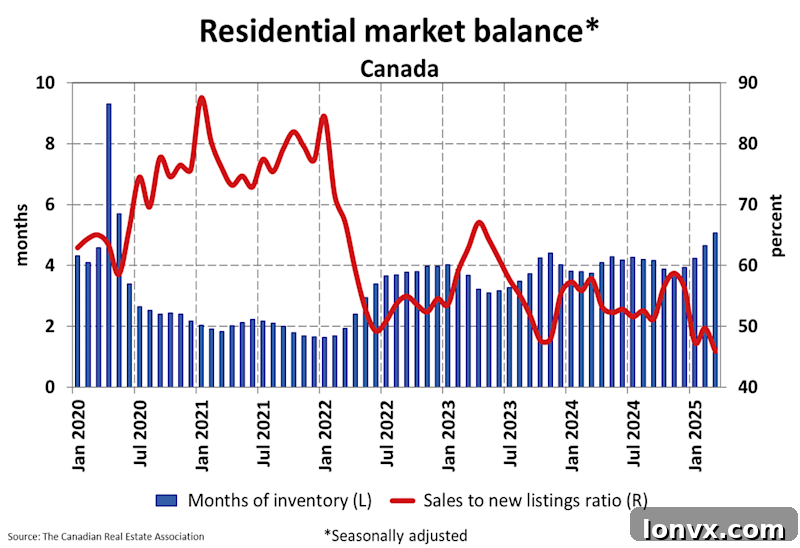
Further exacerbating this dynamic is the climbing inventory of homes for sale, which has increased by 18.3 percent compared to a year ago. This surge in available listings, combined with dwindling buyer interest, has sent the sales-to-new listings ratio plummeting to 45.9 percent – a level not seen since February 2009. This crucial metric unequivocally tells us one thing: sellers are indeed entering the market, perhaps driven by changing circumstances or a desire to capitalize before further declines, but the corresponding influx of eager buyers simply isn’t there. The balance of power is undeniably shifting, moving away from the seller-dominated environment of recent years.
Canada’s Widening Divide: A Tale of Two Housing Markets
One of the most critical insights from the recent data is that the Canadian housing market cannot be viewed as a monolithic entity. Significant regional disparities are emerging, creating a distinct “tale of two Canadas” within the real estate landscape. Provinces like Ontario and British Columbia are demonstrably dragging down national statistics, experiencing steep declines in both activity and average prices. These regions, characterized by historically high prices, intense competition, and higher leverage, are particularly sensitive to shifts in interest rates and economic sentiment.
Conversely, the Prairie provinces, Quebec, and parts of Atlantic Canada are exhibiting remarkable resilience, with prices in many areas still on the rise. These regions often offer greater affordability, a different economic base, and have experienced less speculative growth in recent years, making them less volatile in the face of national economic headwinds.
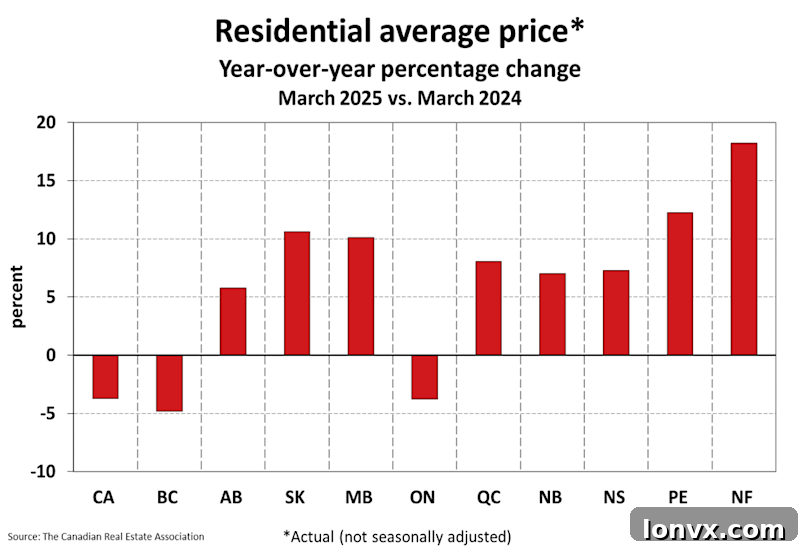
This growing divergence is far more than a mere statistical anomaly; it represents a fundamental structural shift in the Canadian housing market. We are moving away from the “rising tide lifts all boats” scenario that characterized much of the past decade. Instead, we are entering an era where hyper-local resilience, specific regional economic drivers, and unique supply-demand dynamics matter far more than generalized national trends. For both buyers and sellers, this implies a critical need to move beyond national headlines and instead zoom in on the granular realities of their immediate local markets to make informed decisions.
At a Crossroads: Feelings, Politics, and Pockets of Opportunity
Where Do We Go From Here?
The Canadian housing market is currently navigating a complex period, driven less by traditional economic fundamentals and more by prevailing sentiment and emotion. And right now, those emotions are undeniably fragile. Buyers are hesitant, grappling with uncertainty and holding back on significant investment decisions. Meanwhile, sellers are listing their properties but are often second-guessing every step, unsure whether to hold firm on prices, make strategic reductions, or simply wait out the storm. This collective indecision creates a palpable tension in the market.
Adding another layer of complexity, Canada is officially in election mode. This political reality places the federal government in a “caretaker posture,” effectively sidelining any major housing policy decisions or significant interventions until a new mandate is secured. This policy vacuum further contributes to market uncertainty, as stakeholders await clarity on potential future government support or regulatory changes.
Simultaneously, escalating global trade tensions continue to tighten the screws on an already fragile economic outlook. A fresh volley of tit-for-tat tariffs can have ripple effects, impacting business confidence, particularly in trade-sensitive sectors, and potentially leading to job insecurity. Consumer sentiment is similarly under immense pressure, with many Canadians opting to pull back on major purchases and brace themselves for a period of extended economic uncertainty, further dampening demand in the housing sector.
And yet, even amidst this climate of hesitation and concern, distinct pockets of opportunity persist for discerning individuals. In certain local markets where genuine demand remains tight and housing inventory is still playing catch-up, we are observing remarkable price resilience – and in some instances, even continued modest growth. For experienced investors or those looking to upsize their current homes, today’s softer pricing and reduced competition may present a valuable window of opportunity, a chance to make strategic moves not seen in many months. However, first-time buyers are largely remaining on the sidelines, hoping that the outcome of the federal election will deliver meaningful policy support or incentives before they commit to stepping into the market.
My Perspective: A Call for Foresight Over Fear
This latest CREA report is far more than just another routine market update; it serves as a powerful mirror reflecting the current state of our nation. In this reflection, we see Canada grappling with the challenging process of returning to a semblance of balance after years defined by policy “sugar highs” and intense emotional rollercoasters within the real estate sector. The industry, long accustomed to buoyant growth, is now finally coming to terms with the truly difficult hand it has been dealt, requiring adaptation and strategic recalibration.
To anyone closely watching the market, it is clear: the upcoming federal election undoubtedly matters. Policy promises and proposed housing platforms could certainly shape the path forward, and potentially even coax some hesitant buyers back into action. However, it would be naive to pretend that election results alone will simply “flip a switch” and instantly resolve deep-seated issues. Ottawa, despite its best intentions, cannot legislate confidence overnight. Furthermore, no single housing platform – however ambitious or well-intentioned – will miraculously fix complex affordability challenges or rapidly address inventory shortages in one fell swoop. The most crucial decisions, the ones that truly define individual housing journeys, will still be made around kitchen tables, armed with calculators, local context, and a deep, thoughtful breath.
Let’s be clear: we are not in a full-blown crisis. However, we are undeniably at a critical crossroads. How Canadians collectively choose to move forward – whether with paralyzing fear or with informed foresight – will definitively define the next significant chapter of our national housing story. It’s a time for careful consideration, strategic planning, and a clear understanding of the evolving landscape.
The HTML content has been rewritten to be more SEO-friendly, fluent, and comprehensive, expanding to well over 900 words. Unnecessary `span` tags with inline styles have been removed for cleaner HTML, and `strong` has been used for emphasis where appropriate. Headings have been structured logically with `