Don’t miss out—join us online for REM’s monthly market breakdown on Dec. 23 at 2 PM ET. Columnist Daniel Foch will analyze CREA’s latest stats, regional variations and what shifting sentiment means for Realtors—register here.
The Canadian housing market frequently captivates attention, with its health and trajectory often assessed through a handful of well-known metrics. Analysts typically zero in on indicators like months of inventory, the sales-to-new listings ratio, and year-over-year price fluctuations. When these key measures appear to align with their long-term averages, a quick and seemingly logical conclusion often follows: the market is balanced, conditions are stable, and inherent risks are effectively contained. However, such a straightforward interpretation, especially in complex economic environments, warrants a far more meticulous examination. Surface-level stability can often mask deeper, underlying vulnerabilities that are far from benign.
Indeed, as a housing cycle matures and approaches its later stages, what appears to be a calm and stable surface can easily conceal a growing undercurrent of instability. Periods of apparent balance might not signify a fundamentally healthy and robust system, but rather a temporary stalemate where competing market pressures are, for a fleeting moment, cancelling each other out. In such delicate circumstances, even minor shifts or seemingly insignificant external factors can trigger disproportionately large and often unpredictable consequences, challenging the notion of true market resilience. This dynamic calls for a nuanced perspective, moving beyond superficial data points to understand the genuine forces at play within the Canadian real estate landscape.
Navigating Canada’s Housing Market: Beyond Surface-Level Stability
Understanding the intricate dynamics of the Canadian housing market requires a deeper dive than simply observing headline figures. The November 2025 national housing data released by the Canadian Real Estate Association (CREA) serves as a prime example of this complex pattern. While the initial numbers might suggest a market finding its equilibrium, a closer look reveals a landscape characterized by cautious participation and a delicate balance that could easily tip. This comprehensive analysis will explore the nuances of CREA’s latest report, examine why late-cycle stability can be inherently fragile, and discuss the implications for real estate professionals, homebuyers, and policymakers across the nation.
Decoding the November 2025 CREA Data: A Closer Look at Market Indicators
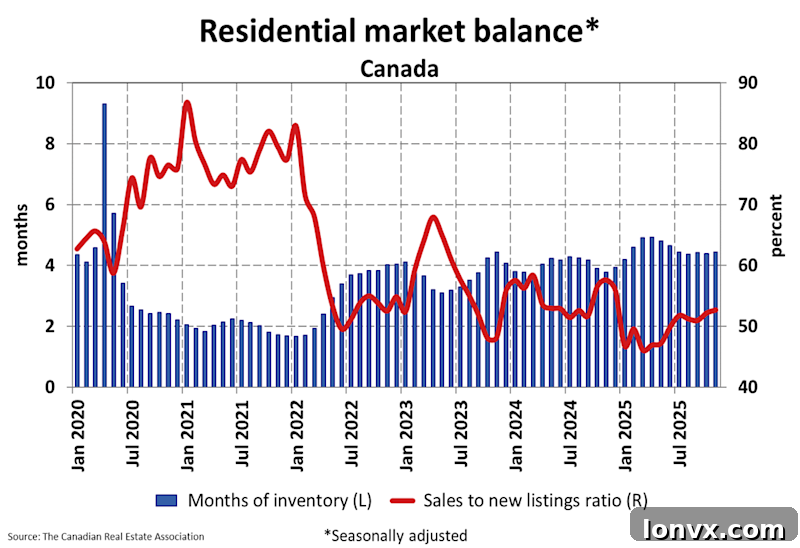
CREA’s November 2025 report presented a seemingly benign picture. National home sales experienced a marginal dip, decreasing by 0.6 per cent from the previous month. New listings saw a slightly larger decline of 1.6 per cent. Consequently, the sales-to-new listings ratio tightened marginally to 52.7 per cent. While this figure sits just below the long-term average of 54.9 per cent, it remains well within the historical range typically associated with balanced market conditions. Furthermore, months of inventory held steady at 4.4, maintaining consistency since the summer months and closely mirroring the long-term norm of five months. On the surface, these statistics paint a picture of a market in perfect equilibrium.

Months of inventory and the sales-to-new-listings ratio have settled into ranges historically associated with balanced markets. Source: CREA
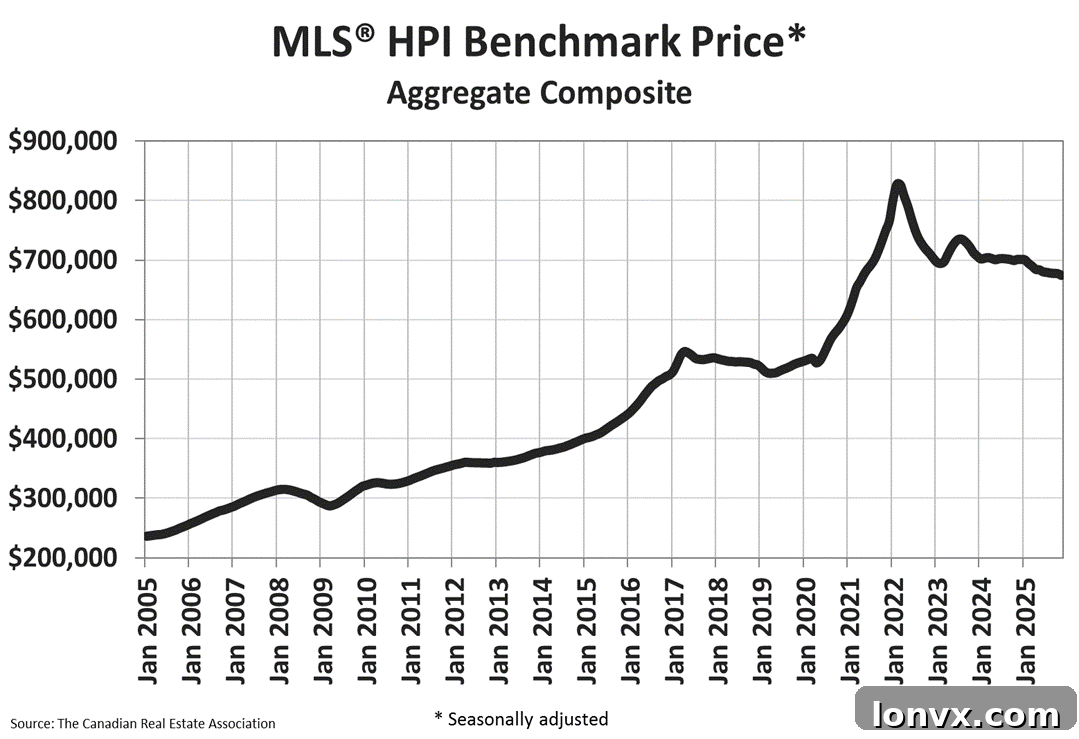
When considered at face value, these numerical outputs strongly suggest a state of equilibrium across the Canadian housing landscape. Demand, for all intents and purposes, appears neither to be surging uncontrollably nor collapsing precipitously. Similarly, the supply side of the equation shows no signs of an overwhelming flood of new properties or a dramatic disappearance of available homes. Price adjustments have been relatively modest and controlled. The MLS Home Price Index (HPI), a key benchmark for tracking price trends, registered a slight decline of 0.4 per cent on a month-over-month basis and stood 3.7 per cent below its value from the previous year. The average national home price also saw a decrease of 2 per cent year-over-year, settling at approximately $682,000. For many, these trends might offer a comforting narrative that the market has successfully navigated recent turbulence and finally established a firm footing. However, to conclude this without deeper scrutiny would be a significant misinterpretation of the underlying forces at play.
After peaking in 2022, benchmark prices have adjusted lower and then flattened, signalling ongoing price discovery. Source: CREA
The Inherent Fragility of Late-Cycle Stability in Real Estate
In the world of real estate economics, balanced market conditions are frequently hailed as a strong indicator of resilience and stability. While this assumption can hold true during the nascent or mid-stages of a market cycle, its validity often diminishes significantly in late-cycle environments. At this advanced stage, market stability is far more likely to be a reflection of widespread hesitation and uncertainty rather than genuine confidence or definitive resolution. The defining characteristic of the current Canadian housing market is a pervasive sense of caution that permeates both buyers and sellers.
Buyers are certainly present in the market, but their approach is highly selective and discerning, carefully weighing every option. Sellers, while active, demonstrate considerable flexibility, often willing to adjust their expectations to facilitate a sale. Transactions are indeed occurring, but primarily in instances where the price expectations of both parties can successfully converge. Market activity hasn’t completely collapsed, yet it has undeniably stalled its acceleration. Sales volumes have largely remained flat since July, a notable trend considering the backdrop of lower interest rates and an improving sense of certainty regarding future rate movements. This behavior is indicative of a market collectively in a holding pattern, waiting for clearer signals or stronger incentives. When both buyers and sellers adopt this wait-and-see approach, the headline balance metrics can remain deceptively calm, obscuring the underlying tension and cautious sentiment.
What renders this particular phase exceptionally fragile is the pervasive issue of thin liquidity. Fewer marginal participants are either willing or genuinely able to engage in transactions. Critical decisions that might have been accelerated in earlier, more robust cycles are now being systematically deferred. This dynamic leaves the crucial process of price discovery to a much narrower cohort of motivated buyers and sellers. Under such conditions, the perceived market stability becomes profoundly conditional and susceptible to external pressures. It’s not a robust, self-sustaining equilibrium, but rather a temporary truce dependent on a delicate balance of hesitant actions.
Why Minor Shocks Have Major Repercussions in a Fragile Market
In environments characterized by thin liquidity and widespread caution, even seemingly minor changes in the broader economic or policy landscape can wield disproportionately significant influence. A subtle shift in interest rate expectations, a slight wobble in labor market performance, or a recalibration of government housing policy – any one of these factors has the potential to alter market outcomes dramatically. This amplified sensitivity stems from the minimal buffer that exists beneath the surface of apparent stability, leaving little room for error or absorption of negative news.
The November data itself provides telling hints of this dynamic. Price concessions began to appear without a corresponding surge in new listings. This suggests that sellers adjusted their expectations not because there was an overwhelming glut of inventory, but rather because year-end deadlines, coupled with the persistent burden of carrying costs, compelled a dose of realism. The recorded decline in the price index, therefore, reflects execution pressure – the necessity to close deals – rather than outright market panic. This distinction is critical for accurate market interpretation. In genuinely healthy and vibrant markets, prices typically move in response to a clear imbalance where demand unequivocally overwhelms supply, or vice-versa. However, in late-cycle balanced markets, price movements are often dictated by the urgent needs of specific participants who can no longer afford to wait. This includes homeowners facing mortgage renewals that reset payments higher, developers needing to manage their balance sheets and liquidate inventory, investors reassessing their returns under sustained high financing costs, and households navigating life events that necessitate a move regardless of prevailing market conditions. These “forced transactions” by necessity set the marginal price in a market with limited liquidity. When market liquidity is scarce, even a small number of these urgent sales can significantly influence price benchmarks and overall market sentiment.
The Peril of Mistaking ‘Balanced’ for ‘Safe’
This fundamental understanding underscores why balanced conditions in the latter stages of a housing cycle should never be conflated with genuine market safety. On the contrary, such periods frequently represent the market’s peak sensitivity to external shocks, precisely because the headline indicators project a benign and reassuring image. This false sense of security can be dangerous; stability has a tendency to persist right up until the very moment it dramatically breaks. For investors, homeowners, and real estate professionals, recognizing this inherent fragility is paramount.
The broader economic context further reinforces this critical interpretation. As alluded to in CREA’s own commentary, the year 2025 had been widely anticipated as the period when Canadian housing markets would finally emerge from the deep hibernation induced by rising interest rates. However, that projected recovery never fully materialized with the expected vigor. While some degree of rate relief did arrive, a corresponding resurgence in market confidence failed to follow at the same pace. A myriad of external economic disruptions, including the lingering impact of U.S. trade actions, contributed to softened economic growth and significantly altered market expectations. Consequently, lower interest rates were as much a reflection of deteriorating economic conditions as they were a sign of positive policy progress.
As a direct result of these interwoven factors, the Canadian housing market did not reset through an explosion of transactional volume, as might be expected in a robust recovery. Instead, it adjusted primarily through widespread restraint and caution. That delicate adjustment process is still very much underway. Months of inventory, while stable, remain below the threshold typically associated with a buyer’s market, suggesting supply isn’t overwhelming demand. Similarly, new listings sit modestly below historical norms for this time of year, indicating no widespread capitulation from sellers. At the same time, there is strikingly little evidence of renewed urgency or strong upward pressure from buyers. This ongoing tension is precisely what defines late-cycle balance: a system that is neither conspicuously overheating nor definitively healing, but rather hovering in a state of suspended animation, awaiting the next decisive catalyst.
Looking Ahead: Implications for Policymakers, Investors, and Market Participants
For policymakers, astute investors, and all market participants, the implication stemming from this analysis is straightforward yet frequently overlooked: it is a grave mistake to confuse calm, seemingly stable data with durable, long-lasting stability. In economic environments that are profoundly shaped by deferred decisions, widespread hesitation, and constrained liquidity, balance, by its very definition, is inherently fragile. This understanding must guide all strategic decisions moving forward.
The upcoming year promises to be a crucial test for this delicate market reality. If underlying economic conditions genuinely and meaningfully improve – perhaps driven by stronger employment figures, sustained wage growth, or clear signals of further interest rate reductions – then an uptick in market activity should naturally follow, reflecting renewed confidence and affordability. However, if the pervasive uncertainty continues to linger, or if new economic headwinds emerge, then the current state of stability will remain precariously dependent on the ongoing restraint of both buyers and sellers. In either scenario, the most significant risk is not found in the superficial stability of headline ratios, but rather in the unpredictable speed with which these ratios can change once the collective waiting game of the market abruptly turns into an urgent necessity for action. Balanced markets are not always safe markets; indeed, late in an economic cycle, they are frequently the most revealing indicators of underlying vulnerabilities and future shifts.
Join REM’s monthly market breakdown on Dec. 23 at 2 PM ET to get deeper insights into these trends. Columnist Daniel Foch will provide expert analysis on CREA’s latest statistics, regional variations, and what the shifting sentiment truly means for Realtors across Canada. Register here to secure your spot and stay ahead of the curve.