
Greater Vancouver Housing Market Forecast H2 2024: Navigating Shifting Tides
The Greater Vancouver real estate market, a consistent focal point for homeowners, buyers, and investors alike, is undergoing significant shifts. Last week, Greater Vancouver Realtors (GVR) unveiled its comprehensive 2024 second-half (H2) housing forecast, offering a deep dive into the evolving dynamics impacting the market. This detailed review considers key economic trends that shaped the first half of 2024 and projects their continued influence on the coming months. As we move further into the year, understanding these forecasts becomes crucial for anyone looking to engage with the property market in this vibrant region.
GVR’s forecast highlights several critical areas, from sales volumes and price appreciation to the unexpected surge in inventory and the nuanced response to interest rate adjustments. These insights paint a picture of a market transitioning from a period of intense seller advantage to more balanced conditions, providing both challenges and opportunities for participants.
Here are the key takeaways and a deeper exploration of what GVR anticipates for the second half of the year, delving into the factors that will likely shape property values and market activity.
Sales and Price Forecasts: A Market in Balance
GVR’s initial 2024 first-half (H1) predictions for sales and prices have proven remarkably accurate, a testament to their analytical rigor. The organization had forecast an approximately 8.0 percent jump in sales across Greater Vancouver compared to 2023, targeting 28,250 sales by year-end. As of July, actual sales tallied 16,227, aligning almost perfectly with their H1 projection of 16,256, demonstrating a mere 0.18 percent difference. This precision gives considerable weight to their revised outlook for the remainder of the year.
A significant observation from the H1 data is the noticeable shift in market balance. While the year began with conditions heavily favouring sellers, increasing inventory levels and a cautious buyer sentiment have gradually moved the market towards a more balanced state. This transition is a key theme for H2 2024, influencing both sales volumes and price trajectories.
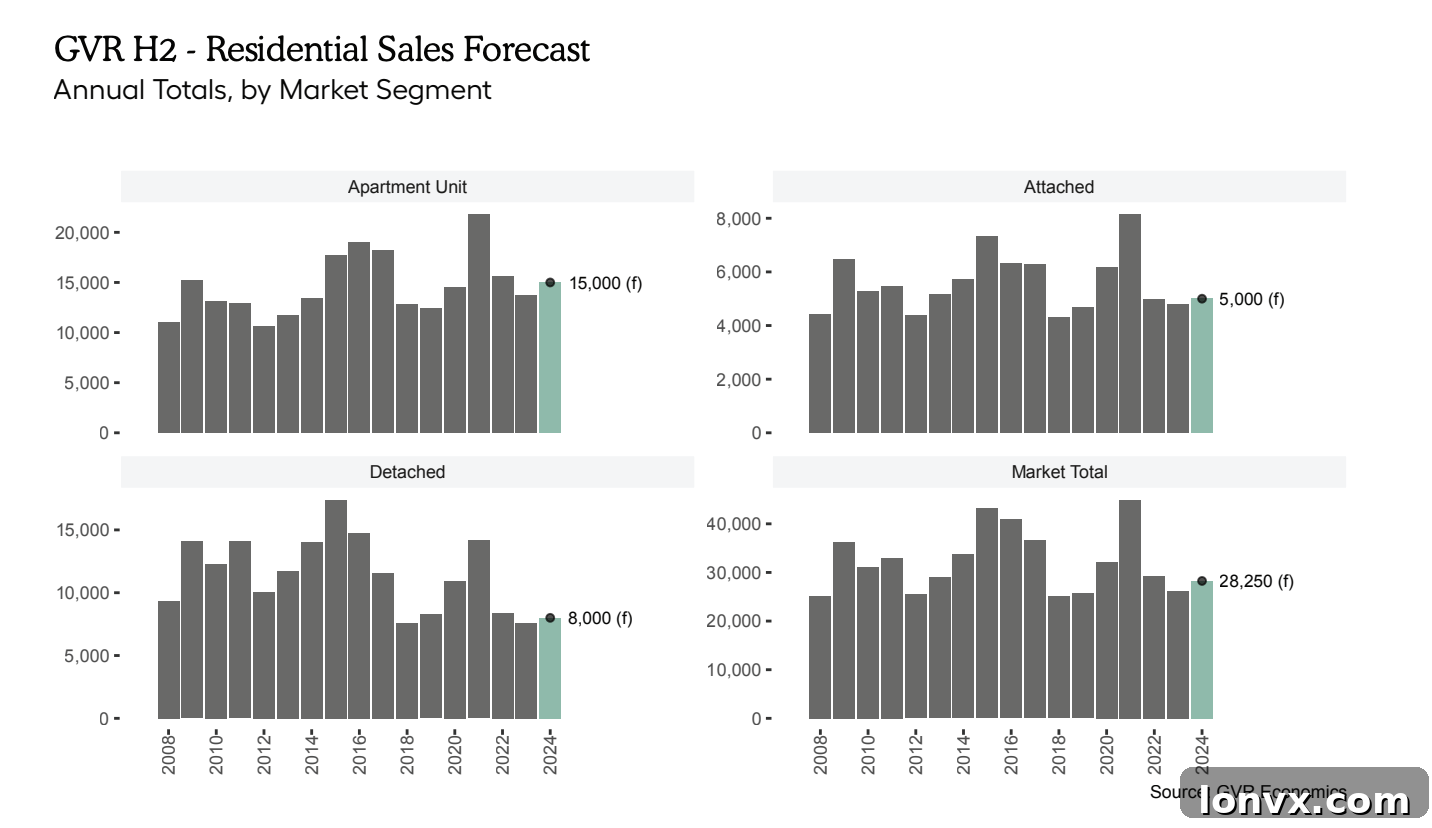
Initially, aggregate price metrics showed slight increases, largely propelled by consistent sales activity coupled with near-record-low inventory levels at the start of 2024. However, as the months progressed and new listings surged, most aggregate price metrics began trending sideways or even slightly downward. This stabilization suggests that while demand remains present, the increased supply is tempering rapid price escalation. Despite these broader trends, the median differential between the list price and the final sale price for all GVR properties has consistently hovered around a 2.0 percent discount since the year began, indicating that savvy buyers are finding some room for negotiation.
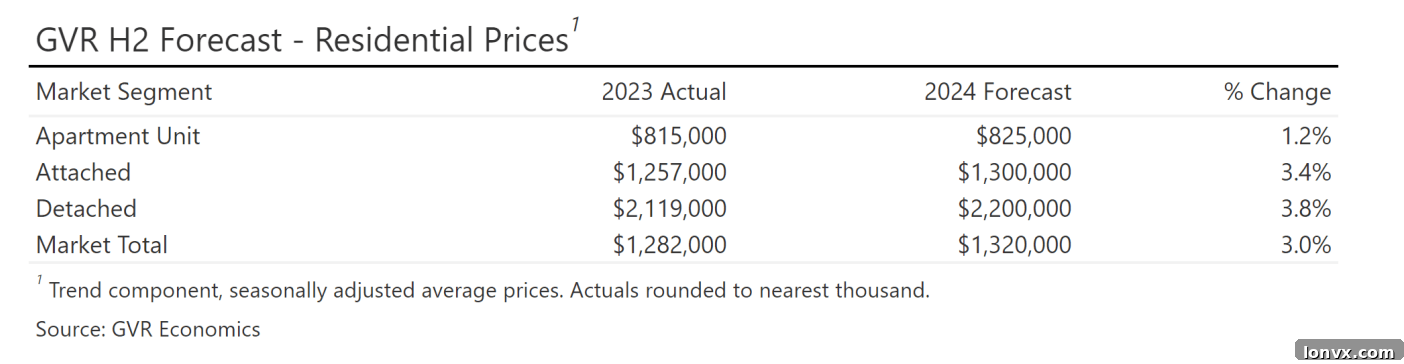
Looking ahead, GVR’s outlook for the second half of the year remains consistent with the emerging balanced market. They anticipate that these conditions will continue to support modest price appreciation, projecting a range of 1.0-4.0 percent across various market segments by year-end. This conservative yet positive forecast reflects an environment where strong underlying demand meets an expanding supply, creating a sustainable, albeit slower, pace of growth. Different property types, such as detached homes, townhouses, and condominiums, may experience varied rates of appreciation within this range, influenced by location, specific amenities, and localized supply-demand dynamics. This balanced growth indicates a healthy market adjusting to new economic realities rather than experiencing a boom or bust cycle.
Surging Inventory: A Boost for Buyers
One of the most significant and perhaps surprising developments in the H1 data has been the substantial increase in housing inventory across Greater Vancouver. The region has not witnessed such high inventory levels since 2019, representing a considerable boost compared to 2023. This surge is a welcome change for prospective buyers, as it signals a return to more balanced market conditions, offering greater choice and potentially less intense bidding wars.
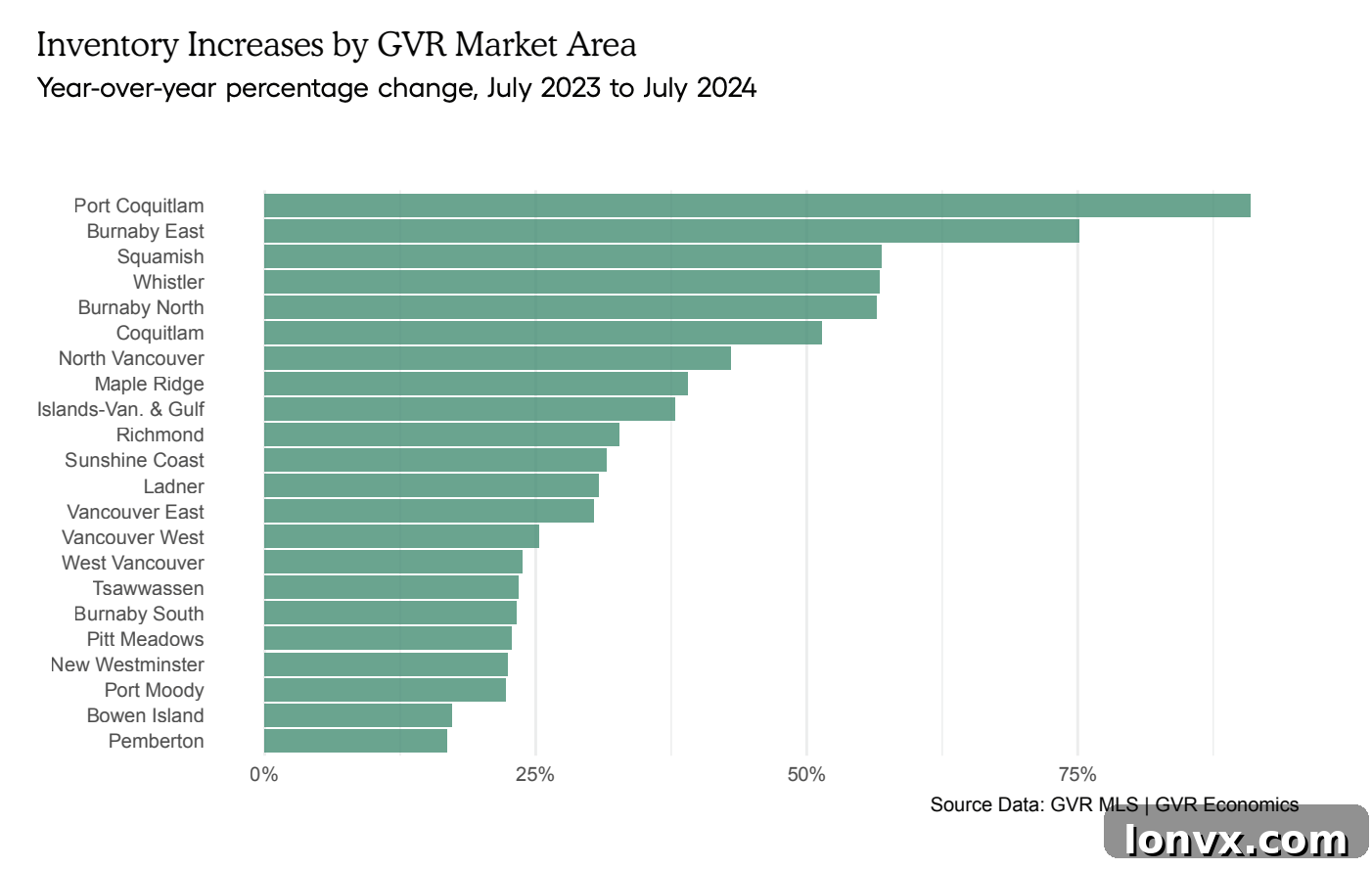
The primary forces driving this trend are a combination of steady demand from buyers and, more notably, higher-than-expected new listing activity. GVR views this increased inventory not as a cause for concern, but rather as a positive development, especially beneficial for those looking to purchase a home. It suggests a healthier, more sustainable market where buyers have more time to make informed decisions without the intense pressure often seen in supply-constrained environments.
While current sales volumes remain below their 10-year average, this is not an entirely new phenomenon in the market’s historical context. What is significant is that newly listed properties are consistently meeting or even exceeding historical averages. The combination of sustained new listings and sales activity that, while steady, remains below the long-term average, has led to a natural accumulation of inventory. This accumulation has provided much-needed breathing room for the market, mitigating the acute supply shortages that have characterized recent years.
GVR’s analysis reveals multiple factors contributing to this boost in new listing activity. One key element is the suppressed listing activity observed in early 2023. Many potential sellers chose to wait on the sidelines during that period, perhaps due to market uncertainty or interest rate fluctuations. These “deferred sellers” are now entering the market in 2024, contributing to the higher new listing volumes. Additionally, changing life circumstances, evolving financial situations, and a renewed sense of market confidence may also be prompting more homeowners to list their properties. This influx of listings is vital for improving affordability and fostering a more equitable market environment for both buyers and sellers.
Interest Rate Cut Impacts: A Cautious Buyer Response
The Bank of Canada’s monetary policy plays a pivotal role in shaping the real estate market, primarily through its influence on interest rates and, consequently, mortgage costs. GVR anticipates additional reductions to the Bank of Canada’s policy rate later this year, which typically would be expected to stimulate buyer demand. However, the forecast carries a note of caution: it may take longer than historically observed for these rate reductions to translate into a significant surge in buyer activity.
This cautious stance is reinforced by the market’s reaction to the 50-basis point reduction in the policy rate during H1. Despite this cut, buyers showed a relatively muted response, with demand not increasing as sharply as some might have predicted. Several factors could explain this subdued reaction. Firstly, even with a 50-basis point reduction, interest rates remain higher than the ultra-low levels seen in recent years, meaning affordability challenges persist for many potential buyers. Mortgage qualification criteria, stress tests, and the sheer cost of housing in Greater Vancouver continue to be significant barriers.
Secondly, a “wait-and-see” approach might be prevalent among buyers. Many could be anticipating further rate cuts, hoping for even more favourable borrowing conditions before committing to a major purchase. Market uncertainty, global economic headwinds, and ongoing inflation concerns could also be contributing to this cautious sentiment, leading buyers to prioritize financial stability over immediate property acquisition.
The H2 forecast projects another 50-basis point reduction to the policy rate. While this move will undoubtedly ease borrowing costs further, GVR suggests that the market’s response might still be gradual rather than immediate. A significant uplift in buyer demand may require not just one or two rate cuts, but a more sustained period of rate stability or further substantial reductions that tangibly improve affordability metrics. This implies that while the direction of rates is downward, the psychological and financial thresholds for a widespread return of aggressive buyer activity are higher than in previous cycles. The market is adapting to a “new normal” where lower interest rates, while helpful, are just one piece of a complex affordability puzzle.
Navigating Affordability and Regional Dynamics
Even with the market shifting towards more balanced conditions and increasing inventory, affordability remains a paramount concern in Greater Vancouver. While higher inventory offers more choice, it doesn’t necessarily translate into significantly lower prices, especially within the context of GVR’s projected modest price appreciation. First-time buyers, in particular, continue to face considerable hurdles, requiring substantial down payments and navigating stringent mortgage qualifications. The shift to a more balanced market might slightly ease pressure but won’t magically solve the underlying affordability crisis.
Moreover, it’s crucial to remember that Greater Vancouver is a diverse region, and market conditions can vary significantly from one municipality or neighborhood to another. While the GVR forecast provides aggregate data, specific areas might exhibit stronger or weaker demand, different inventory levels, and varying price trends based on local amenities, schools, transit access, and specific housing types available. Buyers and sellers should conduct localized research to understand the nuances of their target market within the broader Greater Vancouver context.
For sellers, the increased inventory means a more competitive landscape. Strategic pricing, effective marketing, and a willingness to negotiate may become more important in H2 2024. For buyers, the increased choice and reduced pressure offer an opportunity to be more selective, potentially secure better deals, and conduct thorough due diligence without the rush of previous seller’s markets. This environment rewards patience and informed decision-making.
Conclusion: A Balanced Path Forward for Greater Vancouver Real Estate
The Greater Vancouver real estate market is entering the second half of 2024 on a path towards greater balance, a significant departure from the intense seller-favored conditions of recent memory. GVR’s accurate H1 forecasts and their pragmatic outlook for H2 underscore a market that is adapting to evolving economic realities, particularly in response to interest rate policies and a welcome surge in housing inventory.
While modest price appreciation of 1.0-4.0 percent is still anticipated by year-end, the driving force behind this growth is likely to be sustainable demand rather than speculative exuberance. The substantial increase in inventory, the highest since 2019, is a positive signal for market health and offers much-needed choice for buyers, though affordability challenges persist. The cautious response of buyers to initial interest rate cuts indicates that while further reductions are expected, a significant surge in demand may take time to materialize as buyers await greater certainty and improved financial conditions.
For all market participants, the H2 2024 forecast suggests a period of considered action rather than rapid shifts. Understanding these dynamics is essential for making informed decisions, whether you are looking to buy, sell, or invest in the dynamic Greater Vancouver housing market. The emphasis will be on strategic planning, patient observation, and adapting to a market that, while still robust, is finding its equilibrium.
Review the full H2 forecast here.
Enjoying this article?
Get the latest REM articles in your inbox 3x week so you stay up to date on the latest in the Canadian real estate industry