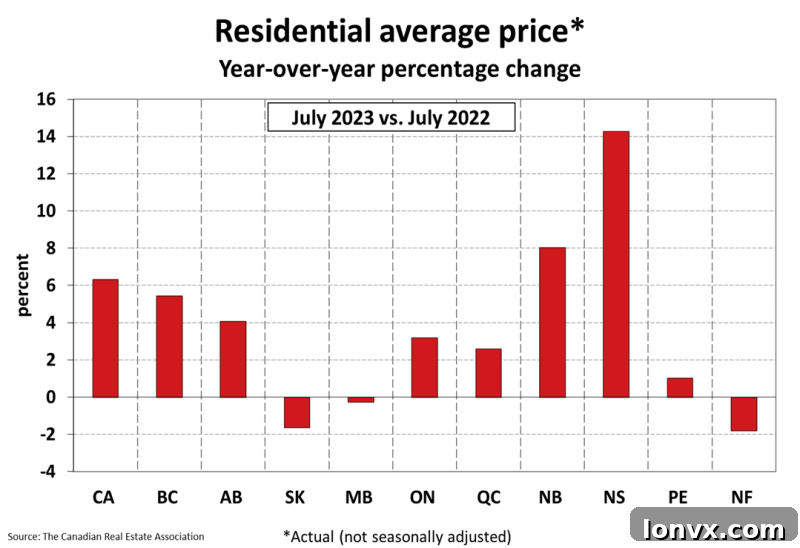
Canada’s dynamic real estate market experienced a notable cooling trend in July, defying the typical summer slowdown with significant shifts in key indicators. For the first time since January, the national Months of Inventory (MOI) metric increased, signaling a potential easing of supply constraints. Simultaneously, the Sales-to-New Listings Ratio (SLNR) continued its sharp downward trajectory for the fourth consecutive month, according to data released by the Canadian Real Estate Association (CREA). These two crucial metrics are widely used by market analysts to gauge the overall balance and health of the Canadian housing landscape.
On a national level 🇨🇦 real estate market cooled down a little in July but remained a Seller’s Market. pic.twitter.com/xk1454TVg4
— Alex (xelan) (@xelan_gta) August 16, 2023
Understanding Months of Inventory (MOI) in the Canadian Housing Market
Months of Inventory (MOI) serves as a critical supply-side metric, offering invaluable insights into the equilibrium between housing supply and demand. This indicator effectively quantifies the current available inventory of homes against the rate at which they are being sold. Essentially, it answers how long it would take to sell all currently listed properties at the current sales pace, assuming no new listings enter the market. A low MOI suggests a scarcity of listings, leading to heightened competition among buyers, whereas a high MOI indicates an abundance of properties, granting buyers greater negotiation leverage.
From an economic perspective, MOI helps to determine whether a market is experiencing excess demand or excess supply. Excess demand, characterized by the quantity demanded surpassing the quantity supplied at a given price, often results in a shortage of homes. In real estate terminology, this scenario is commonly referred to as a “seller’s market,” where sellers typically hold significant pricing power due to limited options for buyers. Conversely, excess supply occurs when the quantity demanded falls below the quantity supplied, leading to a surplus of listings. This environment fosters a “buyer’s market,” where buyers benefit from more choices and increased bargaining power, often leading to price reductions or more favorable terms.
Calculating Months of Inventory: A Key Real Estate Metric
To accurately calculate the Months of Inventory for any given real estate market, follow these straightforward steps:
- Identify the total number of active listings available on the market during the preceding month.
- Determine the total number of completed sales transactions for that same preceding month.
- Divide the total number of active listings by the total number of sales to ascertain the remaining months of inventory.
The precise threshold that distinguishes a “buyer’s market” from a “seller’s market” based on MOI is a subject of ongoing debate among real estate professionals, often varying significantly from one local market to another. However, general consensus suggests that an MOI of less than 4.0 months typically empowers sellers, giving them a stronger position in price negotiations. If the MOI climbs above 6.0 months, the balance of power tends to shift towards buyers, affording them more negotiation room. In July, Canada’s national MOI stood at 3.2 months, a slight increase from 3.1 months in both May and June. This modest 3.2 percent growth in MOI was notably outpaced by a 5.6 percent rise in newly listed properties. This divergence is a crucial signal: while new listings are increasing, particularly in a period traditionally associated with slower supply, buyer demand is struggling to absorb this influx, indicating a weakening market pace.
A sustained increase in MOI suggests a market transition. For sellers, it could mean longer listing periods and potentially needing to adjust pricing expectations. For buyers, this trend opens doors to more options and a less frantic purchasing environment. Understanding these dynamics is paramount for making informed decisions in the Canadian housing market.
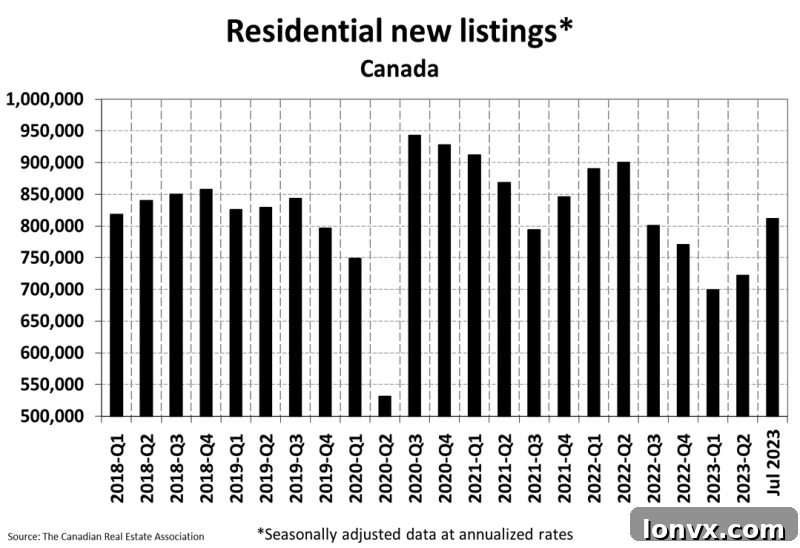
Analyzing the Sales-to-New Listings Ratio (SLNR): A Demand Indicator
The Sales-to-New Listings Ratio (SLNR) is another pivotal metric that gauges the balance between housing demand and supply by comparing the number of homes sold to the number of new properties listed over a specific period. A high SLNR indicates a robust demand, where a significant portion of new listings are quickly absorbed by the market. Conversely, a low SLNR suggests weaker demand or an oversupply, as fewer new listings are converting into sales.
As a direct consequence of new listings outpacing sales growth in recent months, Canada’s national SLNR has continued its steady downtrend. This ratio had peaked just below 70 percent in the second quarter of this year, a period marked by renewed buyer confidence and activity. Tracing the trajectory of this red line back to the pandemic era reveals an extraordinary period where the sales-to-new listings ratio consistently remained above 70 percent. This prolonged period of high SLNR fueled an unprecedented surge in housing prices, culminating in the market’s peak and subsequent sharp correction in the first quarter of 2022, which witnessed a record-setting decline in average home prices.
Historically, a market is considered balanced when the sales-to-new listings ratio hovers around 50 percent. When the ratio consistently climbs above this threshold, it typically signifies a seller’s market, characterized by bidding wars and rapid sales. Conversely, a sustained ratio below 50 percent is indicative of a buyer’s market, where properties stay on the market longer and buyers have the upper hand in negotiations. The current downward trend of the SLNR is a strong signal that the market equilibrium is shifting. Should this pattern persist through the latter half of the year, it is a reasonable expectation that the national Canadian real estate market will transition from a seller’s advantage to a buyer’s market by the close of 2023. This shift would have profound implications for both prospective homeowners and investors, potentially leading to more favorable entry points for buyers and a more competitive environment for sellers.
National Home Sales: Regional Disparities Emerge
While the overall number of homes sold trended downwards nationally in July compared to the previous month, this broad statistic masks significant regional variations across Canada. CREA’s July report highlighted that the national figures were conspicuously skewed by a substantial decline in sales within the Greater Toronto Area (GTA). As CREA acknowledged: “While sales were up in July in more than half of all local markets, a decline in the GTA tipped the national figure slightly negative. Sales were also down in the Fraser Valley, which, together with the GTA, offset gains in Montreal, Edmonton and Calgary.” This statement underscores the disproportionate influence of a few large, historically hot markets on the national narrative.
Regionally, Ontario recorded the steepest decline in sales, dropping by 5.5 percent, closely followed by British Columbia with a 2.6 percent decrease. These provinces, traditionally among Canada’s most expensive real estate markets, are feeling the amplified effects of higher interest rates and tightened affordability. In stark contrast, Alberta continued to demonstrate robust growth, experiencing a 4.0 percent increase in home sales compared to the previous month. This sustained strength in Alberta can largely be attributed to ongoing interprovincial migration trends and a persistent “flight to affordability” by individuals and families seeking more attainable housing options outside of the highly priced markets of Ontario and British Columbia. Provinces offering a more favorable cost of living and potentially stronger economic prospects continue to attract new residents, thereby bolstering their local housing markets.
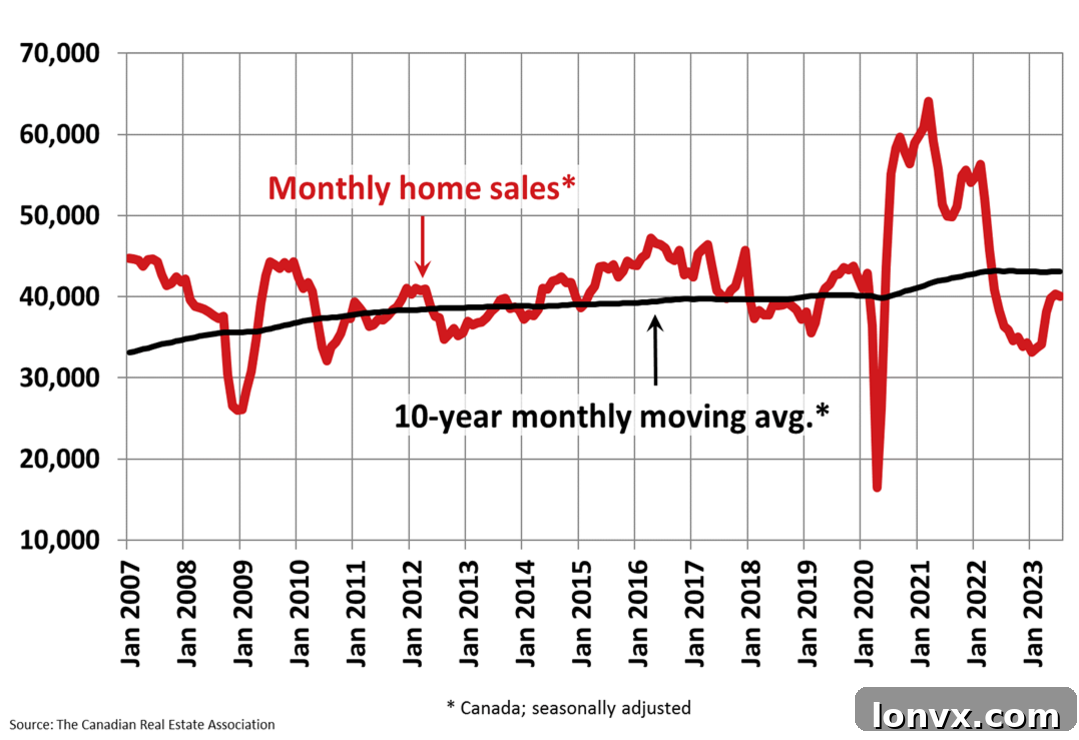
Graphically, the rebound in home sales observed earlier this year appears to have lost considerable momentum over the summer months. The market now awaits the release of fall-market data with keen anticipation to determine whether sales activity can regain its upward trajectory and potentially return to the 10-year average. This benchmark is crucial as it represents a historical level of activity that can indicate a return to more sustainable market conditions. The ongoing dislocations and unique challenges within the Toronto market, in particular, will play a significant role in shaping the national sales narrative in the coming months, making it a critical area to monitor for broader market implications.
Canadian Housing Price Trends: HPI vs. Average Price Dynamics
After a period of unprecedented volatility in recent years, Canadian house prices appear to be settling back into a more predictable long-term growth trajectory. The Aggregate House Price Index (HPI), a preferred metric by many economists for its adjustment for changes in housing characteristics, registered a healthy 1.1 percent growth since the previous month. This latest increase positions the index to be down by only 1.5 percent compared to the same month last year. Consequently, there is a strong likelihood that Canada will soon witness positive year-over-year growth in house prices once again, even if the market’s underlying movement remains relatively sideways.
This anticipated positive year-over-year growth is largely due to the “base-year effect.” This phenomenon occurs when current prices are compared against particularly low figures from the previous year, specifically towards the end of 2022, a period when the market was experiencing significant turmoil and price corrections. Comparing current, albeit modest, price gains against these depressed previous-year values can create an optical illusion of robust growth, even if the month-over-month or quarter-over-quarter growth is more subdued.
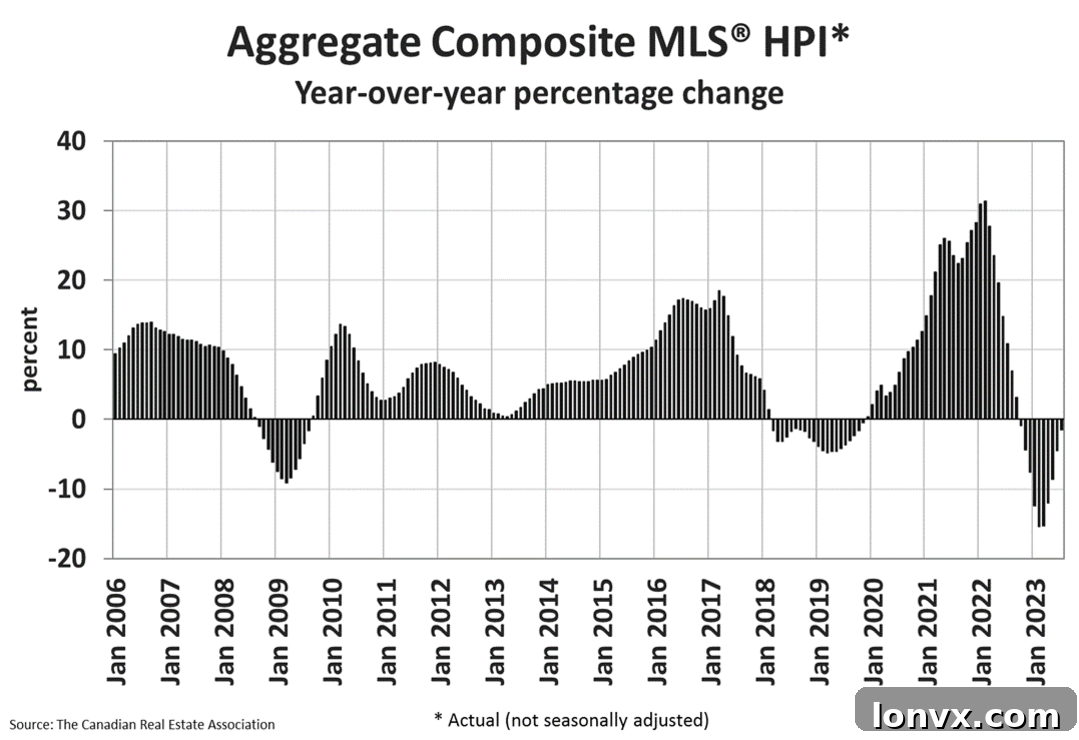
Despite the upward movement in the HPI, it is essential to approach this data with a degree of caution, especially when considering the average house price, which continues to trend downwards. This divergence between the HPI and the average house price is a noteworthy market anomaly. Typically, when such discrepancies occur, the HPI tends to correct and align with the average price data in due course, albeit with a slight lag. Currently, we observe the HPI climbing while average prices have commenced a steep decline. This presents a critical question for market participants and analysts: which metric offers a more reliable guide for pricing expectations in the Canadian housing market?
The HPI is generally favored for its ability to provide a more accurate measure of “pure” price changes by neutralizing the impact of shifts in the types of homes sold. However, the average price offers a tangible snapshot of what buyers are actually paying. This ongoing divergence creates uncertainty and underscores the complex nature of current market dynamics.
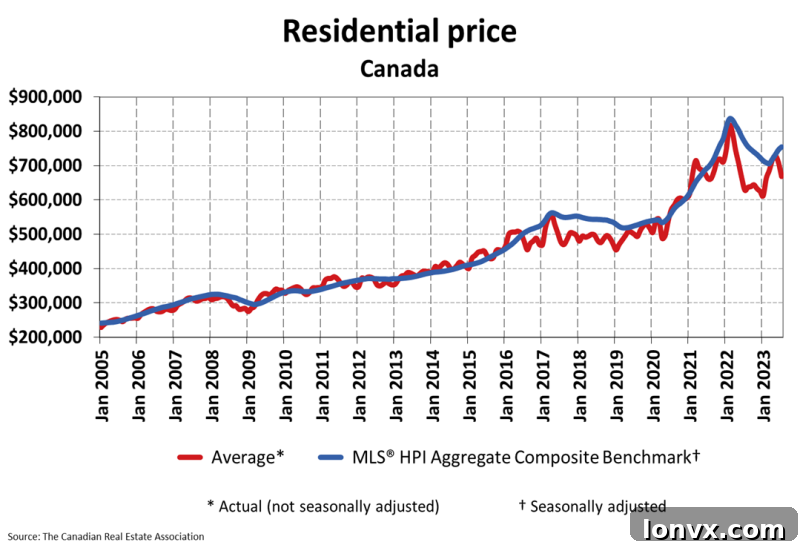
It is also crucial to acknowledge CREA’s repeated recognition that the national average price can be significantly distorted by data from the Toronto market, a factor that is highly probable in the current scenario. Toronto’s high property values and considerable transaction volume can disproportionately influence national averages. This susceptibility to large, volatile markets like Toronto explains CREA’s tendency to favor the more stable and adjusted HPI during periods of significant market fluctuation. As the Canadian real estate market navigates these turbulent waters, understanding the nuances between these pricing metrics becomes increasingly vital for accurate interpretation and strategic decision-making.