GTA Housing Market Sees Shift: Overbidding Cools in June as Buyers Adopt ‘Wait-and-See’ Approach
The vibrant intensity of the Greater Toronto Area (GTA) housing market began to show signs of a subtle but significant shift last month, as competitiveness eased following the spring surge. Data reveals a notable decline in overbidding activity across the region, indicating a potential recalibration of buyer expectations and market dynamics.
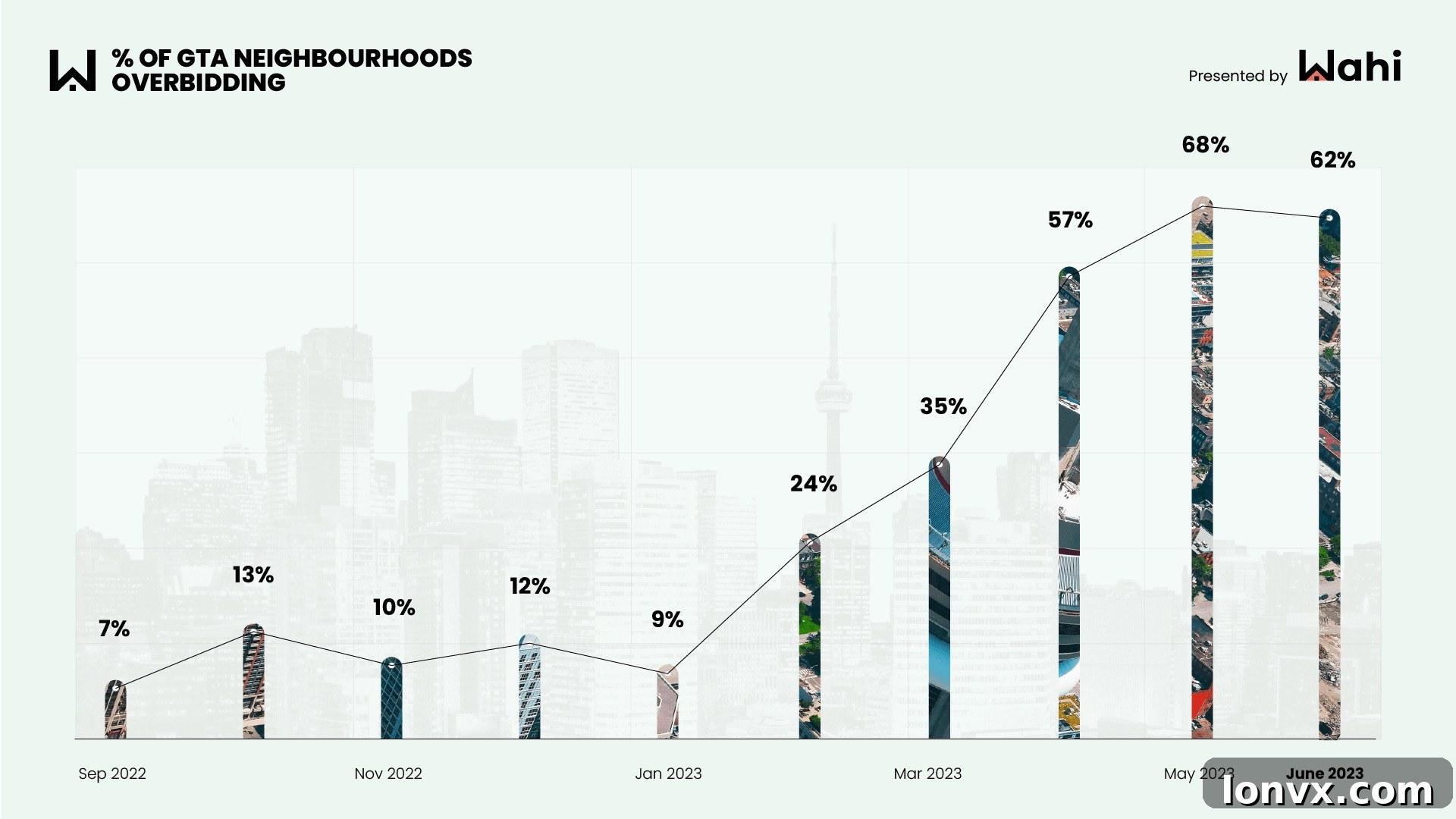
A comprehensive analysis conducted by Wahi, a leading real estate intelligence platform, highlights this trend. In June, 62 percent of GTA neighborhoods were categorized as experiencing overbidding, a decrease from 68 percent recorded in May. This marks a clear deceleration in the rapid pace that characterized the earlier months of the year.
Delving deeper into the numbers, June saw 203 out of 326 neighborhoods within the GTA experiencing scenarios where homes sold for more than their asking price. This figure is down from 222 neighborhoods in May, representing the first month-over-month decline in overbidding activity since January. To put this into perspective, January recorded only nine percent of neighborhoods in overbidding territory, a slight dip from 12 percent in December 2022. The recent shift suggests a move away from the aggressive bidding wars that often define the spring market.
Source: Wahi
Key Factors Influencing the Market Shift
Several significant factors are believed to have contributed to this cooling trend in June, impacting buyer sentiment and purchasing strategies across the Greater Toronto Area. Understanding these influences is crucial for both prospective buyers and sellers navigating the current real estate landscape.
The Bank of Canada’s Unexpected Rate Hike: A Catalyst for Caution
According to Benjy Katchen, CEO of Wahi, the unexpected interest rate hike by the Bank of Canada in June played a pivotal role in shaping market behavior. This move likely prompted many potential buyers to adopt a more conservative “wait-and-see” approach, pausing their home-buying plans to assess the implications of higher borrowing costs. An increase in the benchmark interest rate directly translates to higher mortgage rates, thereby reducing purchasing power and making homeownership less affordable for a segment of the population. This financial pressure can quickly temper enthusiasm and competitiveness in the market, leading to fewer aggressive bids.
Market Seasonality: The Inevitable Summer Slowdown
Beyond monetary policy, market seasonality is also a significant contributor to the decline in overbidding activity. As Katchen rightly points out, “To an extent, a decline of overbidding activity heading into the summer is to be expected.” The spring market, typically from March to May, is often the most competitive period for real estate. Families aim to move before the school year ends, and warmer weather facilitates property showings and open houses. As summer approaches, buyer activity often naturally wanes, with many individuals and families prioritizing vacations and other summer activities over house hunting. This seasonal dip in demand can reduce the urgency and intensity of bidding wars, allowing the market to normalize slightly.
The combination of these two powerful forces – an unanticipated economic policy shift and predictable seasonal patterns – created a perfect storm for a market cooldown. Buyers, now facing increased borrowing costs and potentially less competition, have gained a slight advantage, while sellers may need to adjust their pricing expectations or marketing strategies to reflect the new reality.
Unpacking Overbidding: Top Neighbourhoods Still Leading the Charge in June 2023
Despite the overall cooling trend, certain neighborhoods in the GTA continued to demonstrate remarkable resilience and high demand, experiencing significant overbidding. These areas often boast desirable amenities, excellent schools, strategic locations, or a limited supply of homes, making them attractive even in a shifting market. Here are the top five neighborhoods where properties consistently sold above their asking price in June 2023, based on Wahi’s analysis:
| Neighbourhood | Overbid (%) | Median Overbid Amount ($) | Median Sold Price ($) |
|---|---|---|---|
| 1. Victoria Square, Markham | +26% | +$322,100 | $1,600,000 |
| 2. Broadview North, Toronto | +23% | +$276,000 | $1,500,000 |
| 3. Berczy Village, Markham | +19% | +$270,001 | $1,550,000 |
| 4. Bickford Park, Toronto | +19% | +$235,500 | $1,509,444 |
| 5. Rouge Woods, Richmond Hill | +18% | +$252,400 | $1,647,500 |
These neighborhoods exemplify pockets of intense demand, with buyers willing to pay substantial premiums. Markham and Toronto feature prominently, highlighting the continued desirability of well-established suburban communities and specific urban enclaves. Victoria Square in Markham stands out with an astounding 26% overbid, translating to over $322,000 above the asking price on average. This indicates that even with a broader market slowdown, unique factors like community appeal, property type, or specific property features can sustain high demand and competitive bidding environments in select areas.
*Neighbourhoods are ranked according to calculations based on percentage changes between list and sale prices.
Navigating Underbidding: Opportunities in a Shifting Market in June 2023
While some areas continued to see fierce competition, other neighborhoods in the GTA experienced underbidding, where properties sold for less than their original list price. This segment of the market presents potential opportunities for discerning buyers, particularly those looking in higher-value brackets. Understanding where underbidding occurs can inform strategic purchasing decisions and reveal emerging trends in different price points and property types. Here are the top five neighborhoods with the most significant underbidding in June 2023:
| Neighbourhood | Underbid (%) | Median Underbid Amount ($) | Median Sold Price ($) |
|---|---|---|---|
| 1. Summerhill, Toronto | -10% | -$195,000 | $2,175,000 |
| 2. Southwest Oakville | -5% | -$159,400 | $2,837,500 |
| 3. Chaplin Estates, Toronto | -4% | -$95,000 | $2,300,000 |
| 4. Eastlake, Oakville | -3% | -$96,200 | $2,650,000 |
| 5. King, York Region | -3% | -$59,000 | $1,957,860 |
The underbidding list largely features affluent areas in Toronto, Oakville, and the York Region, characterized by high median sold prices, often exceeding $2 million. This suggests that the luxury market or higher-priced segments might be more sensitive to interest rate hikes and broader economic shifts. Buyers in these areas might find more room for negotiation, potentially securing homes at a discount compared to the initial asking price. For instance, Summerhill in Toronto saw properties selling for a median of 10% below list price, representing a significant saving of $195,000. This trend indicates a power shift in favor of buyers in these specific, high-value markets, offering an opportune moment for those with substantial purchasing power to acquire premium properties.
Wahi’s Methodology: A Comprehensive Lens on Market Trends
Wahi’s analysis provides a robust and transparent methodology for determining overbidding and underbidding trends, offering a clear picture of the GTA’s real estate landscape. The company meticulously compares the differences between the list price and the final sold price for all types of homes within a given neighborhood. This comprehensive approach ensures that the analysis captures the full spectrum of the market, including both condominium units and various types of detached or semi-detached houses.
To ensure statistical reliability and accuracy, Wahi excludes neighborhoods with fewer than five transactions in a month. This crucial filter prevents outliers or limited data sets from skewing the overall market representation, providing a more reliable and indicative view of genuine market dynamics. By employing this rigorous methodology, Wahi delivers an objective and insightful perspective on where buyers are competing fiercely and where they might find more negotiating leverage, making its reports an invaluable resource for anyone involved in the GTA real estate market.
Broader Implications and Future Outlook for the GTA Real Estate Market
The cooling of overbidding activity in the GTA market for June 2023 marks a pivotal moment, signaling a potential shift from a predominantly seller-favored environment towards a more balanced market. For prospective buyers, this trend could usher in a period of reduced urgency and increased negotiation power. The “wait-and-see” approach, influenced by higher interest rates, suggests that patient buyers might find more inventory and less aggressive competition in the coming months, potentially leading to better value propositions.
Conversely, sellers in the GTA may need to adjust their expectations. The days of multiple, unconditional offers well above the asking price might become less common, particularly outside the most intensely sought-after neighborhoods. Strategic pricing, enhanced marketing efforts, and a willingness to negotiate could become essential for successful transactions. Understanding their specific neighborhood’s micro-market trends, whether it’s still experiencing overbidding or has shifted to underbidding, will be crucial for sellers to position their properties effectively.
Looking ahead, the trajectory of the GTA housing market will largely depend on several macroeconomic factors. Future decisions by the Bank of Canada regarding interest rates will be paramount; further hikes could prolong the cooldown, while a pause or reduction might rekindle buyer confidence. Inflation rates, employment figures, and overall economic stability will also play significant roles in shaping consumer sentiment and investment decisions in real estate. The availability of housing supply, a persistent challenge in the GTA, will continue to influence price pressures. Should inventory levels remain low, even with dampened demand, prices may hold relatively steady, albeit with less dramatic appreciation.
As summer progresses, it will be important to monitor whether the June slowdown was an anomaly driven by specific events or the beginning of a sustained trend towards a more balanced and sustainable market. Both buyers and sellers are advised to stay informed through reliable market analyses and to consult with real estate professionals to navigate these evolving conditions effectively. The GTA remains a dynamic market, and adaptability will be key for all participants in the months to come.
Enjoying this article?
Get the latest real estate articles in your inbox 3x a week so you stay up to date on the latest in the Canadian real estate industry.