
The Toronto real estate market continues to navigate a complex landscape this month, marked by a persistent standoff between eager buyers and cautious sellers. While recent sales figures might initially spark optimism compared to the previous year, it’s crucial to contextualize these numbers. Last year presented an exceptionally challenging period for the market. From a broader, long-term perspective, the fall market, particularly September, has shown relative weakness when measured against typical historical performance.
Toronto Real Estate Market: Key Insights from September
The Toronto Regional Real Estate Board (TRREB) recently released its comprehensive Market Watch report, offering critical insights into the Greater Toronto Area (GTA) housing market. Here’s a detailed breakdown of the essential points:
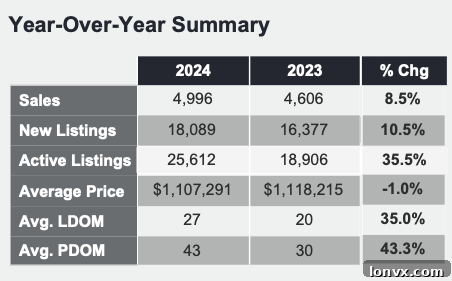
- Increased Sales Activity: Home sales in September saw an 8.5% increase year-over-year. While positive, this growth needs to be viewed against a backdrop of severely depressed sales activity in the previous year.
- Surging New Listings: The number of new listings entering the market grew by 10.5%, slightly outpacing the growth in sales. This indicates a significant influx of homes available for purchase, contributing to greater market inventory.
- Extended Selling Timelines: Properties are taking considerably longer to sell—between 35% and 45% more time compared to September of last year. This extended duration reflects a shift from a frenzied seller’s market to one where buyers have more breathing room.
- Substantial Supply Accumulation: As a direct consequence of slower sales cycles, active listings have surged by an impressive 35.5%. This accumulation of available homes signifies that housing supply is becoming substantial, moving towards a more balanced, if not buyer-friendly, environment.
- Persistent Price Adjustments: Despite some positive indicators, house prices continue their downward trajectory. Nominally, prices are 1.0% below last year’s figures. When adjusted for inflation, the real decline in home prices extends to 3.0%, highlighting ongoing affordability challenges and market recalibration.
Source: TRREB
Is the GTA Housing Market Recovering or Rebalancing?
TRREB suggests that the recent uptick in sales signals a recovery, attributing it to favorable market conditions such as anticipated interest rate cuts and revised mortgage lending guidelines. While these factors are undeniably influential in shaping market dynamics and fostering a healthier environment, a deeper analysis reveals a more complex picture. The GTA real estate market appears to be in a state of rebalancing rather than a full-fledged recovery.
Instead of a definitive “upwards” trend, we are more likely observing a “sideways” market—one characterized by stabilization and adjustment rather than rapid growth. The crucial factor supporting this perspective is the disproportionate growth in housing supply, which has consistently outpaced demand. This dynamic fundamentally challenges the narrative of a straightforward market recovery. Until there is a meaningful shift where buyers enter the market significantly faster than new listings appear, it remains challenging to conclude that a complete recovery is underway. This rebalancing act means a more measured and sustainable market environment, contrasting with the speculative surges of previous years.
Increased Sales Driven by Buyer Opportunity, but Price Remains Paramount
The 8.5% year-over-year increase in home sales—rising from 4,606 units in September 2023 to 4,996 in September 2024—is often cited as compelling evidence of a market recovery. TRREB President Jennifer Pearce highlights that buyers are actively capitalizing on more accessible borrowing costs and recent adjustments to mortgage lending guidelines. These changes are indeed making homeownership more attainable for specific segments of the population.
Key factors contributing to this increased buyer activity include:
- Bank of Canada Rate Cuts: Anticipation and realization of rate cuts by the Bank of Canada have begun to ease the financial burden on prospective homeowners.
- Reduced Fixed Mortgage Rates: A decline in the Canadian five-year bond yield has translated into lower five-year fixed mortgage rates, offering more attractive financing options.
- Introduction of Longer Amortization Periods: The upcoming introduction of longer amortization periods will help reduce monthly mortgage payments, enhancing affordability for many households.
- Expanded Mortgage Insurance Eligibility: The ability to insure mortgages for homes valued up to $1.5 million opens up opportunities for a broader range of properties to qualify for insured financing, benefiting more buyers.
While these developments undeniably improve affordability for certain buyers constrained by high capital costs and a restrictive lending environment, a significant hurdle persists: the B20 stress test. With buyers still needing to qualify at rates exceeding 5.0%, the actual selling price of a home ultimately remains the most critical factor for many individuals and families looking to re-enter the Greater Toronto Area’s competitive housing market. The improved lending conditions act as a gateway, but the final price tag is the ultimate determinant of purchase feasibility.
Easing of Mortgage Stress Test Could Bolster Market Stability
TRREB emphasizes that any easing of the mortgage stress test, particularly for existing homeowners renewing their mortgages, could inject significant stability into the market. Such a policy change would empower current homeowners and investors to retain their properties, even when facing financial pressures, rather than being forced to sell. This could prevent a wave of distressed sales, which would otherwise destabilize prices and inventory levels.
Furthermore, TRREB anticipates that additional interest rate cuts will gradually enable a larger proportion of households to achieve homeownership. This outlook is especially pertinent for first-time buyers, a demographic consistently identified by the Bank of Canada as constituting nearly 50% of all homebuyers. Engaging and supporting this key segment is crucial for any meaningful and sustainable market recovery. By making homeownership more accessible, these measures could foster a healthier and more inclusive real estate environment, providing a necessary boost to demand without necessarily re-inflating prices in an unsustainable manner.
Housing Supply Continues to Outpace Buyer Demand
A more detailed examination of the September data reveals a nuanced imbalance within the Toronto housing market. Although buyer demand, as measured by sales volumes, experienced growth, the rate at which new listings entered the market surged even faster. New listings increased by 10.5% year-over-year, slightly surpassing the growth rate in sales. In September alone, a substantial 18,089 new listings were added to the Multiple Listing Service (MLS), significantly contributing to what is already becoming a better-supplied market.
This widening gap between supply and demand isn’t indicative of a housing shortage; rather, it points towards an easing of market pressures, creating more favorable conditions for prospective buyers. Compounding this trend is a noticeable increase in the “time to sell.” On average, it now takes an additional week for a property to find a buyer compared to the roughly 20 days on market observed in September of the previous year. This deceleration in absorption rates has led to a significant accumulation of supply, with active listings now 35.5% higher than in September 2023. This dynamic signals a clear shift towards a market where buyers have more choice and time to make informed decisions.
Enhanced Negotiation Power for Buyers: A Shift from Seller Dominance
Should the current trends of increasing supply and extended selling times persist, it is highly probable that buyers will re-engage with the market more confidently. With a greater selection of homes available, prospective purchasers will be empowered to explore various options, compare properties, and engage in more substantive negotiations with sellers. This dynamic, driven by the imbalance between supply and demand, inherently materializes as a decline in overall prices across the market.
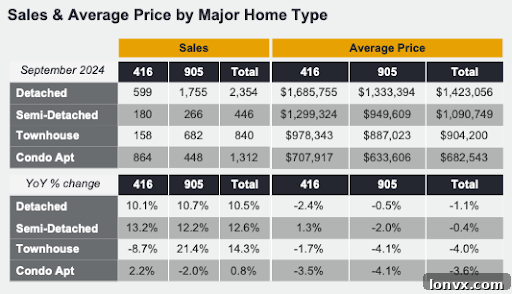
The MLS Home Price Index (HPI) Composite benchmark, a reliable measure of typical home price changes, registered a 4.6% decrease year-over-year. Concurrently, the average selling price in September experienced a 1.0% drop compared to the same month last year. TRREB attributes these declines to the increased negotiating power now wielded by buyers, particularly within the more affordable market segments such as condominiums and townhouses. These property types are especially favored by first-time buyers, whose increased activity at the lower end of the market can significantly skew overall average prices downwards. Interestingly, despite a prevailing state of excess supply, condominium sales in the 416 area code (Toronto proper) have actually increased year-over-year. This ability for buyers to negotiate on price is a clear and unequivocal indicator of a significant shift: the Toronto real estate market is no longer heavily tilted in favor of sellers, marking a return to more balanced conditions.
Source: TRREB
The Pricing Context: Questioning a True Market “Recovery”
By definition, a genuine market recovery would typically be characterized by the stabilization or, more commonly, an increase in home prices, as demand begins to consistently outstrip supply. However, this critical condition is not currently met within the Greater Toronto Area housing market. While average selling prices have shown a slight uptick on a seasonally adjusted basis when compared to August 2024, the persistent year-over-year decline in benchmark prices strongly suggests that the market has yet to fully rebound to its previous peaks. The acute affordability challenges that plagued the market prior to the recent series of interest rate hikes are certainly being alleviated, but they have by no means vanished entirely.
Furthermore, while reductions in interest rates can undoubtedly improve short-term affordability and stimulate demand, they do not inherently address the underlying, long-term structural issues that continue to impact the housing market. These include chronic supply constraints, escalating construction costs, and regulatory hurdles. It is also worth noting that while lower borrowing costs can provide a temporary boost to demand, they also carry the risk of encouraging speculative buying, which could further distort the market, particularly if the fundamental supply of housing fails to keep pace with this renewed interest. A true recovery necessitates a holistic approach that tackles both demand-side affordability and supply-side development.
Recovering Sales Activity, But Not Yet Home Prices
Despite the generally optimistic tone often conveyed in market reports, the Greater Toronto Area housing market appears to be in a more accurate state of balance rather than a robust recovery. It is true that sales volumes have increased, and the Bank of Canada’s rate cuts have undeniably eased some of the financial pressure on both buyers and sellers, providing a much-needed reprieve. However, this positive trend in sales must be weighed against other significant indicators.
The burgeoning supply of homes, coupled with ongoing modest declines in prices, paints a picture of a more buyer-friendly market. In this evolving landscape, housing supply is not merely catching up to demand but, in several segments, is beginning to surpass it. This dynamic is fundamentally reshaping market power, providing buyers with significantly enhanced negotiating leverage. While this development is undoubtedly positive for overall affordability and market accessibility, it does not, by itself, signal a robust recovery in home prices. Instead, the current market is best characterized as one where buyers have successfully regained a degree of control, creating a more sustainable and less speculative environment. However, the underlying, systemic challenges pertaining to long-term housing supply and widespread affordability continue to persist, requiring ongoing attention and strategic solutions.
This return to a more balanced market dynamic is, nonetheless, a welcome development for the real estate profession, which has contended with drastically reduced activity for an extended period. The steady resurrection of sales activity points towards a healthier, albeit more competitive, operational environment for agents and brokers alike.
Enjoying this article?
Get the latest REM articles in your inbox 3x week so you stay up to date on the latest in the Canadian real estate industry