
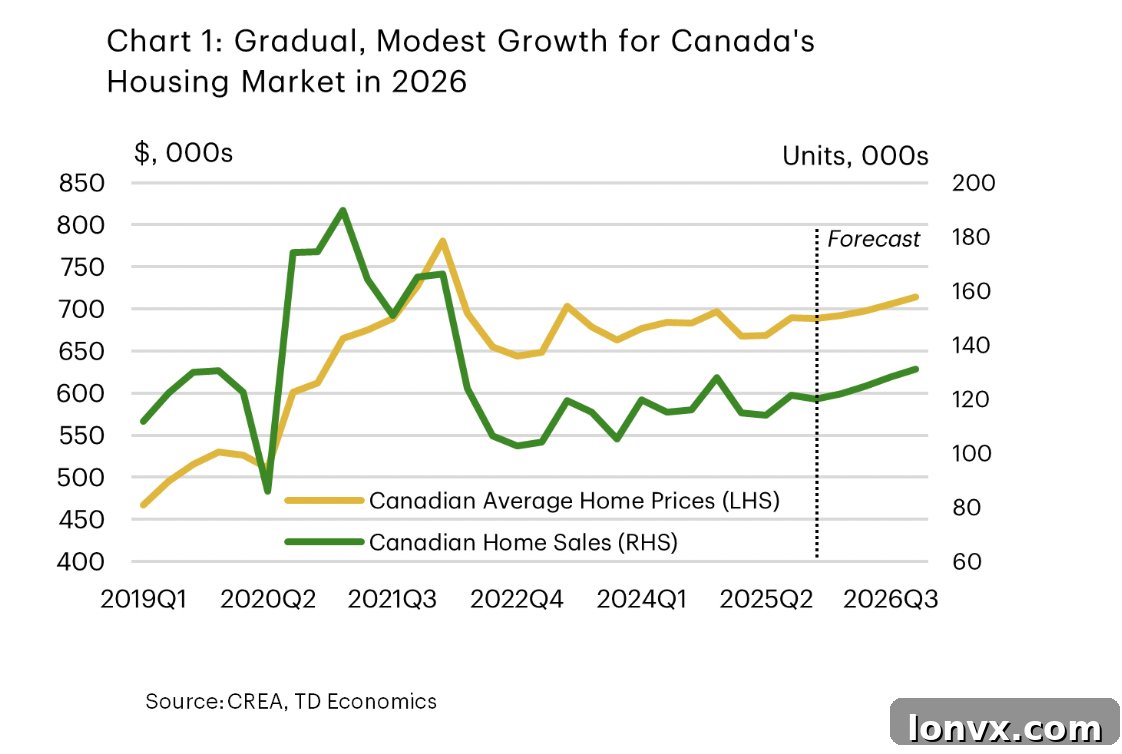
Canada’s housing market is poised for a recovery in 2026, yet TD Economics cautiously refrains from labeling it a “comeback year.” Instead, the financial institution anticipates a “modest, gradual recovery” for Canadian real estate throughout the year, marking a shift after what TD describes as a “disappointing” conclusion to 2025.
In its recent provincial housing outlook, TD provides a detailed analysis, highlighting that while pent-up demand is expected to stimulate activity, the lingering impact of economic uncertainty, a softer labour market, and a neutral interest-rate environment will likely temper the pace of the rebound. Economist Rishi Sondhi emphasizes that these combined factors will ensure a restrained, rather than rapid, resurgence for the Canadian housing sector.
A Weaker Start to 2026 for Canadian Housing
The Canadian housing market experienced a significant loss of momentum in the final quarter of 2025, tempering expectations for the year ahead. After a robust third quarter, national resale housing activity saw a dip in sales, with average prices remaining flat compared to the previous period. Sondhi points out that this softer finish to the past year provides a weaker foundation for 2026, leading to a downward revision in TD’s sales and price forecasts for the upcoming year.
Despite this challenging backdrop, TD Economics maintains that a recovery remains achievable. The bank’s outlook continues to project a “modest, gradual recovery” for Canada’s housing market, largely underpinned by a substantial amount of demand that has been accumulating on the sidelines for several years. As Sondhi explains, “Pent-up demand will continue to be satiated, and sales will receive some support from solid or improved affordability in certain markets across the country.” This suggests that while the recovery won’t be explosive, underlying demand could provide a steady lift.
This long-term demand, accumulated during periods of market uncertainty and high interest rates, is expected to slowly re-enter the market as conditions stabilize. Buyers who have delayed purchases are likely to act, particularly in regions where affordability shows signs of improvement, offering a crucial lifeline to the market. However, the influence of broader economic factors cannot be overstated, as they will dictate the pace and consistency of this recovery.
Interest Rates: A Neutral Force in the 2026 Housing Market
A significant factor influencing the Canadian housing market in 2026 will be the trajectory of interest rates, or rather, their stability. TD Economics anticipates that interest rates will act more as a neutral force, neither significantly boosting nor hindering the market. According to Sondhi, the Bank of Canada is expected to largely remain “on the sidelines” throughout the year, maintaining its current policy rate.
This perspective aligns perfectly with the central bank’s recent decision to hold its policy rate at 2.25 per cent. The Bank of Canada indicated that its economic outlook has seen little change since October, but it did caution about “heightened” uncertainty. This uncertainty is attributed to several external factors, including unpredictable U.S. trade policy, escalating geopolitical risks, and the upcoming review of the Canada-United States-Mexico Agreement (CUSMA).
A neutral interest rate environment means that homebuyers and sellers should not expect significant relief from lower borrowing costs, nor should they fear sudden increases. This stability, while not providing a direct stimulus, offers a degree of predictability that can help restore buyer confidence, allowing pent-up demand to gradually materialize. However, it also means that affordability challenges, particularly in high-cost regions, will persist unless accompanied by meaningful price adjustments or income growth. Mortgage rates, closely tied to the Bank of Canada’s policy rate, will likely remain relatively stable, influencing the purchasing power of many prospective buyers.
Ontario: Canada’s “Weakest” Housing Market in 2026 Forecast
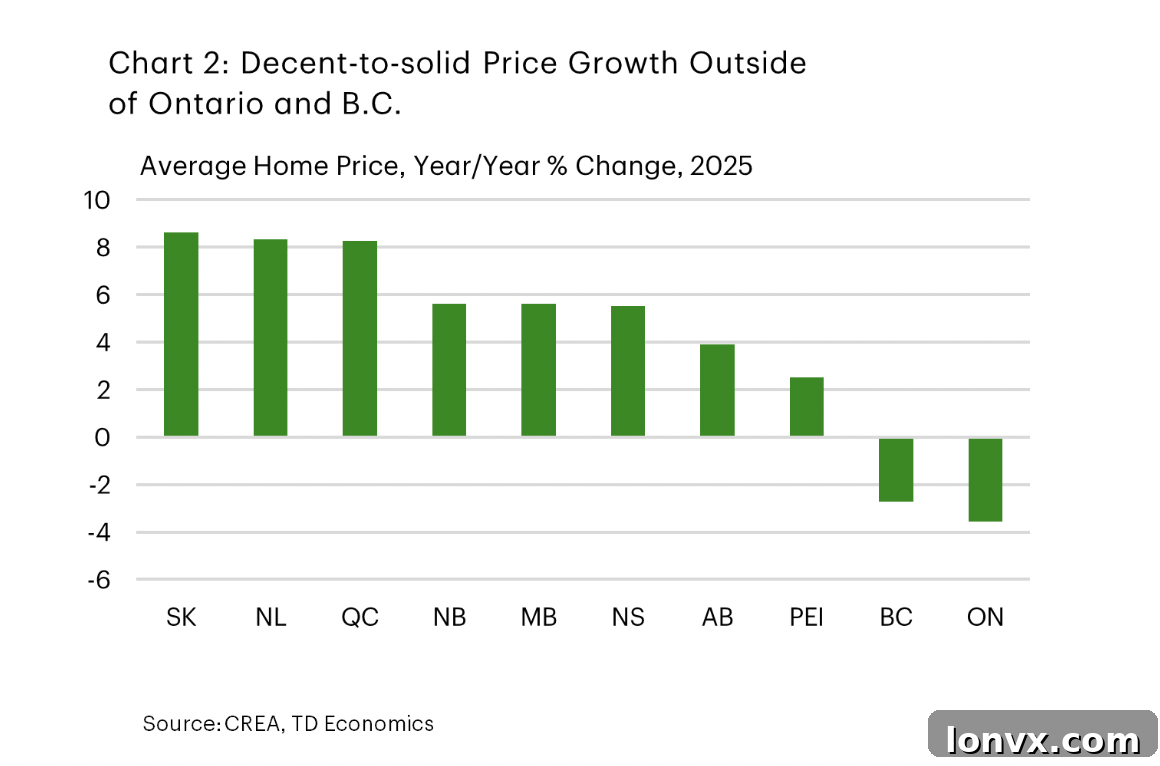
Regionally, TD’s report identifies Ontario as the weakest housing market in Canada, continuing to lag behind other provinces. The province has been particularly hard hit by economic uncertainty and a softening labour market, which together have dampened buyer demand. Affordability, a persistent challenge in Ontario, especially in the Greater Toronto Area (GTA), “remained stretched,” further deterring potential buyers.
Adding to these pressures, a significant pullback by investors in the condominium market has weighed heavily on activity, particularly within the GTA. Many investors, facing higher carrying costs, difficulties in closing purchases pre-qualified at ultra-low, pandemic-era interest rates, and the “reduced attractiveness of real estate assets due to falling prices and rents,” are listing their properties. This increased supply, coupled with reduced demand, has created “loose conditions” that TD expects to keep price growth negative, on average, during the first half of 2026.
However, the report suggests a potential shift later in the year, with prices “inching into positive territory” supported by “significant pent-up demand.” Sondhi highlights the sheer scale of suppressed activity, noting that per capita home sales in Ontario were “some 25 per cent below long-term averages” in December. This substantial gap implies considerable room for a rebound once economic conditions stabilize and confidence returns, making Ontario a market to watch for a late-year resurgence, albeit from a low base.
British Columbia: Nearly as Soft, But With Nuances
British Columbia’s housing market, particularly Vancouver, also experienced a challenging period, mirroring some of Ontario’s difficulties. The report indicates that “sales tumbled about six per cent last year,” contributing to an approximate three-per-cent decline in average prices across the province. Vancouver, a high-value market, recorded an even weaker performance, with sales down four per cent and average prices declining by 10 per cent.
Despite ongoing loose supply-demand conditions, economist Rishi Sondhi notes that “compositional effects” have helped to cushion average prices to some extent. This refers to a higher share of expensive homes selling, which can artificially prop up the average price even as benchmark prices for typical homes continue to soften. This dynamic suggests that while the overall average might appear less severe, underlying market weakness remains, especially for properties at lower price points.
The BC market, characterized by its high entry barriers and susceptibility to global economic shifts, will likely see a similar gradual recovery to Ontario, contingent on improved affordability, stable interest rates, and a healthier employment picture. The interplay between limited new supply, investor activity, and the province’s economic resilience will be crucial in determining its trajectory through 2026.
Prairie Markets Still Outperforming Canada’s Housing Trend
In stark contrast to the softness observed in Ontario and British Columbia, the Prairie provinces continue to demonstrate resilience and outperformance in the Canadian housing market. Saskatchewan, in particular, stands out as one of the “hottest housing markets in the country,” recording an impressive nine-per-cent price growth in 2025. This robust performance is attributed to “solid affordability” and consistently strong job growth, making it an attractive destination for homebuyers seeking value.
Sondhi forecasts that while Saskatchewan’s economy is expected to gear down slightly, it will nonetheless outperform Canada’s overall economic performance again this year. Consequently, home price growth is anticipated to slow but “remain solid,” indicating continued strength and stability for the province’s real estate sector. This sustained growth makes Saskatchewan a unique bright spot in the national landscape, driven by favourable local economic conditions and comparative affordability.
Manitoba and Alberta are also projected to see more moderate yet positive outcomes. Alberta’s housing market, following a period of strong gains, is now described as “more balanced.” This rebalancing reflects several factors: an easing in interprovincial migration, a rise in new listings, and a cooling, but still positive, job growth. While not experiencing the rapid appreciation of Saskatchewan, Alberta’s market remains healthy, offering a balanced environment for both buyers and sellers. Manitoba, with its steady economic fundamentals, is also expected to maintain a stable, albeit not explosive, growth trajectory.
Atlantic Canada: Elevated Prices, But Cooling Growth
The Atlantic Canadian housing markets, which experienced unprecedented growth in recent years, still boast historically high home prices. However, TD Economics anticipates that this rapid growth will ease in 2026, transitioning to a more sustainable pace. Newfoundland and Labrador led the region in 2025, achieving near double-digit price gains for the second consecutive year. This impressive performance was fueled by strong sales activity, robust economic growth, and relatively favourable affordability compared to other major Canadian cities. Tight supply conditions further contributed to firm market dynamics.
Looking ahead, TD expects both price and sales growth in Newfoundland and Labrador to cool as the province’s economic momentum slows and it records another year of net job losses. While the market remains elevated, the peak of its rapid expansion appears to be behind it.
Elsewhere in the Atlantic region, Prince Edward Island has largely returned to more normal conditions after several years of extraordinary gains. Price growth on the island is now expected to track closer to its long-term trend. Nova Scotia and New Brunswick also currently maintain relatively tight market conditions, benefiting from continued demand. However, softer migration patterns and a gradual worsening of affordability are projected to limit further significant upside as the year progresses. These provinces will likely see a moderation in growth, shifting from seller-dominant markets to more balanced conditions as supply catches up with demand and economic forces temper enthusiasm.
Quebec Cools After a Strong Performance in 2025
Quebec was undeniably one of the strongest performers in the Canadian housing market in 2025, staging an impressive rebound after a flat year in 2023. The province saw home sales rise sharply, with average prices climbing by approximately 15 per cent. TD Economics attributes this surge to robust job and income growth, coupled with surprisingly strong consumer confidence. As Sondhi notes, this resilience “counts as a surprise given its exposure to the trade war,” highlighting the underlying strength of Quebec’s economy.
However, looking ahead to 2026, TD anticipates that this strong momentum will ease. Several factors are expected to contribute to this moderation. Affordability in Quebec has deteriorated following the rapid price increases, making homeownership more challenging for many. Additionally, job growth is projected to slow, which will naturally temper demand. Furthermore, per capita sales figures are currently well above long-term averages, suggesting that there is less room for sustained, rapid gains. While Quebec’s market remains healthy, it is likely to transition to a more normalized and sustainable growth trajectory, rather than the exceptional pace seen in 2025.
Risks and Opportunities: Navigating the 2026 Canadian Housing Market
Beyond the regional dynamics and interest rate environment, TD Economics also highlights several broader headwinds and potential tailwinds for the Canadian housing market in 2026. A significant concern raised is the near-zero population growth, which could have cascading effects on both rental markets and investor demand.
Sondhi elaborates on this point, explaining, “These newcomers typically have very low homeownership rates when they first enter the country, but rental demand will continue to be negatively impacted by reduced overall population growth. This could feed back into investor demand, as lower rents would reduce the cash-flow from owned properties that are rented out, making real estate less attractive for investment purposes.” This dynamic poses a challenge, as a slowdown in population growth could ease rental pressures, potentially reducing the incentive for new investment in rental properties.
However, risks in the housing market cut both ways. As Sondhi points out, “Housing activity has had some tendency to surprise expectations to the upside in the past,” especially given the substantial scale of pent-up demand observed in key markets across Canada. Should economic conditions improve faster than anticipated, or if buyer confidence returns more swiftly, this latent demand could fuel a stronger rebound than currently projected.
On the downside, two major external factors loom large: the upcoming CUSMA negotiations and ongoing geopolitical tensions. These uncertainties could significantly impact economic sentiment, potentially keeping prospective buyers on the sidelines, wary of future instability. Any adverse developments on these fronts could easily derail a nascent recovery, reintroducing caution and delaying purchasing decisions.
Considering all these factors, TD’s overarching message for the Canadian housing market in 2026 is clear and nuanced: a recovery is indeed on the horizon. However, it is expected to be a slow, uneven process, highly sensitive to shifts in economic conditions, government policies, and global events. Stakeholders in the Canadian real estate sector, from first-time homebuyers to seasoned investors, should anticipate a dynamic year characterized by gradual improvements intertwined with persistent uncertainties, requiring careful monitoring and strategic decision-making.