
Canadian Real Estate Market Slump: An In-Depth Analysis of Sales, Prices, and Future Prospects
The Canadian real estate market continues its significant retreat, registering sales volumes well below the 10-year average for another consecutive month. A notable three percent decline in sales was observed from December to January, marking a challenging start to the new year. While the holiday season typically ushers in a quieter period for property transactions, the last two months have been exceptionally slow, pointing to deeper underlying shifts within the Canadian housing market.
This sustained period of reduced activity is not merely a seasonal blip; it reflects a broader market recalibration influenced by a confluence of economic factors. For potential homeowners, current homeowners, and industry professionals alike, understanding these dynamics is crucial to navigating the evolving landscape of Canadian real estate.
A Sustained Period of Low Volume in Home Sales
A closer examination of data from the Canadian Real Estate Association (CREA) reveals that home sales have entered a protracted period of low volume, a trend not witnessed since the major recessionary period of 2009. This prolonged slowdown has sent ripple effects throughout the real estate sector, impacting everything from agent commissions to developer confidence and mortgage lending activities.
The industry has felt the pinch acutely, with earnings suffering significantly as transaction volumes plummeted by a staggering 37.1 percent compared to the previous year. This substantial drop underscores the severity of the current market contraction, making it one of the most challenging environments for real estate professionals in over a decade.
Historically, the Canadian real estate market has demonstrated a cyclical nature, characterized by periods of robust growth followed by corrections and subsequent rebounds. Looking at past cycles, particularly in 2008, 2017, and more recently, the initial stages of 2023, large drops in transaction volume have often been followed by a comparable upward rebound. This pattern offers a glimmer of hope amidst the current gloom, suggesting that the market may be setting the stage for a future recovery, although the timing and magnitude remain uncertain.
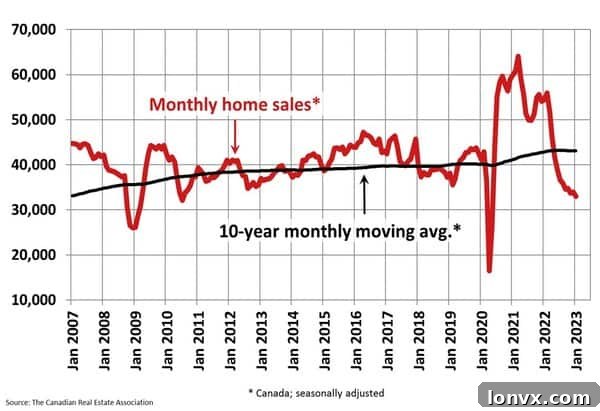
Monthly home sales (Canadian Real Estate Association)
Understanding Market Cycles and Their Implications
The comparison to 2009 is particularly telling. During that period, Canada experienced the reverberations of the global financial crisis, leading to a significant contraction in economic activity and housing demand. While the triggers for the current downturn differ – primarily driven by aggressive interest rate hikes aimed at taming inflation – the outcome of reduced transaction volumes shares striking similarities. Understanding these historical parallels helps contextualize the present situation and informs expectations for the future trajectory of the Canadian housing market.
For market participants, these cycles emphasize the importance of long-term perspectives over short-term fluctuations. While current conditions present significant challenges, the market’s inherent ability to self-correct and rebound has been a consistent feature. However, the path to recovery is rarely linear and is often contingent on broader economic stability, consumer confidence, and the Bank of Canada’s monetary policy decisions.
Significant Price Declines Mirroring Volume Trends
The correlation between transaction volume and housing prices becomes exceptionally clear when examining how prices have evolved during these periods of market adjustment. The downturn in sales has been accompanied by substantial price corrections across the country, fundamentally reshaping affordability metrics and buyer expectations.
CREA’s MLS Home Price Index (HPI), a sophisticated measure designed to track typical home prices, continued its decline by 1.9 percent from the previous month. On a year-over-year basis, the HPI is now down a considerable 12.6 percent. This index is generally considered a more accurate representation of price trends than the national average price, as it adjusts for changes in the mix of homes sold, providing a clearer picture of value shifts.
Meanwhile, the actual national average home price has seen an even more dramatic drop, falling 18.3 percent from this time last year. This continued downward trend has broken previous records, marking the largest annual drop in the average price since the tumultuous global financial crisis. Such a significant correction underscores the rapid repricing happening across the Canadian real estate landscape.
Historical Context: Exceeding the 1990s Correction
Further research, notably from Ben Rabidoux, founder at Edge Realty Analytics Ltd., highlights the historical magnitude of this correction. According to his analysis, the current drop in home prices has now exceeded what Canada experienced in the 1990s – a period widely remembered as the country’s last major housing correction. This comparison is particularly stark, signaling that the current market adjustment is one of the most profound in recent Canadian history.
The 1990s correction was characterized by high interest rates, economic recession, and an oversupply of housing in some markets. While the underlying causes today share some common threads (high interest rates), the global economic context and demographic pressures are different. Nevertheless, the scale of price depreciation now surpasses that era, prompting a reassessment of market stability and future growth projections.
Canadian house prices have now seen the largest cumulative decline from peak since the 1970s pic.twitter.com/iKTmqz8roz
— Ben Rabidoux (@BenRabidoux) February 15, 2023
Regional Dynamics: Toronto and Vancouver Leading the Downturn
It’s important to note that much of the national price decline is significantly influenced and skewed downward by data from Canada’s most expensive and dynamic markets: Toronto and Vancouver. These metropolitan areas, often characterized by their sophistication and sensitivity to economic signals, appeared to behave in an almost forward-looking fashion in response to the Bank of Canada’s aggressive interest rate hikes.
Steep declines observed as early as the second quarter of 2022 in these markets paved the way for the record year-over-year declines now being reported. This early response suggests that buyers and sellers in these sophisticated markets quickly began to “price in” the entire cycle of anticipated rate increases once the Bank of Canada initiated its tightening policy. Such swift adaptation underscores the heightened awareness and responsiveness of these specific regions to monetary policy shifts.
CREA anticipates that the next two months are likely to post the largest year-over-year price declines, especially as most markets reached their peak values in February or March of 2022. As the anniversary of these peaks approaches, the percentage drops will naturally become more pronounced, further highlighting the extent of the market correction. Despite these sobering statistics, there is a palpable sense of optimism emerging within the market. Many hope that the most aggressive phase of rate hikes is now behind us, and anecdotal evidence points to renewed energy and activity from buyers who have been patiently waiting on the sidelines for prices to stabilize or become more attractive.
The Intricate Dance of Supply and Demand
The spring market of 2023 faces considerable pressure to not only halt the ongoing price declines but also initiate a much-needed resurrection of transaction volume. However, the cumulative effect of increased interest rates appears to have stripped the market of its traditional urgency. Buyers, now facing higher borrowing costs, have more leverage and are less inclined to participate in bidding wars, opting instead for a more measured approach to property acquisition.
Tight Inventory Despite Softening Demand
One of the peculiar aspects of the current Canadian real estate market is the continued tightness in new inventory, even as demand softens. January saw only a modest 3.3 percent increase in new listings month-over-month. Furthermore, the national market recorded approximately 4.3 months of inventory, which, while an increase from peak frenzy periods, still indicates a relatively balanced to slightly undersupplied market.
The concept of “months of inventory” is a crucial metric, representing how long it would take to sell all available homes on the market at the current rate of sales. A range of 4-6 months is generally considered a balanced market. The current 4.3 months suggests that despite reduced buyer activity, the trickle of new supply is preventing the market from tipping into a state of excess supply, which could accelerate price declines. This constrained supply has, in many markets, played a significant role in slowing further dramatic price reductions.
Several factors contribute to this tight inventory. Many existing homeowners with low fixed-rate mortgages are reluctant to sell, as doing so would mean buying into a higher-rate environment. Additionally, new home construction has faced challenges, including labor shortages, supply chain issues, and rising material costs, which limit the influx of new housing units. This delicate balance between subdued demand and restricted supply creates a unique market dynamic that prevents a full-blown buyer’s market in many areas, even amidst declining prices.
The Road Ahead: Navigating Uncertainty and Potential Recovery
As the Canadian real estate market grapples with this period of adjustment, all eyes are on the Bank of Canada and its future monetary policy decisions. Any indication of a pause in rate hikes or, eventually, rate cuts, could significantly impact buyer confidence and market activity. The interplay of inflation, employment rates, and overall economic stability will continue to dictate the housing market’s trajectory.
For potential buyers, the current environment presents both challenges and opportunities. While higher borrowing costs remain a hurdle, declining prices offer increased affordability in some segments, potentially opening doors for first-time homebuyers who were previously priced out. For sellers, understanding the shift towards a more balanced, or even buyer-favored, market is crucial for setting realistic expectations and pricing strategies.
In the long term, Canada’s strong immigration targets and demographic growth are expected to continue supporting housing demand. However, addressing the structural issues contributing to supply shortages, such as zoning restrictions and development bottlenecks, will be vital for fostering a healthier, more sustainable housing market. The coming months will be critical in determining whether the Canadian real estate market can find its footing, stabilize, and begin its anticipated rebound, or if further adjustments are yet to come.