
Canada’s Detached Housing Market: Investors and Move-Up Buyers Fueling Growth in GTA, Vancouver, and Fraser Valley
A recent comprehensive report by Re/Max Canada sheds light on the evolving dynamics of the detached housing market across some of the nation’s most competitive regions: the Greater Toronto Area (GTA), Greater Vancouver, and the Fraser Valley. The findings indicate a significant shift in market drivers, with real estate investors and move-up buyers now primarily fueling sales activity and price appreciation. This trend underscores a growing challenge for first-time homebuyers, who are increasingly finding themselves priced out of these highly desirable and expensive markets.
The first half of 2024 has seen a notable surge in demand from these experienced buyer segments. While aspiring homeowners grapple with persistent affordability hurdles, those with existing equity or investment capital are strategically positioning themselves. They are leveraging what the report describes as “softer housing values” – a potential window of opportunity before the Bank of Canada (BoC) concludes its period of quantitative tightening, an economic policy aimed at reducing the money supply and curbing inflation.
The Impact of Interest Rate Adjustments and Burgeoning Demand
Christopher Alexander, President of Re/Max Canada, emphasizes the current market sentiment, stating, “While affordability remains the top obstacle for first-time homebuyers, more experienced buyers and investors are taking advantage of softer housing values, making their moves ahead of the Bank of Canada’s end to quantitative tightening.” This strategic behaviour by seasoned buyers suggests a proactive approach to market conditions, capitalizing on opportunities that might not be accessible to those without substantial existing equity or financial reserves.
The report also highlights a substantial buildup of pent-up demand. Alexander estimates that approximately 20,000 to 25,000 potential buyers are currently waiting in the wings within the GTA, with an additional 5,000 poised to enter the market in the Greater Vancouver area. This significant reservoir of demand suggests a strong underlying desire for detached properties, ready to be unleashed by favorable market signals.
Regarding interest rate changes, the report offers a nuanced perspective. “The first interest rate cut in June did little to incentivize buyers, but early indications show the second may have struck a nerve,” Alexander notes. This suggests that while an initial reduction might not have been enough to significantly alter buyer behaviour, subsequent cuts could be pivotal in restoring confidence and stimulating transactional activity, especially among those who have been monitoring the market closely for signs of easing financial pressures.
Further reinforcing these observations, the Re/Max Hot Pocket Communities Report analyzed 83 markets across Canada. It found that nearly 40 percent of these surveyed markets (specifically 33 out of 83) reported an increase in detached home values during the first six months of 2024. Concurrently, 30 percent of markets (25 out of 83) experienced a rise in the number of sales. These statistics collectively point to a resilient and robust demand for detached homes, indicating that despite persistent affordability challenges, certain buyer segments are actively participating and driving growth in property values and transaction volumes.
GTA: Strong Sales Momentum and Significant Price Increases
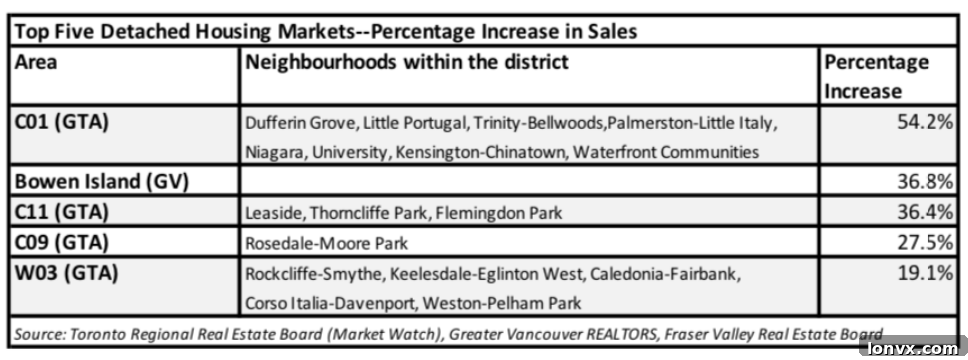
The Greater Toronto Area remains a focal point of Canada’s real estate narrative, and the Re/Max report zeroes in on its internal dynamics. Within the GTA, the 416 area code, which encompasses Toronto proper, has demonstrated the strongest sales momentum for detached homes. A considerable portion – just over 34 percent – of neighbourhoods within the 416 either maintained stable sales activity or experienced significant growth in detached home purchases. This performance surpasses that of the surrounding 905 area code, as well as the Greater Vancouver and Fraser Valley regions, highlighting Toronto’s continued desirability and investment appeal despite its already high price points.
This resurgence is particularly noteworthy given the challenging real estate landscape characteristic of the region, where elevated prices have long kept many prospective first-time buyers on the sidelines. The robust activity suggests that investors and move-up buyers are finding value and opportunity even in a market perceived as inaccessible by others.
Specific Toronto neighbourhoods have emerged as hotbeds of activity, recording notable increases in homebuying interest and transactions. Areas like Dufferin Grove, known for its vibrant community and Victorian homes, Little Portugal, with its rich cultural fabric, Trinity-Bellwoods, a highly sought-after neighbourhood adjacent to a popular park, and the affluent Rosedale-Moore Park, have all reported significant gains in sales. These areas often attract buyers looking for established communities with strong amenities and growth potential.
On the pricing front, the West End of Toronto has led the charge, experiencing some of the most substantial increases in detached housing values. For instance, prestigious neighbourhoods such as Kingsway South and High Park North have seen prices surge dramatically, rising by over 7.0 percent to 9.0 percent compared to the previous year. These increases reflect strong demand for premium properties in well-regarded areas, driven by buyers willing and able to invest in prime Toronto real estate.
Greater Vancouver and Fraser Valley: Limited Inventory Fuels Price Appreciation
Moving westward, the British Columbia real estate market, particularly Greater Vancouver and the Fraser Valley, presents a similar picture of strong demand, though with its own unique market characteristics. In this region, limited inventory has been identified as a critical factor underpinning price appreciation in the detached home category. When the supply of available homes cannot keep pace with buyer demand, prices naturally climb.
The Fraser Valley, in particular, has seen widespread price increases, with over 83 percent of its local markets reporting a rise in average detached home prices. This indicates a broad-based market strength throughout the region, extending beyond just a few specific hot spots. Closely following, Greater Vancouver also showed significant growth, with over 70 percent of its neighbourhoods noting rising median values for detached properties.
Certain areas within these regions have experienced exceptional price gains, showcasing the intensity of demand. Squamish, renowned for its outdoor lifestyle and scenic beauty, Burnaby, a rapidly developing urban centre adjacent to Vancouver, and Port Coquitlam, offering a more suburban feel with good connectivity, have recorded some of the largest price increases. Median home values in these locations have climbed by as much as 14.2 percent, demonstrating aggressive market conditions. This sustained demand is a result of a confluence of factors, including continued migration to the region, limited developable land, and a robust local economy. It’s driven by both local buyers seeking to secure a home in their desired community and a steady stream of investors looking to capitalize on the region’s long-term growth potential and strong rental market.
Significant Shift in Investor Activity
A particularly noteworthy finding of the Re/Max report is the observable shift in investor behaviour, especially prominent within the GTA. A growing segment of investors, previously attracted to the condominium market, are now redirecting their focus towards detached homes. This strategic pivot is largely a response to the perceived underperformance of condominiums, which, for many, have not delivered the expected returns or cash flow.
This re-evaluation of investment strategies is substantiated by a recent report from Urbanation and CIBC Economics. That analysis revealed that condominium investors who finalized purchases of newly completed units in 2023 faced significant financial challenges, often encountering negative cash flow nearing $600 per month. Such substantial monthly losses have naturally prompted many to reconsider the viability of condo investments, making detached homes, particularly those on smaller lots in Toronto’s east end, a more appealing alternative. These smaller detached properties often offer a better entry point for investors seeking greater land value appreciation and potentially more stable rental income streams compared to the saturated condo market.
The implications of this shift are far-reaching. It could lead to increased competition for detached homes, further driving up prices in this segment. Concurrently, it might ease some of the pressure on the condo market, although the negative cash flow issue suggests deeper structural challenges for condo investors. Understanding this shift is crucial for comprehending future market trends and where investment capital is likely to flow.
Addressing the First-Time Buyer Dilemma and Pathways to Affordability
While the report highlights impressive price appreciation and strong market activity in many segments, it also starkly underscores the persistent and growing challenges confronting first-time homebuyers. Affordability remains the paramount barrier, particularly within the high-demand, high-cost regions like the GTA and Greater Vancouver. The dream of homeownership feels increasingly out of reach for many, contributing to significant social and economic concerns.
However, the report also identifies critical “pockets of affordability” within these otherwise expensive markets. Regions such as Durham in the GTA and the Sunshine Coast in Greater Vancouver still offer detached homes priced under $1 million. These areas present valuable opportunities for those determined to enter the housing market, albeit often requiring a compromise on commute times or proximity to major urban centers. Such opportunities, while limited, are vital for maintaining some semblance of accessibility to homeownership.
Recognizing the severity of the affordability crisis, the report puts forth a key policy suggestion aimed at providing some relief: extending longer amortization periods, specifically up to 30 years, to resale homes. This measure, currently available primarily for new construction, would align resale mortgages with those for new builds. By lengthening the mortgage term, monthly payments would be reduced, potentially helping more buyers qualify for mortgages in high-priced markets. While this alone may not solve the entire affordability crisis, it represents a concrete step that could offer tangible relief to a segment of prospective homeowners.
Christopher Alexander eloquently captures the interconnectedness of the market, stating, “All boats rise with the tide — once the first-time buyers segment gains greater traction, we should see a ripple effect.” This analogy suggests that a healthier, more accessible market for first-time buyers is not just beneficial for them, but for the entire housing ecosystem. “We’re not there quite yet, but the tide is beginning to turn… The gap is closing amid growing buyer confidence,” he adds, hinting at a cautiously optimistic outlook for the future, provided conditions continue to improve.
However, the horizon is not without its clouds. Alexander points to the “only dark cloud on the horizon is the possibility of a U.S. recession given stock market volatility.” Canada’s economy is deeply intertwined with that of the United States, meaning any significant economic downturn south of the border would inevitably send ripples across Canadian markets. Alexander stresses that Canada is “not insulated,” and buyers should “stay tuned to any possible economic headwinds.” This cautionary note highlights the sensitivity of the housing market to broader macroeconomic conditions, reminding stakeholders to remain vigilant.
Conclusion: Navigating a Dynamic Market
The Canadian detached housing market, particularly in the GTA, Greater Vancouver, and the Fraser Valley, is currently a complex and dynamic landscape. While robust demand from investors and move-up buyers continues to drive price growth and sales momentum, the persistent challenge of affordability for first-time buyers remains a critical concern. The influence of interest rate policies, shifts in investor preferences, and the ever-present shadow of global economic uncertainty all contribute to a market that requires careful monitoring.
As the Bank of Canada navigates its monetary policy and potential future rate adjustments, their decisions will undoubtedly shape buyer confidence and market accessibility. Policy considerations, such as extended amortization periods, offer potential pathways to alleviate some affordability pressures, but a holistic approach will be necessary to ensure long-term market health and equitable access to homeownership for all Canadians. The market is showing signs of adaptation and evolving priorities, making it crucial for all participants—buyers, sellers, and policymakers—to remain informed and agile.
Review the full report, including comprehensive market overviews, here.