Canada’s Winter Recreational Real Estate: Navigating Stability and Shifting Trends
As the chill of winter ushers in thoughts of pristine slopes and cozy getaways, many prospective buyers and investors turn their attention to Canada’s picturesque recreational real estate markets. These regions, famed for their natural beauty and outdoor activities, offer more than just a seasonal escape; they represent significant investment opportunities and, increasingly, year-round living possibilities. But what does the current property landscape look like in these coveted destinations? A recent comprehensive report by Royal LePage sheds light on the market’s enduring stability, even as it navigates a period of evolving economic conditions and lifestyle changes.
Despite a slight year-over-year decline in home prices within Canada’s most popular ski regions at the start of the year, attributed to softening demand driven by elevated interest rates, rising living costs, and broader economic uncertainties, the market demonstrates remarkable resilience. This stability, contrary to widespread expectations of significant downturns, underscores the unique appeal and underlying strength of recreational properties across the nation. Understanding the dynamics at play is crucial for anyone looking to enter or observe this fascinating segment of the Canadian real estate sector.
A Period of Adjustment: Slower Activity and Stable Prices in Recreational Markets
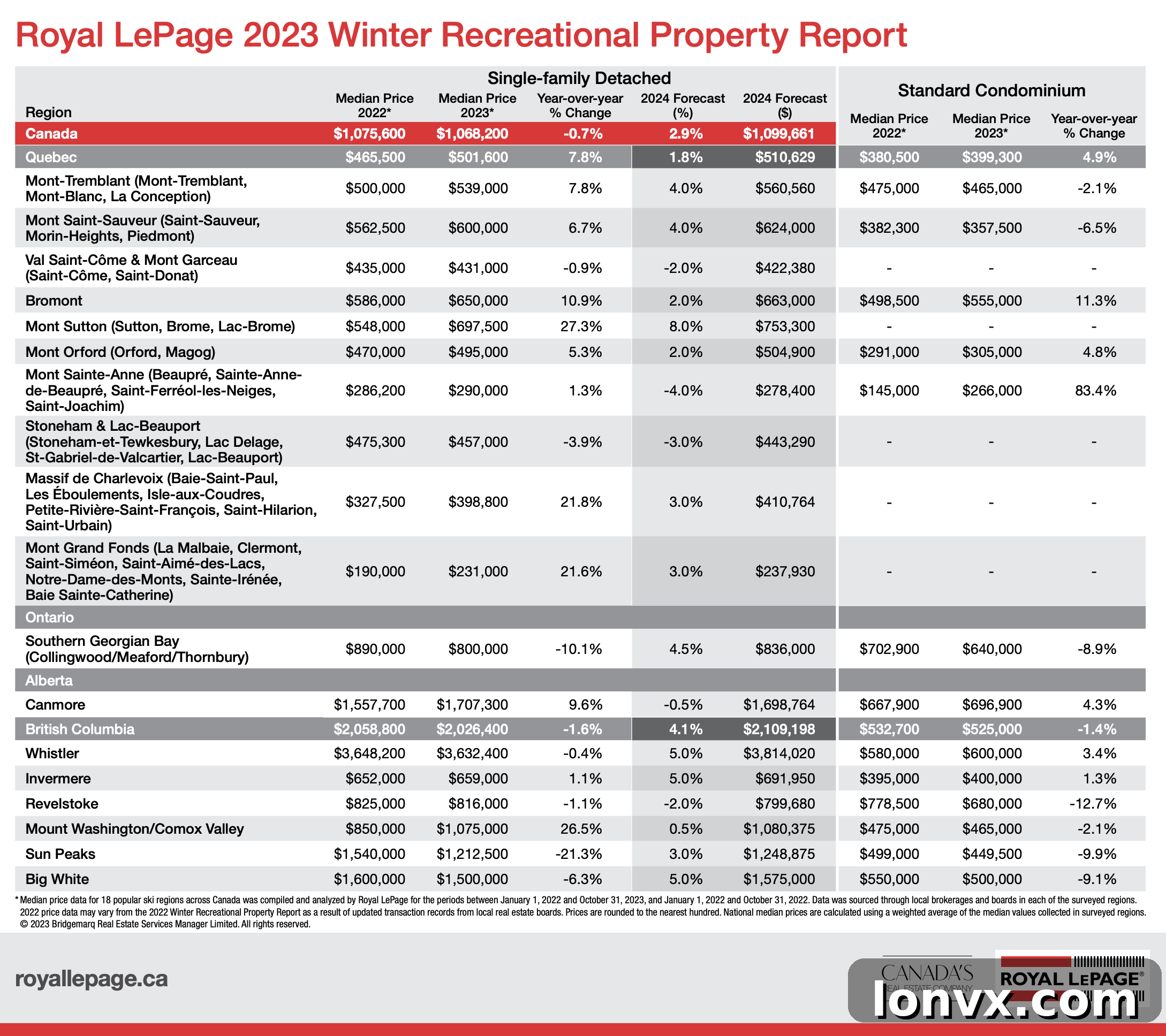
The initial ten months of 2023 painted a picture of a recreational market undergoing a calculated recalibration. The nationwide median price for a single-family detached home in these sought-after areas remained largely consistent, experiencing a marginal decrease of just 0.7 percent year-over-year to $1.068 million. This modest adjustment, far from a sharp decline, signals a market that is finding its new equilibrium after the unprecedented surge witnessed during the pandemic years.
Pauline Aunger, a respected broker of record for Royal LePage Advantage Real Estate, eloquently explains this phenomenon: “While Canada’s diverse winter recreational communities present varied market activities, the overall pace has noticeably decelerated. Annual sales have seen declines in most regions, and inventory levels have seen a modest increase as the market continues its journey back to balance. Crucially, this slowdown has not translated into precipitous price drops across the majority of markets.” This suggests a careful interplay between reduced demand and constrained supply, preventing widespread depreciation.
Aunger further elaborated on the driving forces behind this stability. “Despite the rising cost of living exerting pressure on demand for recreational properties, prices have held firm, primarily due to persistent low supply levels and sellers’ strong capacity to patiently await advantageous offers.” This highlights a seller’s market where property owners, often less financially stressed than those selling primary residences, have the luxury to defer sales if desired prices aren’t met. The market is effectively returning to historical norms, moving away from the frenzied activity fuelled by the pandemic’s unique circumstances. The current elevated interest rate environment has undoubtedly intensified this cooldown, as potential buyers, including those eyeing high-end recreational properties, become more acutely aware of mortgage expenses and the broader economic outlook.
Future Projections: Modest Growth and Enduring Appeal
Looking ahead, the outlook for Canada’s recreational ski regions remains optimistic. Royal LePage forecasts a median price increase of 2.9 percent for single-family detached homes over the next 12 months, pushing the average value to approximately $1,099,661. This projection is underpinned by expectations of stable, or even modestly declining, interest rates throughout the upcoming year. Such a forecast instills confidence, suggesting that the current period of adjustment will pave the way for renewed, albeit measured, growth.
Aunger reinforces this positive outlook, stating, “Recreational house prices in Canada’s popular ski regions are anticipated to maintain their stability and experience modest growth in the year ahead. Although demand has softened and supply has expanded compared to the extraordinary boom ignited by the pandemic, market activity is now aligning with pre-pandemic historical averages. This trend is expected to sustain a gentle upward trajectory in prices as Canadians continue their pursuit of coveted spots on some of the world’s most desirable slopes.” This reflects a broader understanding that the fundamental allure of these regions—their natural beauty, recreational opportunities, and quality of life—remains undiminished, continuing to draw interest from both domestic and international buyers.
The Financial Undercurrent: How Interest Rates and Living Costs Shape Decisions
The economic landscape has been a significant influencer in the recent market dynamics. The Bank of Canada’s aggressive monetary policy, which saw the overnight lending rate increase ten times since March 2022, has pushed the policy rate to over a two-decade high. These elevated borrowing costs, compounded by the general surge in the cost of living, have undeniably created a cooling effect across recreational markets. While similar trends are observed in primary residential markets, their impact on recreational properties has been comparatively milder, partly due to the financial profile of many recreational homeowners.
A national survey of recreational property market experts revealed that 41 percent noted an increase in properties listed for sale compared to the previous year, directly attributable to the rising interest rates. There is a prevailing sentiment that the Bank of Canada may hold its key lending rate steady in upcoming announcements, potentially offering a much-needed reprieve for some segments of the market. However, the financial pinch is palpable for many. Aunger observes, “While recreational homeowners might possess a higher tolerance for increased expenses, they are by no means immune. A significant portion of recreational property owners purchase their homes outright, with cash, thereby mitigating interest rate concerns. However, a considerable number still rely on financing.”
For those requiring financing, current conditions have led to a pause in purchase plans, with many prospective buyers opting to wait for interest rates to decline to avoid higher monthly mortgage payments. The current economic climate also means that some existing homeowners are finding their monthly expenditures increasingly burdensome, prompting them to explore cost-cutting measures or even consider downsizing their recreational assets. This strategic hesitation from buyers and the financial recalibration by some owners are critical factors shaping the market’s pace and inventory levels.
Evolving Rental Regulations and Their Market Impact
Adding another layer of complexity, changes in short-term rental regulations across various municipalities are significantly impacting recreational property owners. These new rules are making it considerably more challenging for owners to offset their higher expenses by renting out their properties on a short-term basis. This is particularly relevant for those who relied on rental income to manage property costs, including mortgage payments, taxes, and maintenance.
In response to these challenges, the federal government’s recent Fall Economic Statement introduced legislative changes designed to encourage homeowners to engage in longer-term rentals or to list their properties for sale. This push aims to alleviate housing supply pressures, but for recreational property owners, it means a need to re-evaluate their investment strategies and potentially adapt to new operational models, further influencing supply dynamics in these unique markets.
The Post-Pandemic Evolution: Year-Round Residents Reshaping Communities
Historically, recreational properties primarily served as vacation homes or secondary residences for Canadians. However, the seismic shifts brought about by the pandemic, particularly the widespread adoption of remote work, have fundamentally altered this dynamic. An increasing number of Canadians are now choosing recreational markets as their primary residences, transforming seasonal communities into vibrant, year-round towns and villages. This trend reflects a desire for improved work-life balance, access to nature, and often, more affordable living compared to major urban centers.
The impact of this shift is evident in recent market data. Nearly 60 percent of surveyed recreational regions reported double-digit declines in property sales during the first ten months of 2023 when compared to the same period last year. Concurrently, Royal LePage’s experts observed a nationwide decrease in demand (47 percent) but a significant increase in both inventory (88 percent) and the average number of days properties remained on the market (82 percent) compared to the previous year. These statistics underscore a market that is settling, with buyers taking more time to make decisions and more options becoming available.
Aunger elaborates on this evolving landscape: “While the mass exodus to recreational markets seen at the pandemic’s peak, characterized by soaring prices and sales, has subsided, the expanded access to high-speed internet in more remote regions has solidified the trend of year-round residents.” This infrastructure improvement is a game-changer, enabling individuals to work remotely from virtually anywhere, blending the lines between leisure and daily life. “We are currently navigating a softer recreational market,” Aunger notes, “marked by fewer immediate buyers and rising inventory levels as consumers meticulously evaluate their discretionary spending amidst higher borrowing costs. Unlike purchasing a primary residence, most individuals in the market for a recreational property enjoy the flexibility to wait for the ideal home or for more auspicious market conditions to materialize.” This luxury of patience fundamentally differentiates the recreational market from the often urgent primary housing market.
Climate Factors: A Growing Consideration
Beyond economic shifts, the study also highlighted the significant, unprecedented wildfire season experienced across Canada. This, along with other evolving climate factors, profoundly impacted summer real estate markets, including many recreational communities. The increasing frequency and intensity of such events introduce new considerations for property owners and buyers alike, from insurance implications to the long-term desirability and accessibility of certain regions. Climate resilience and environmental risks are becoming increasingly important due diligence factors in recreational property investment.
Conclusion: A Resilient Market Adapting to a New Era
Canada’s winter recreational real estate market is undeniably in a transitional phase, moving from the extraordinary peaks of the pandemic era to a more balanced and sustainable trajectory. While interest rate hikes and rising living costs have introduced a degree of caution among buyers, the market’s inherent stability, bolstered by persistent demand from those seeking unique lifestyles and solid long-term investments, remains robust. The demographic shift towards year-round residency, facilitated by remote work and improved infrastructure, is fundamentally reshaping these communities, adding a new dimension to their appeal and development.
For investors, buyers, and sellers, understanding these multifaceted trends—from economic indicators to lifestyle changes and environmental considerations—is paramount. The market is maturing, offering both challenges and opportunities. As Pauline Aunger’s insights suggest, the enduring charm of Canada’s recreational properties, particularly its iconic ski regions, will continue to attract those seeking a blend of natural beauty, leisure, and a compelling investment opportunity, even as the market adapts to a new normal. Prudent navigation and informed decision-making will be key to success in this evolving landscape.
For a detailed breakdown and regional summaries, the full Royal LePage report is available here.